Please note: if an earlier link doesn't work, it may have changed following an update! Check the Category Labels in the side-bar on the right! There you can find animator drafts for sixteen complete Disney features and eighty-six shorts, as well as Action Analysis Classes and many other vintage animation documents!
Thursday, October 16, 2008
Back in a bit!
I am writing this having just arrived in Florida. My first time here. The last weeks were really busy, and I take a little break before it goes crazy again. This is just a short note to tell you that there will be a bit of a pause in postings here, but I will be back in the beginning of November, with more shorts drafts!
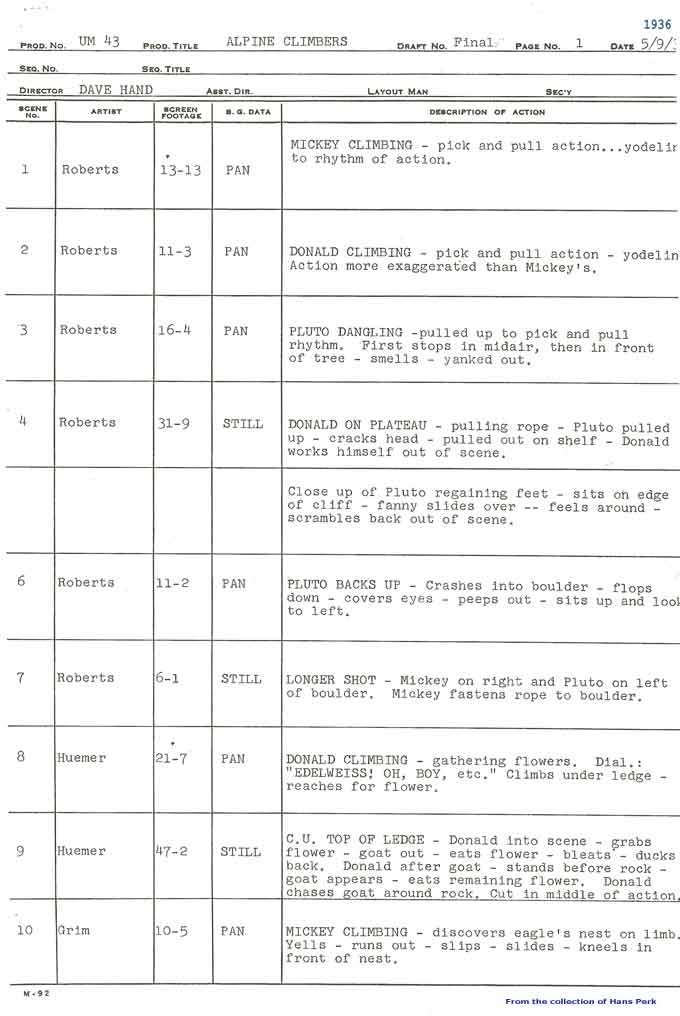
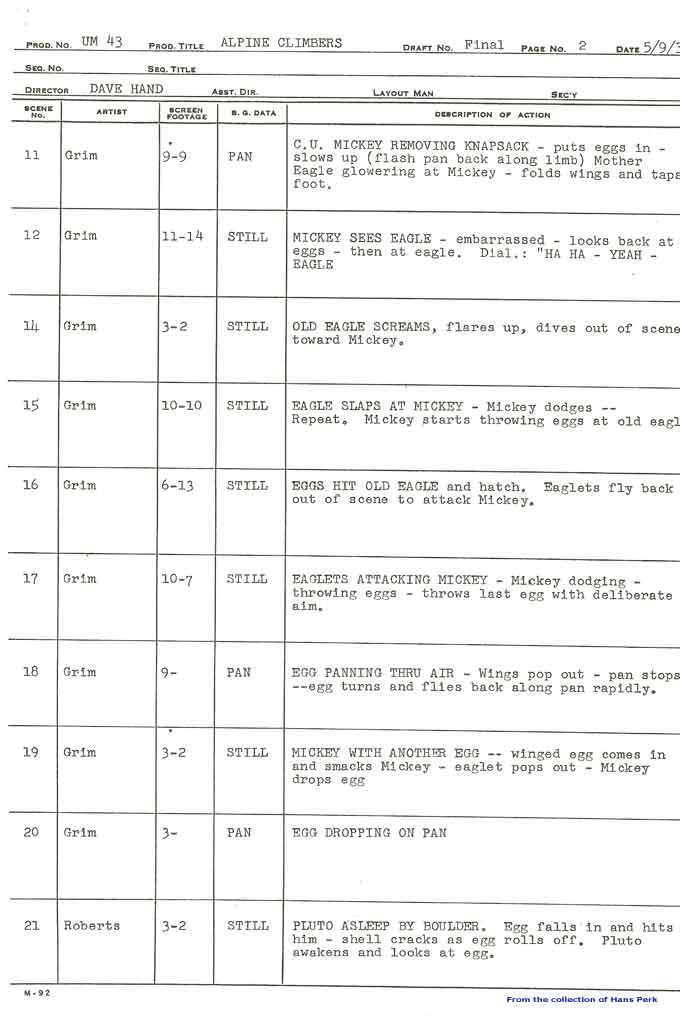
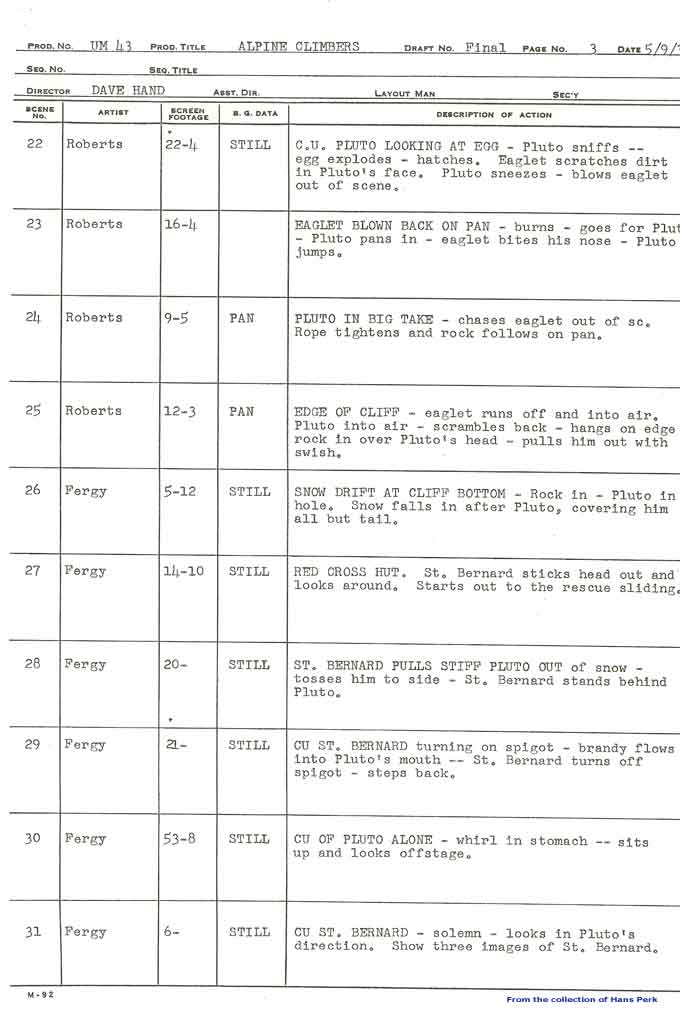
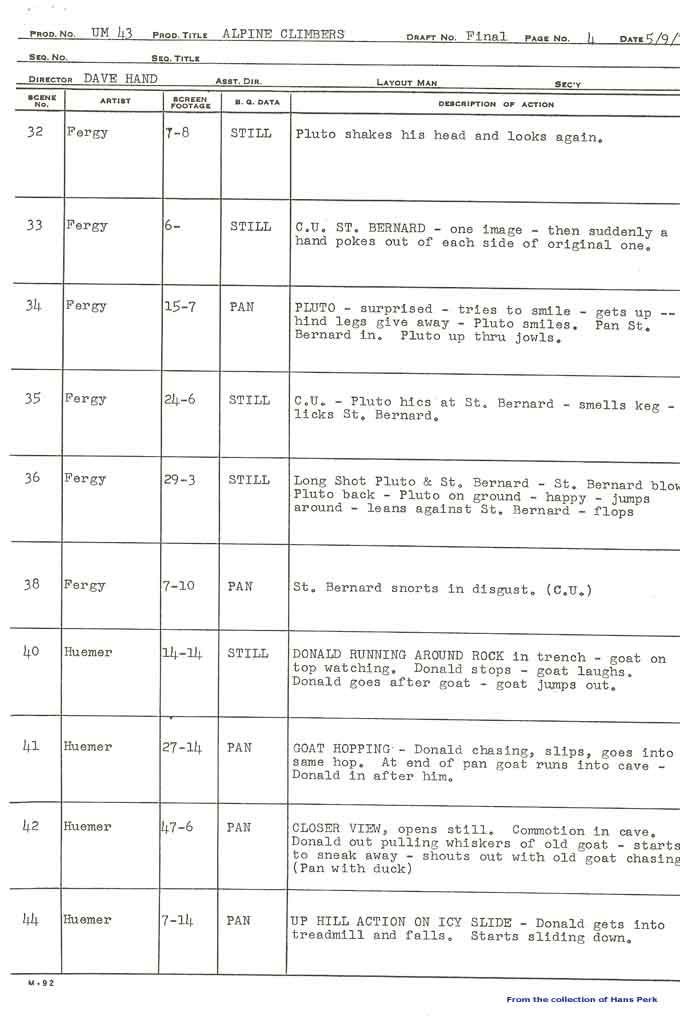
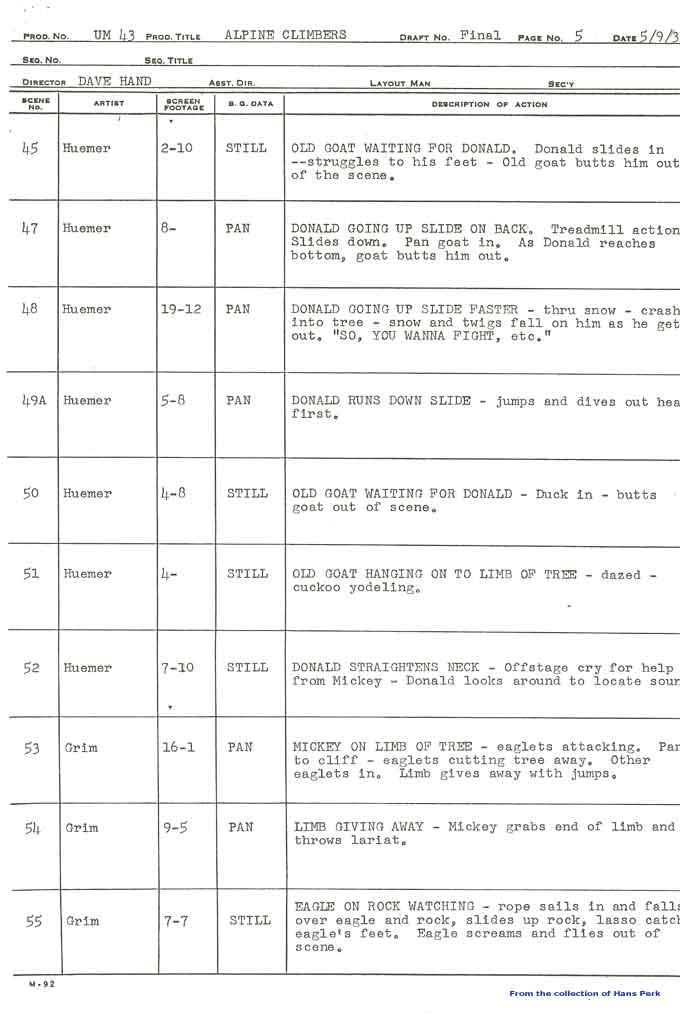
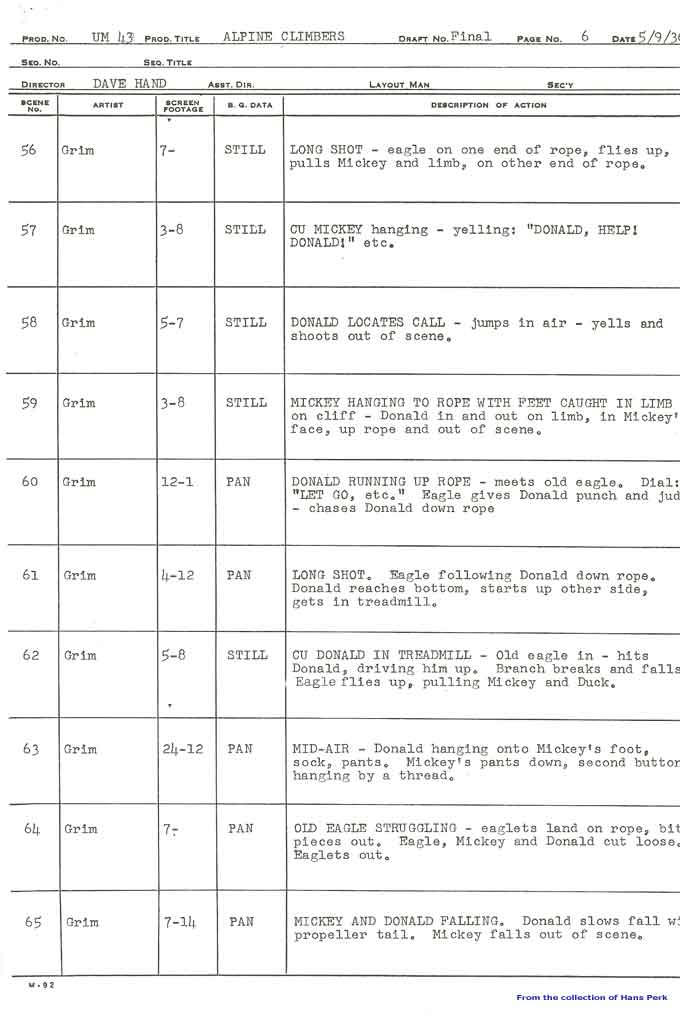
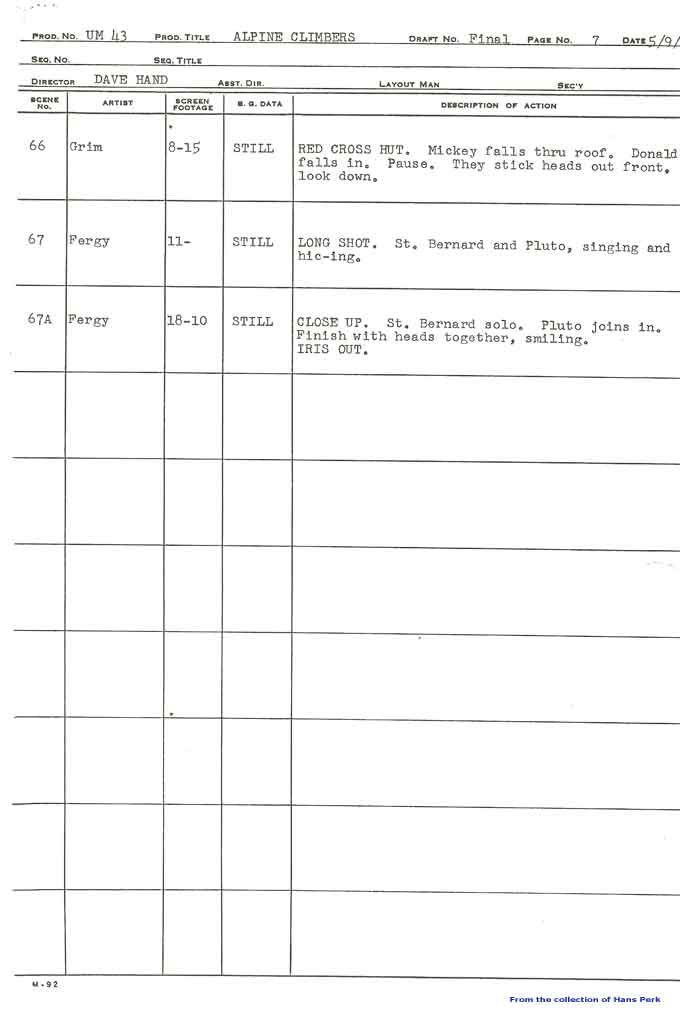
Another true classic, Alpine Climbers was directed by Dave Hand, released 7/25/36, this FINAL draft of 5/9/36. There were only four animators assigned to this short: Bill Roberts (intro of all characters, Pluto and eaglet), Dick Huemer (Donald), Grim Natwick (Mickey) and Norm Ferguson (Pluto and St. Bernhard).
Alpine Climbers was released on the 2001 DVD set "Walt Disney Treasures - Mickey Mouse in Living Color."
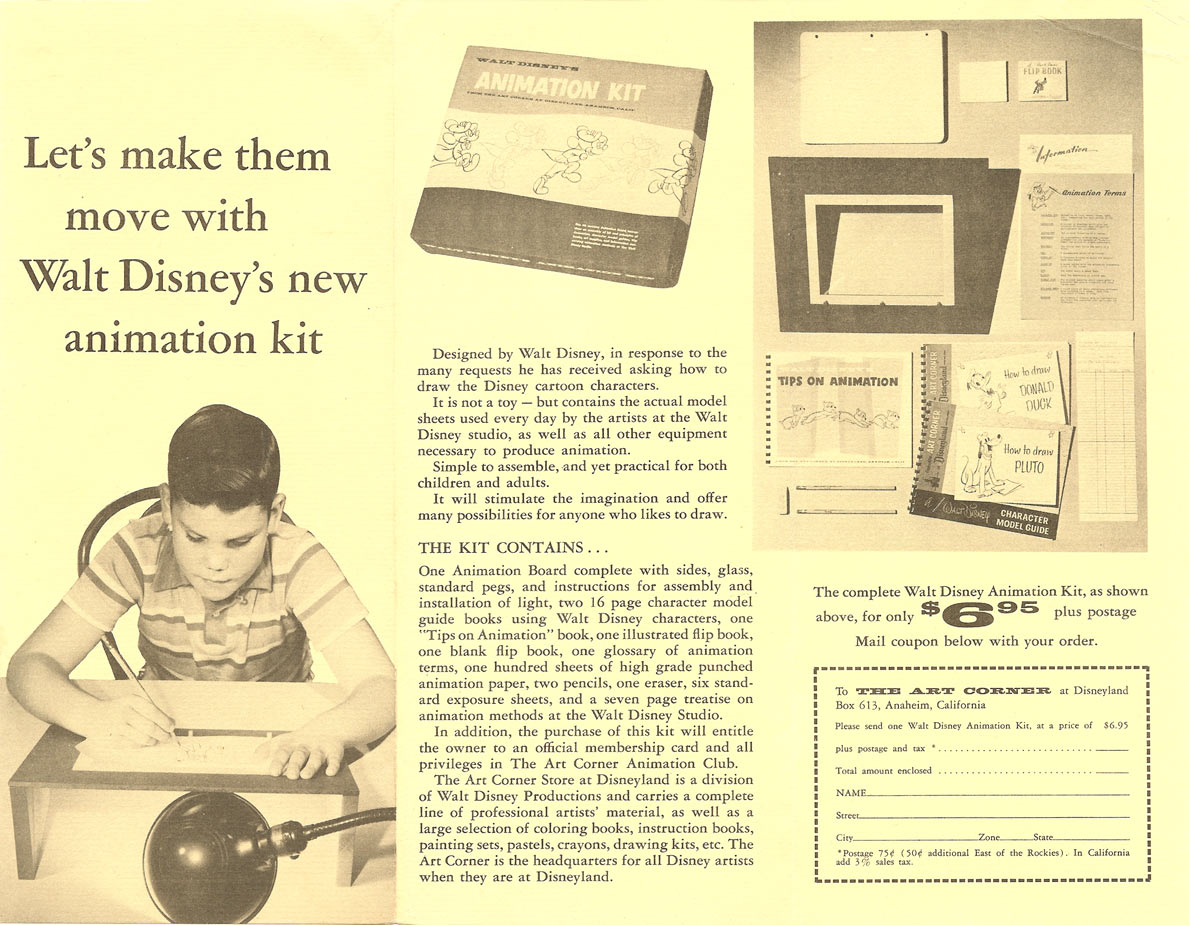
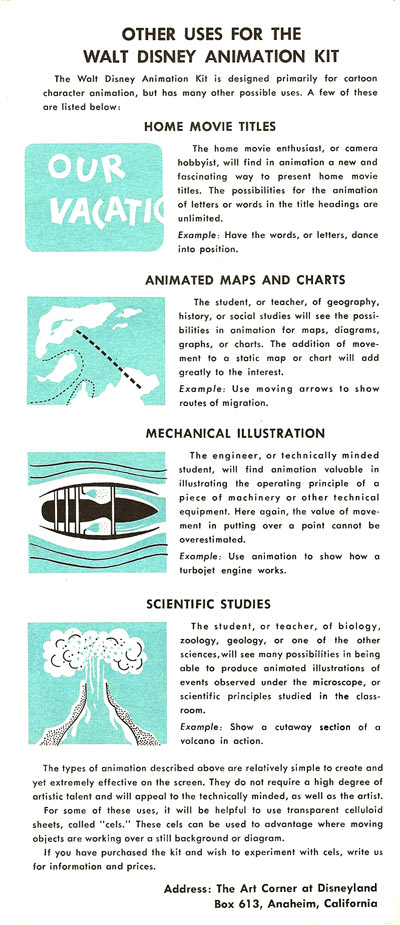
...with Walt Disney's new animation kit! Only $6.95...
This is an ad leaflet with insert from the late 50s. The insert seems to be a later addition, as they may have found that not too many people had any idea what they could use the animation kit for.
The contents of the box have been discussed some time ago, on Jenny Lerew's blog. What I especially liked was that one could turn in ones drawings with exposure sheet at the Art Corner, and get a pencil test on 16mm of it in return! I wonder how long that lasted! Now - do we know anyone who started his/her career in animation using this kit?
CartoonBrew's Amid Amidi sent me a message to spread the word about a free cartoon on Cartoon Brew TV, Van Beuren's 1928 Dinner Time. Amid says: "I'm sure you already know the story behind this, but this is the film that inspired Walt to pursue making "Steamboat Willie". It was a sound film that Walt saw in New York in 1928 and which made him realize that he could do a better job of combining sound and animation.
"Dinner Time" is specifically mentioned in a letter from Walt Disney to his brother Roy and collaborator Ub Iwerks. Excerpts from the letter are reprinted in the Disney bios by Neal Gabler, Bob Thomas and Michael Barrier, but the actual film hasn't been seen in 80 years.
We're presenting the short exclusively on Cartoon Brew TV. You can see the original short as well as hear a newly recorded audio commentary by Jerry Beck and Mark Kausler. It's free to watch, and feel free to embed the video directly if you're so inspired!"
So herewith! I am aware that this for many is Old News by now, but it is important enough to mention. Yes, it IS an awful racket. I thought it interesting that the commentators mention that the film was copyrighted December 1928, so Walt may have seen a preview print at a distribution office...
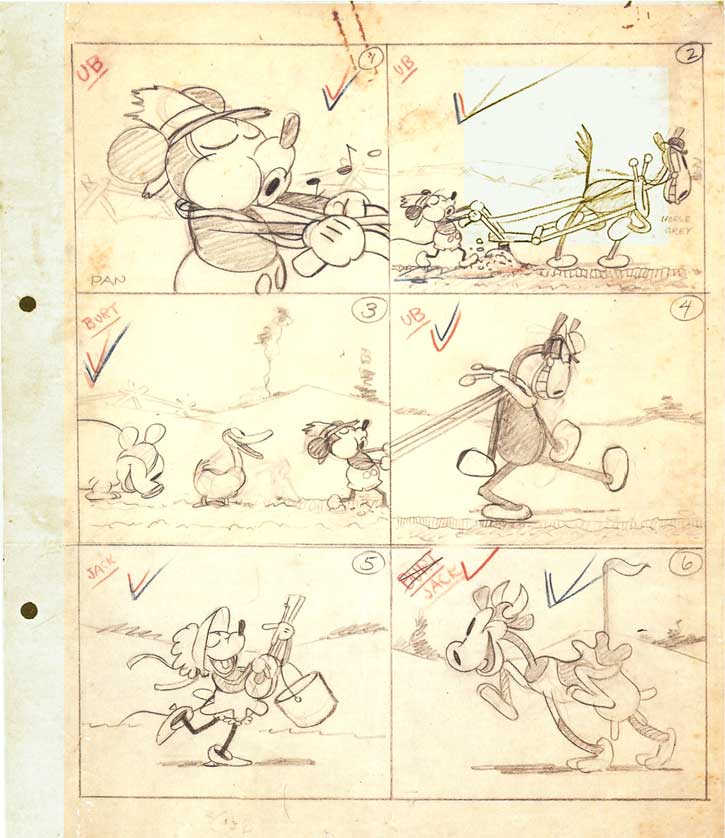
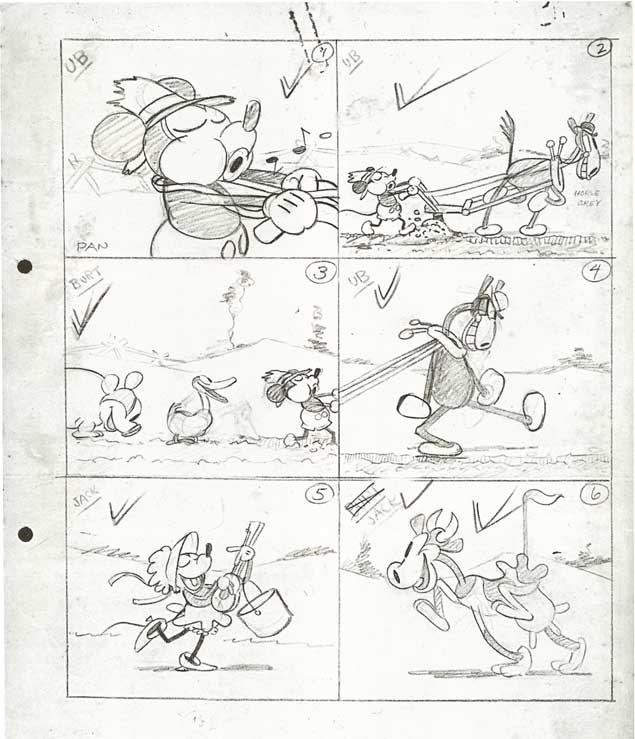
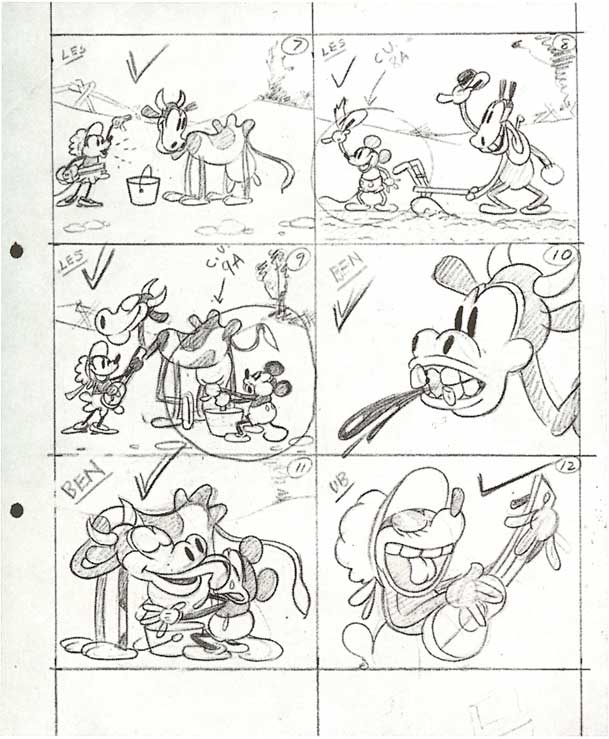
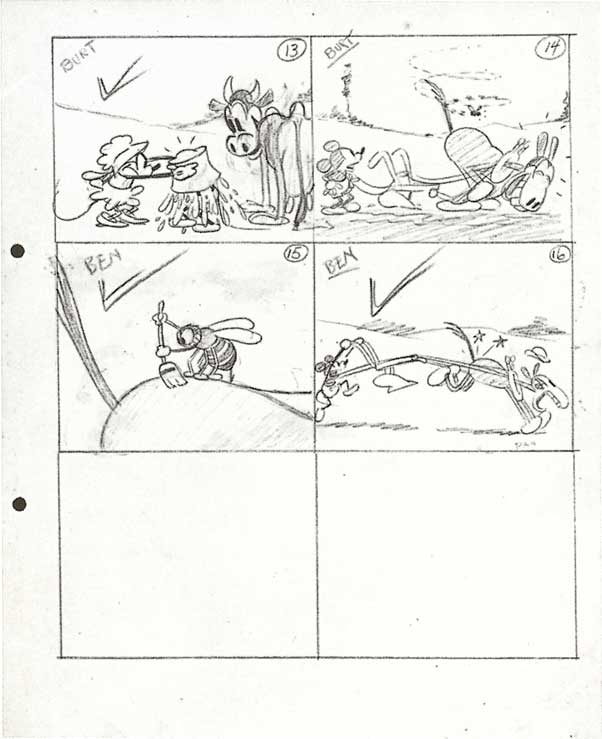
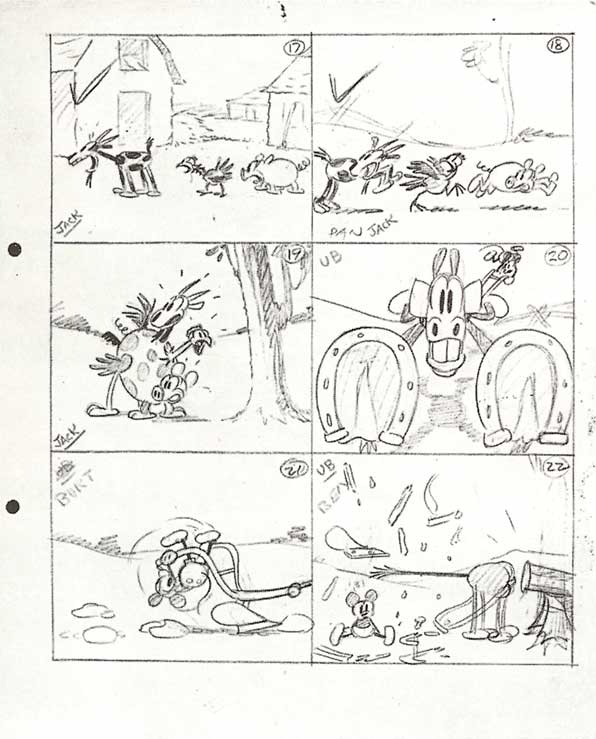
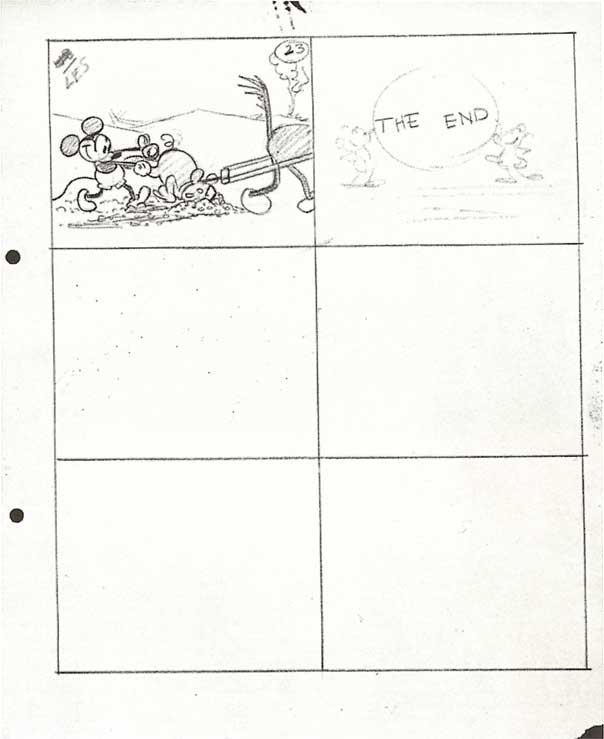
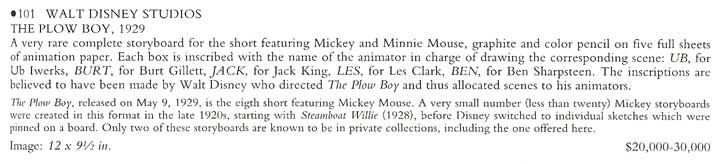
Remember that I spoke of a box of early Disney goodies in Kentucky, sold off at Christie's East? Here is one of the items sold at the time, the storyboard of the 1929 short The Plow Boy, drawn by Ub Iwerks, the director. I scanned these from Christie's June 9th, 1995 catalog. In lieu of a draft, this has animator assignments on it.
The catalog front page is in color, so I reconstructed it here:
The early Mickeys were made in close cooperation between Walt Disney and Ub Iwerks. Ub drew the boards, but Walt was never far away. Some of the names may not be in Walt's handwriting, as noted in the description. Read this, though, as it saves me from typing a lengthy, redundant explanation. (Click to enlarge!)
I believe I was told this board fetched a neat $42,000...
(Note: IMDb calls the film The Plowboy, but some contemporary documents I have call it The Plow Boy, and even The Plough Boy!)
A quick word before I continue with new postings. If you are new to my blog, I'd like to refer you to the archive pages linked to in the right side bar. Here you can find out how most all of Disney's shorts from 1928 and for some 25 years onwards were timed to a musical beat. You can read who animated which scenes on 60+ Disney short films and five feature films. You can find the technical manuals and transcripts of Action Analysis Classes of the 30s. And let's not forget information on early Disney patents. There are animation drawings, model sheets, articles and curiosa. Most of the stuff in the 433 postings over the last 2 years and a bit has never been published anywhere else.
And then there is some info on my own studio as well! This last week saw the Danish premiere of our feature film Journey to Saturn, based on the 1970s Danish graphic novel by the late Claus Deleuran...
You must have heard by now that Volume 2 of Russell Schroeder's "Disney's Lost Chord" is finished and ships! Read more about it and order it here!
As to myself, I am now residing in Southern California, and moved into a new apartment, which is why I have not been able to update this blog. Too much to see to, and no internet connection! This is now fixed, so there is more to follow soon!
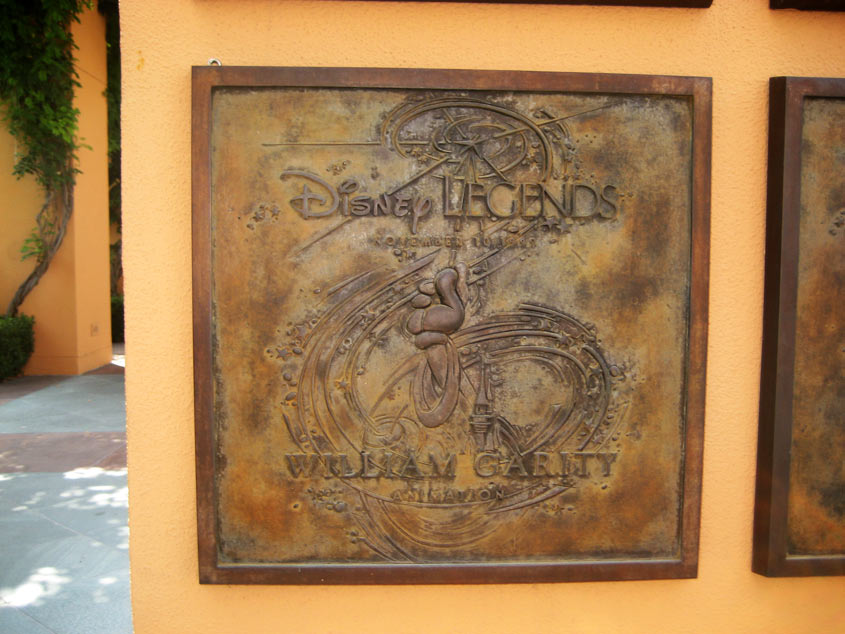
Last week-and-a-half, I stumbled upon Bill Garity's Disney Legends plaque on one of the pillars on the structure surrounding Legends Plaza (where the reflecting pool was before) on the Disney Studio lot. Since I am nothing if not a completist, I include a picture of it here...
Musical Beats Revisited ...Now hear it from an old master...
Much of animation is simply a matter of doing a job as it should be done. Maybe a scene is no more than a funny walk or a brief dance step. An animator's responsibility is to interpret a track, picking it apart mentally and then making his animation interpret each innuendo, each nuance with drawings that hopefully add life to a scene—even beyond the scope of the soundtrack. An important part of a track is musical. The music beat is vital to the artist. On an animator's work sheet, usually referred to as an Exposure Sheet, music beats are indicated in actual film frames. An eight (8) beat would be eight frames of film; a twelve (12) beat, twelve frames of film. It is natural to assume that an artist's plan would be to carefully accent each musical beat, however, astute animators avoid anything so mundane. A musical beat is a marvelous thing. An animator can split it in the middle, avoid it completely, or even divide it into three or four parts as a musical composer often does. A musical beat is the skeleton on which an animator builds the muscle of his action. He can plan an accent to happen before, behind or right on a beat, according to how he desires to psyche his audience.
Art Babbitt, the suave and talented savant of Animation's Golden Years, has a tantalizing way of reaching an accent a twelfth of a second late. It reminds one of a magician catching a coin or a playing card in midair at the very instant you are sure he will not get it. It is maddening, but it is good entertainment. An experienced animator has many strings on his bow. Milt Kahl, recently retired Zeus among animators, picks up a beat with the adeptness of Sherlock Holmes pinpointing an important clue in a murder plot. To Frank Thomas, an artist with unusual musical skills, the reading of a beat came naturally and tastefully. He accomplished it with the sang froid of a fastidious gourmet putting just the proper touch of Escoffier sauce to a serving of chilled oysters. Every beat has its special character—its special importance. Freddy Moore had a slam-bang manner of animating rough-shod through one beat, then picking up the next beat with the caution one might use in picking up a live rattlesnake. Norm Ferguson, master of all of the elements of animation, could carry three characters through a syncopated sound track and put the right emphasis on each beat so neatly that no one could ever quite tell how it happened. His exposure sheets were more complicated than the musical score for Beethoven's 9th Symphony. Bill Tytla was a glittering star among animators, a modern Pieter Brueghel working with living pawns, a wild cossack riding a loco horse over the steppes of the Ukraine. He was a wizard at searching out beats—a fantastic planner and plotter. Sometimes a beat is hidden away in a pile of trashy sound effects, but it is still worth searching for. Bill always found and used a hidden beat. It added a touch of Tabasco to his animation. Too often a novice hopes to accent a beat with exaggerated mouth action. Mouths can be funny, but they do little to help an accent—even with funny dialogue. A body accent, a dramatic posture, is The Thing—always. An animator may have a track that is only dialogue or recorded sound. Lacking a musical beat with which to work, he must choose from the track accents on which he can structure his animation.
--Thus wrote master animator Grim Natwick, of Betty Boop and Snow White fame, on January 6th, 1978, in an article or chapter called "Reading Sound." It is not known to me what he wrote this for, but I find it very interesting and in line with my previous postings on beats and barsheets. If you have not yet read these, I invite you to do so, as "animation to a musical beat" has been undervalued for much to long, especially among CG artists who wrongly consider any technique applied to hand-drawn animation to be too old-fashioned or just inapplicable to the CG medium. In the past century, many wonderful artists have pioneered the medium of entertainment through animation, and it would be a crying shame not to at least take notice of their advancements!
A Long Story Short... ...or: How two sheets of paper got united after some 25 years...
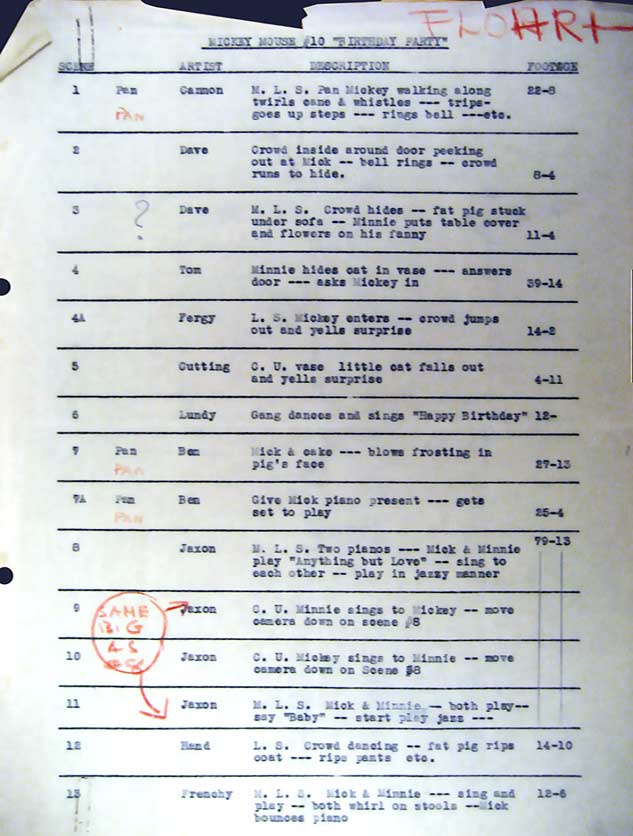
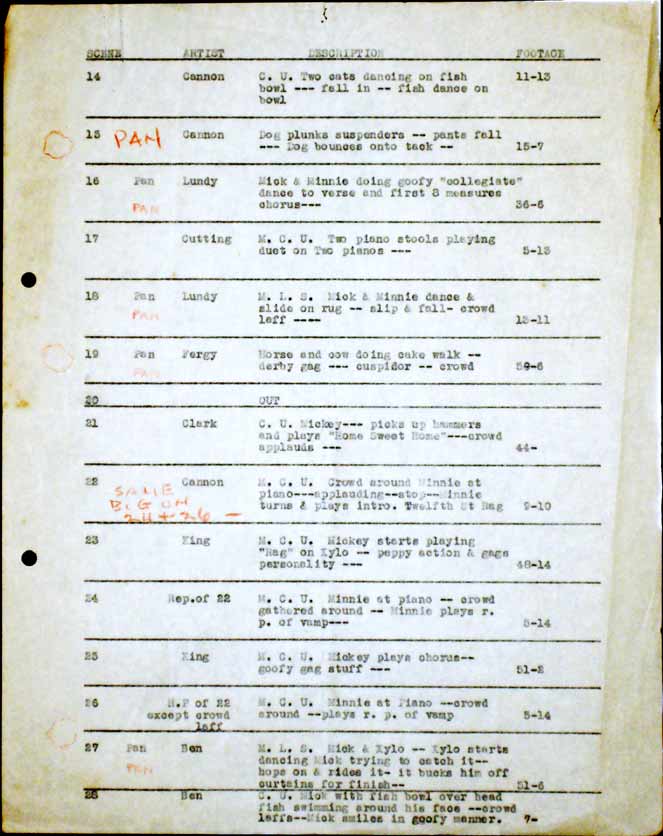
In truth I never thought I would see this draft completed. I had previously posted page one of it (the first image below) and noted that it was the first page of the original typed draft of Prod. CM-10, The Birthday Party, directed by Burt Gillett, released Jan. 6th, 1931. It only goes to show that it's a small world after all:
When director Burt Gillett (1891-1971) was lured away by Van Beuren in 1934 after his tremendous success with Three Little Pigs, he took with him to New York a box of drawings and notes. He gave these to a Joannie, the 14-year old daughter of a family that Gillett and his first wife Louise had befriended. [The family of George and Anna Oberle lived on 647 Undercliff Ave., eight houses from Gillett in nr. 615, in Edgewater, NJ.] Years passed, and so did Joannie [Joan Elizabeth Oberle, born in 1920, was accidentally shot and killed by her fiancee on October 25, 1939] - and the box ended up with her sister [Ruth Ann] and her [second] husband, a farmer (and very nice person) [Claude Crastan] who moved to Kentucky.
In the 70s they rediscover the box (and split it into two boxes), and try to find interest in the items, but find there isn't any. Then, in the late 80s, they happen to see an article about a New York collector in a magazine and they contact him - and sell him a stack of papers (for $800), only to read in their local newspaper a short while later that he had sold a single item from those papers at auction for $24,000. Later they find he sold many of the items through Cristie's East, selling for as much as $44,000 for a two-page item. They contact Christie's, and in 1994 and 1995 sell most of the rest of the items - for about a quarter of a million dollars: original Ub Iwerks storyboards for some of the earliest Mickeys, animation drawings and layouts, stills and even original Oswald contracts between Walt Disney and Margaret Winkler Mintz! I am certain that for Disney animation history, this was THE find of decade, though probably not many knew the source of this material.
Late last year the good folks in Kentucky find a box with the left-over materials that Christie's had sent back, as they did not think these would sell, and I am fortunate to have been able to acquire quite a few of these items through eBay - story notes, outlines, scribbles and a short stack of flippable animation drawings from the 1930 short Just Mickey. And one of the items is... page TWO (of two) of the Birthday Party draft! It matches exactly over page one, even the stains from the paper clip match! Obviously, page one had come to me circuitously through the New York collector's purchase (eventually sold to me by a Florida seller), but both pages unquestionably started out in that same box in Kentucky. Now, they're united and complete again after some 25 years! How about that?
Christie's did not always know what they were dealing with, as several of the items they sold cheaply had Walt Disney's handwriting on them, and they did not notice this. I now know a great deal more about Walt's handwriting, and I am certain that the red markings on this draft are in his hand. The name Flohri is also his scribble, and I now suspect it was his assignment of background painter Emil Flohri (1865-1938) to this project. Since Walt's work was his life (as Mike Barrier knows but Neil Gabler doesn't seem to, looking at their books), he was a very hands-on producer in this period, actively involved in every phase of production...
[Ruth (Oberle) Crastan, born in 1929, died in 2013, Claude Crastan, born in 1935, died in 2018. Updated after 2025 research.]
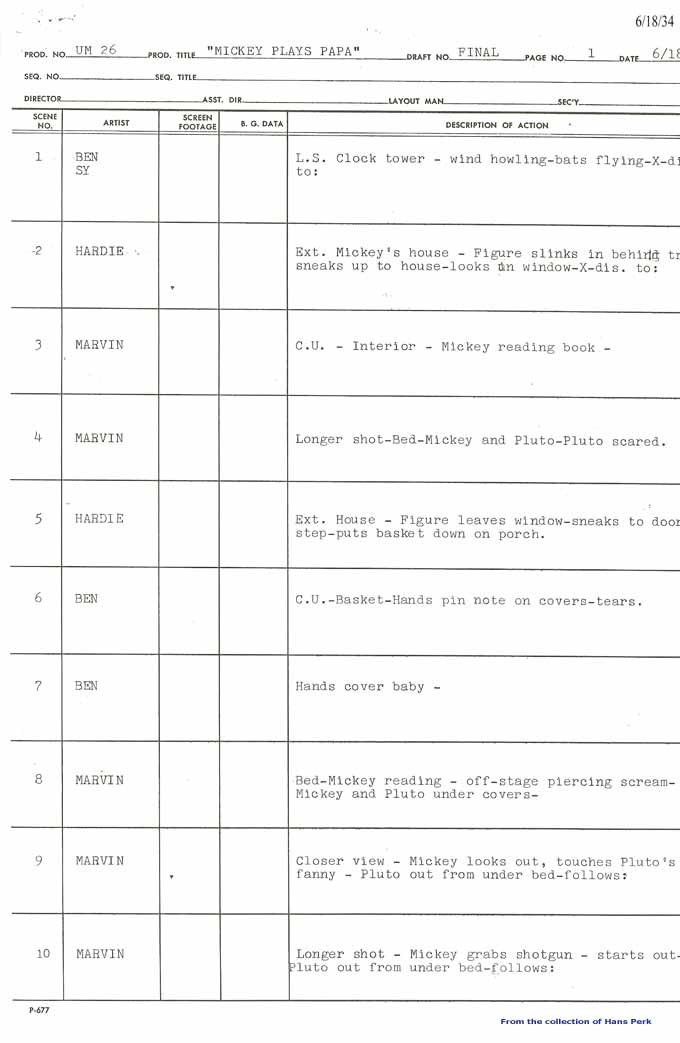
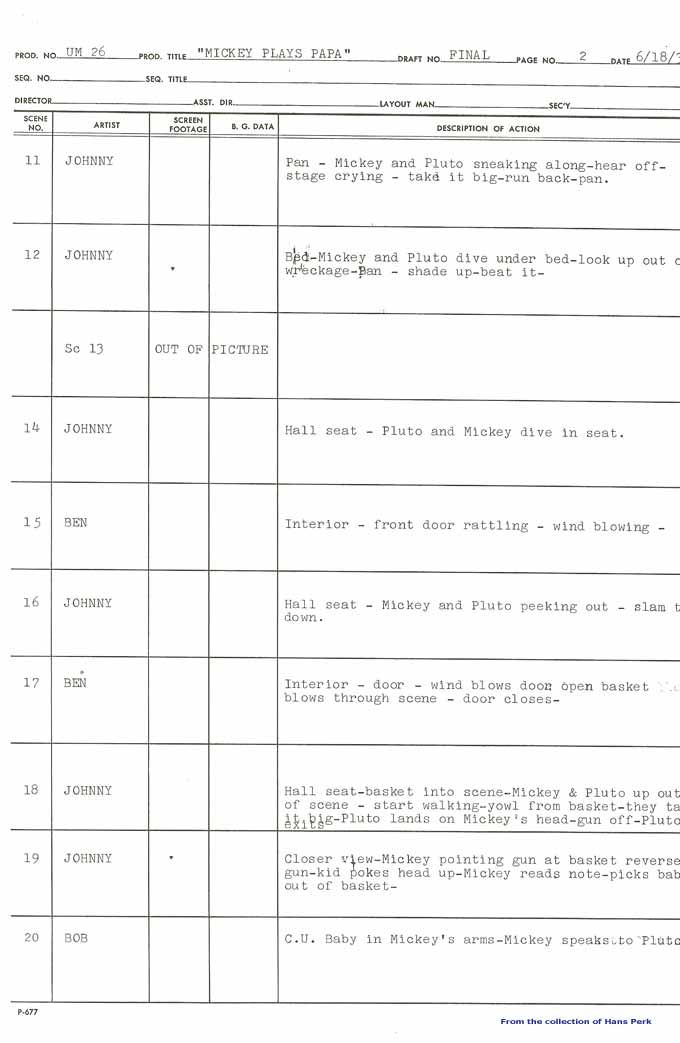
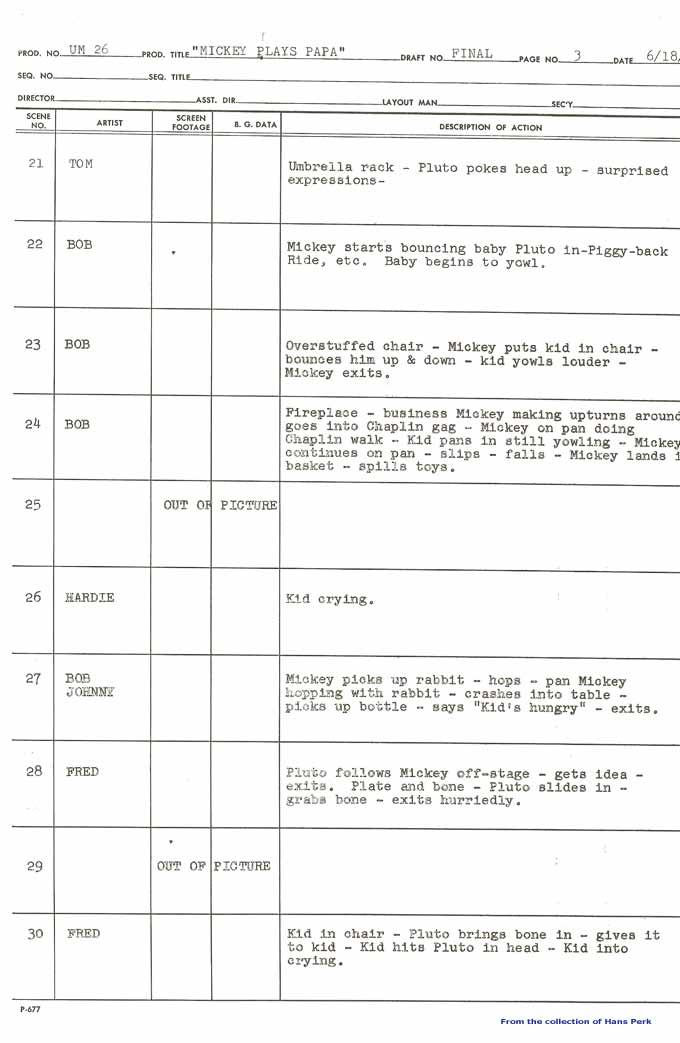
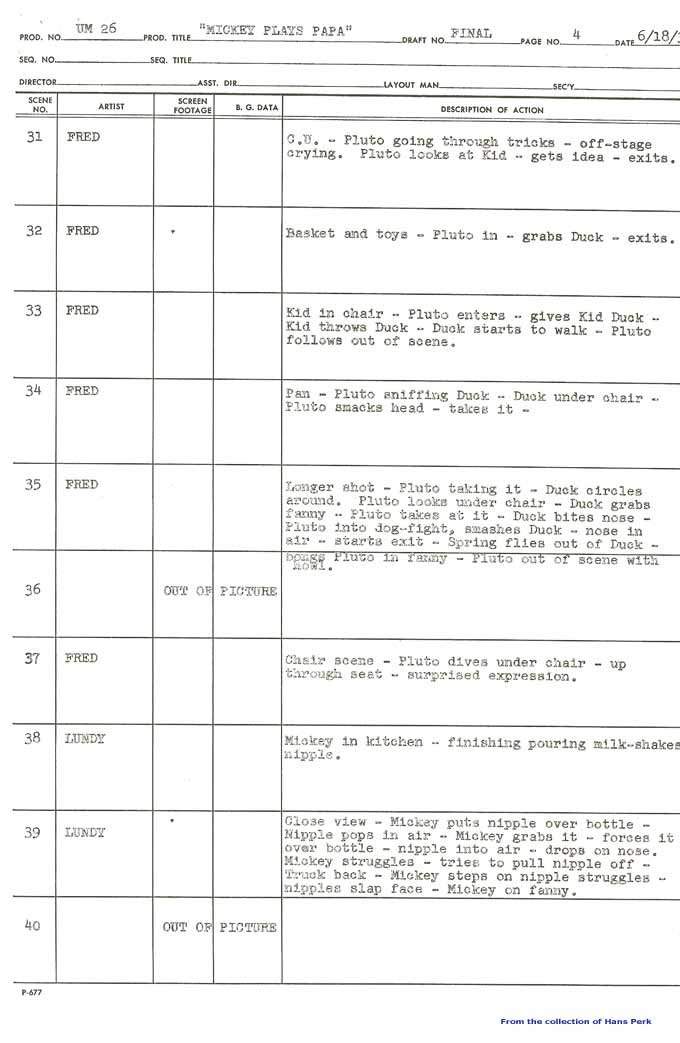
First the copyright synopsis, so we know what we are dealing with, if we cannot quickly pull out disc 2 of the Treasures DVD - Mickey Mouse in Black and White Vol. 2.
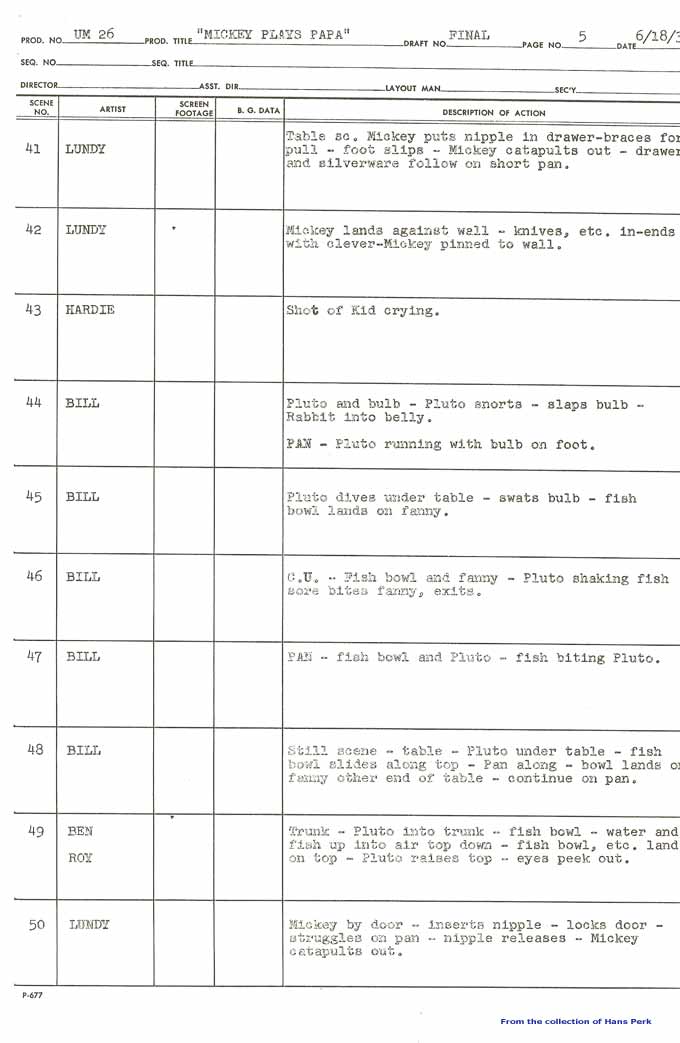
Directed by Burt Gillett, released 9/29/34, this draft dated 6/18/34. Animation by Hardie "Little Toot" Gramatky, Marvin Woodward, Johnnie Cannon, Bob Wickersham, Tom Palmer (one scene), Fred Moore, Dick Lundy, Bill Roberts and, of course Ben Sharpsteen, also as supervisor of Cy Young and Roy Williams.
The story is simple and sweet, but somewhat curious. Maybe naive is a better description. The animation shows lapses back to the simpler style of a few years earlier, with speedlines galore, but we are also seeing small glimpses of things to come in the color Mickeys a year later. Hardie Gramatky's figure slinking about the house is very theatrical (but as such nicely animated), while Johnnie Cannon's scenes with a scared Mickey and Pluto even here seem a bit old-fashioned - the same goes for Lundy's scenes of Mickey in the kitchen. Fred Moore and Bill Roberts' business with Pluto is nice, but seems somewhat contrived, and not as "felt" as Norm Ferguson's animation of the time. But most important, the film is character-driven from start to finish, and whatever shortcomings the animation might have, the storytelling holds our interest in the characters, in a way a precursor to Snow White, which at this time had begun its preproduction...
Things are finally somewhat back to normal, and I will be posting more regularly!
I'd like to follow, and conclude my Multiplane week with a little celebration of the inventor, Bill Garity.
We met Garity several times before, as inventor of the click track and the method for making 3-D (stereoscopic) animation, and now as the patent holder of the Multiplane Camera. He is also one of the inventors of Disney's pseudo-stereophonic sound system Fantasound, of the film mixing console that used the Iron Pencil to follow the score, and of a sound fader that suppresses one channel while boosting another. He even invented a rig for shooting miniature airplanes for the war-time films. And lets not forget that before Disney, he had several vacuum tube patents to his name.
As important as he was to the technical development at the studio, and with him being the first person officially named manager of the studio, it seems surprising that not much has been written about him. He was justly made a Disney Legend posthumously in 1999, and it is on the Legends site we can read most about him. Since details can drown in the plethora of Legends mentioned there, I shamelessly lifted the following text from the Legends site:
« Bill Garity gave Disney animation a technical edge. Among his contributions, the film pioneer helped put sound to the 1928 animated short "Steamboat Willie," the first cartoon to feature synchronized sound, and helped develop other inventions. Walt Disney soon came to rely on Bill, naming him the Studio's first manager.
"Bill Garity is an unsung hero of Disney history," said Dave Smith, director of the Walt Disney Studio Archives. "With his pioneering efforts in sound and camera techniques, he helped set Disney Studios apart from others, while his planning and supervisory expertise resulted in the building of a highly efficient Studio in Burbank."
Born in Brooklyn on April 2, 1899, Bill attended Pratt Institute of Art in New York. During World War I, he served two years with the Radio Research and Development section of the U.S. Signal Corps. After the War, he met radio pioneer Lee DeForest and for the next seven years helped develop early sound for film.
In 1927, Bill installed an audio sound system in New York's Capitol Theatre to accommodate the first newsreel with sound, which featured footage of the Washington reception of aviator Charles Lindbergh after his successful Atlantic crossing.
A year later, he met Walt while developing the Cinephone motion picture recording system. Their meeting was fate. Walt was determined to lift animation to a unique storytelling art form and Bill had the technical know-how to help him achieve his lofty goal.
With the success of "Steamboat Willie" and his new sound cartoons, Walt purchased Bill's recording system for his small Hollywood Studio and asked if he would install it and train a technician. Bill's anticipated 60-day trip to California lasted more than 13 years when he joined The Walt Disney Studios in 1929.
While there, Bill headed a department of 18 skilled engineers, who helped design, build and extend the capabilities of the animated cartoon. The team, under Bill's able guidance, also created the multiplane camera, which gave depth to animated films beginning with the 1937 short, "The Old Mill," followed by such animated classics as "Pinocchio," "Fantasia," and "Bambi." The invention, which made it possible to create camera movements, which simulated live-action films, earned an Academy Award® in the Scientific and Technical category.
In 1940, Bill's team invented "Fantasound," an innovative stereo system installed in theaters for Disney's classic, "Fantasia." The stereo system, which greatly enhanced the effect of the musical animation masterpiece, also earned a nod at the 1941 Academy Awards®.
A year later, Bill left the Studio to pursue other entertainment ventures, including serving as vice president and production manager of Walter Lantz Studios.
On September 16, 1971, Bill Garity died in Los Angeles. »
A very worthy Disney Legend! And a nice article, though they have forgotten to mention a few things in their write-up, like the stereoscopic process...
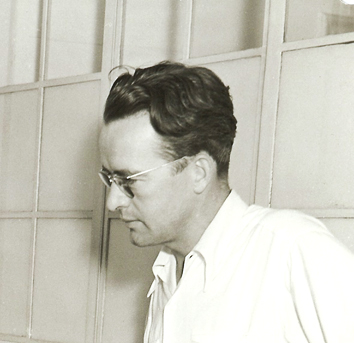
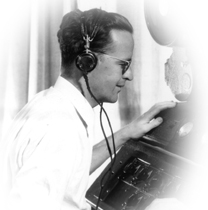
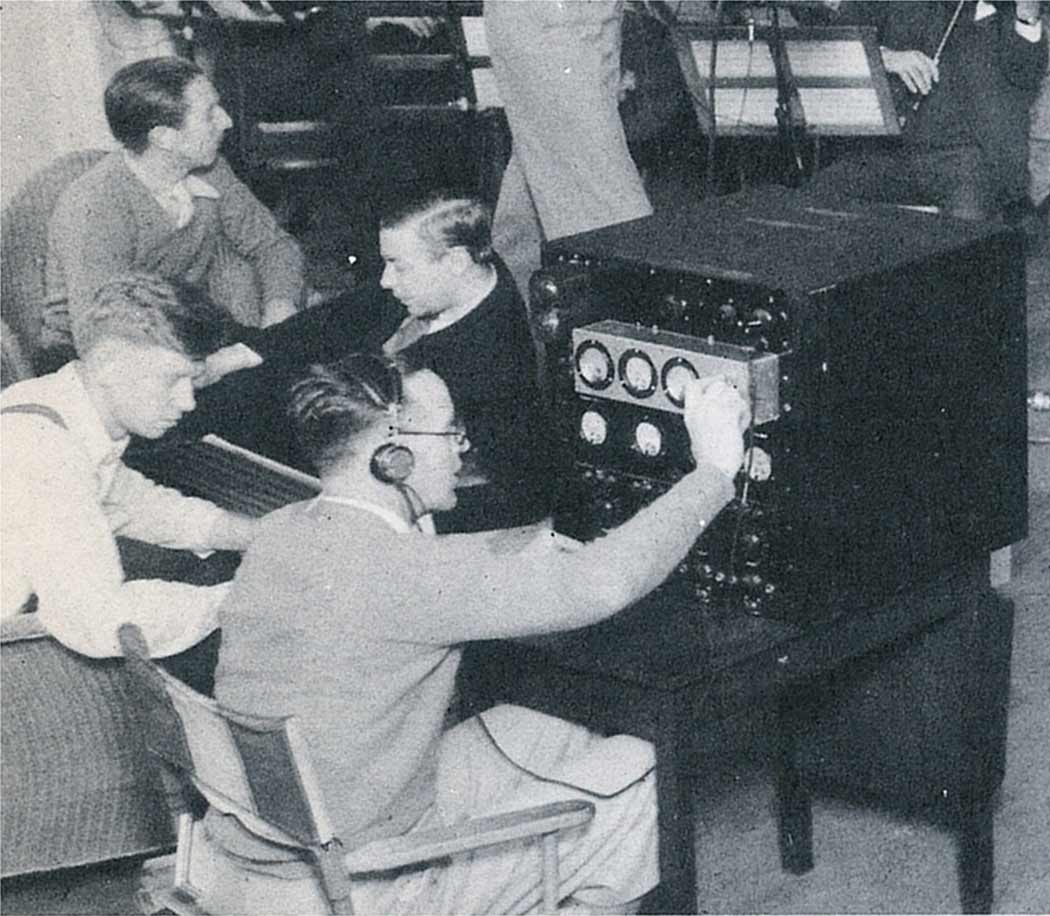
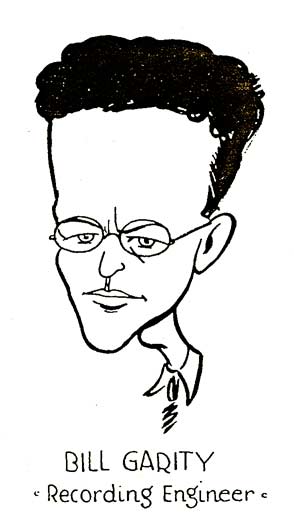
The left image, from Bob Thomas' The Art of Animation (1958) shows Garity recording at a music session with Frank Churchill conducting a studio orchestra. It is in Finch's Art of Walt Disney (1973) as well - we see more but smaller. With him in the picture Walt, of course, and below him Wilfred Jaxon Jackson. I believe the reclining gent in the dark suit to be gag man Earl Duvall. I stumbled over the middle image... There must be lots more picture to this, but the person who cut the image on the reverse out of a Fantasia program also cut away a good part of our featured engineer... The right image: when in the early 30's the staff of the studio congratulated Walt, probably on his two Academy Awards® in 1932, Jack King drew this caricature of "sound engineer" Bill Garity.
Let's not forget, on Didier's great blog, we saw the top of his head...
In one publication from 1940 on Fantasound, Garity credited Walt: "We've done things...most of them Walt's ideas, that looked impossible at first."
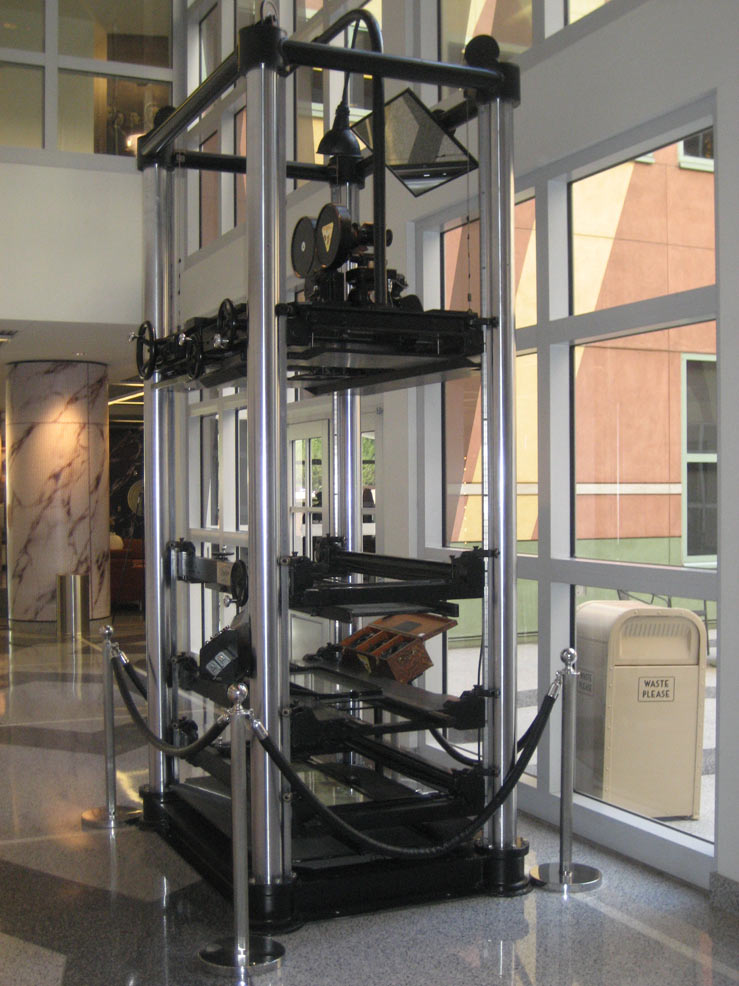
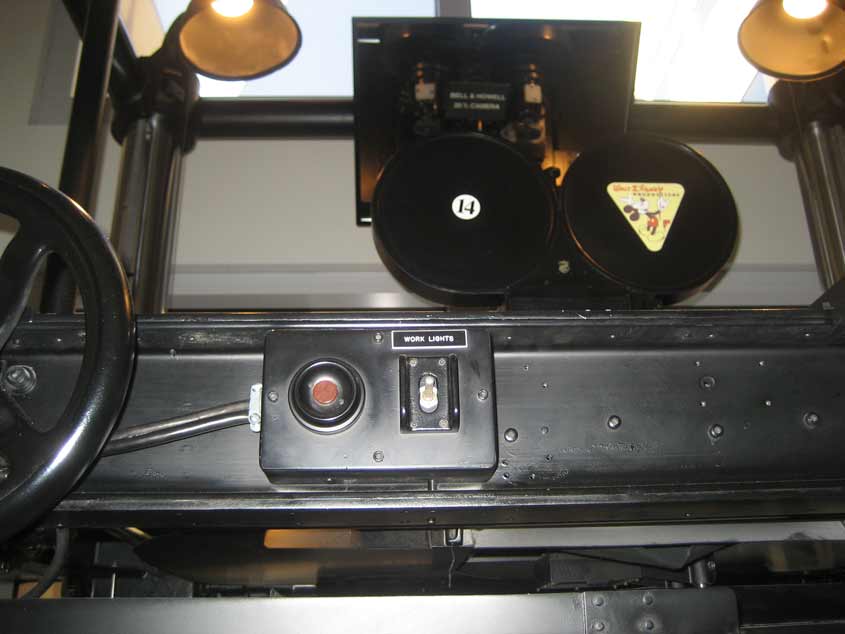
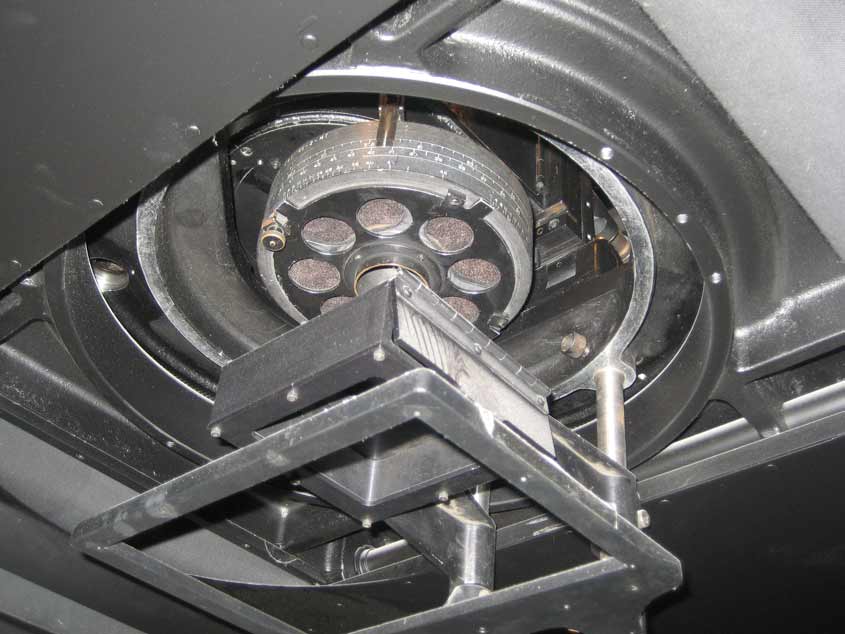
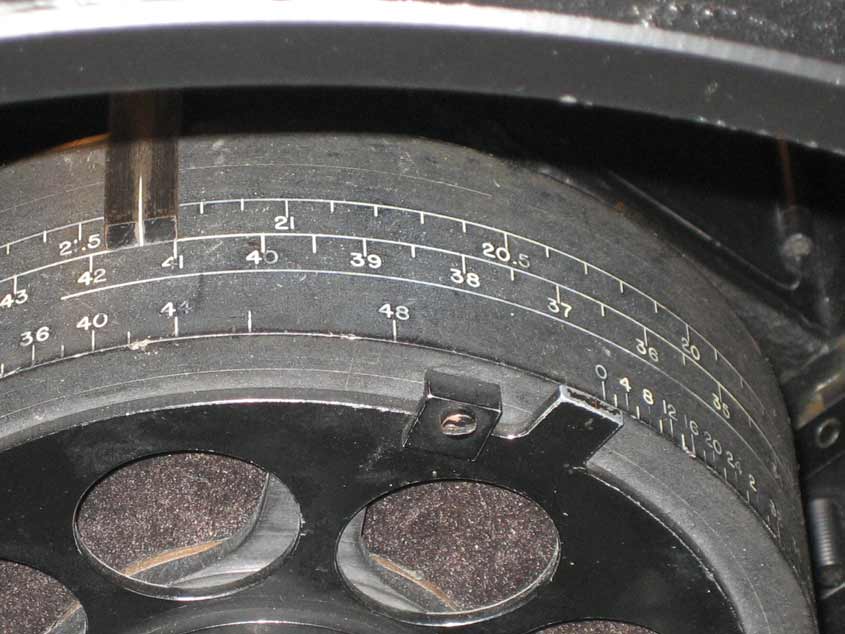
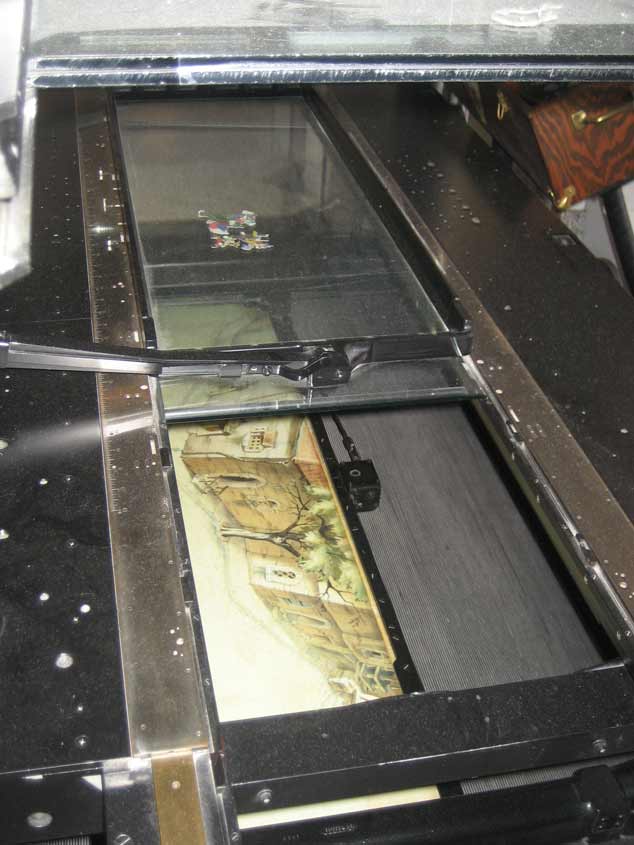
Can't get enough of the Multiplane camera either? Here is my final posting to top off Multiplane week. I thought of spreading this out, like Disney's 18 month "year," but enough is as good as a feast, especially since most of the readers are out locating metal columns or attending welding class.
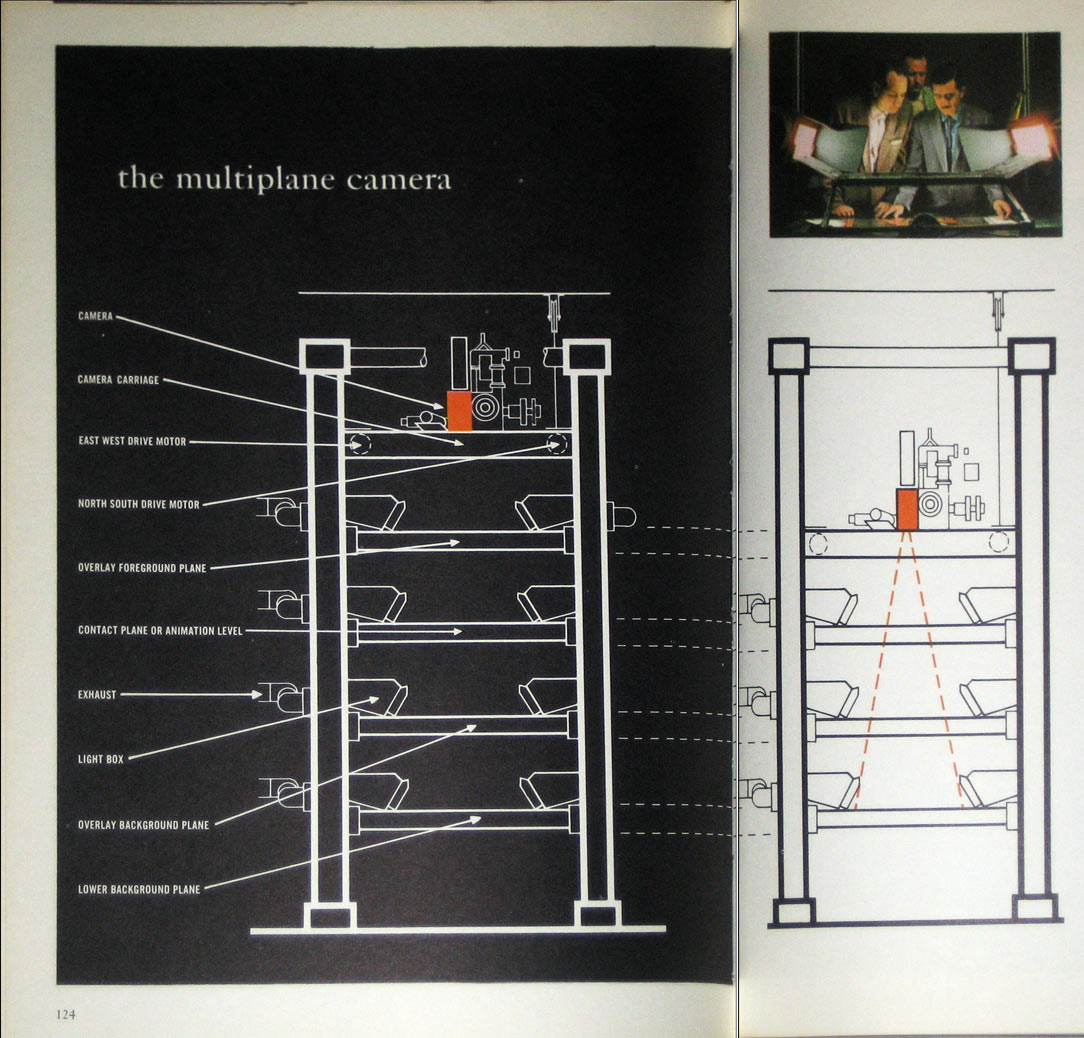
First the simplified drawing printed in Bob Thomas' Art of Animation (1958). It shows how the levels can move in relation to each other. Where the patent art was a complex schematic, this one is down to the basics...
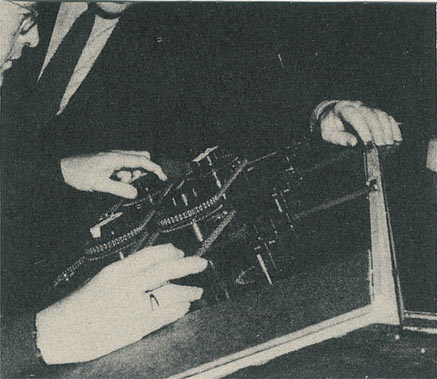
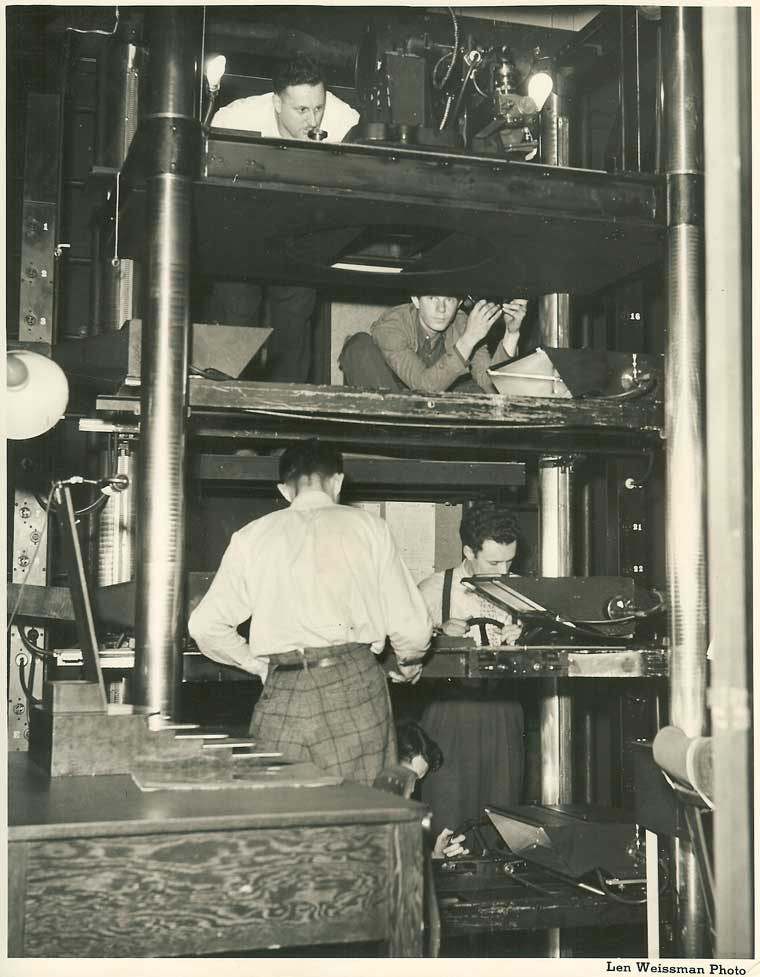
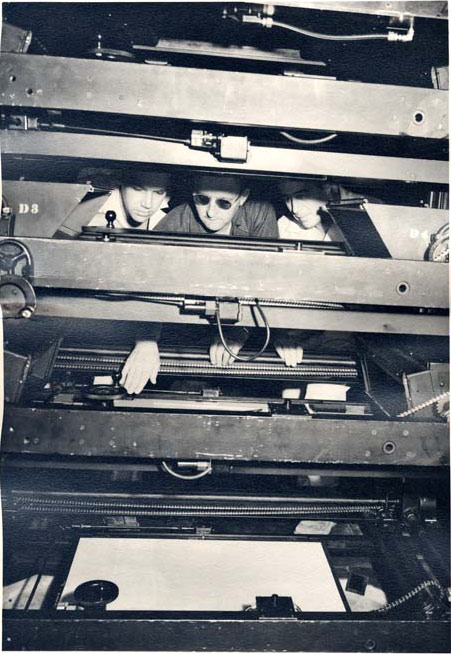
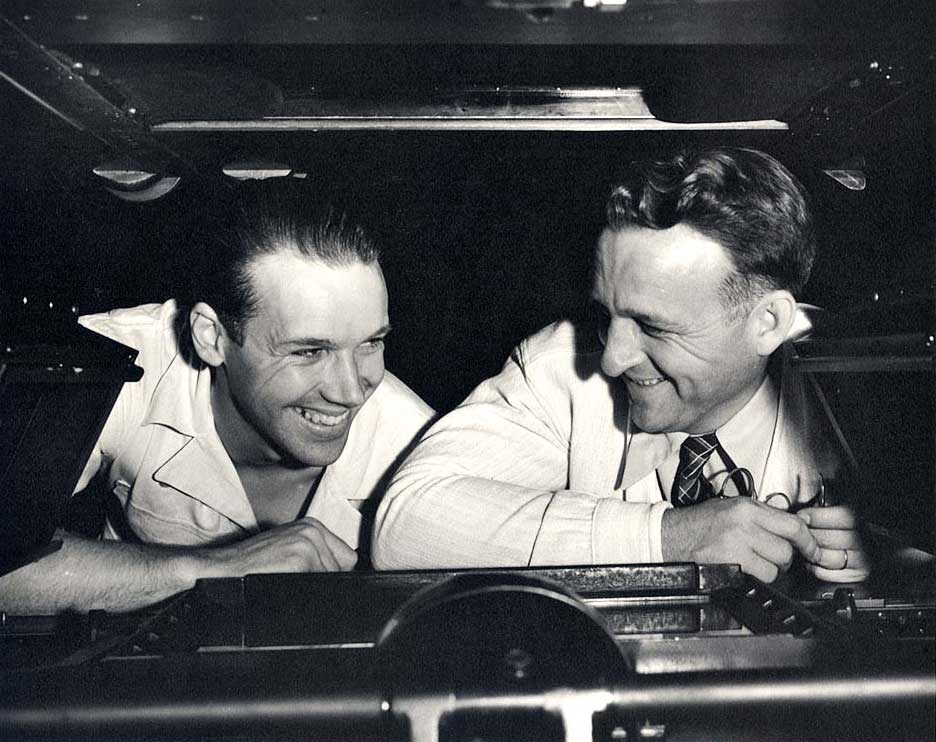
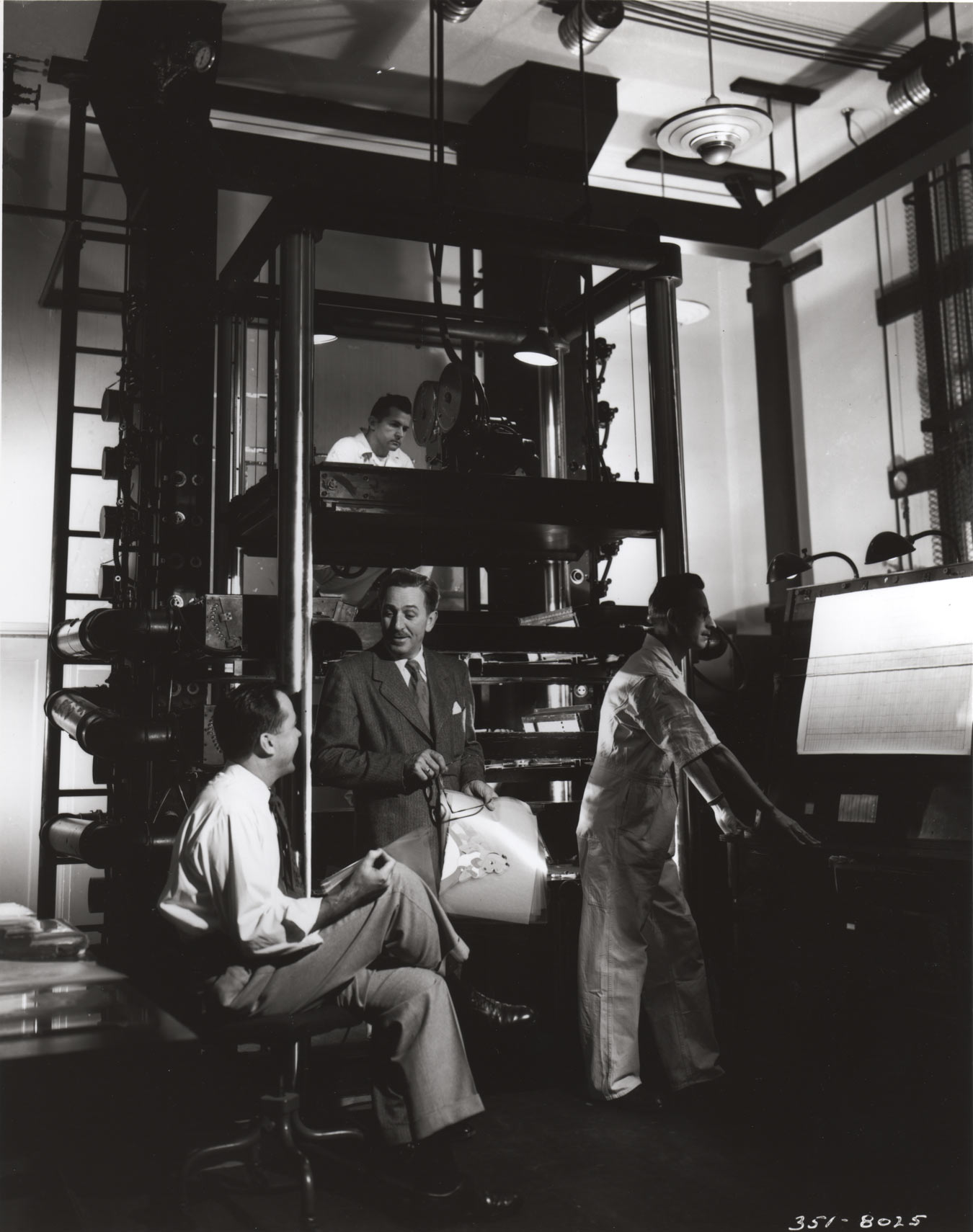
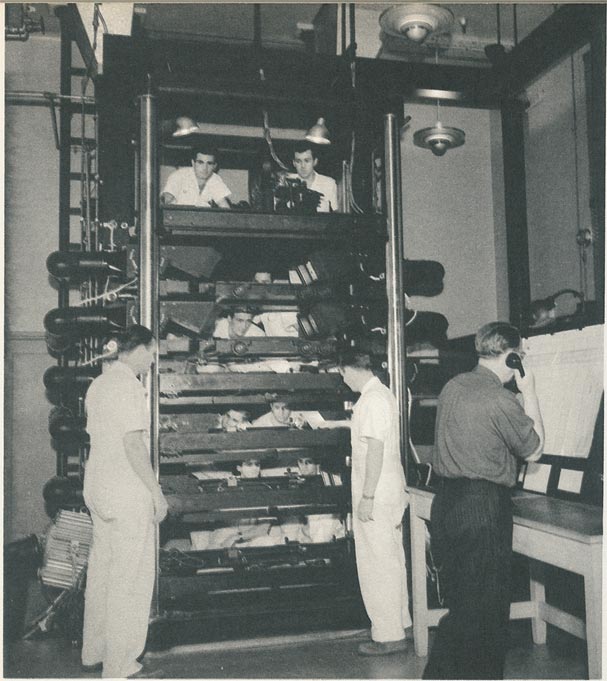
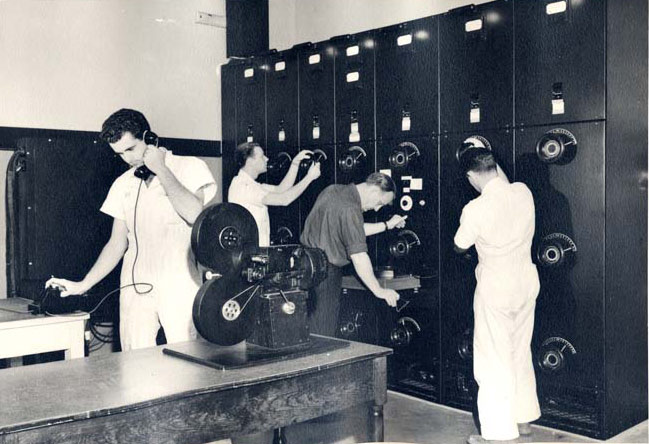
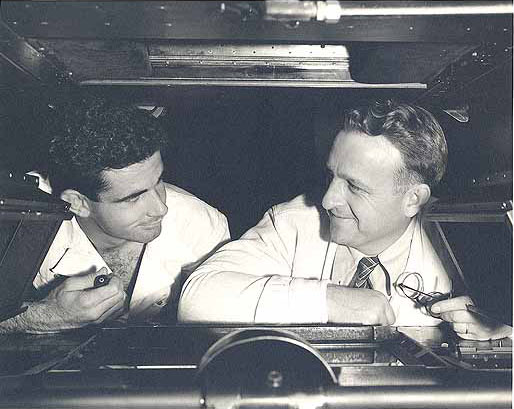
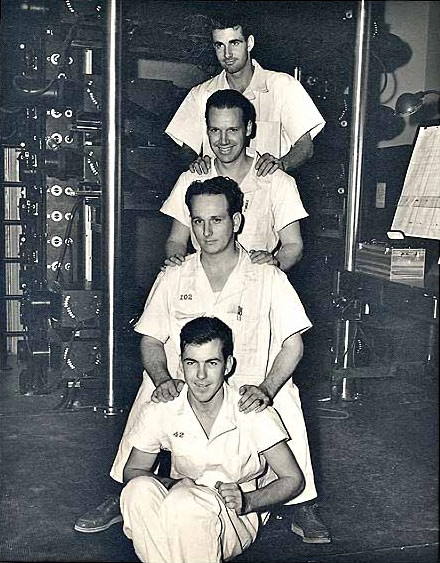
The camera at work - first in plain clothes (a clearer version of the one in the first posting of this series), then in lab coats, the two right images seemingly press pictures - the gent on the right seems to be the department head. (Suggestions anyone?)
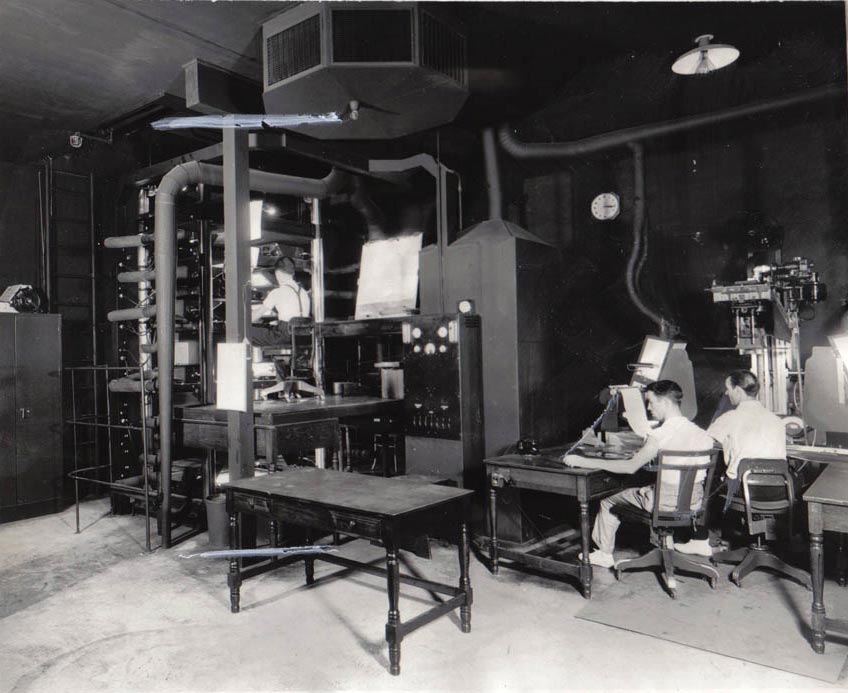
The next picture on the left has a caption written up: « The multiplane camera room. This new type of camera, developed within the studio at a cost exceeding $75,000, is seen at the left. It consists of seven movable horizontal planes so that characters can be shot at various levels. Each level can be individually lighted. The multiplane method also serves to give an illusion of depth to the photography. In many cases, it is not necessary to shoot a scene on the multiplane camera. Only about 30 per cent of the footage of "Snow White" was shot on the multiplane. » So this probably dates from early 1938, and seems to show the same camera as in the first picture above, with a fixed camera level. Note there is only one camera operator on the Multiplane crane. The Snow White draft only mentions two scenes specifically using Multiplane, Seq. 3-B Sc. 1 & 3, the end of her collapse with the animals' eyes. Some scenes are using the larger 6½ Field, though, and we saw in a technical reference that these first could only be shot on the Multiplane camera. It was used as a big version of a stationary setup!
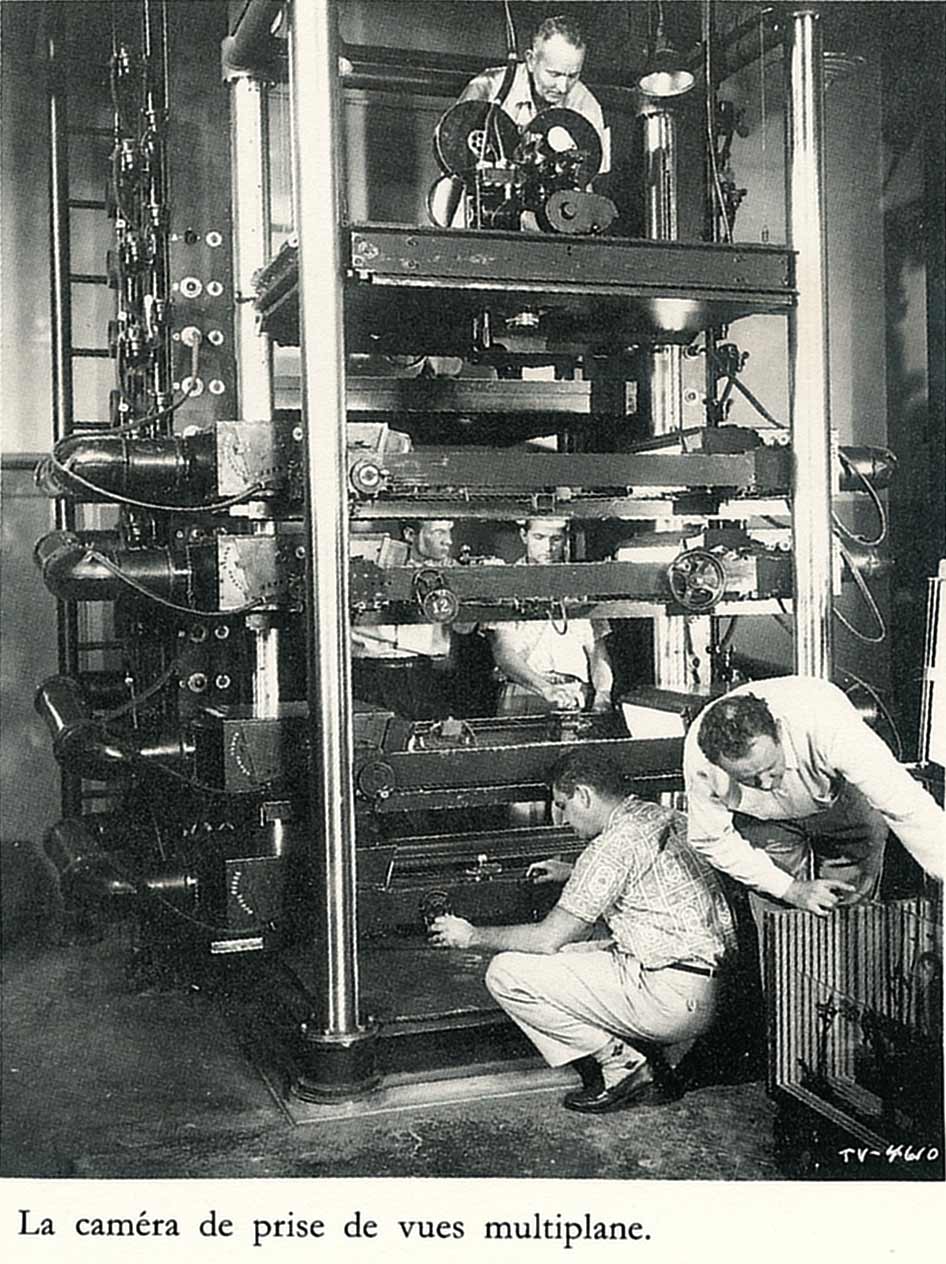
The center image comes from the curious French 1987 exhibition catalogue "Les Artistes de Walt Disney," edited by Pierre Lambert, who later did those wonderful glossy art books. I still wonder where he got his list of the Nine Old Men from... The neg number indicates that this was shot for a TV show. It seems to be a still for The Tricks of our Trade—more later. Note the holder for the glass panes.
On the right we see Walt himself visiting the camera department during the shooting of Alice in Wonderland in March 1951.
As a treat within a treat, here is a little collection of Card Walkeriana. As you probably know, Esmond Cardon "Card" Walker (born in Rexburg, Idaho 1/9/1916 - died in La Cañada Flintridge, California 11/28/2005) started as mailroom clerk at Disney in 1938. Then worked in the camera department, and became one of the unit managers for short subjects. US Navy during WW2, then, back at Disney, head of the ARI, the Audience Research Institute, Disney's focus group research department. Vice president of advertising and sales in 1956, elected to the board 1960. President in 1971, CEO in 1976, Chairman of the board 1980, retired as CEO in 1983, member of the board of directors until 1999. Named Disney Legend in 1993. He was "one of Walt's Boys." But here, of course, we are only interested in him as cameraman.
First the image from Finch's Art of Walt Disney (1973) with Walker top left, on the same camera as in the previous two images. Then the lamp voltage regulators, with the future company president on the phone. Then the same setup as above but with Card on the left - with eyes closed. Finally four members of the crew, with Card Walker at the top...[and below him Truman Woodworth, Dick Grills and Bob Gibeaut.]
That's all very nice, but of course the most important thing we can do is to remember to revisit the films that were made possible with this invention—not because of the camera, but because of their amazing storytelling and entertainment.
Watch Snow White and the Seven Dwarfs, "Walt Disney's First Full-Length Feature Production in Multiplane Technicolor." "When the script called for the camera to "'truck up' for a close-up," the lens remained stationary, while the cels moved upward." (From TCM).
Then see the second film released as being "in Multiplane Technicolor," Pinocchio—especially sequence 2 scenes 1.01 to 1.06—for arguably the most famous Multiplane shot over the rooftops of Geppetto's village, laid out by Thor Putnam, and costing as much as a $48,000 by itself, more than an entire short film. "The backgrounds which we were able to use on this camera for Pinocchio were twice as big as those which fitted into the original multiplane set-up used in Snow White." (From TCM's notes). The Pinocchio draft mentions most all Multiplane scenes.
Watch Fantasia again. It is brimming with Multiplane shots!
Check out the opening of Bambi as laid out by Dick Anthony.
Admitted, there are scratches and cel flicker. Still, you'll have to agree, the effects added by the Multiplane camera are stunning...
We end Multiplane week with the following piece that someone uploaded to YouTube. You can find this on one of the Disney Treasures DVDs - from the show The Tricks of our Trade, the February 13nd, 1957 Disneyland episode. It was obviously produced for entertainment, but hey, you see the actual camera at work! (As in Walt's intro to The Old Mill). Nowadays, using computer technology "virtualizes" the Multiplane camera, so in most animation software used for hand-drawn film, one can in some way simulate by pressing a few buttons what might have taken a large crew weeks to accomplish back in the analog days of Pinocchio and Fantasia. I think it is good to learn how things used to be done, the hard, old-fashioned way, so we can make a better product in the future. Some things were more fun to do because it was harder to do them. Only occasionally I had the chance to work directly with a similar contraption, and yet - - - I miss the romance of the Multiplane camera...
Interested in animation since 1975, worked in Holland with Danish animator Børge Ring for four years (incl. on the Oscar-winning 'Anna & Bella'), then moved to Denmark in 1984. In SoCal since 2019.
Co-founder in 1988 of A. Film, Europe's foremost animation studio, in business for over 30 years. We are the studio behind 'The Flight before Christmas', 'Help! I'm a Fish', 'Asterix and the Vikings', 'Checkered Ninja' and many more...
Director of "Miffy the Movie (2013). Currently the President and CEO of A. Film L.A., Inc. in Los Angeles, mainly editing for A. Film, Denmark.
Though we are very involved in new techniques, I share a deep passion for Great Classical Animation with everyone at the studio; Frank Thomas and Ollie Johnston's "Illusion of Life" is our bible.