Please note: if an earlier link doesn't work, it may have changed following an update! Check the Category Labels in the side-bar on the right! There you can find animator drafts for sixteen complete Disney features and eighty-six shorts,
as well as Action Analysis Classes and many other vintage animation documents!

Tuesday, September 21, 2010

Three Peg Bar

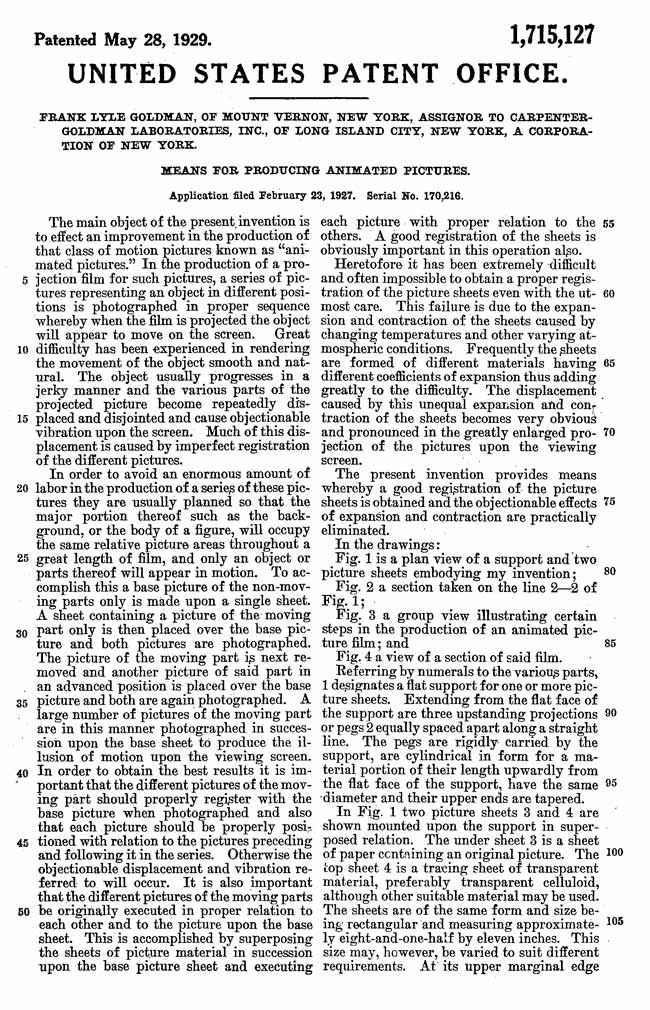
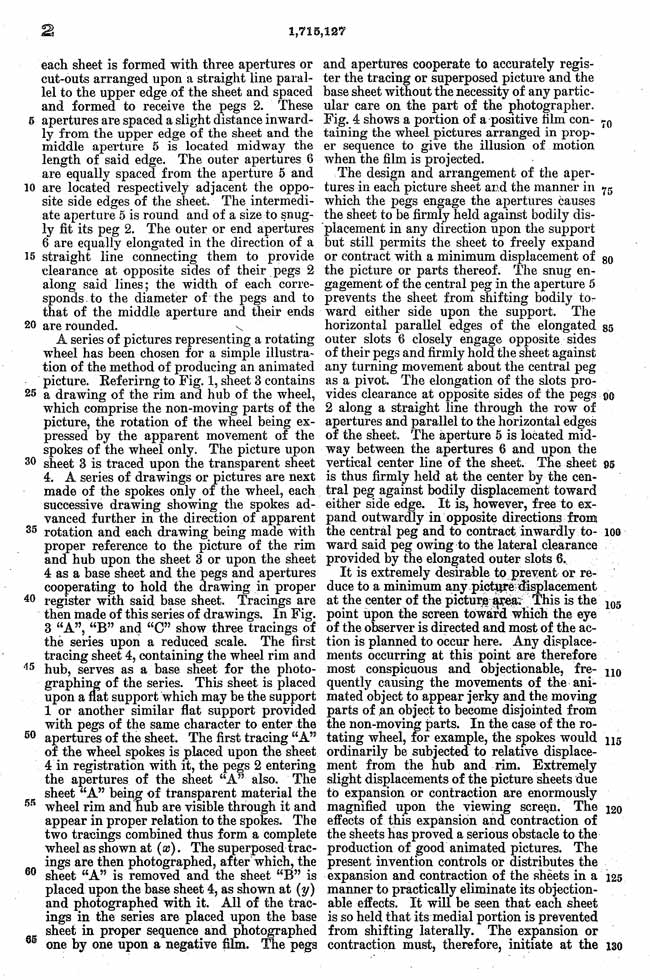
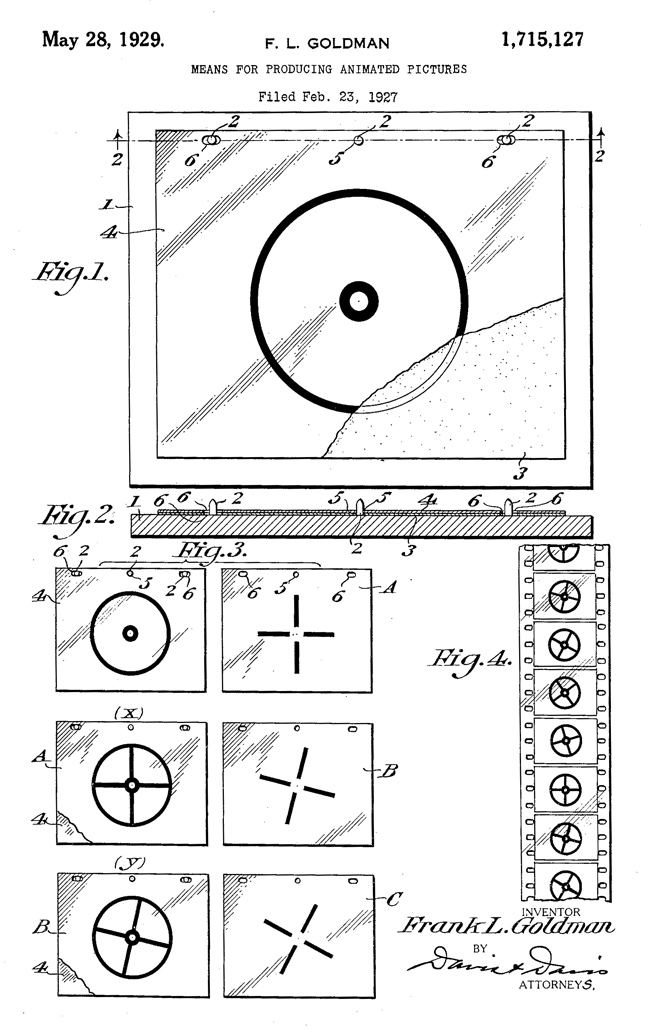
As one can see in the table on my paper-and-pegbar page, the Disney studio first added three pegs with a center peg for the 1935 short film Mickey's Garden.

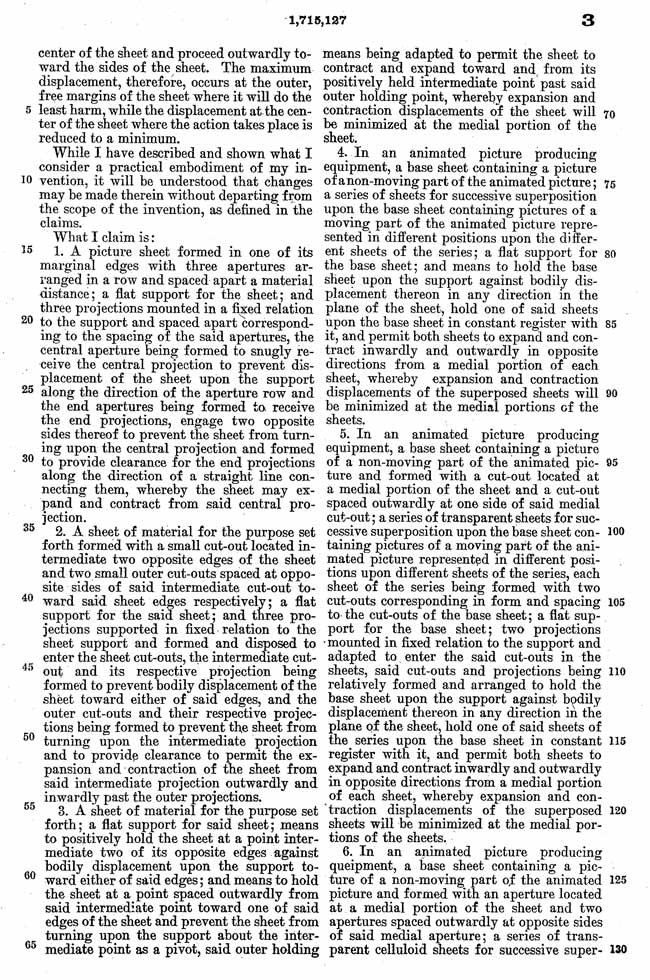
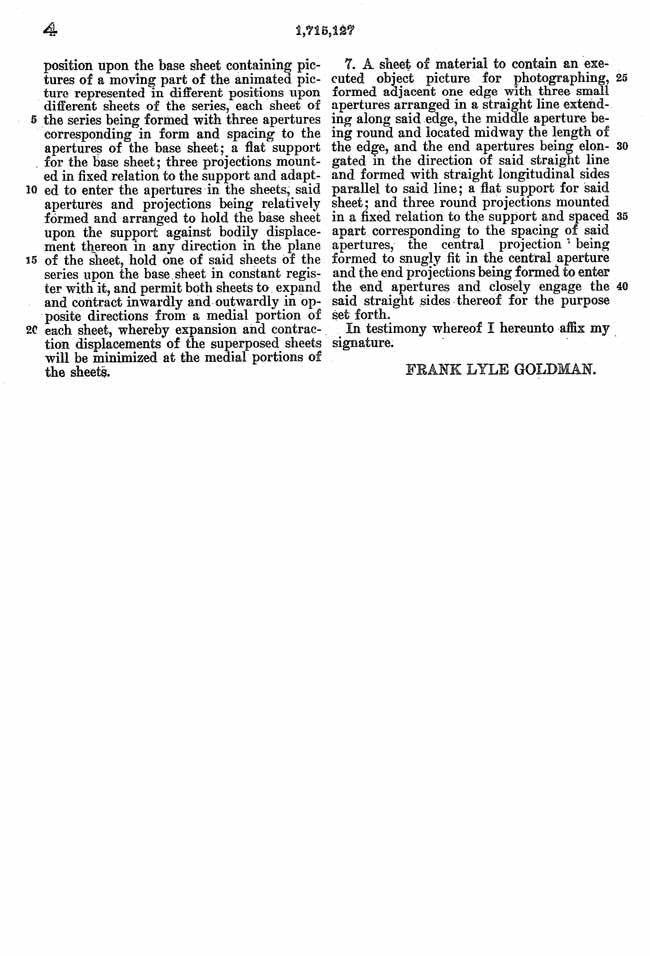
However, already in February 1927, a patent was filed (granted May 1929) that describes the three peg system. It also gives good reasons to implement this system. The inventor named is Frank Lyle Goldman, who according to this page was Max Fleischer's best friend! (If this is the same person, but what would be the odds there were two of that name in animation at that time on the East Coast?)
12345

Those of us who "grew up" using good old ACME pegs, or you East Coast-ers using Oxberry pegs, may have wondered why one professionally would not just use two pegs which seems simplest. Well, here is the explanation. Having manufactured aluminum animation discs myself back in 1983, I must admit that this did not come as a surprise to me. Obviously, the pegbars that we were used to had flat outer pegs (and yes, one could lay a ruler over the outer Oxberry pegs), but the principle is the same as in above patent.

Do we know when Fleischer started using flat-round-flat holes in their animation paper? Did the Disney studio have to pay a licensing fee for using the three pegs in addition to their regular two round pegs?

[Still really busy - not much time for blogging!]

Labels:

Monday, July 20, 2009

One Small Step for Man...


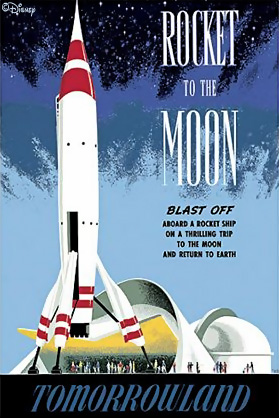
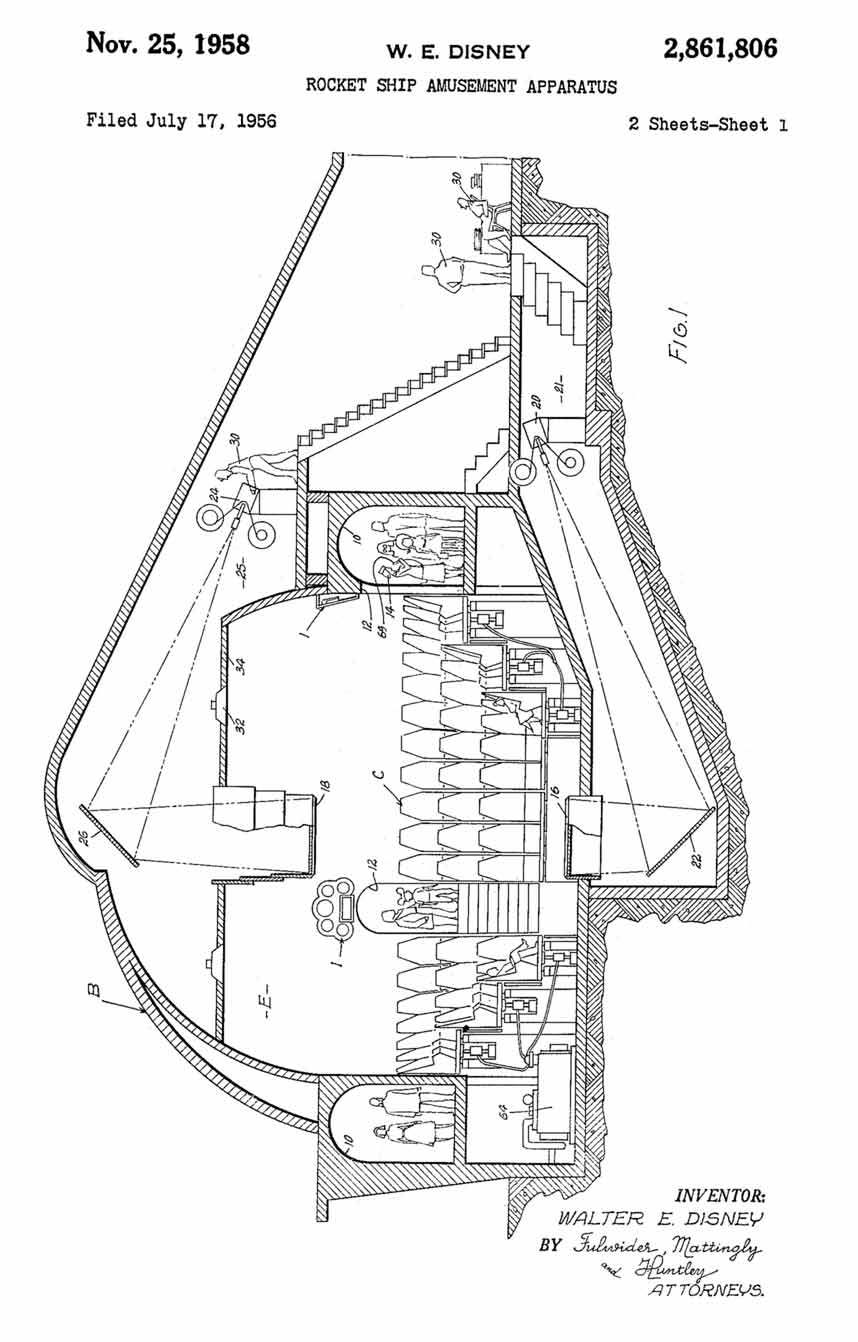
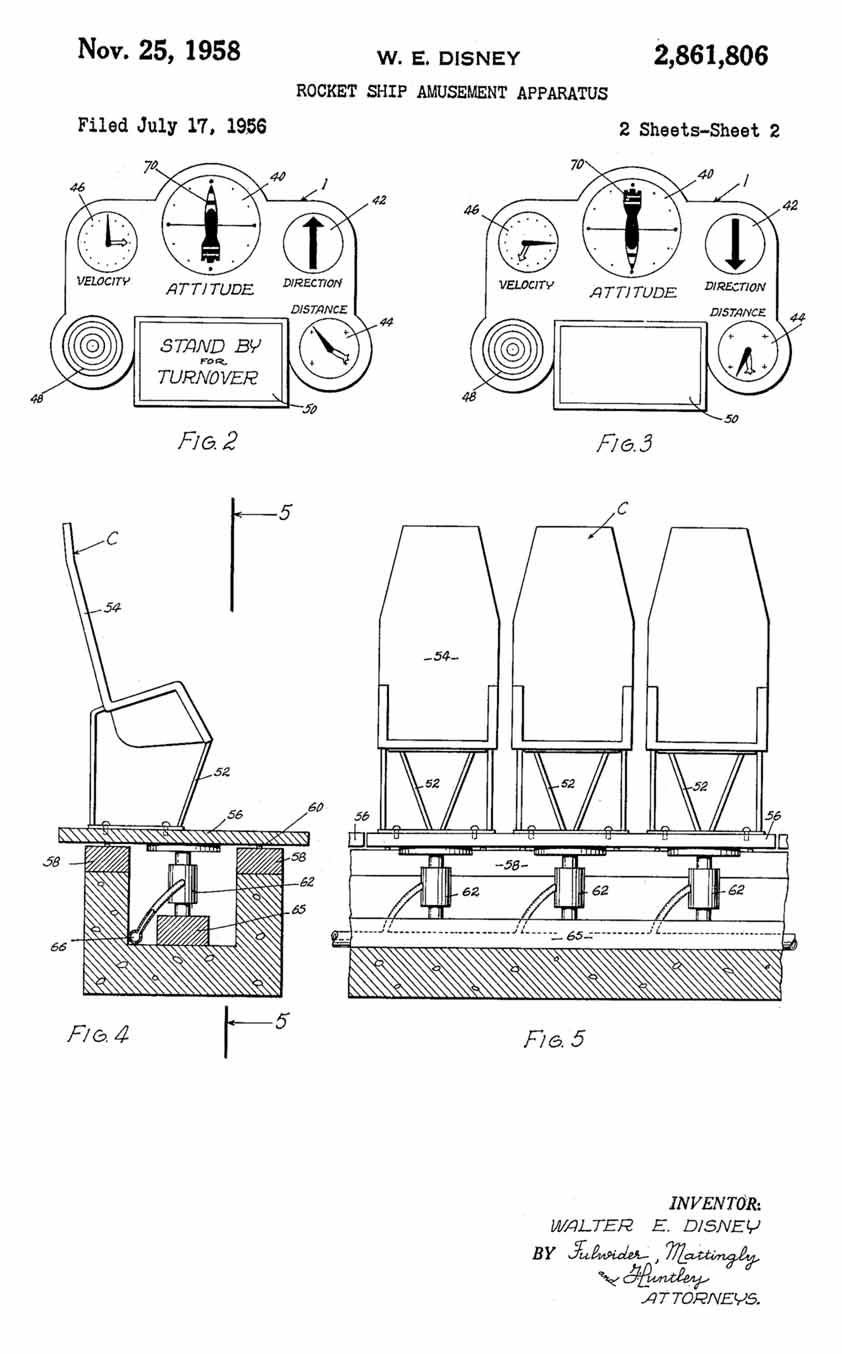
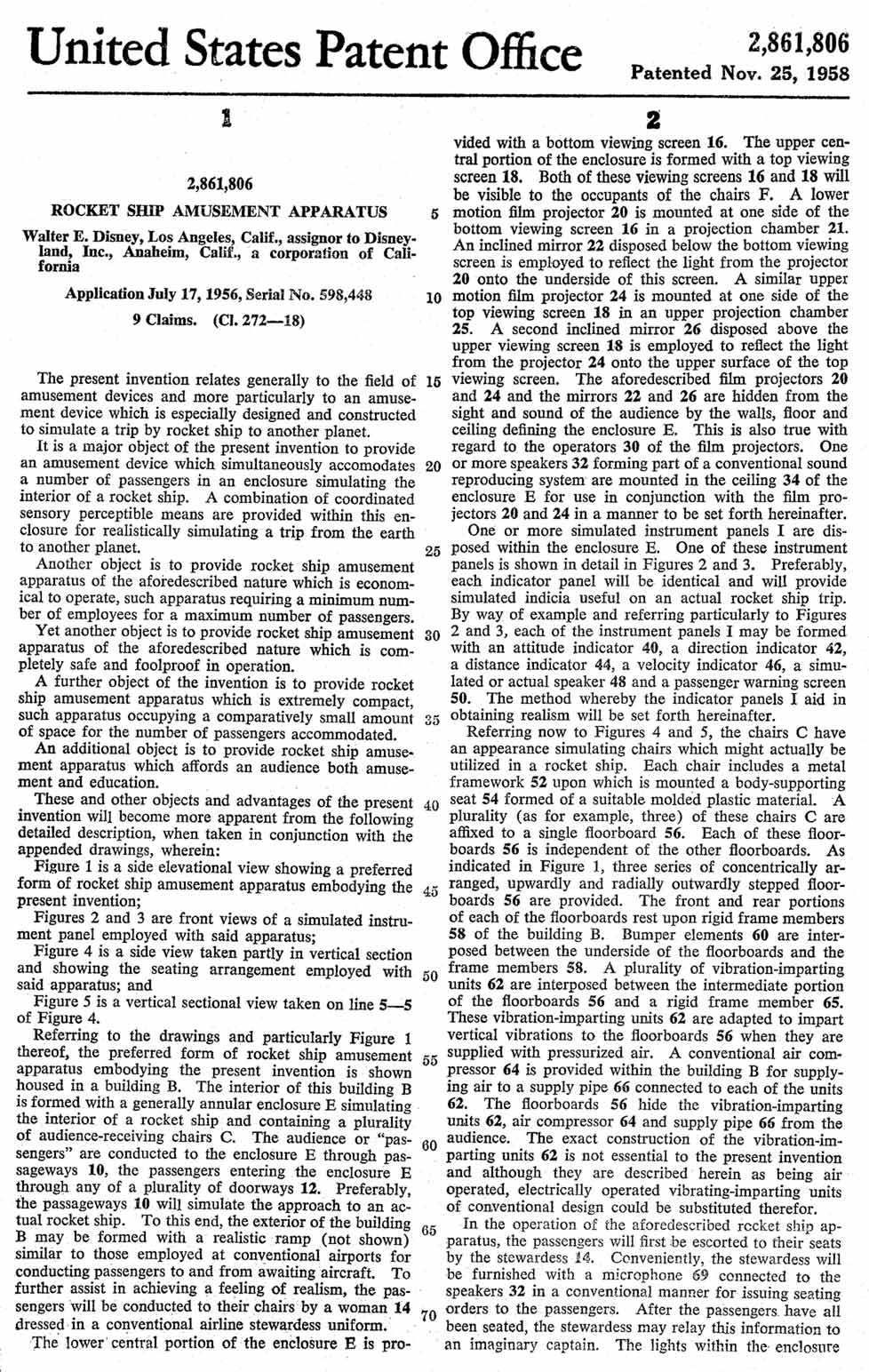
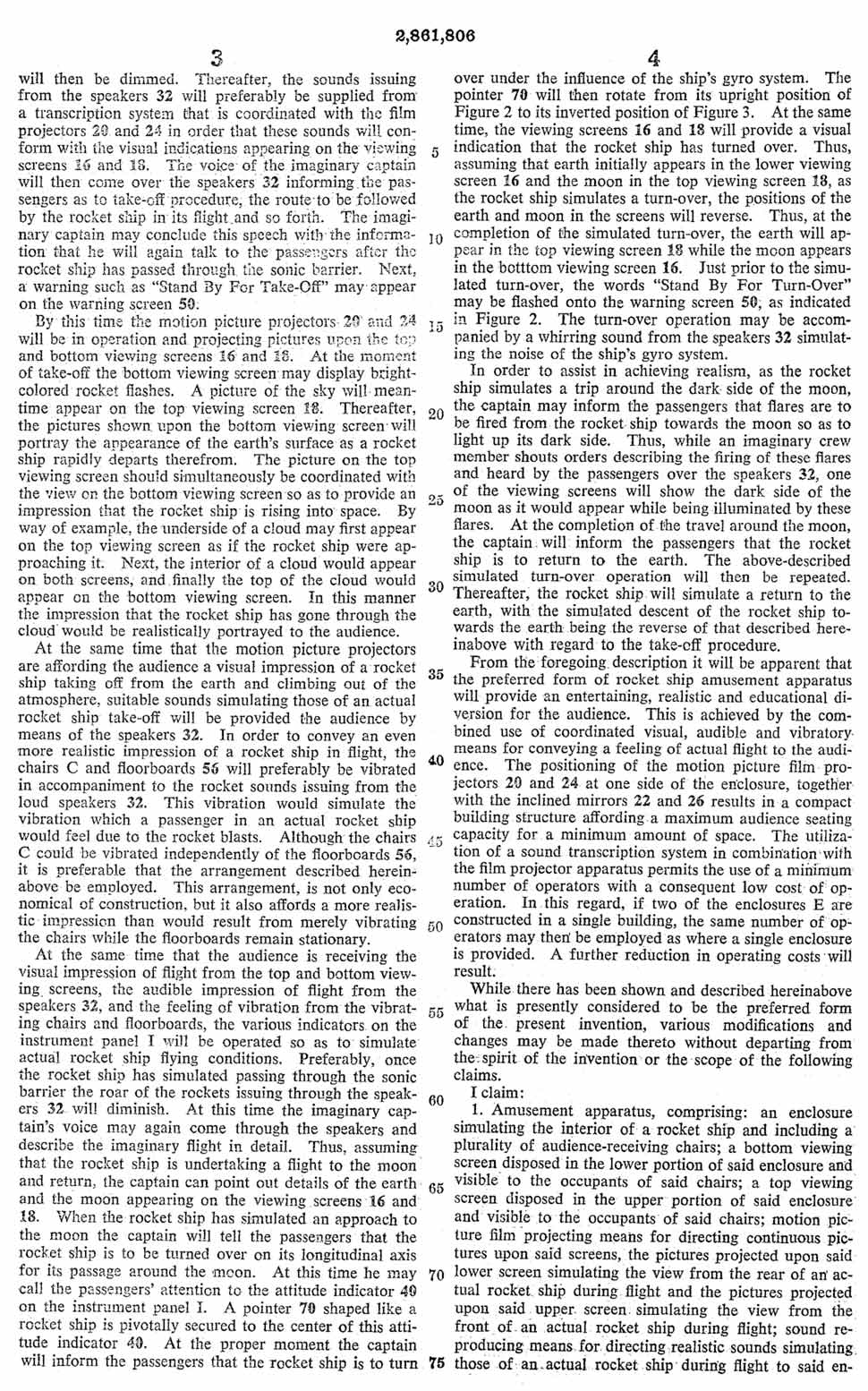
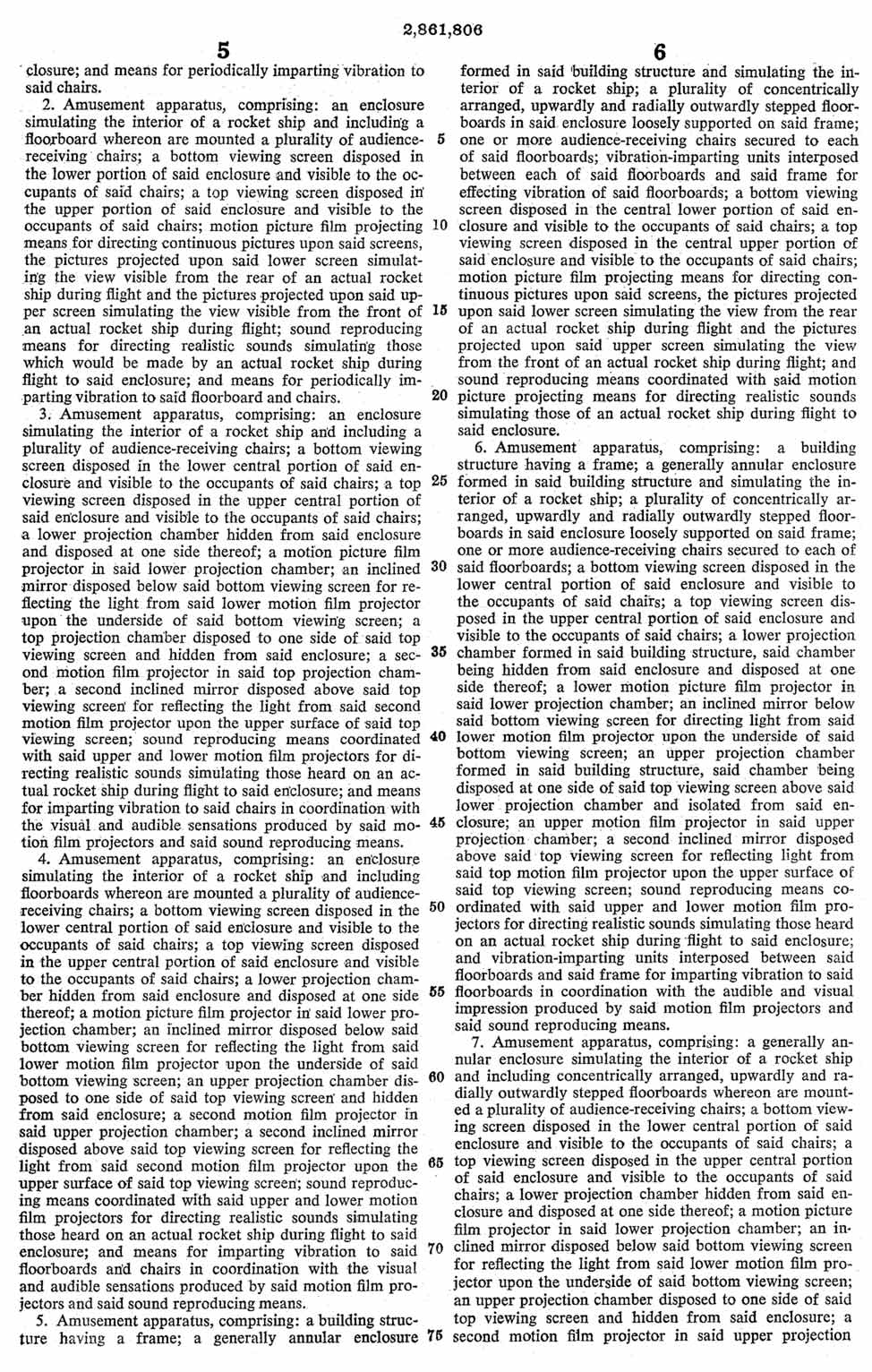
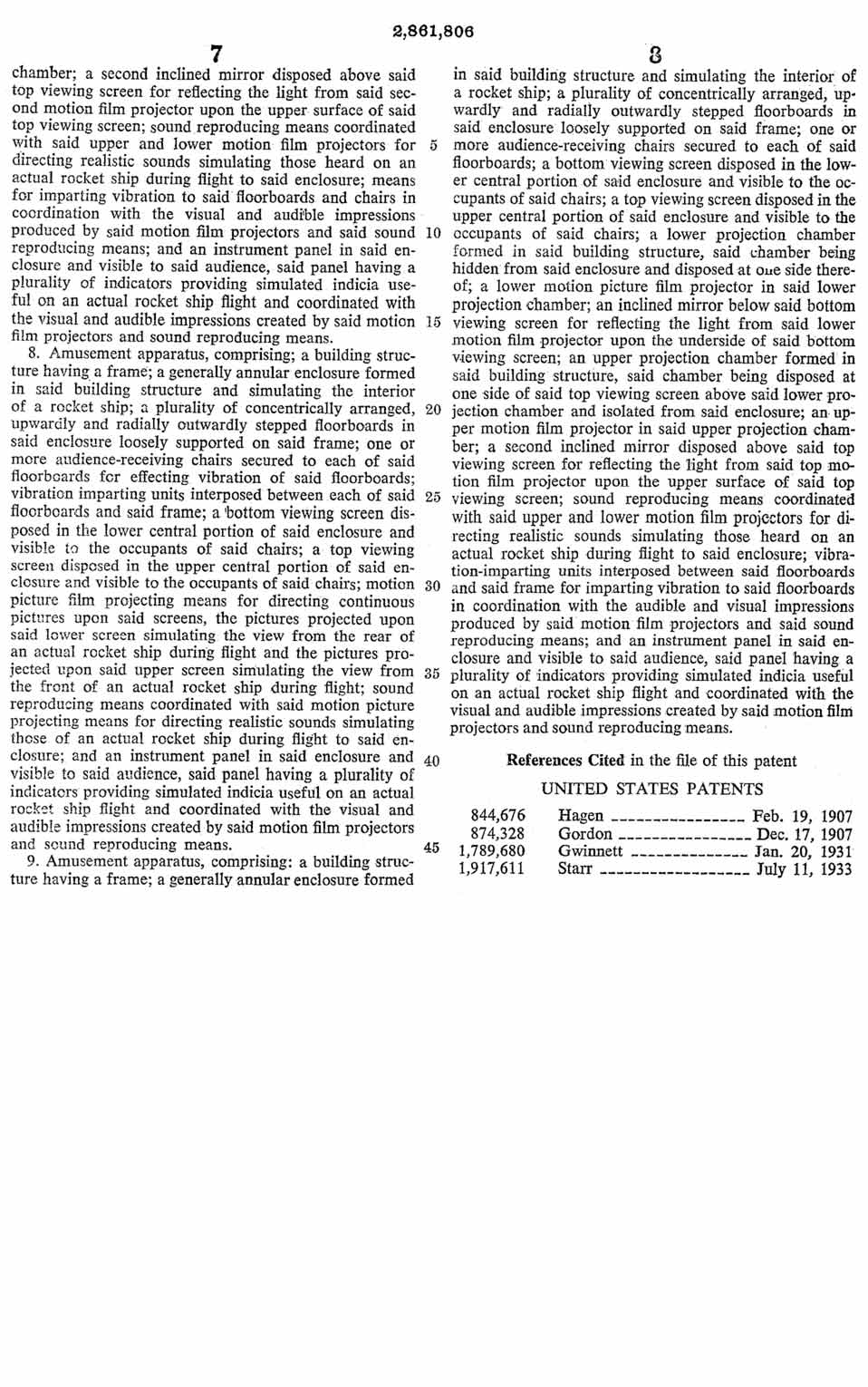
On this day of the 40th anniversary of the landing of the first man on the moon, I would like to offer the patent to the Rocket to the Moon attraction as it was installed in Tomorrowland in Disneyland in 1955 and lasted until 1966. It bears Walt Disney's own name as the inventor, and was filed - just as the Circarama patent - on July 17th, 1956, one year to the day after opening day, the day we celebrated on Friday. For more info see on Yesterland.

I do not know if one of the attorneys was related to Ken Mattingly, the Flight Commander of Apollo 16. Coincidence?
123456
I, too, was glued to the tv that day (night!) in 1969 in Holland...

Labels: ,

Tuesday, April 14, 2009

The Blend

   
--The two Disney patents of Mary Louise Weiser
The Pinocchio Blu-Ray really brings home to us the amount of work that went into the creation of the beautiful imagery. The characters have a rounded look that adds dimensionality and realism to the otherwise flat surfaces. The technique used to accomplish this look is generally just referred to as "The Blend." On the Special Features one can hear noted historian J.B. Kaufman refer to it as such.

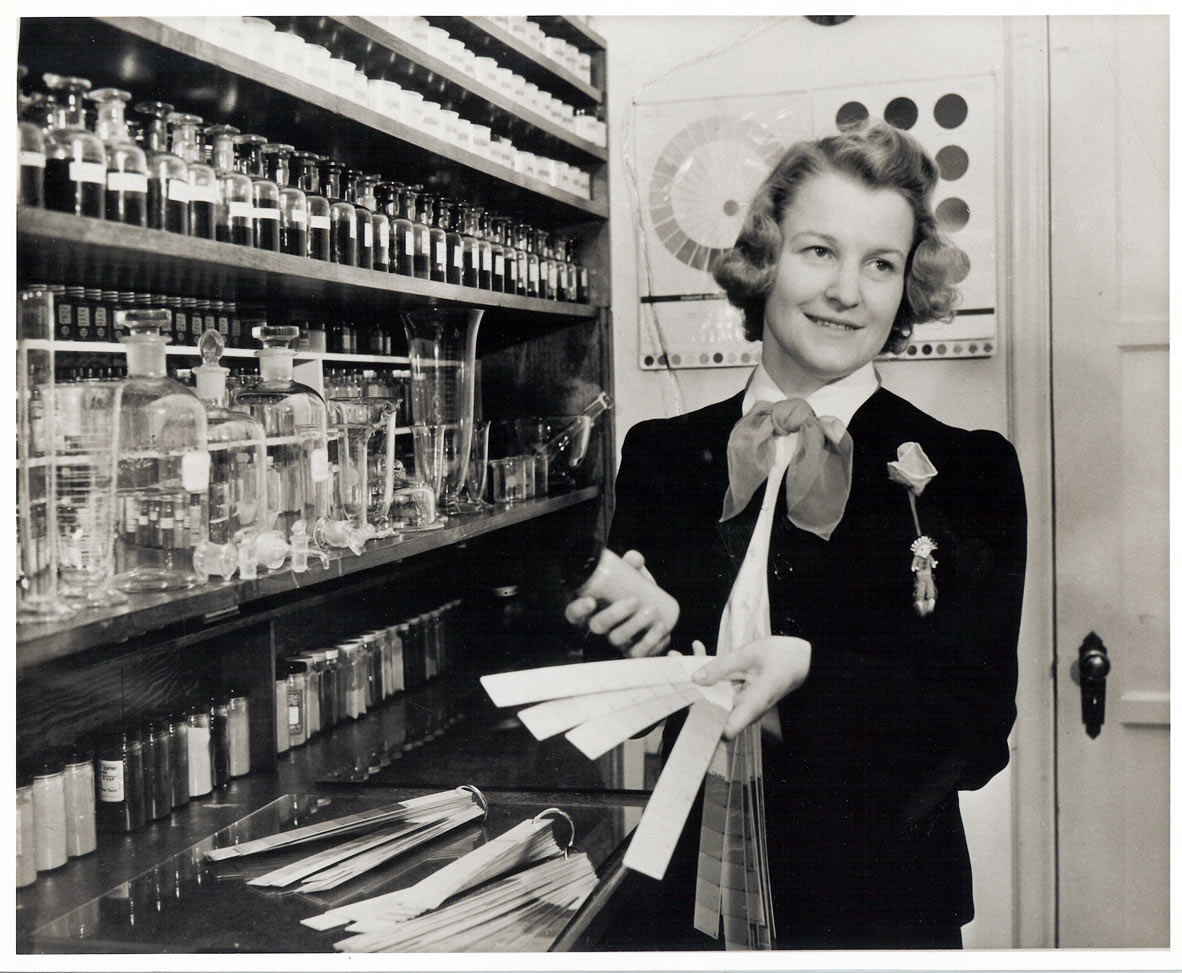
Mary Louise Weiser<< Click to enlarge...
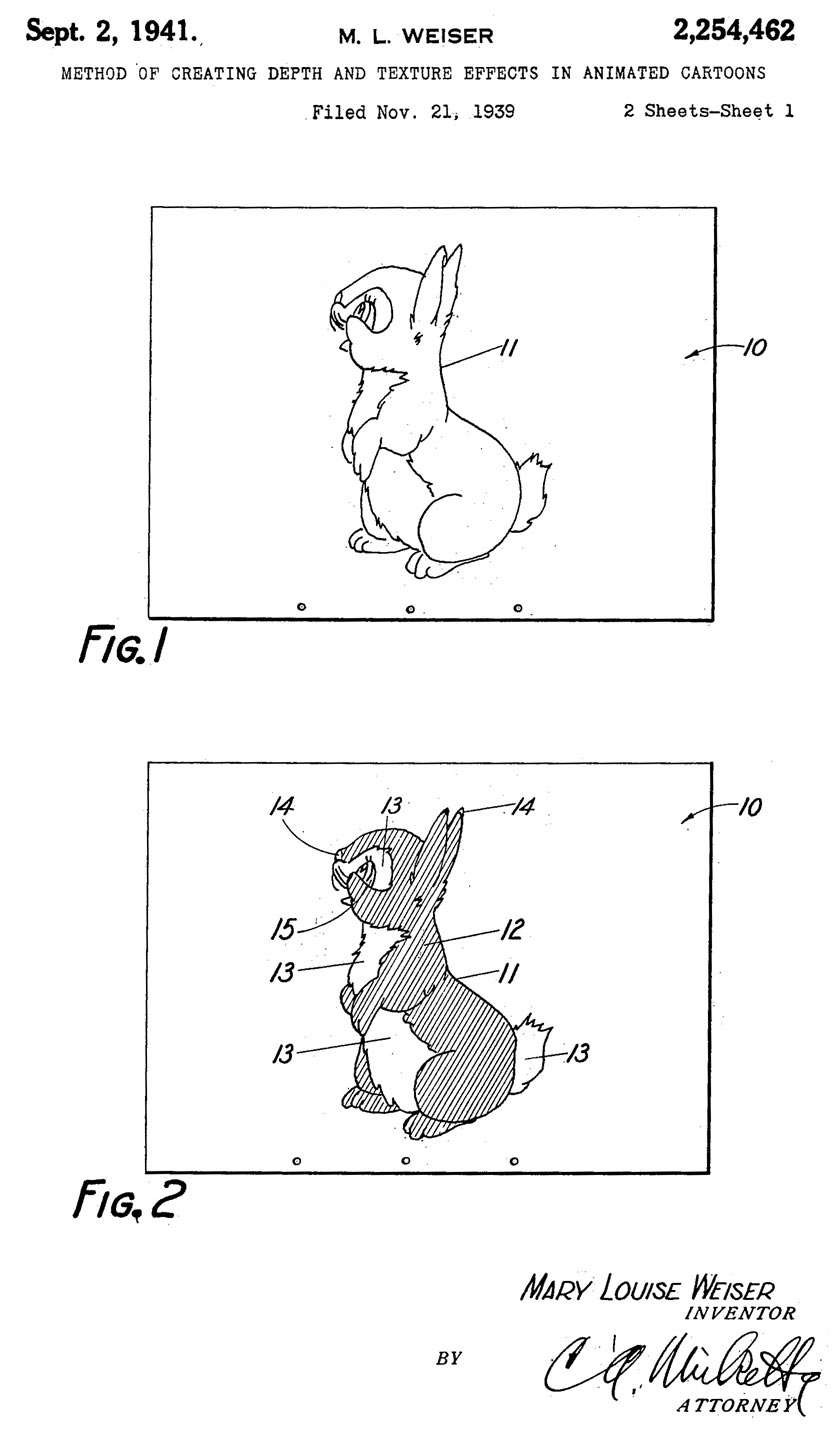
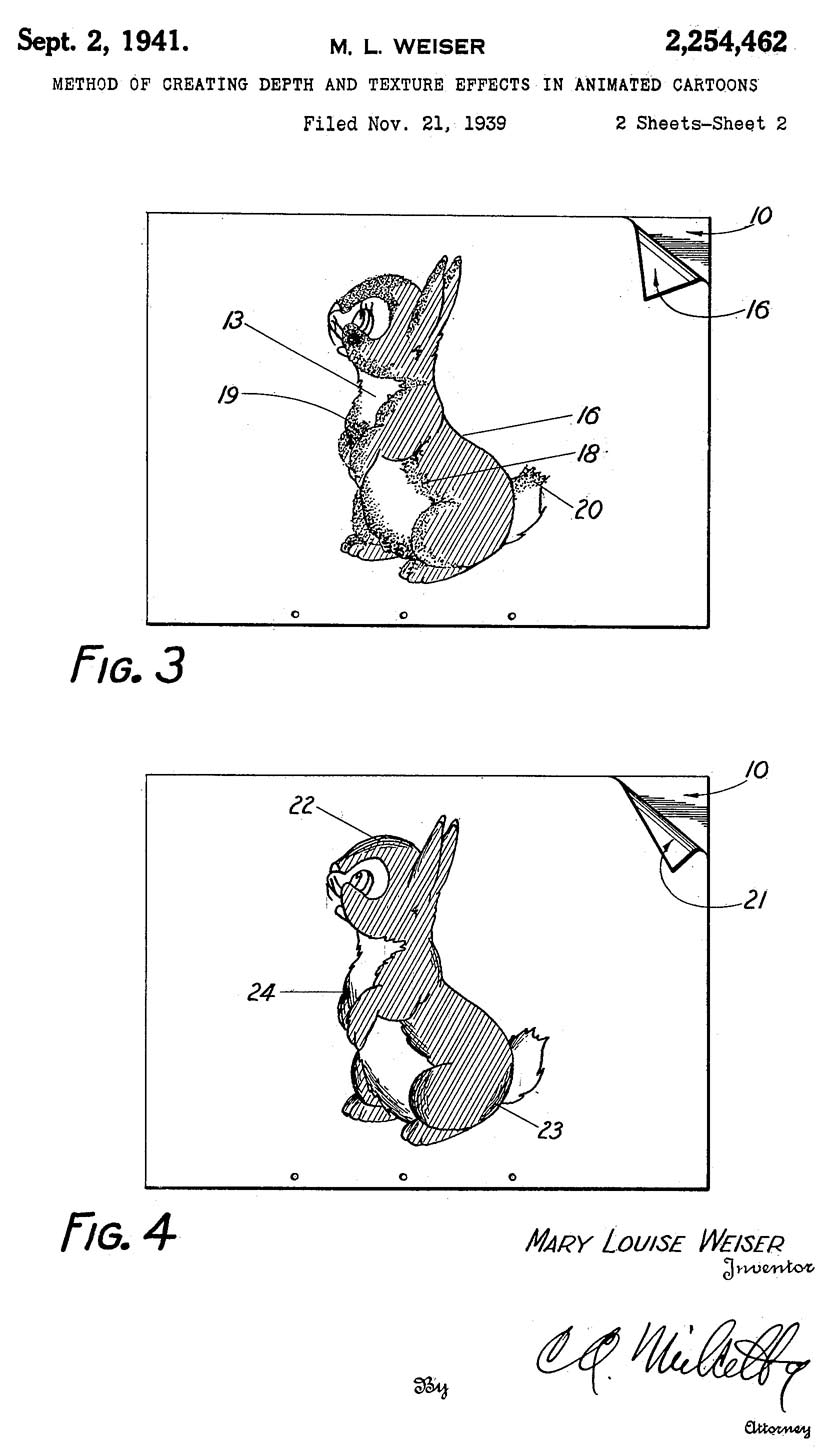
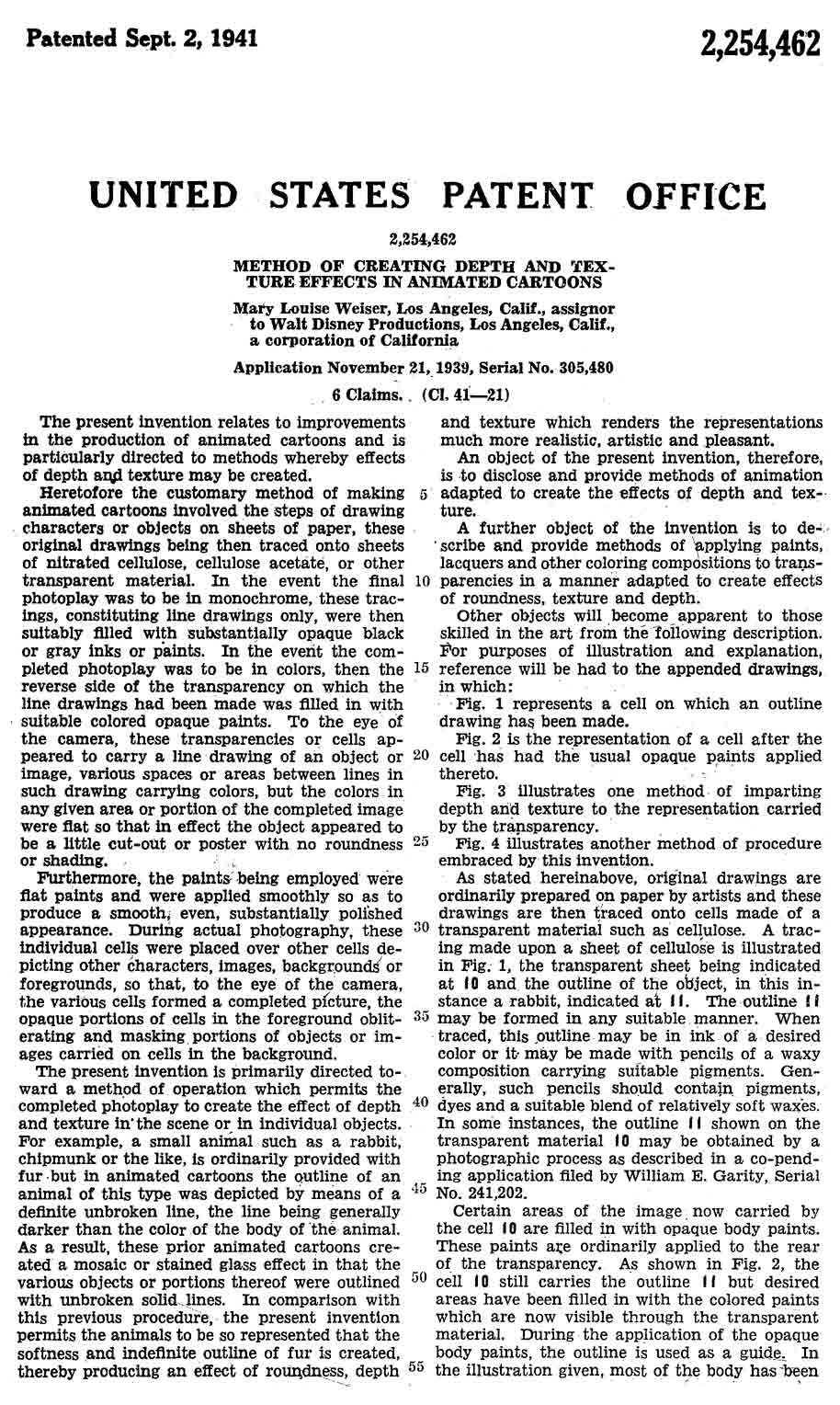
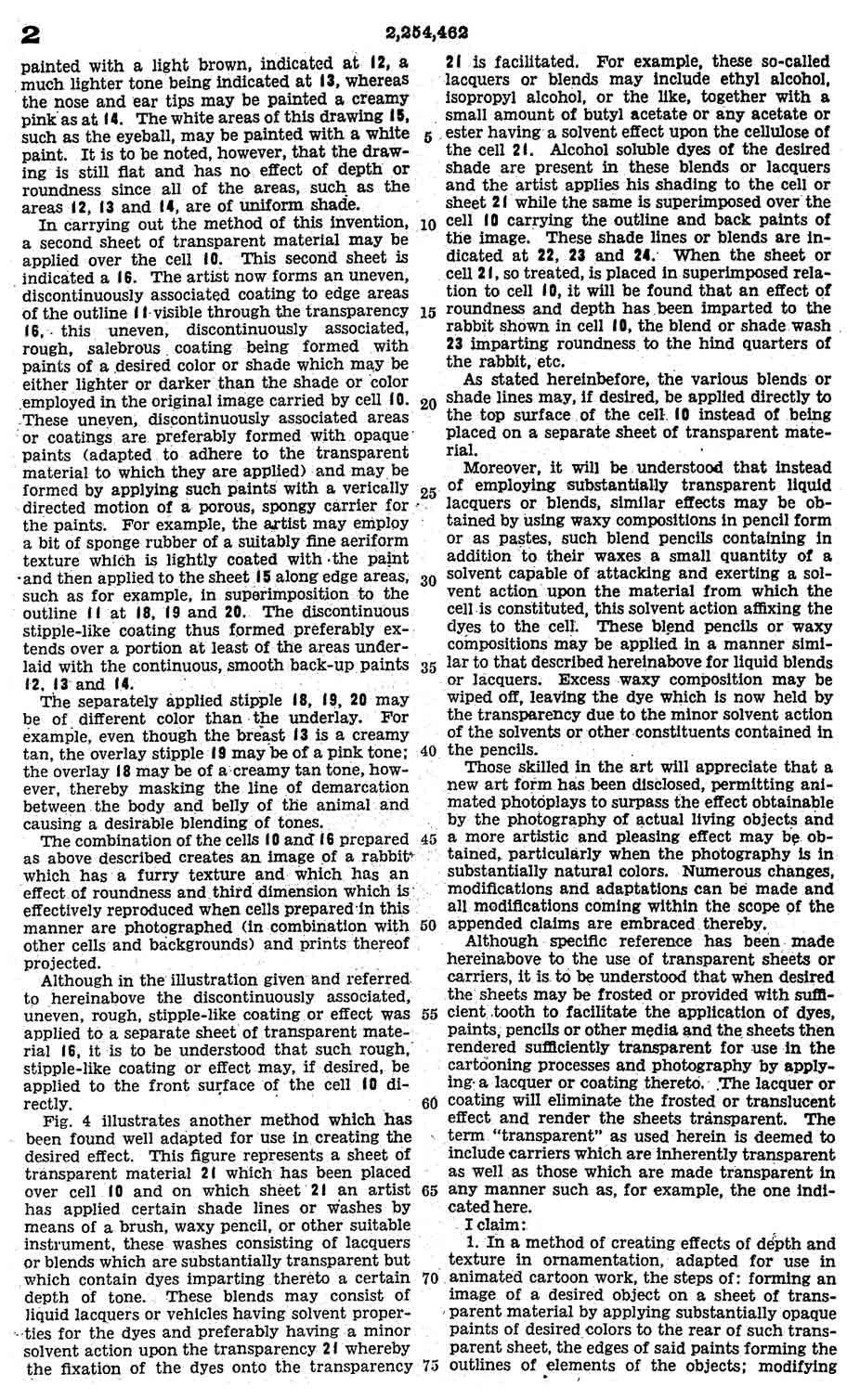
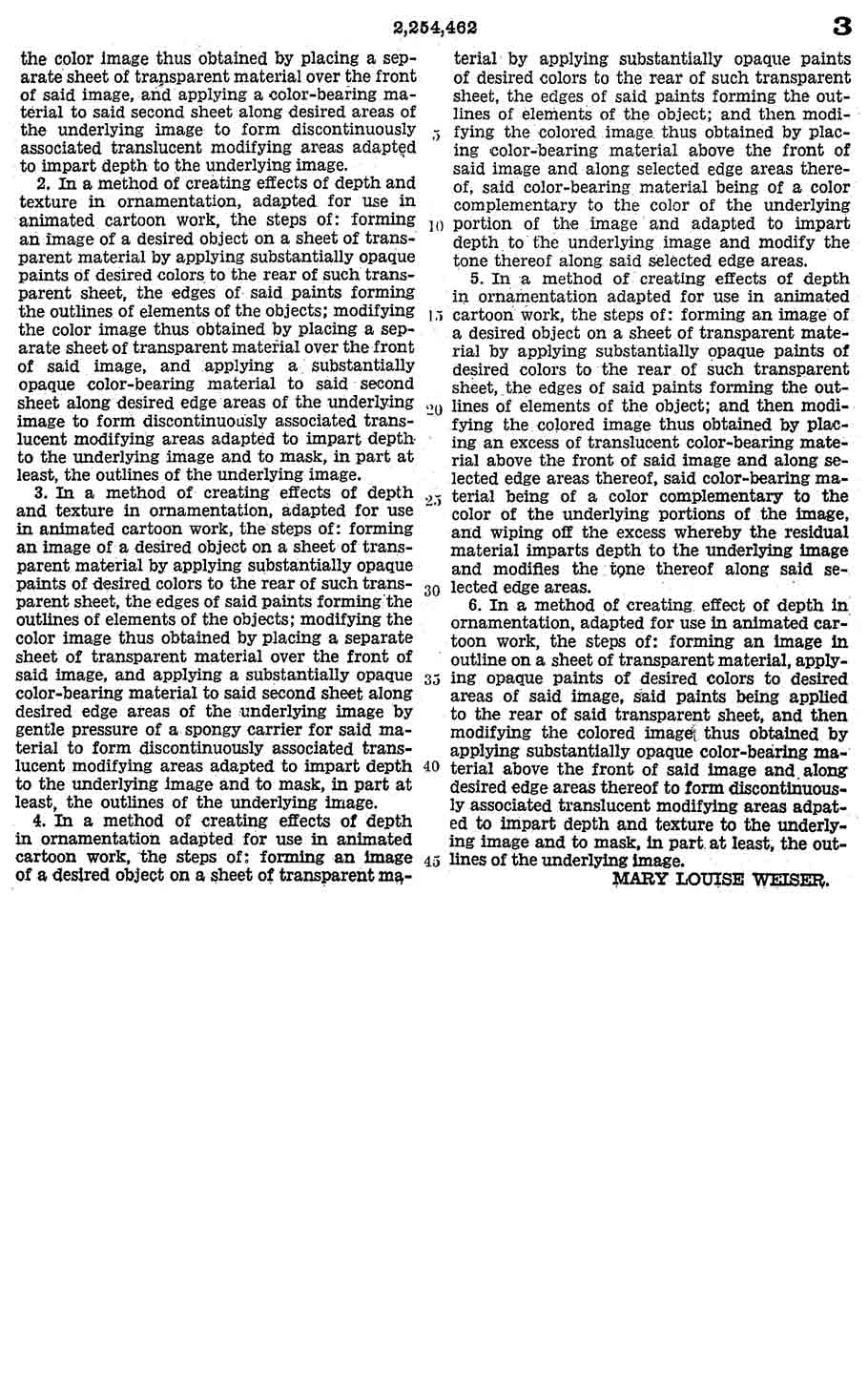
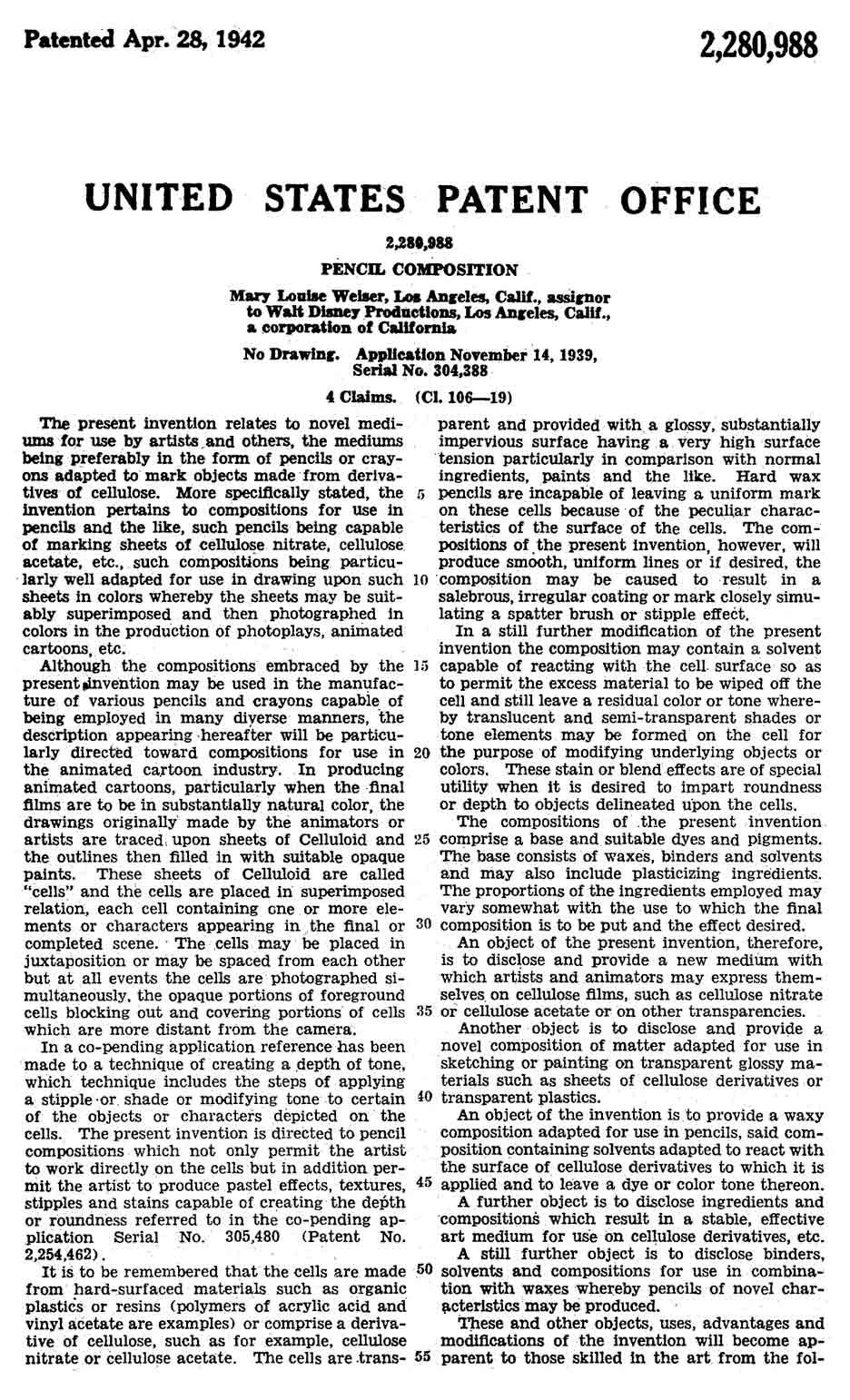
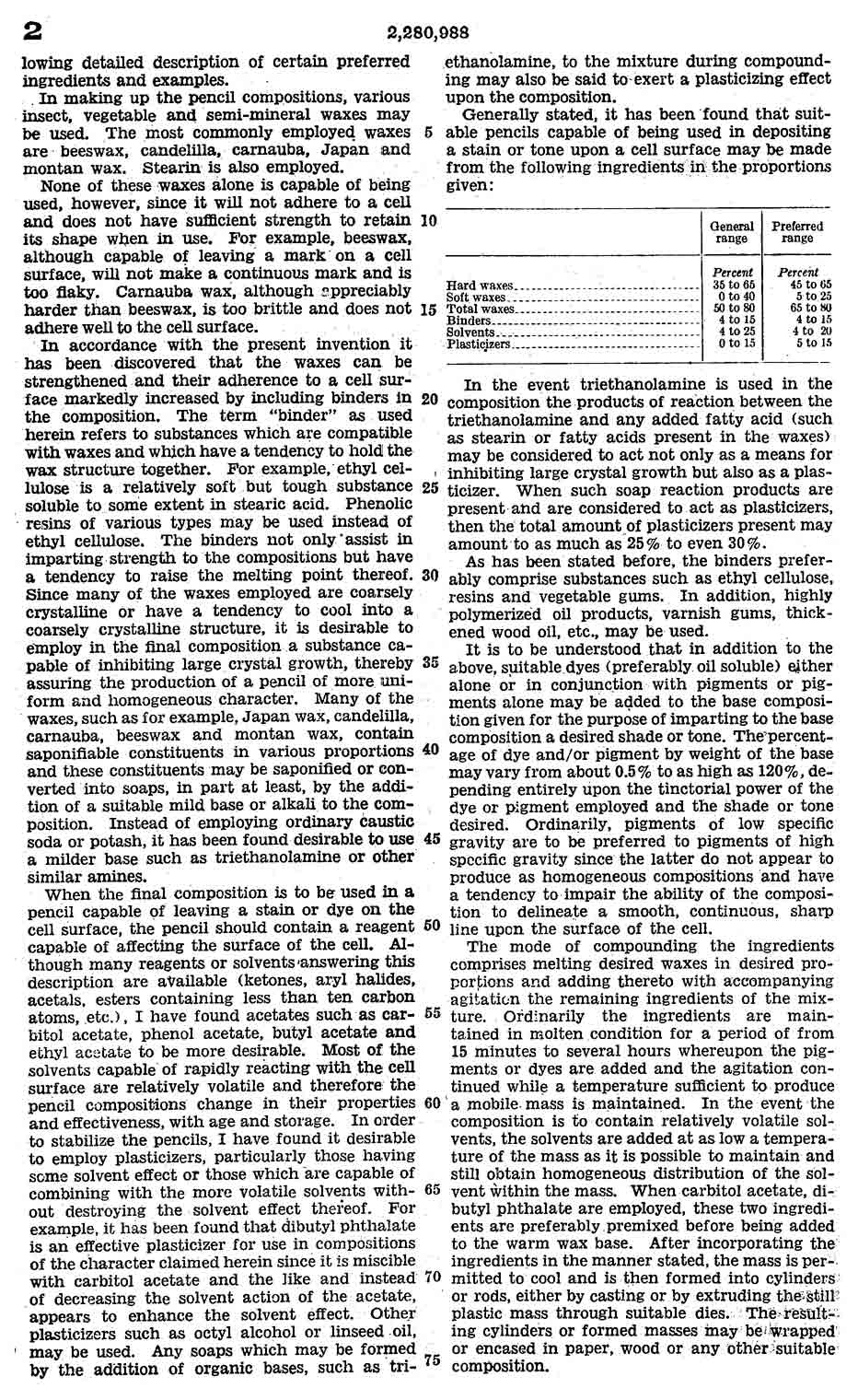
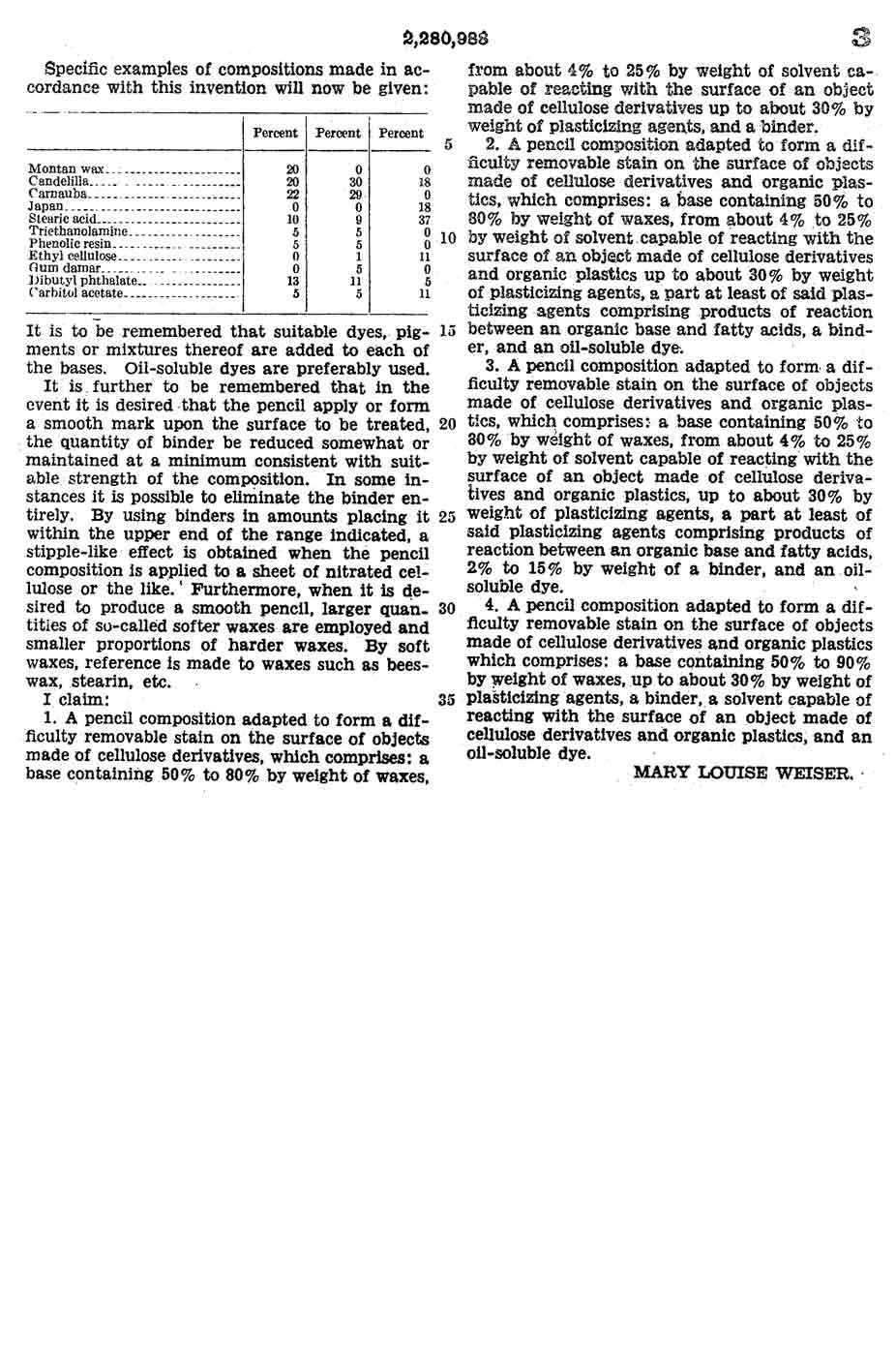
I recently found this image of Mary Louise Weiser, head of the Ink and Paint Department at the Walt Disney Studios in 1939, during the period when the techniques for painting Pinocchio and Fantasia were finalized. Ms. Weiser has two patents to her name, assigned to Walt Disney Productions: one for a formula for grease pencils (filed Nov. 14, 1939, granted Apr. 28, 1942, nr. US 2,280,988), and one for a method of adding roundness and texture to characters - in other words, "The Blend" (filed a week later, Nov. 21, 1939, granted Sept. 2, 1942, nr. US 2,254,462).

As you can see in the following, the actual patent, the "discontinuously associated translucent modifying areas adapted to impart depth to the underlying areas" - is basically just this: on the cell with the character, or on a new one on top of this, dab with a sponge, apply a lacquer or draw with grease pencil, to get an effect of roundness. In other words, The Blend just means "paint the effect on top of the cell!" No witchcraft! This is basically what they did on Snow White over two years earlier, when they applied rouge to Snow White's cheeks. The patent does go into different ways to accomplish this effect, in itself an interesting insight...
12345

Ms. Weiser's patent for grease pencils directly refers to the above patent, and she sees these as an integral part of reaching the goal of getting a good blend-effect on the cellulose-based cells. In the wording of the patent, it would "not only permit the artist to work directly on the cells but in addition permit the artist to produce pastel effects, textures, stipples and stains capable of creating the depth and roundness referred to in the co-pending application" above!
123
The use of grease pencils in animation has been very well established during the 70's and 80's. I remember the quest for good pencils "as used by Richard Williams in Soho Square" during the making of Børge Ring's Anna & Bella, which we cleaned up directly with cell pencils.
(I would like to see that application by Bill Garity that was co-pending with this, on a photographic process to create the characters' lines!)

The Blend has previously been referred to as a "technique that was used:" we just knew they used "The Blend," without getting into the details. It seems clear to me now that there really were no details! In some scenes of Jiminy Cricket, we see a very smooth blend, possibly airbrushed on, or lightly applied with a small sponge - in others we see heavy clear light lines either made with a paint brush or with grease pencil. Just a lot of work, all done by hand, by "dedicated professionals."

Nowadays, of course, CG animation has this roundness built in - at times even too much of it. Hand-drawn animation gets its help from paint programs that may have the possibility of adding a shading effect like the Blend. Still, I hope that the above will give some insight into the considerations and elbow grease that went into the creation of the masterpiece that is Pinocchio. Give a kind thought to Ms. Weiser next time you watch the fruit of her labor!

[Addition: on page 189 of The Illusion of Life, you can find another image of Mary Weiser!]

Labels: ,

Sunday, March 01, 2009

The Iron Pencil   - Re-recording and Mixing at Walt Disney Productions

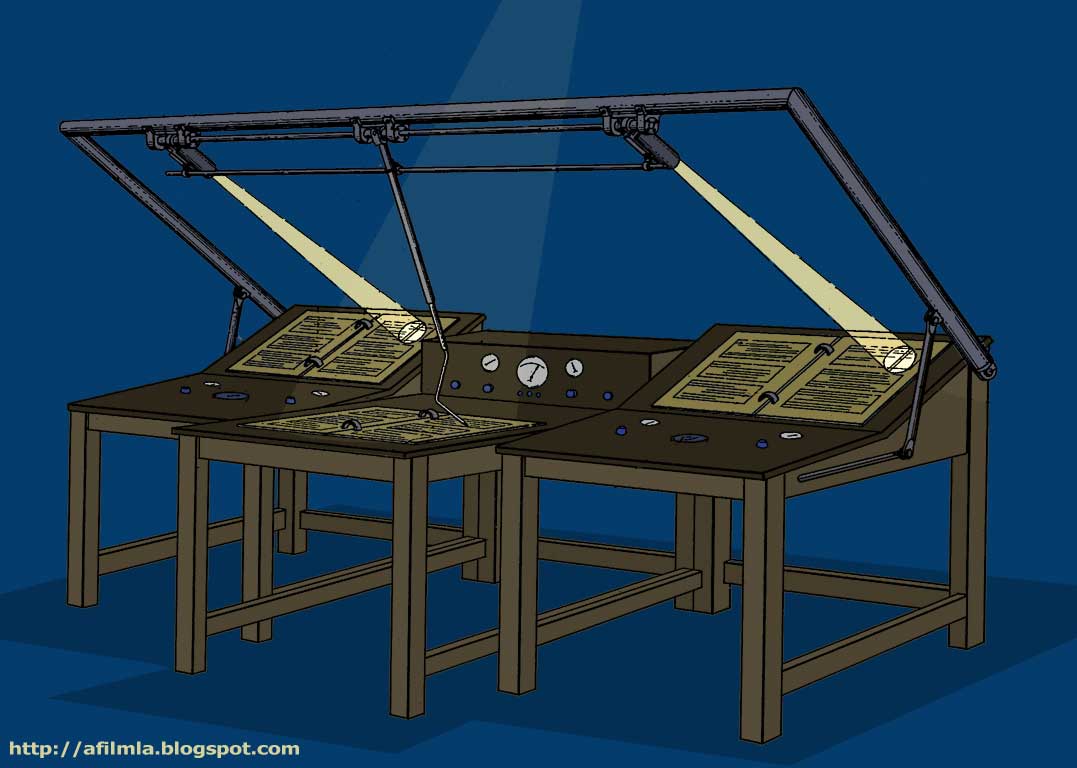
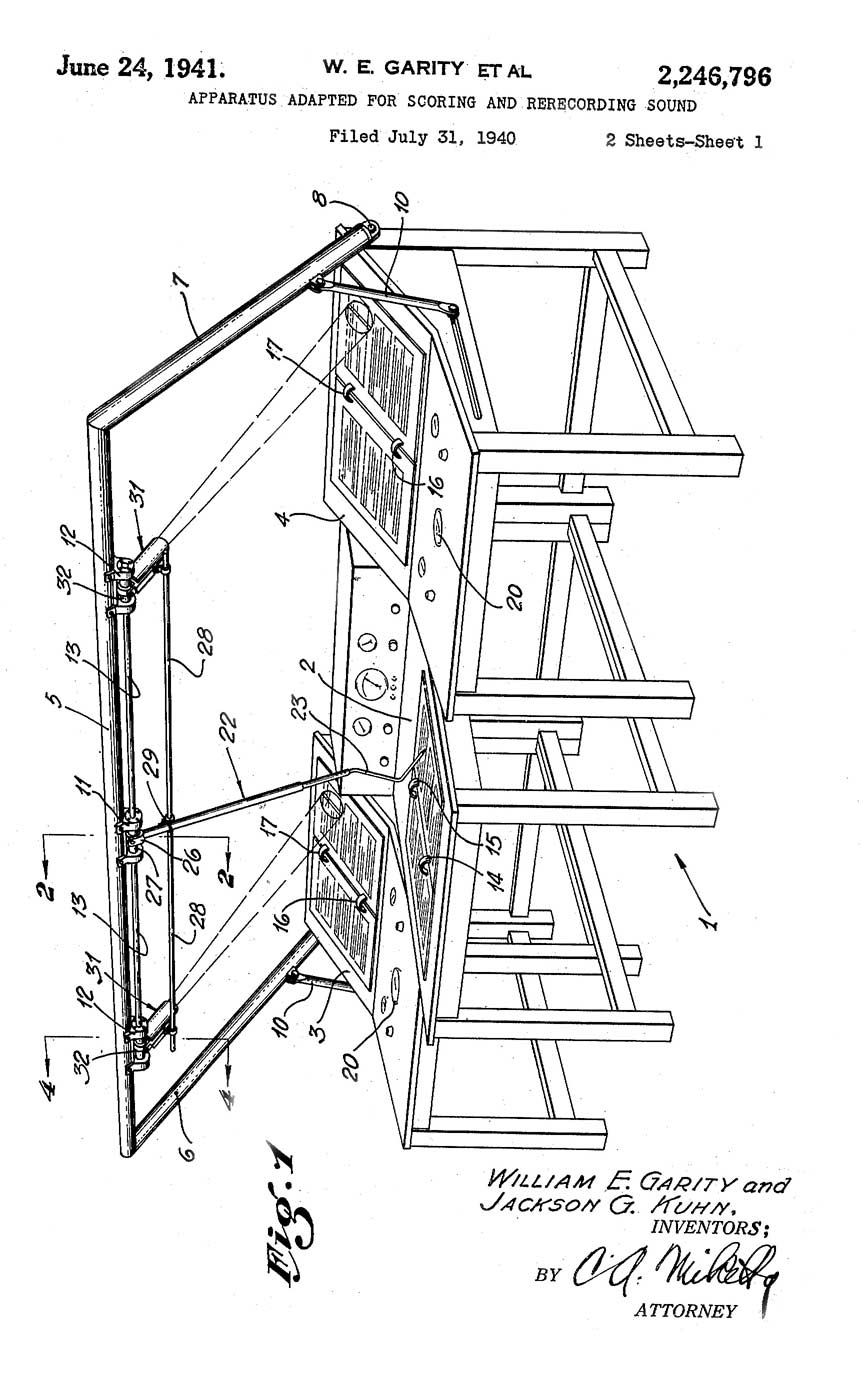
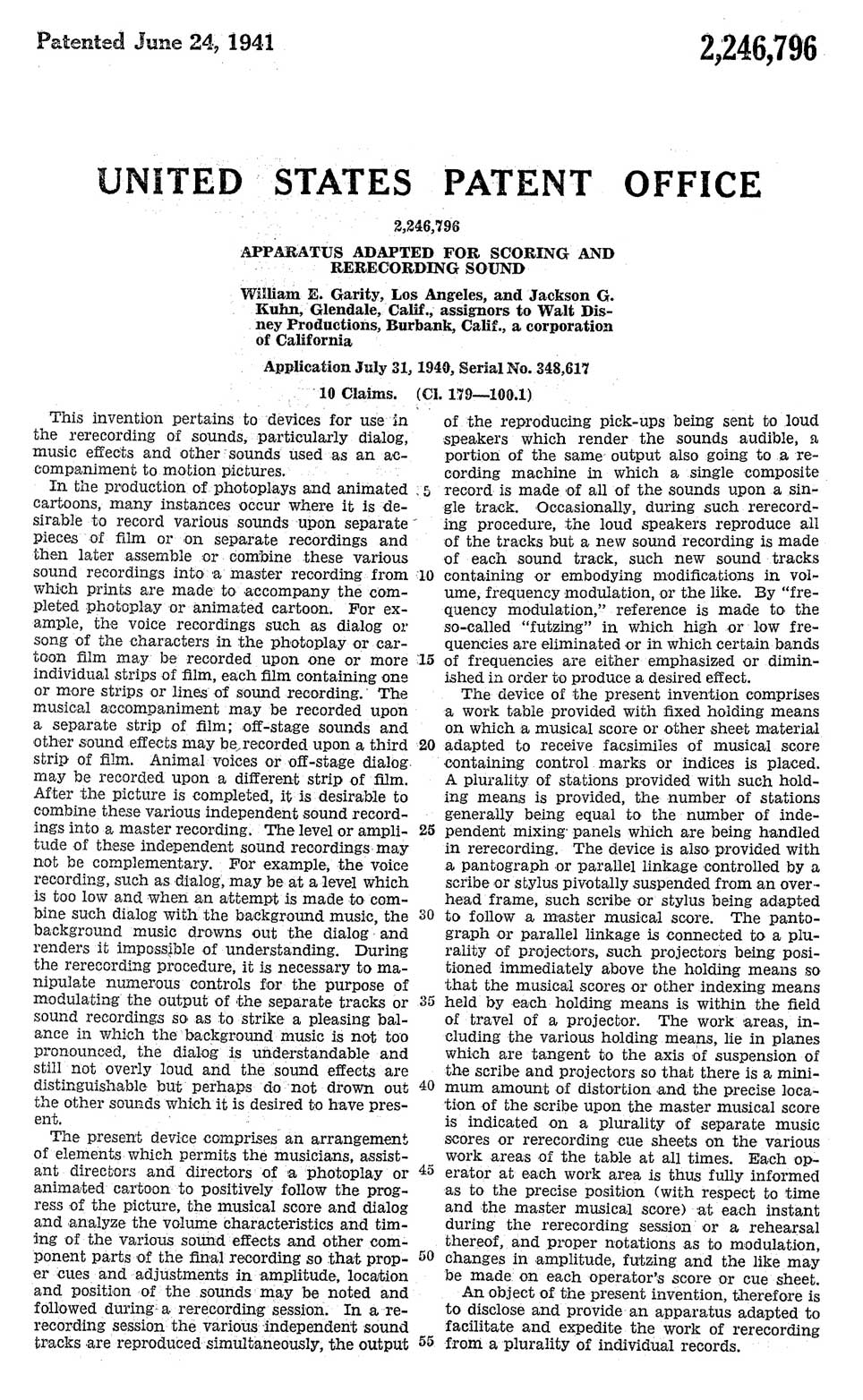
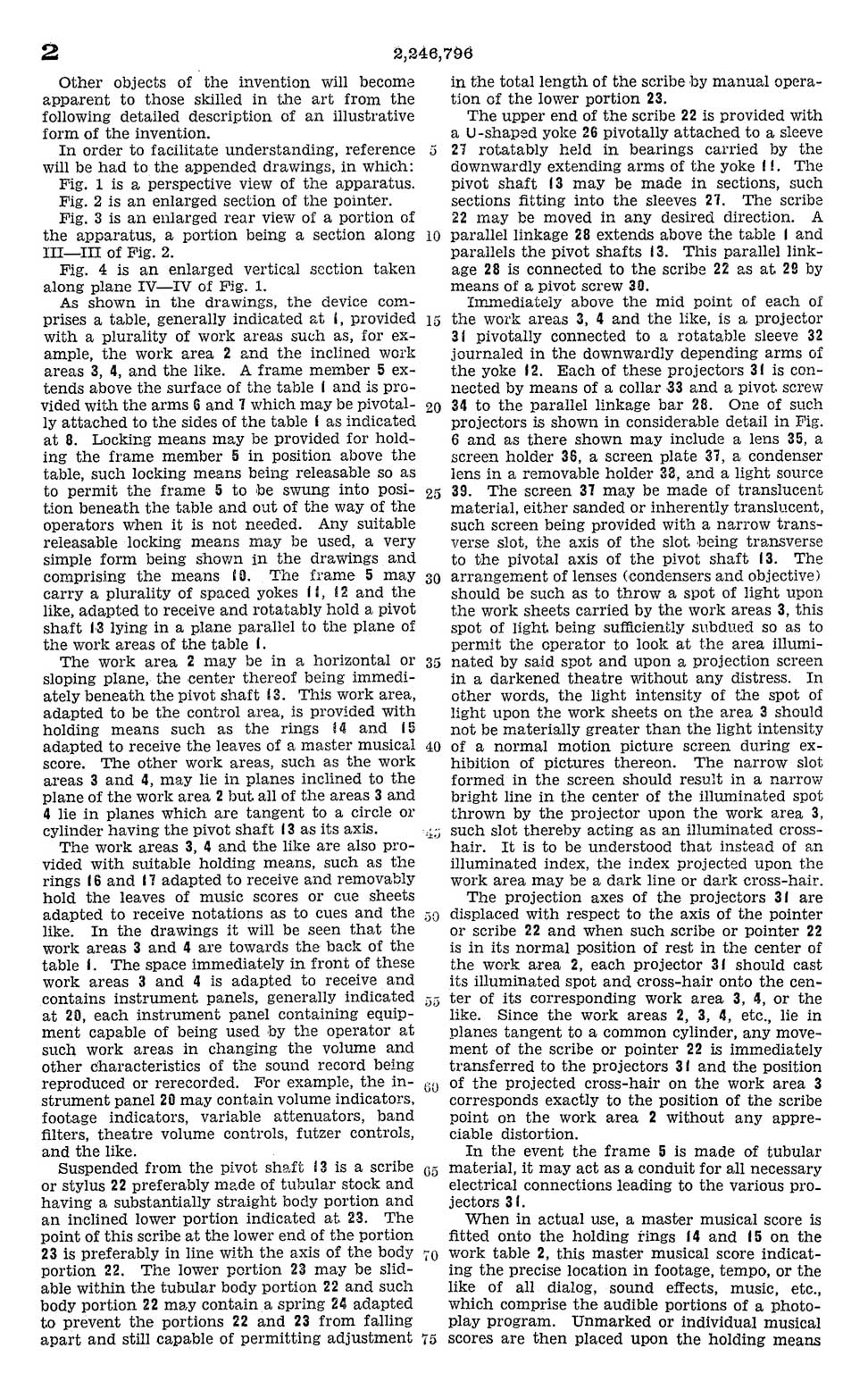
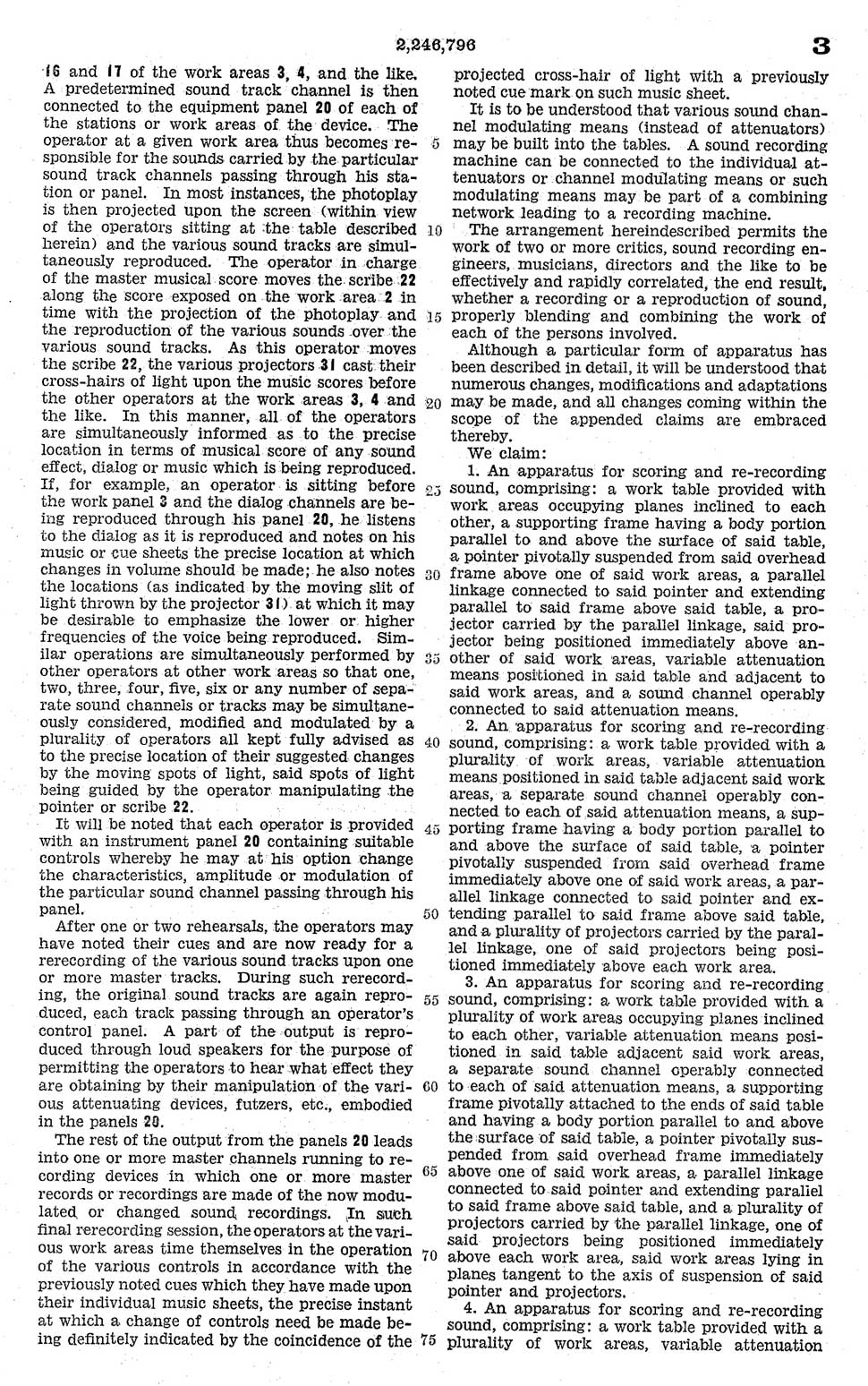
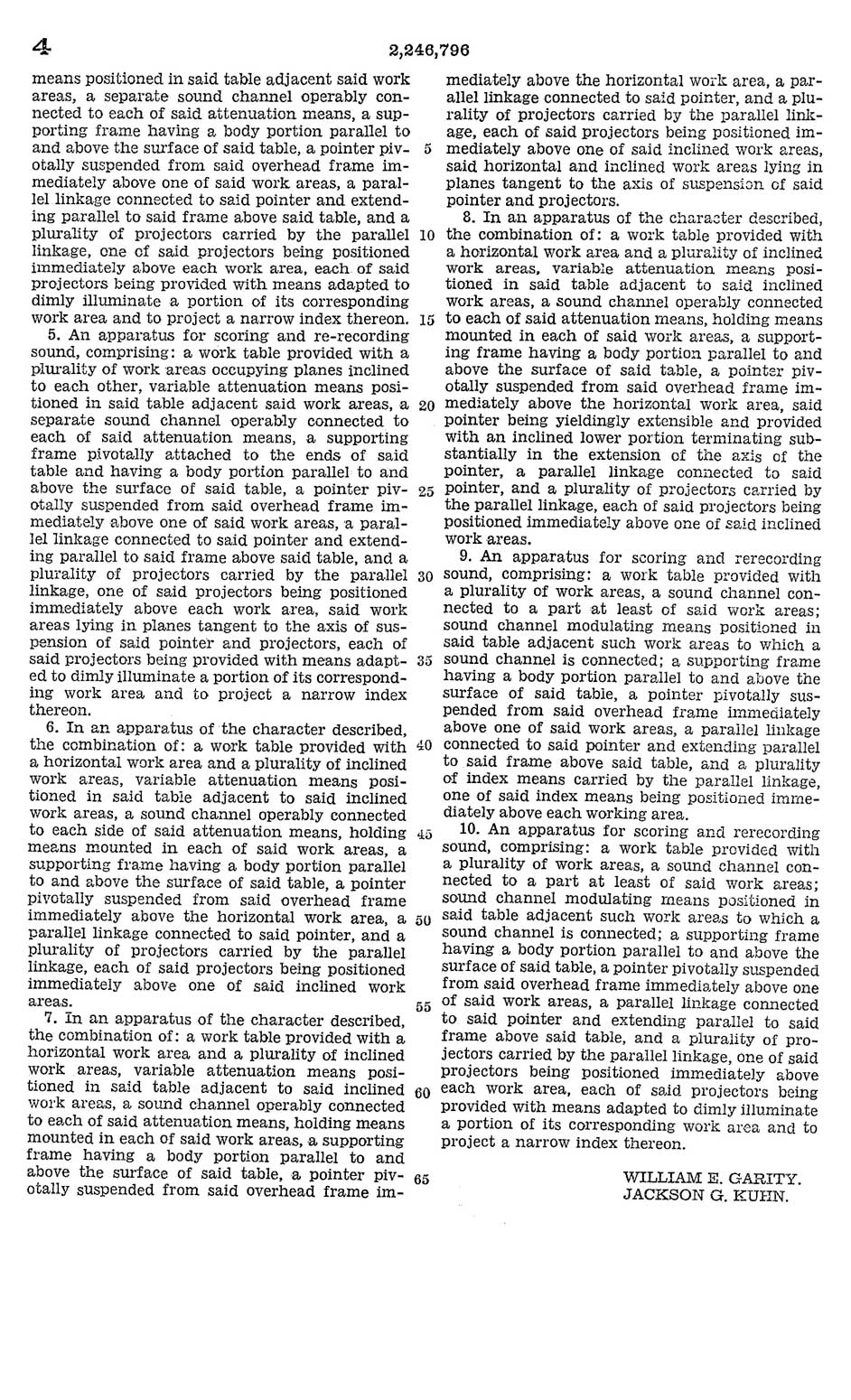
Here is an antiquated yet interesting invention: to be able to get consistency in rerecording and mixing of soundtracks at the Disney studios, a console that is generally referred to as The Iron Pencil was designed by Bill Garity and Jackson G. Kuhn (whom I believe to be alumnus of the Department of Physics, Cornell University, Ithaca, New York around 1930).

The patent was applied for on July 31st, 1940, the same day as the filing of the two Fantasound patents, which implies to me that it was invented originally for mixing Fantasia, which was released in November that year. The patent was granted June 24th, 1941, in the middle of the infamous strike.

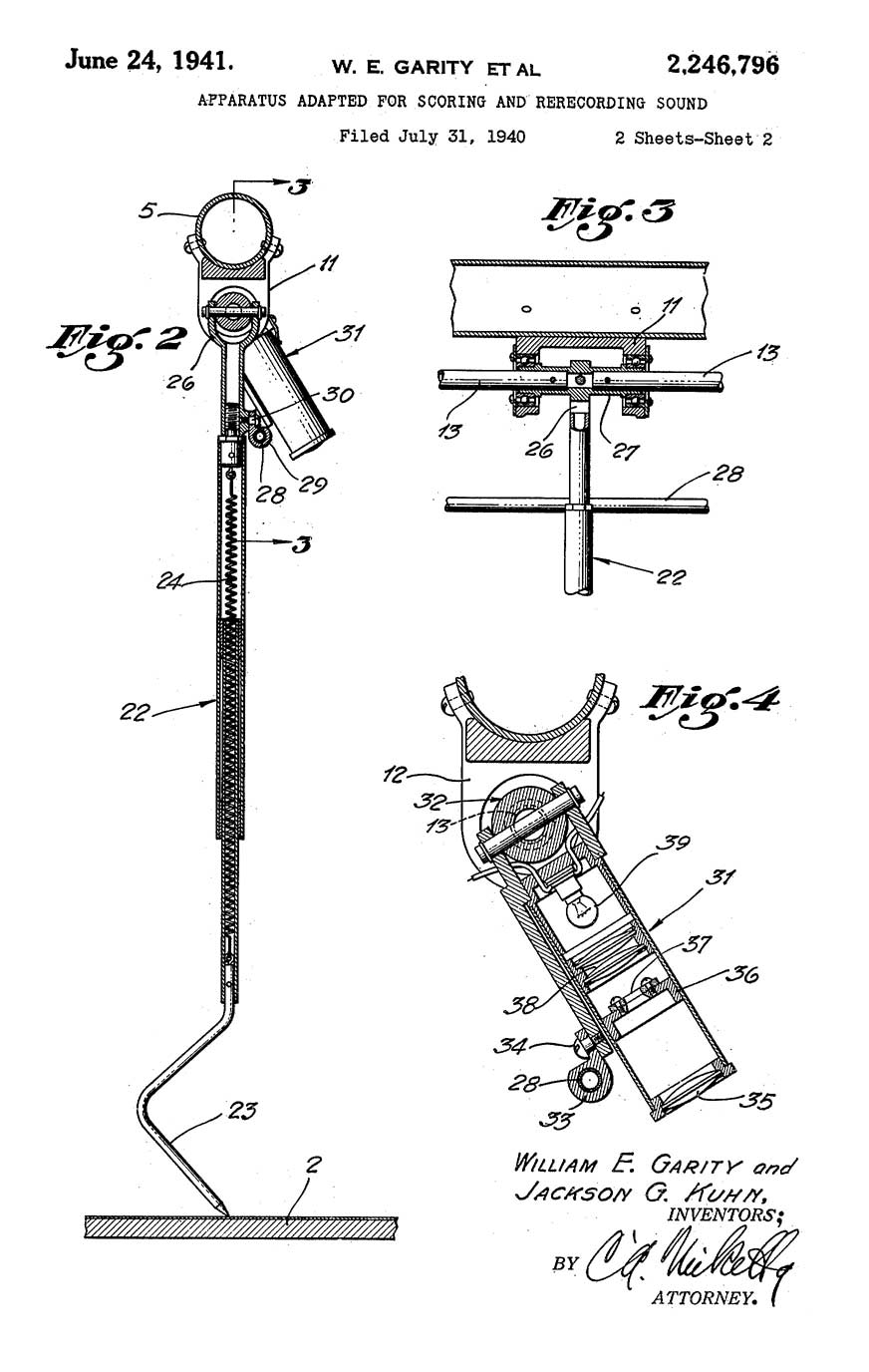
In its simplest form the console would look like the patent application image: in the center would be the master score, and the musician - or Jim MacDonald - would follow it using a metal pin connected to a pantograph system which in turn moved a lamp throwing a light circle, not much larger than an inch in diameter, on copies of the score marked for that specific track. This would be followed by an operator who, based on the lighted information, would control a fader for just that track, which may have been music, effects or vocals...
The Iron Pencil<< Click On It!
This patent application image, which I painted for clarity, shows two slave consoles, on either side of the master score. There seem to have been connected more consoles this way, maybe six or eight!

It is certainly an archaic system, compared to modern computer-operated mixing consoles, but it was no doubt a vast improvement over having to follow a bouncing ball. Director Jack Kinney believed it still to have been in use around 1973!

Here is the entire patent document:
12 3456
Any editors out there who used it?

Labels: , ,

Monday, August 11, 2008

William E. Garity, Inventor

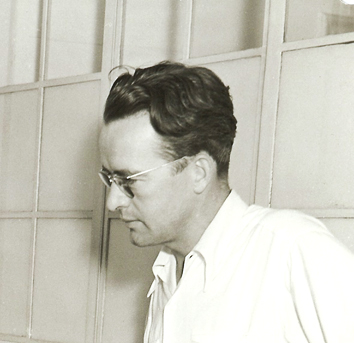
I'd like to follow, and conclude my Multiplane week with a little celebration of the inventor, Bill Garity.Bill Garity 1940
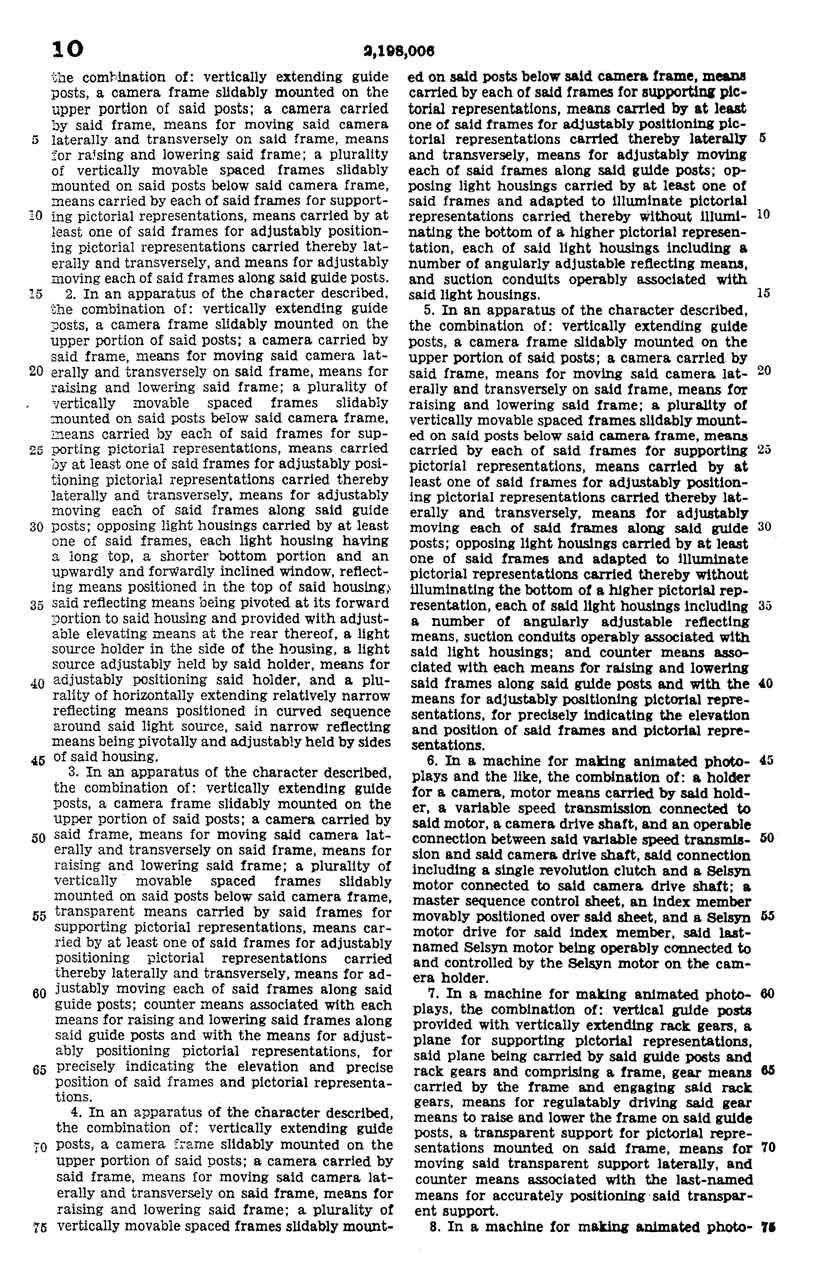
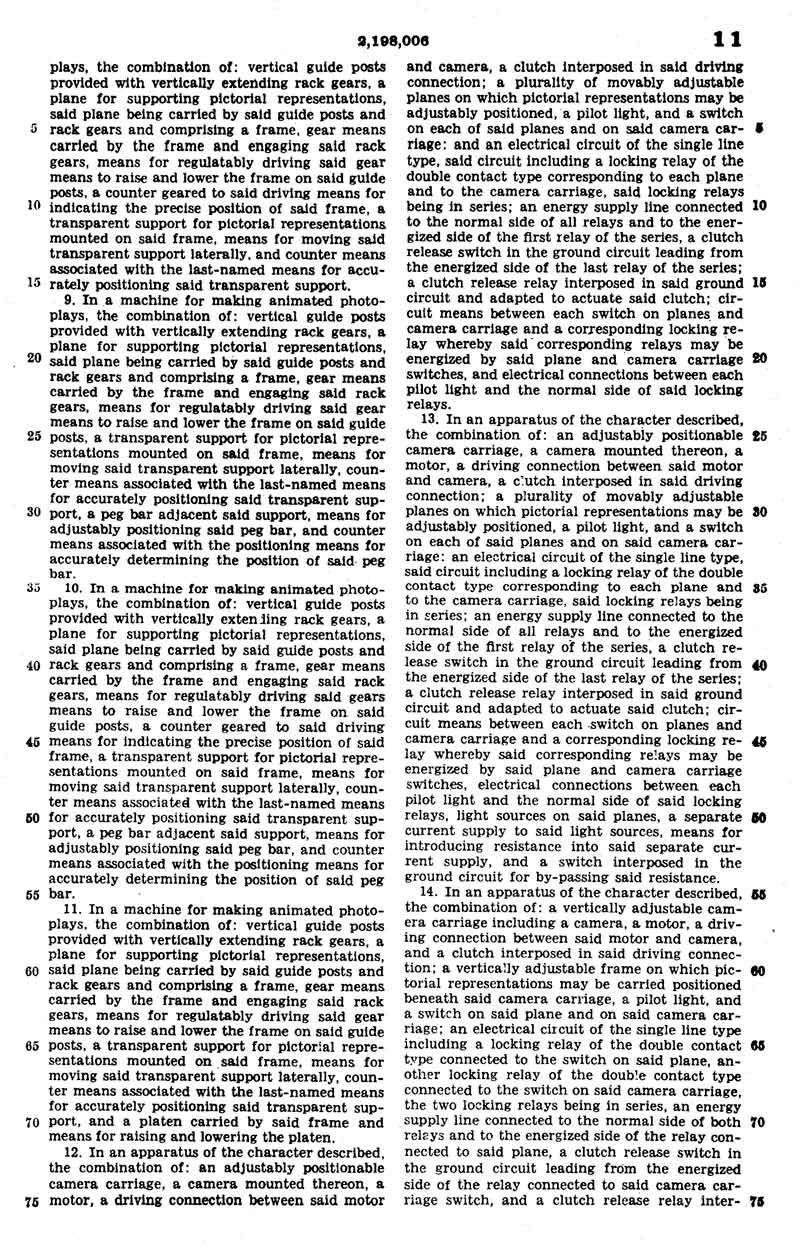
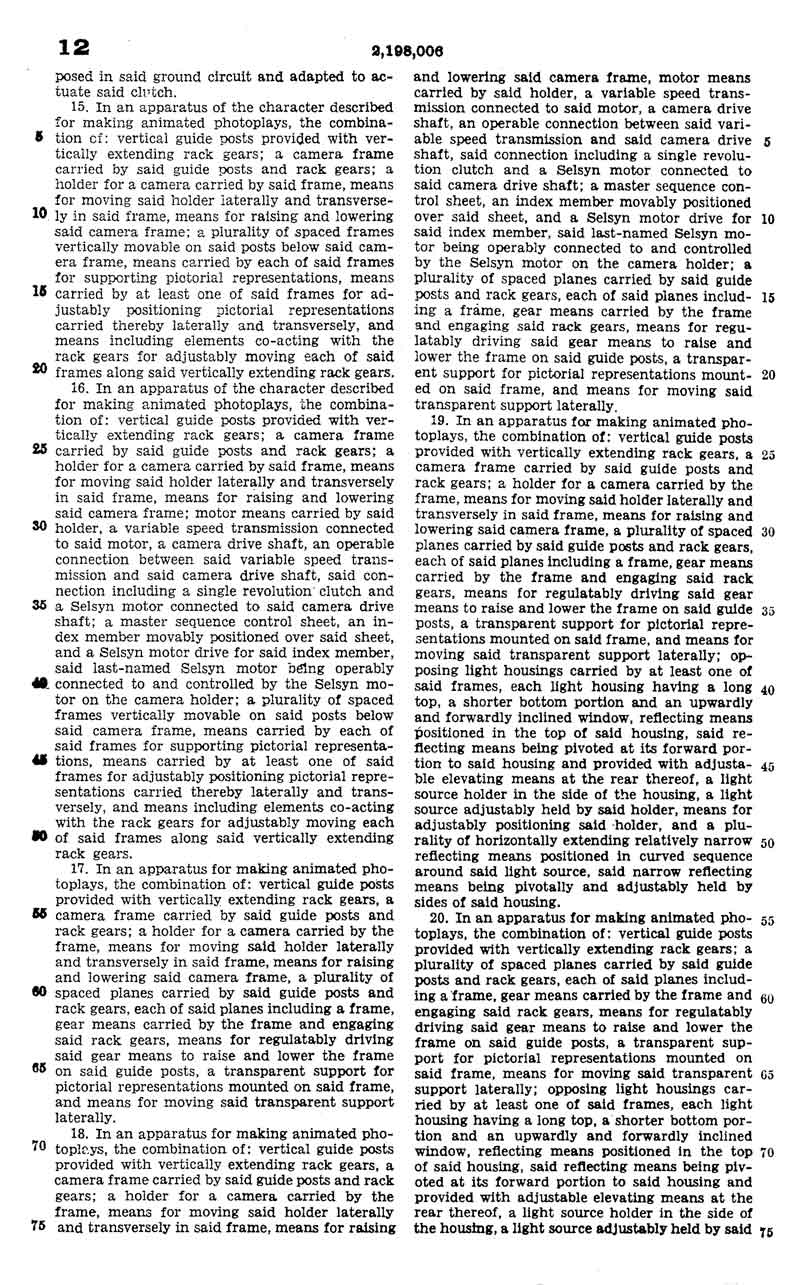
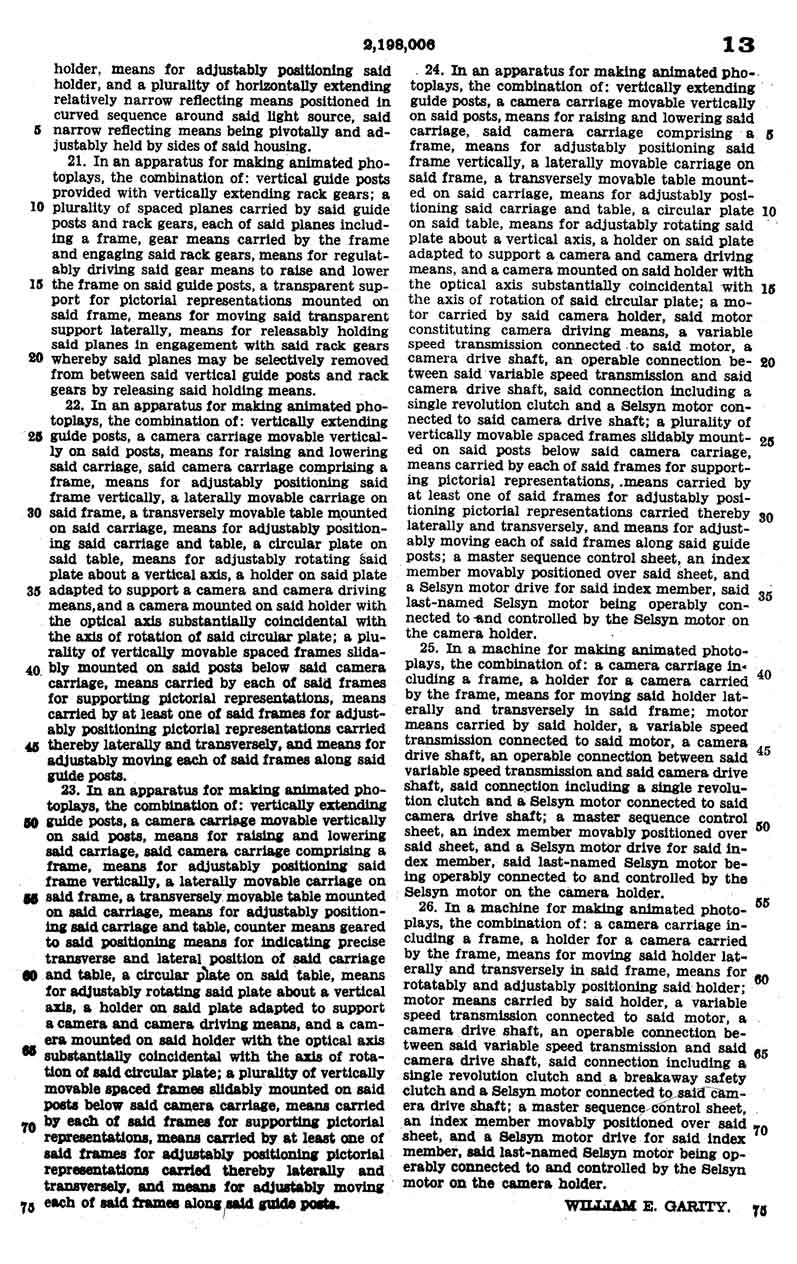
We met Garity several times before, as inventor of the click track and the method for making 3-D (stereoscopic) animation, and now as the patent holder of the Multiplane Camera. He is also one of the inventors of Disney's pseudo-stereophonic sound system Fantasound, of the film mixing console that used the Iron Pencil to follow the score, and of a sound fader that suppresses one channel while boosting another. He even invented a rig for shooting miniature airplanes for the war-time films. And lets not forget that before Disney, he had several vacuum tube patents to his name.

As important as he was to the technical development at the studio, and with him being the first person officially named manager of the studio, it seems surprising that not much has been written about him. He was justly made a Disney Legend posthumously in 1999, and it is on the Legends site we can read most about him.
Since details can drown in the plethora of Legends mentioned there,
I shamelessly lifted the following text from the Legends site:

Bill Garity from the Disney Legends page « Bill Garity gave Disney animation a technical edge. Among his contributions, the film pioneer helped put sound to the 1928 animated short "Steamboat Willie," the first cartoon to feature synchronized sound, and helped develop other inventions. Walt Disney soon came to rely on Bill, naming him the Studio's first manager.

"Bill Garity is an unsung hero of Disney history," said Dave Smith, director of the Walt Disney Studio Archives. "With his pioneering efforts in sound and camera techniques, he helped set Disney Studios apart from others, while his planning and supervisory expertise resulted in the building of a highly efficient Studio in Burbank."

Born in Brooklyn on April 2, 1899, Bill attended Pratt Institute of Art in New York. During World War I, he served two years with the Radio Research and Development section of the U.S. Signal Corps. After the War, he met radio pioneer Lee DeForest and for the next seven years helped develop early sound for film.

In 1927, Bill installed an audio sound system in New York's Capitol Theatre to accommodate the first newsreel with sound, which featured footage of the Washington reception of aviator Charles Lindbergh after his successful Atlantic crossing.

A year later, he met Walt while developing the Cinephone motion picture recording system. Their meeting was fate. Walt was determined to lift animation to a unique storytelling art form and Bill had the technical know-how to help him achieve his lofty goal.

With the success of "Steamboat Willie" and his new sound cartoons, Walt purchased Bill's recording system for his small Hollywood Studio and asked if he would install it and train a technician. Bill's anticipated 60-day trip to California lasted more than 13 years when he joined The Walt Disney Studios in 1929.

While there, Bill headed a department of 18 skilled engineers, who helped design, build and extend the capabilities of the animated cartoon. The team, under Bill's able guidance, also created the multiplane camera, which gave depth to animated films beginning with the 1937 short, "The Old Mill," followed by such animated classics as "Pinocchio," "Fantasia," and "Bambi." The invention, which made it possible to create camera movements, which simulated live-action films, earned an Academy Award® in the Scientific and Technical category.

In 1940, Bill's team invented "Fantasound," an innovative stereo system installed in theaters for Disney's classic, "Fantasia." The stereo system, which greatly enhanced the effect of the musical animation masterpiece, also earned a nod at the 1941 Academy Awards®.

A year later, Bill left the Studio to pursue other entertainment ventures, including serving as vice president and production manager of Walter Lantz Studios.

On September 16, 1971, Bill Garity died in Los Angeles. »

A very worthy Disney Legend! And a nice article, though they have forgotten to mention a few things in their write-up, like the stereoscopic process...

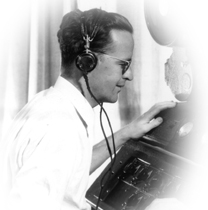
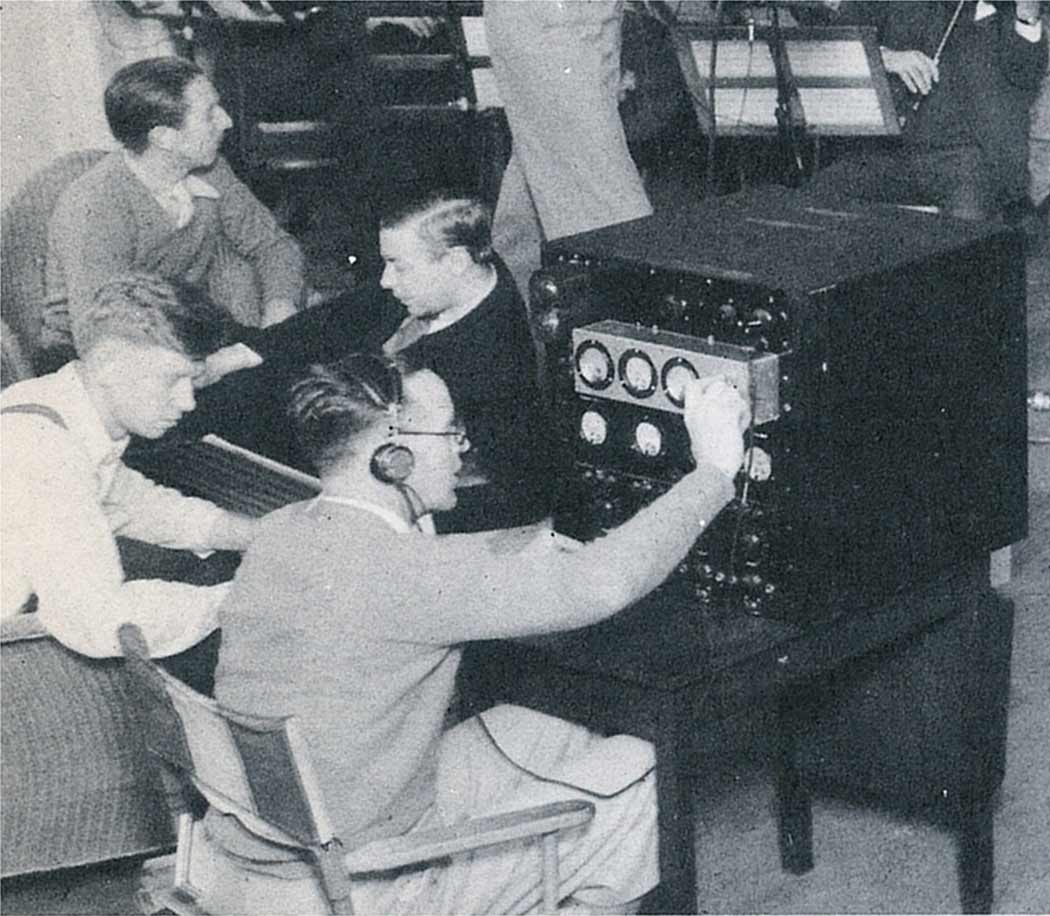
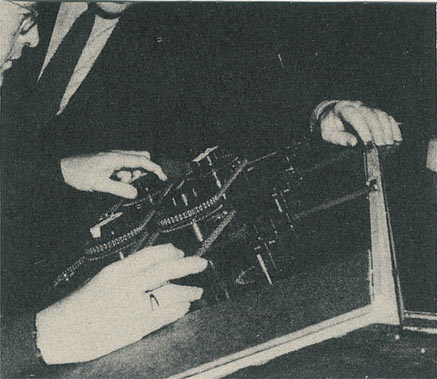
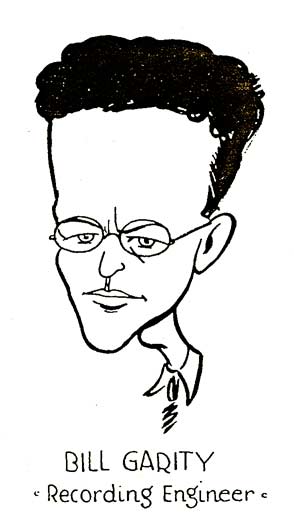
Bill Garity RecordingBill Garity nose his dialsBill Garity 1931< Click on it...
The left image, from Bob Thomas' The Art of Animation (1958) shows Garity recording at a music session with Frank Churchill conducting a studio orchestra. It is in Finch's Art of Walt Disney (1973) as well - we see more but smaller. With him in the picture Walt, of course, and below him Wilfred Jaxon Jackson. I believe the reclining gent in the dark suit to be gag man Earl Duvall.
I stumbled over the middle image... There must be lots more picture to this, but the person who cut the image on the reverse out of a Fantasia program also cut away a good part of our featured engineer...
The right image: when in the early 30's the staff of the studio congratulated Walt, probably on his two Academy Awards® in 1932, Jack King drew this caricature of "sound engineer" Bill Garity.

Let's not forget, on Didier's great blog, we saw the top of his head...

In one publication from 1940 on Fantasound, Garity credited Walt: "We've done things...most of them Walt's ideas, that looked impossible at first."

Labels: , ,

Thursday, August 07, 2008

In Glorious Multiplane - 4

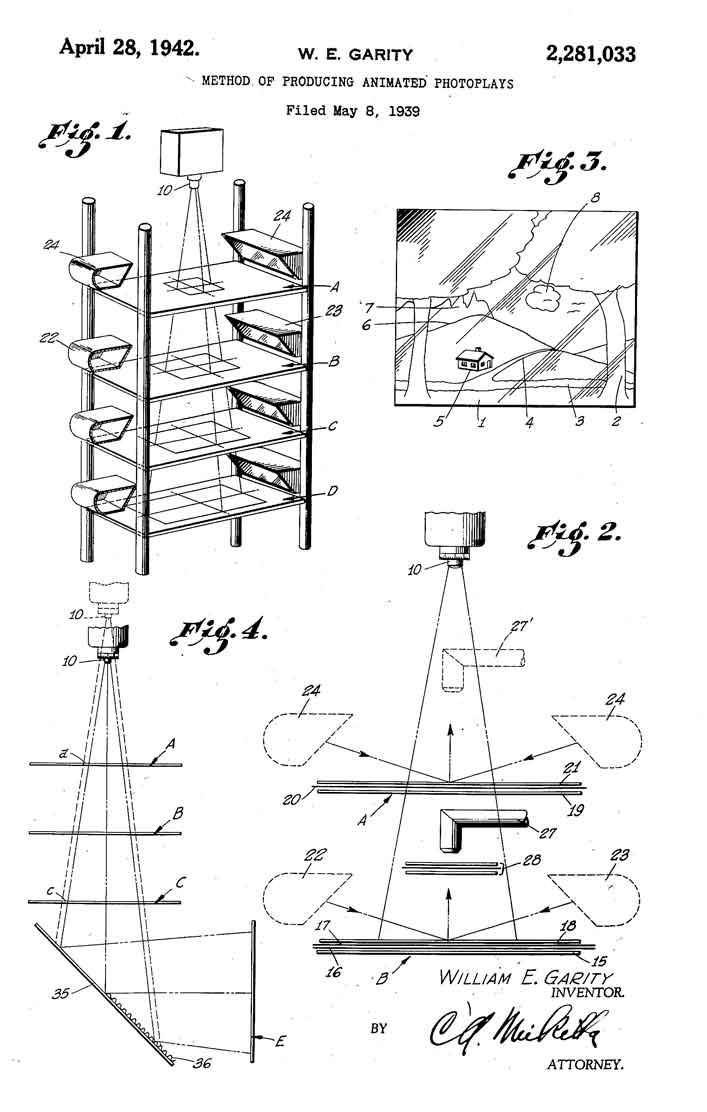
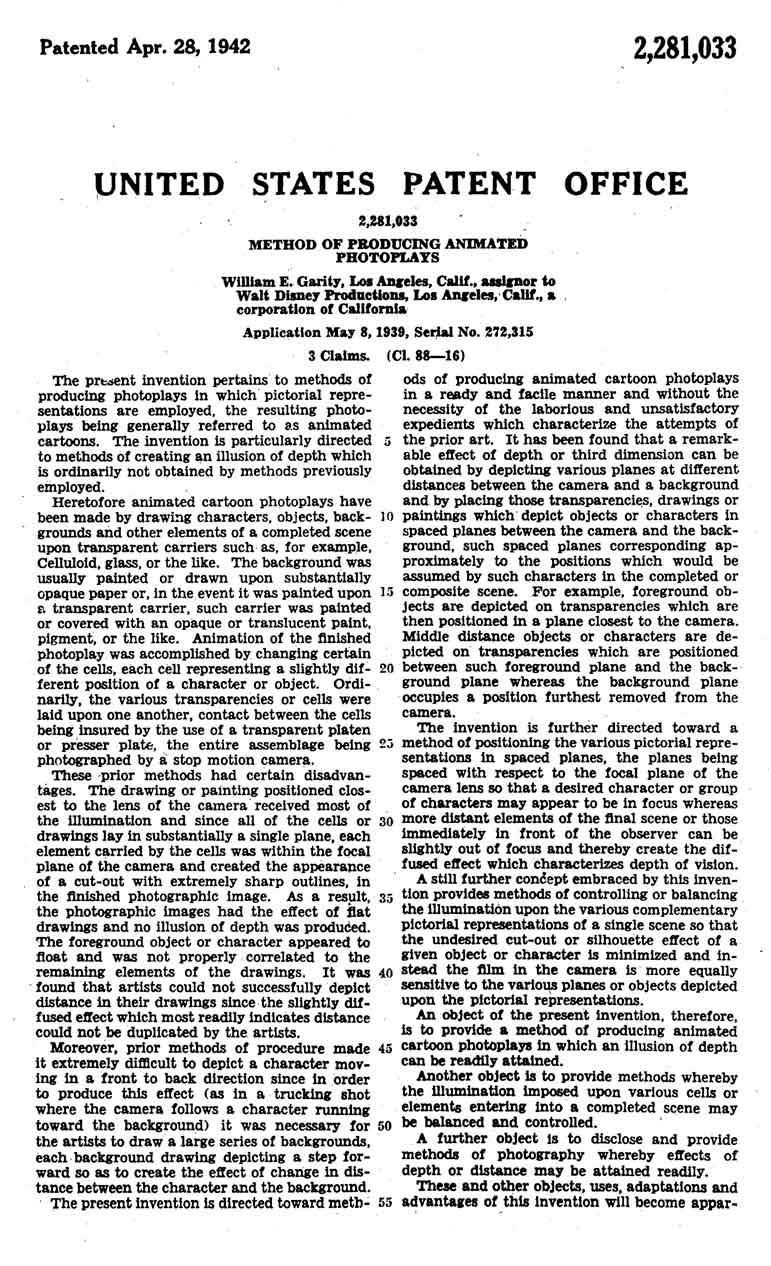
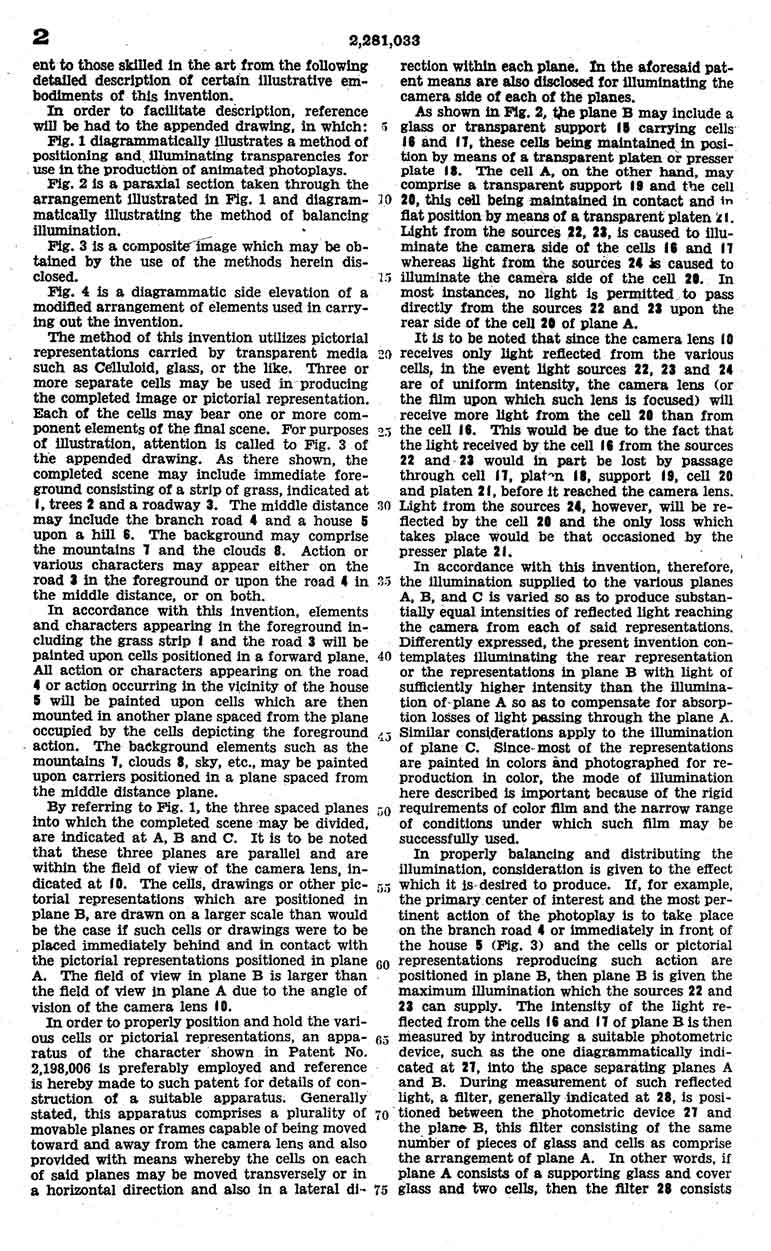
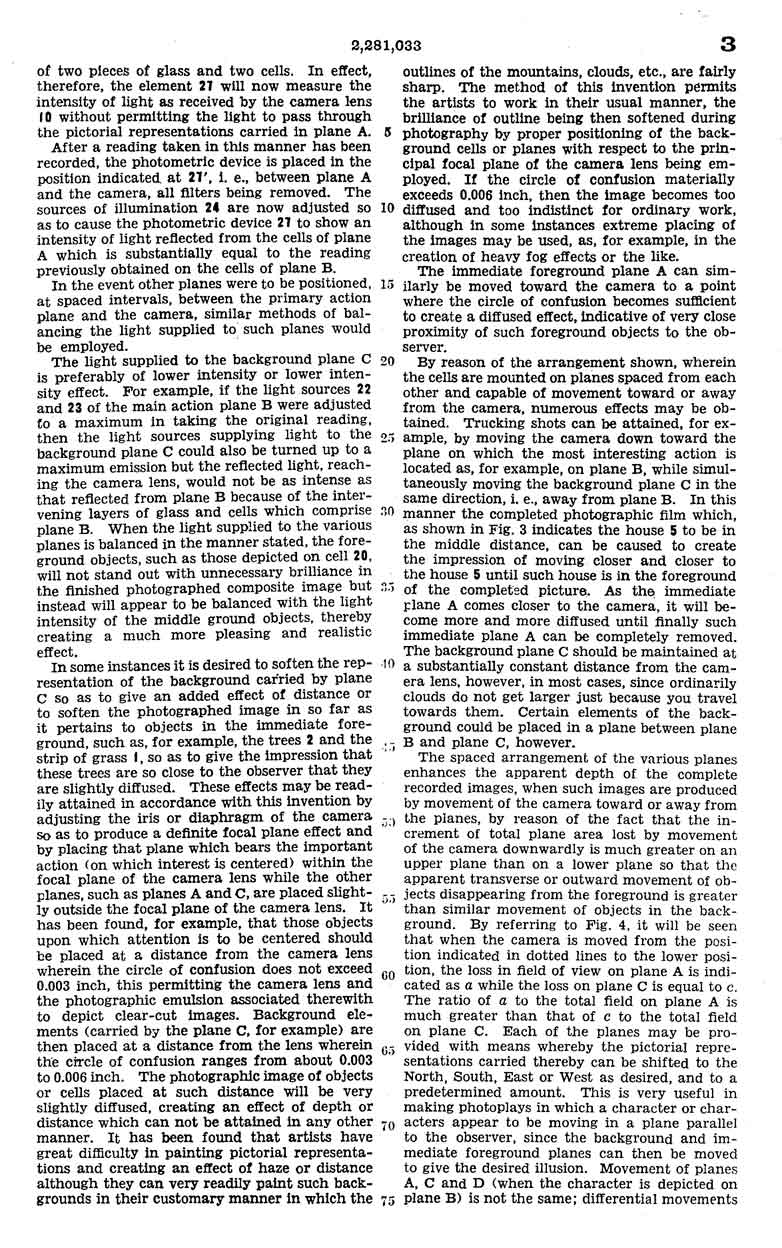
The question arises - what is new in this patent? It is a different application from the one we saw two postings ago!

Again, it was applied for by Bill Garity on behalf of Walt Disney Productions, filed May 8th, 1939, granted April 28th, 1942. It thus was filed between the patents of the last two postings.

This patent introduces the "photometric device" and its workings, and shows that the background could be mounted at an angle using a mirror. Otherwise, it is just a simplified version of the patent applied for half a year earlier!
Or am I missing something?
0102030405

Labels: , ,

Wednesday, August 06, 2008

In Glorious Multiplane - 3

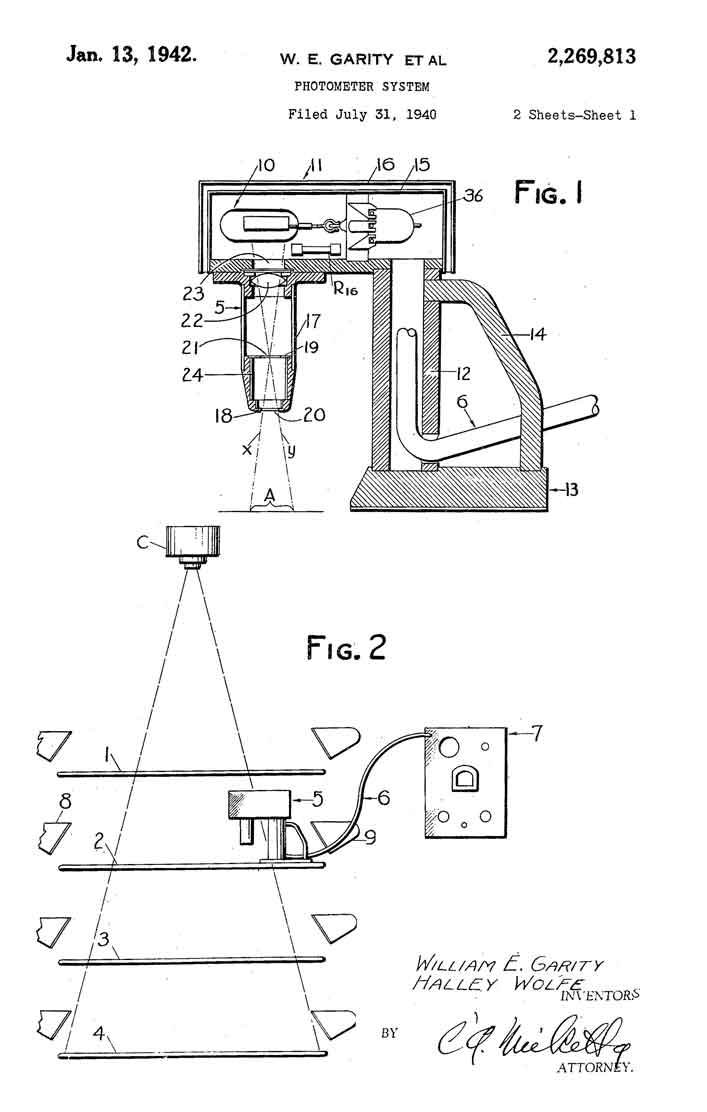
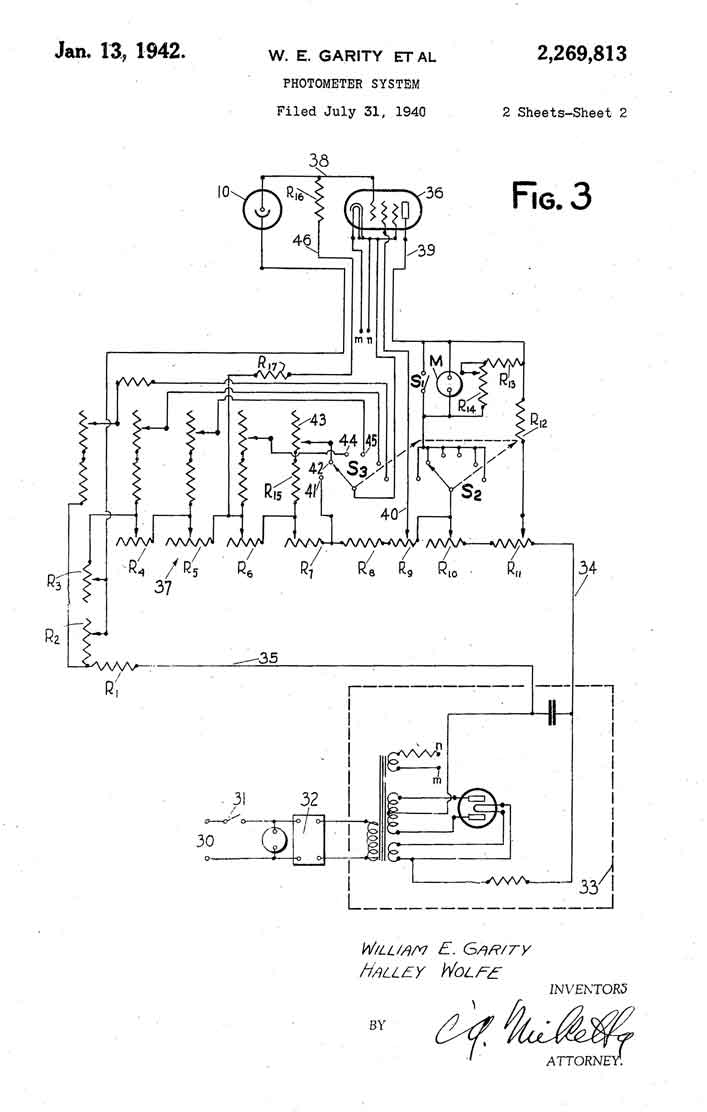
Of course a new camera needs a new - light meter, or photometer!

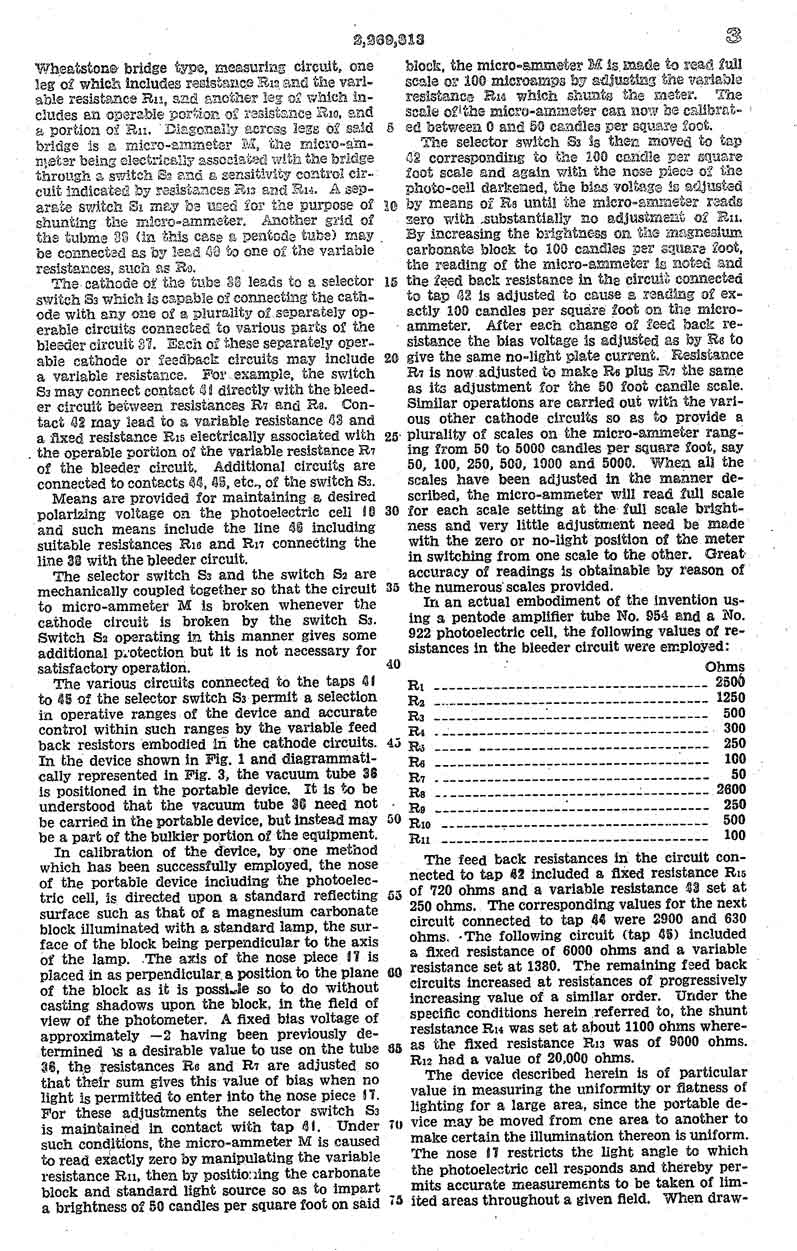
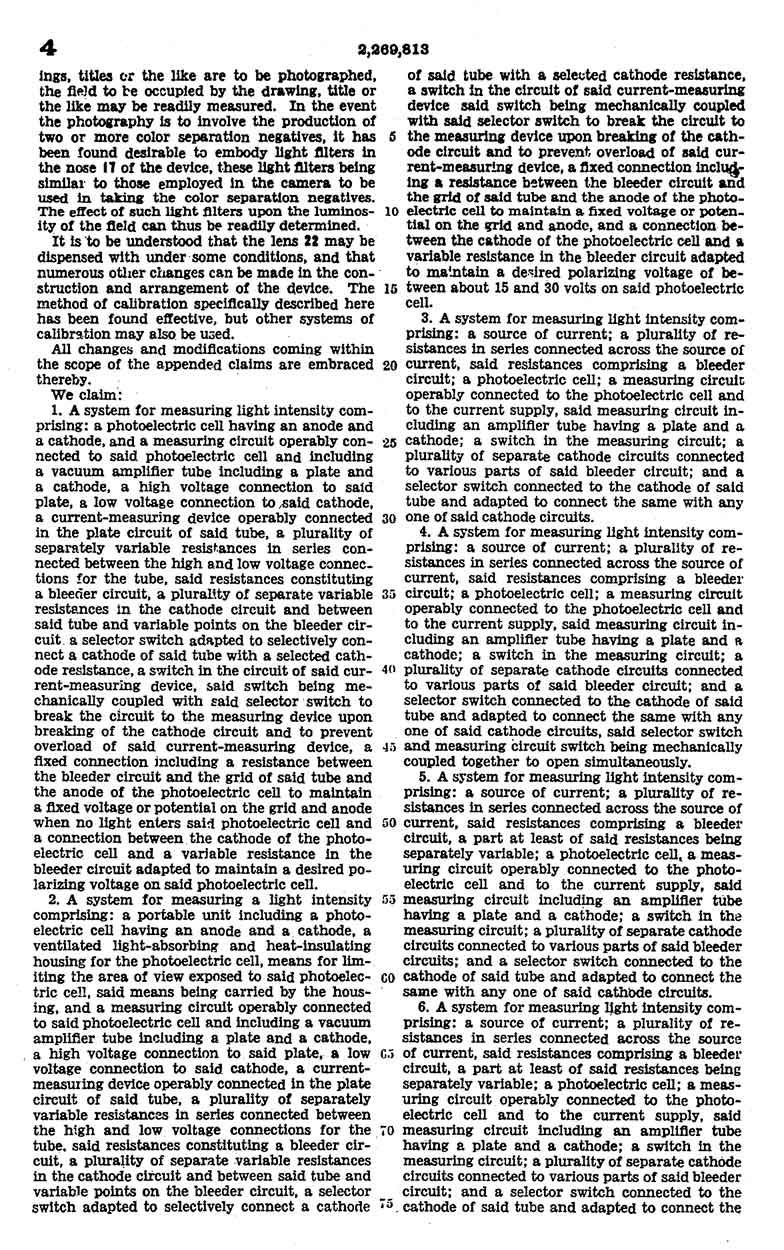
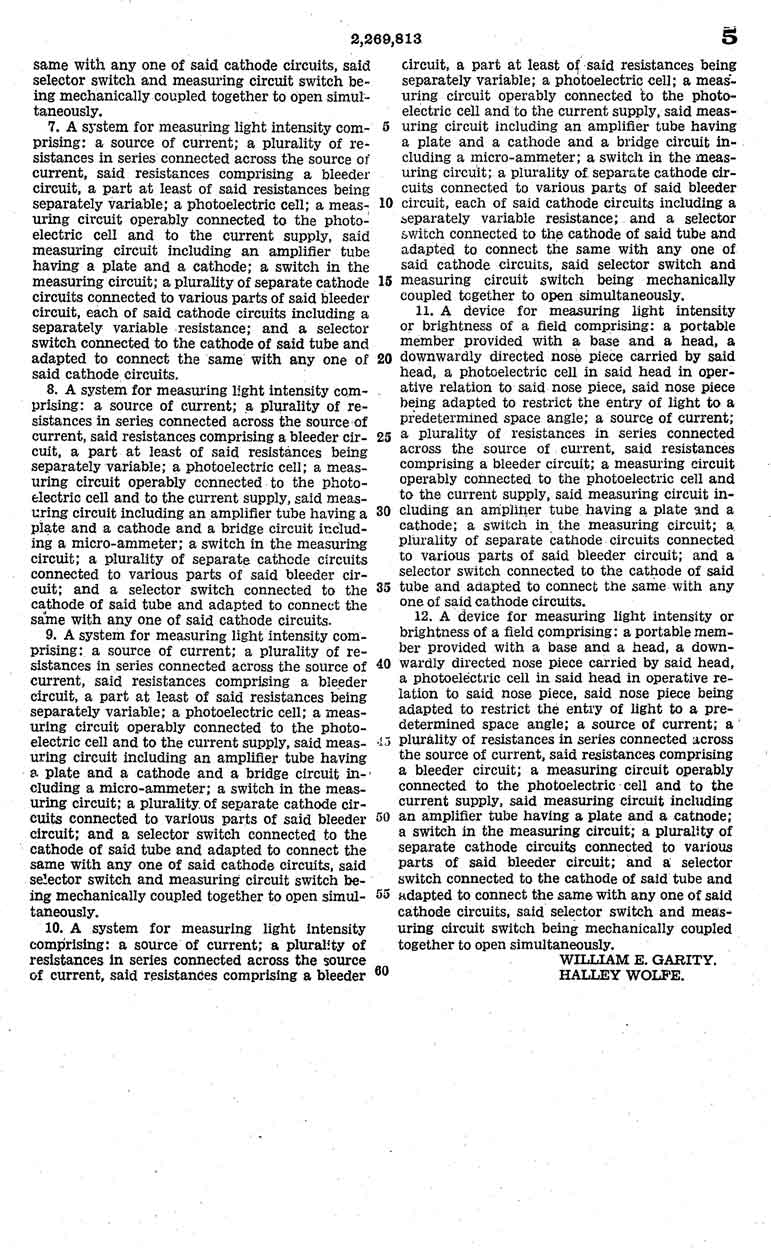
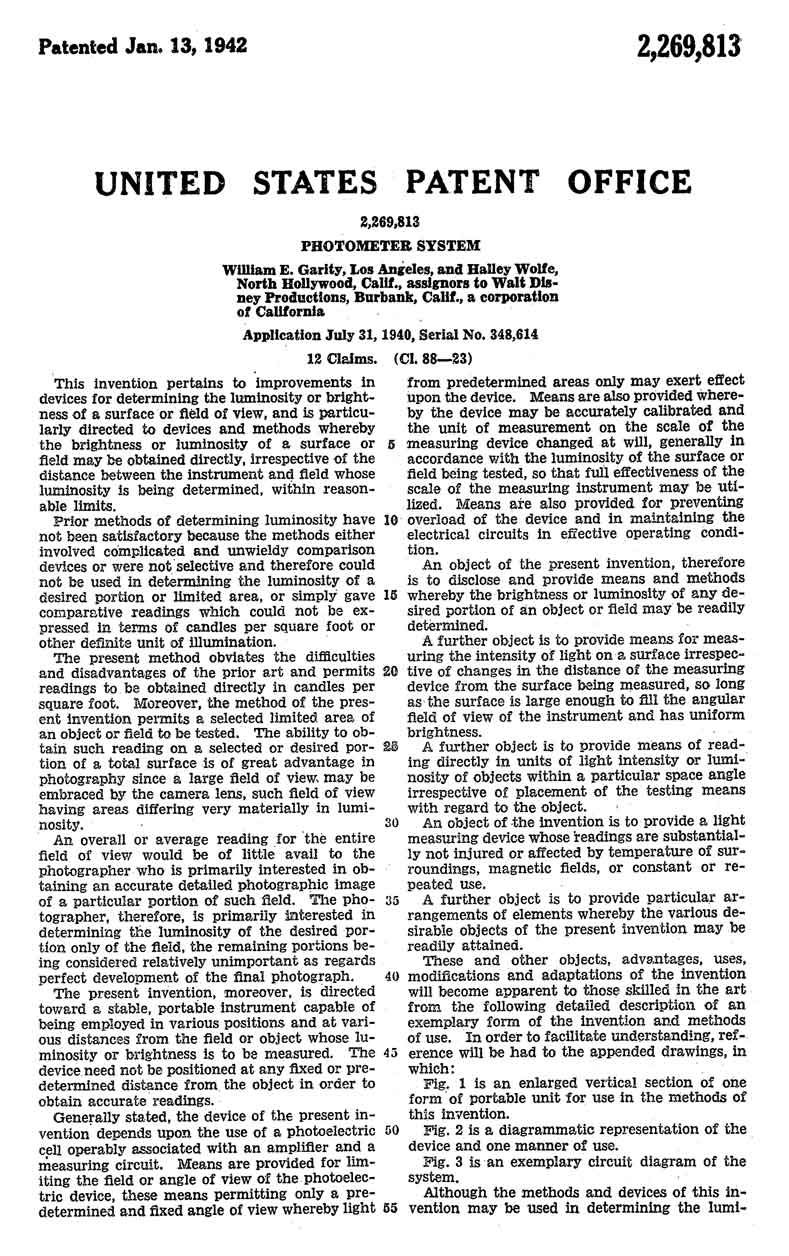
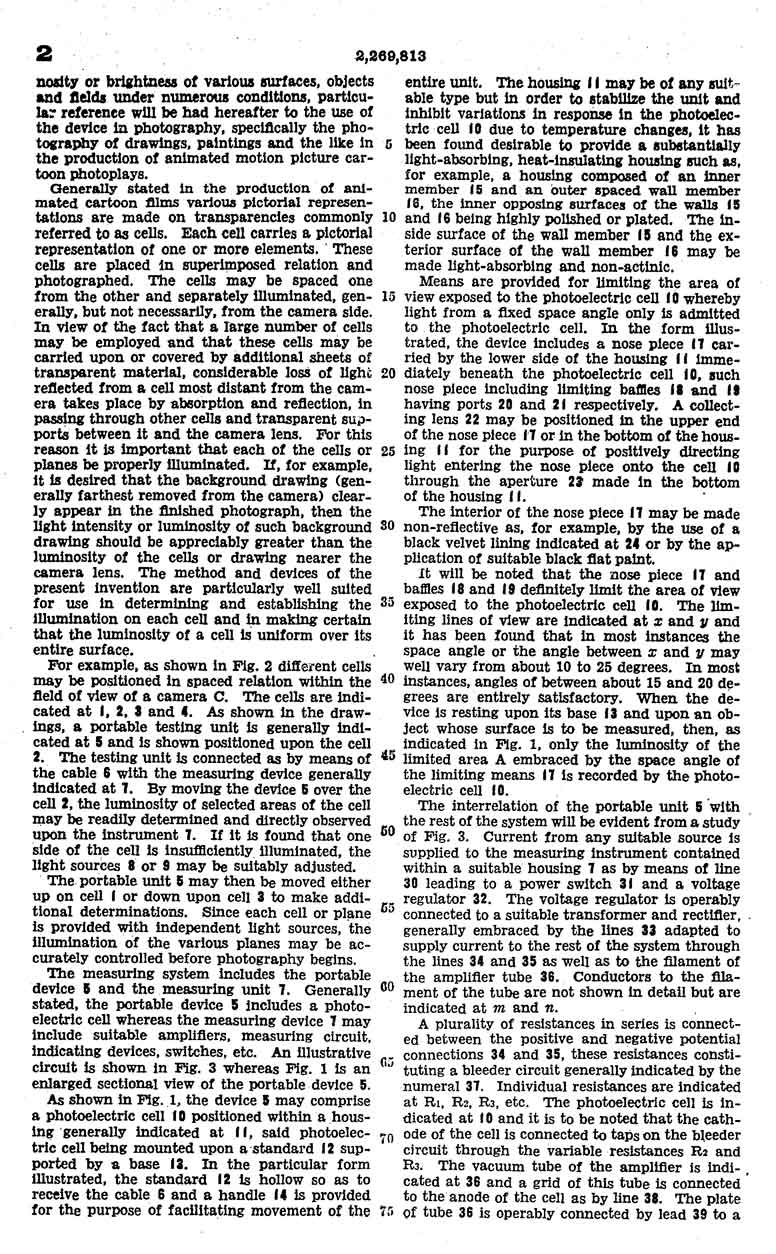
So Bill Garity and Halley Wolfe applied for on July 31st, 1940 and were granted, on January 13th, 1942, a patent that pertains a device that can measure the light intensities on the artwork at a distance far enough away to be valuable, but close enough to allow for the layer above it without measuring its own shadow.

The patent mentions that the meter is easily movable to different parts of the drawing or title to be photographed. The fact that measurements are taken on a display away from the measuring device, connected by a wire, must have been a boon, too. Note that there are twelve claims to this patent, all confusingly alike for a non-engineer like myself! Well, it does mention that it also gives means for precise calibration and prevention of overloads, so that sounds practical enough.
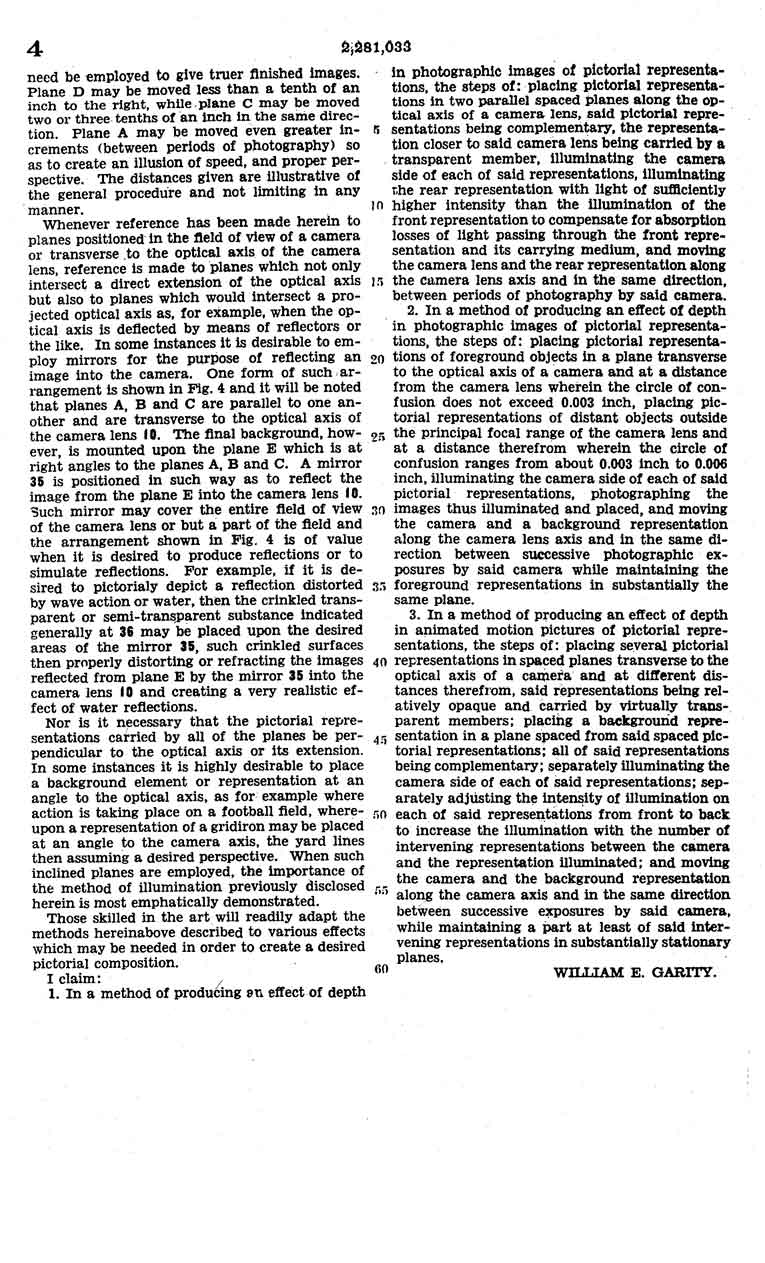
Figure 2 shows clearly that this was designed for use on the Multiplane camera, also illustrated in the text where the example is given that the light intensity of a background that is further away from the camera should be appreciably greater than that of cels or drawings nearer the camera lens...
0102
0304050607
If you built a camera rig based on yesterday's drawings, making this will be a cinch, and you'll need it...

[2024 addition: Halley Wolfe was born in Porterville, CA, 7 Oct 1909, died in Los Angeles 21 Oct 1976. Started at Disney 31 Oct 1938. Listed in the 1950 census as "underwater sound tech" for the U.S. Navy.]

Labels: , ,

Tuesday, August 05, 2008

In Glorious Multiplane - 2

We continue Multiplane week with the original patent.

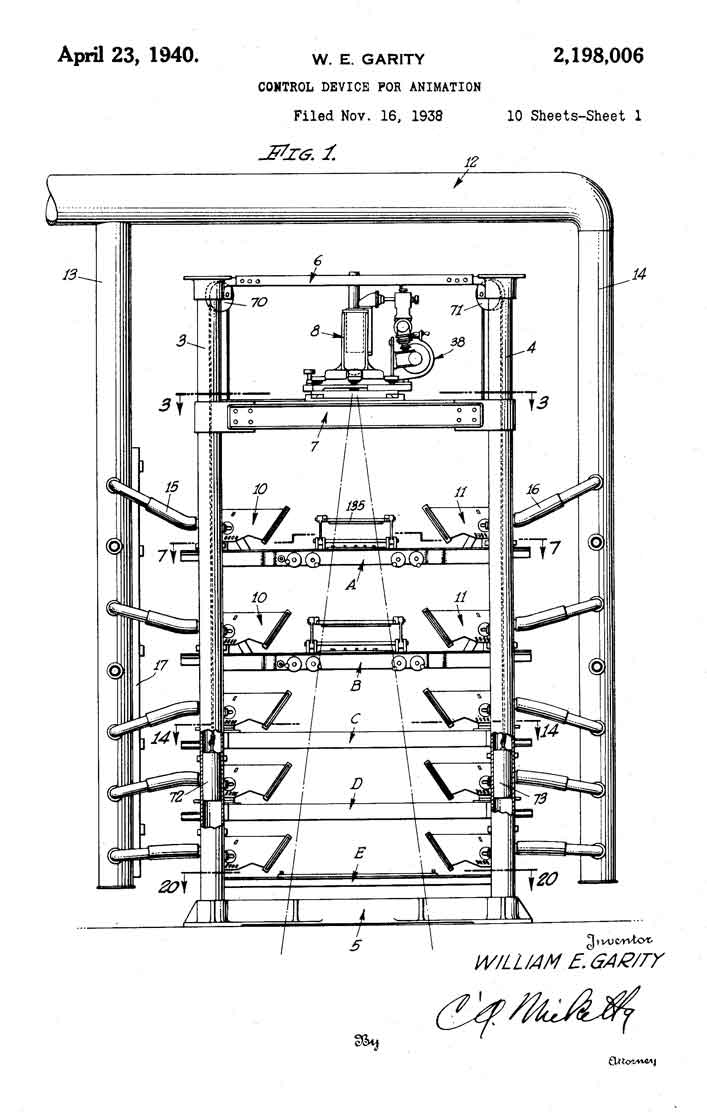
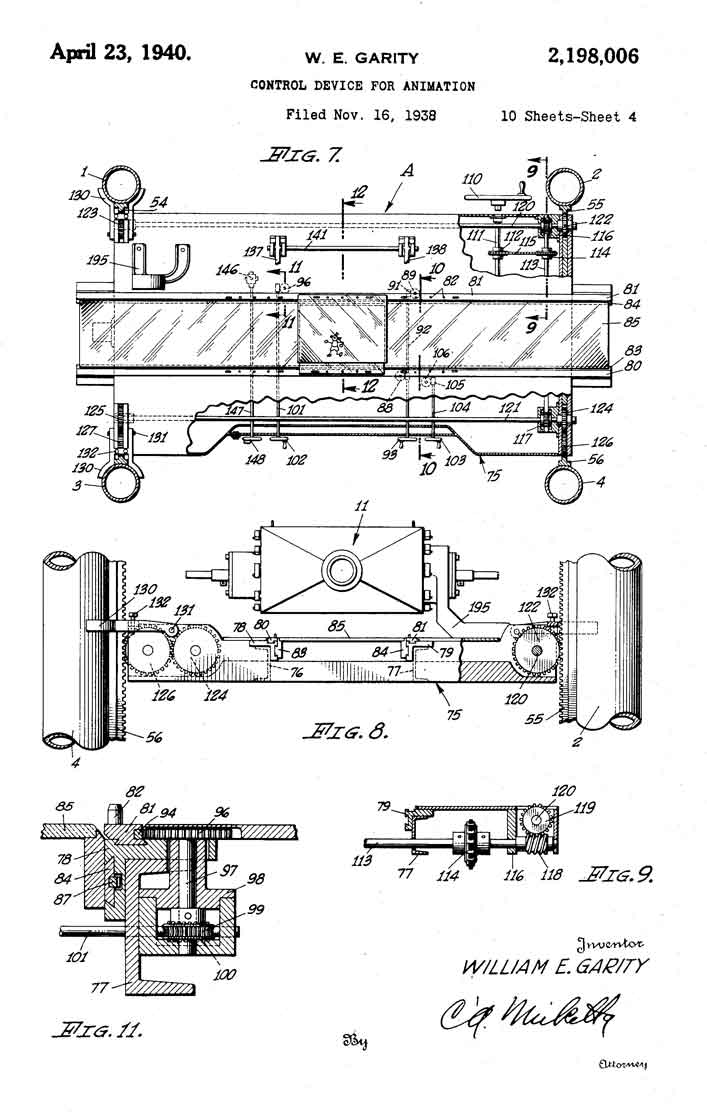
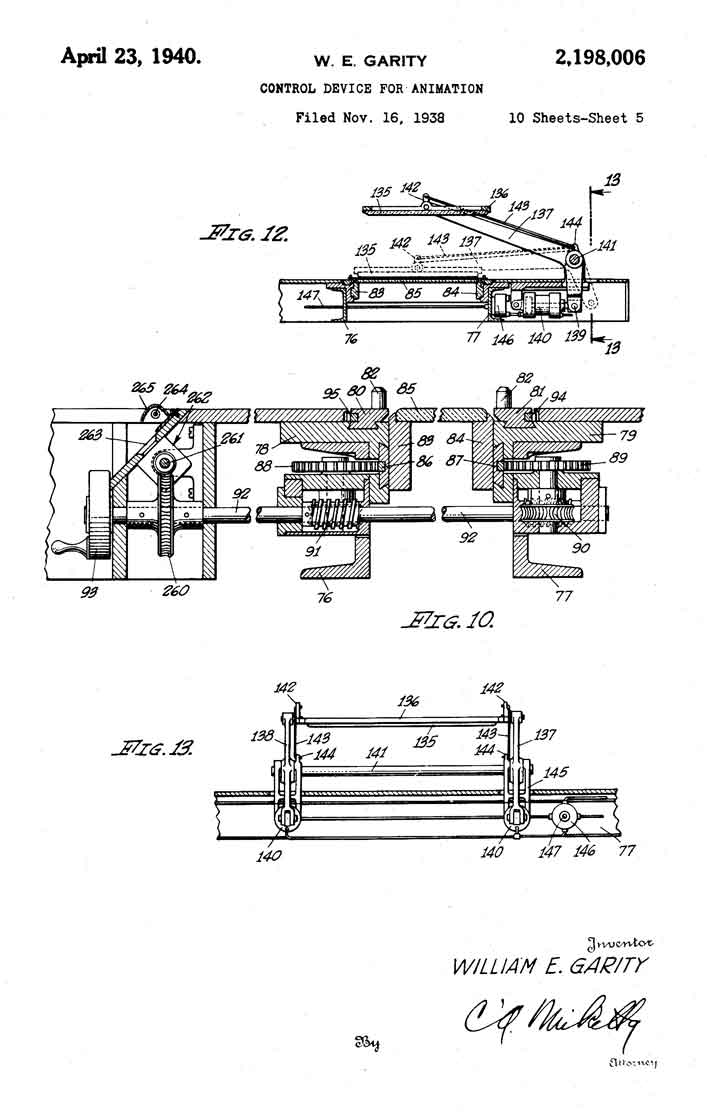
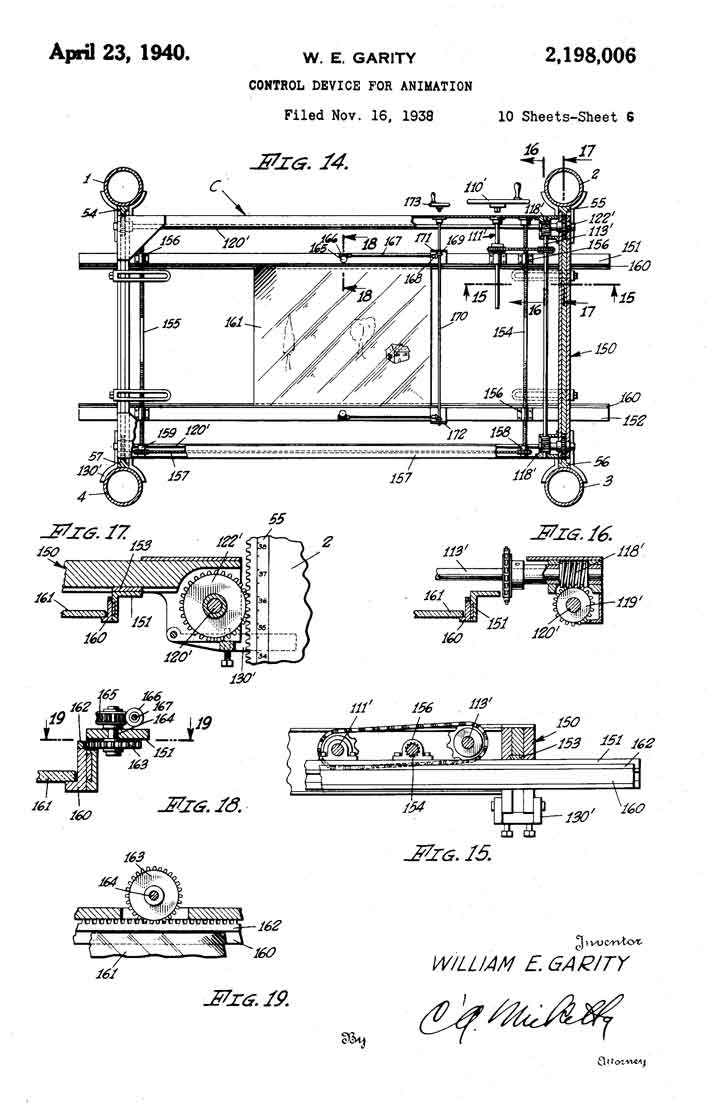
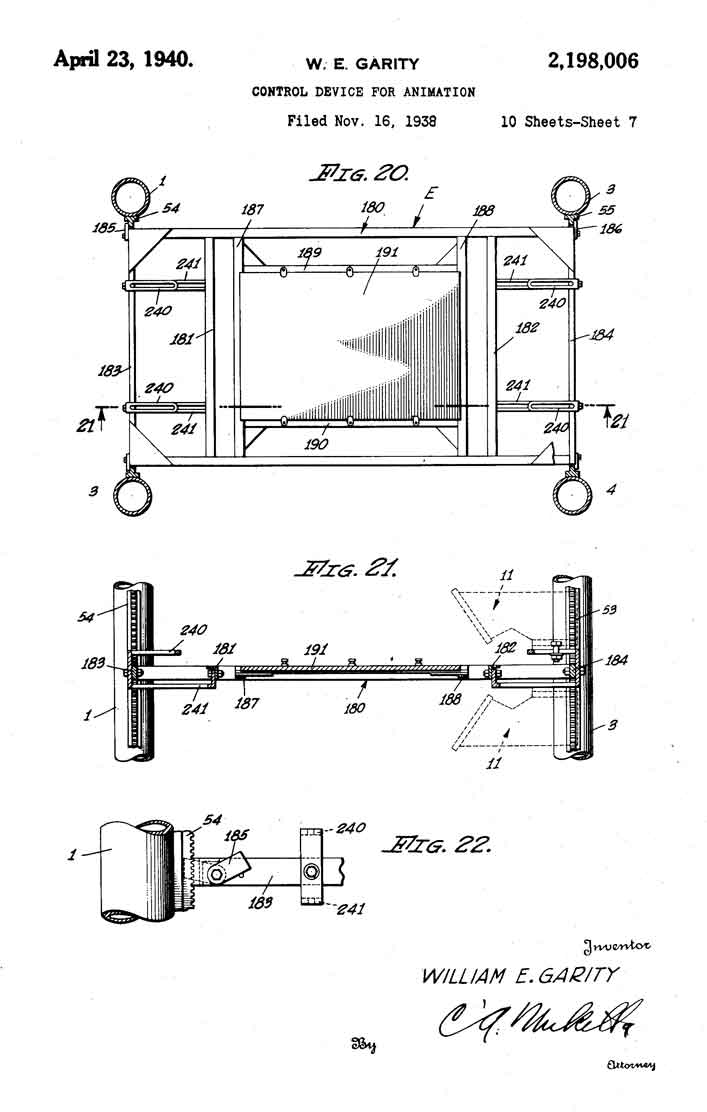
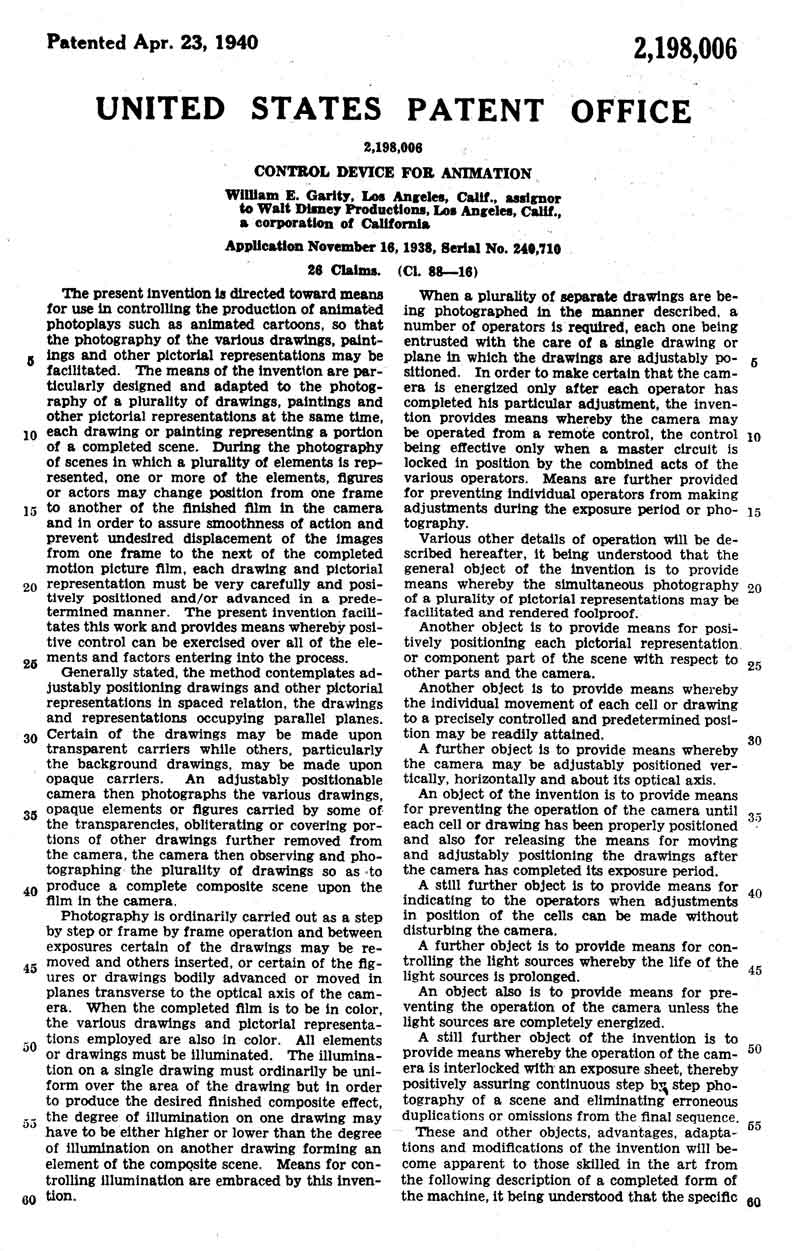
The first drawing of this patent is in my mind the most beautiful patent drawing ever, one I some day may want a big poster of up on my wall. The patent was applied for by Disney engineer Bill Garity on behalf of Walt Disney Productions, two days before Mickey's 10th birthday, on November 16, 1938. It was granted April 23, 1940.
Note: The Old Mill, officially the first film to use the Multiplane camera, was released a full year earlier, November 5th, 1937!

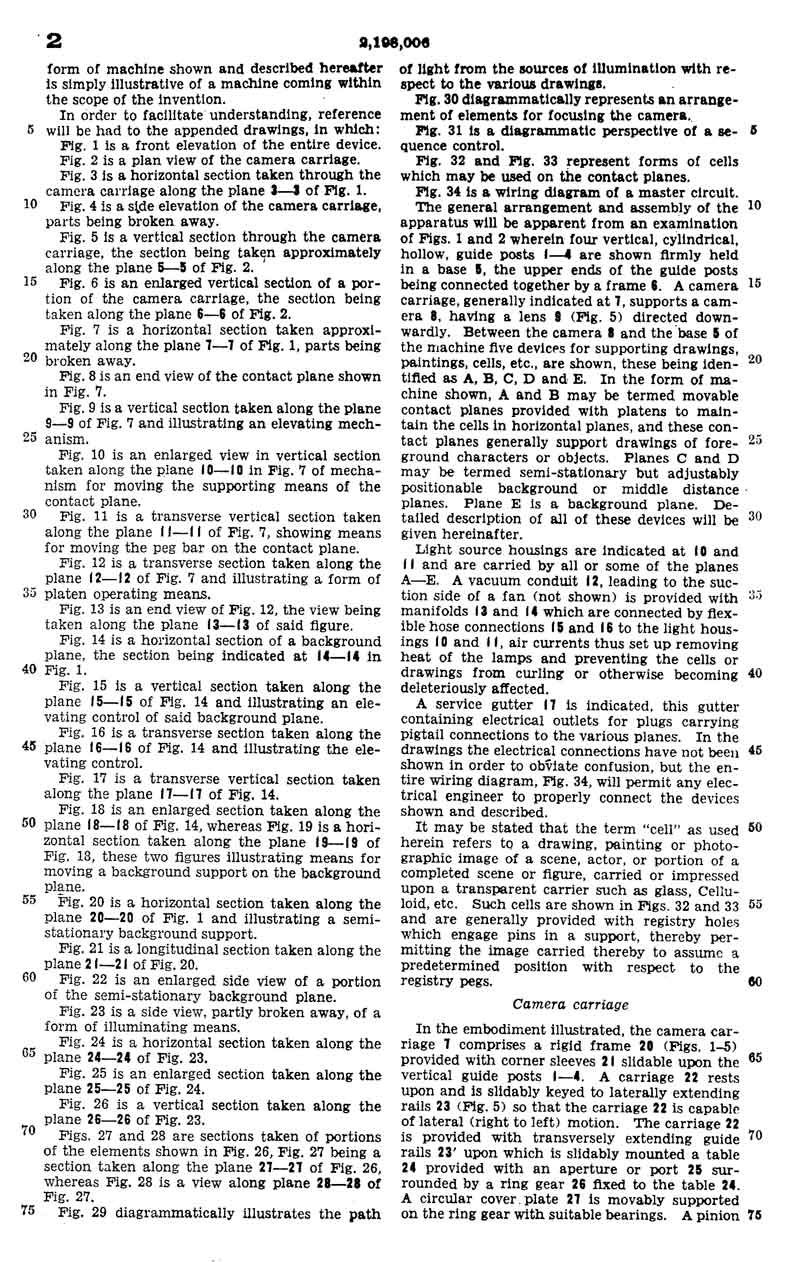
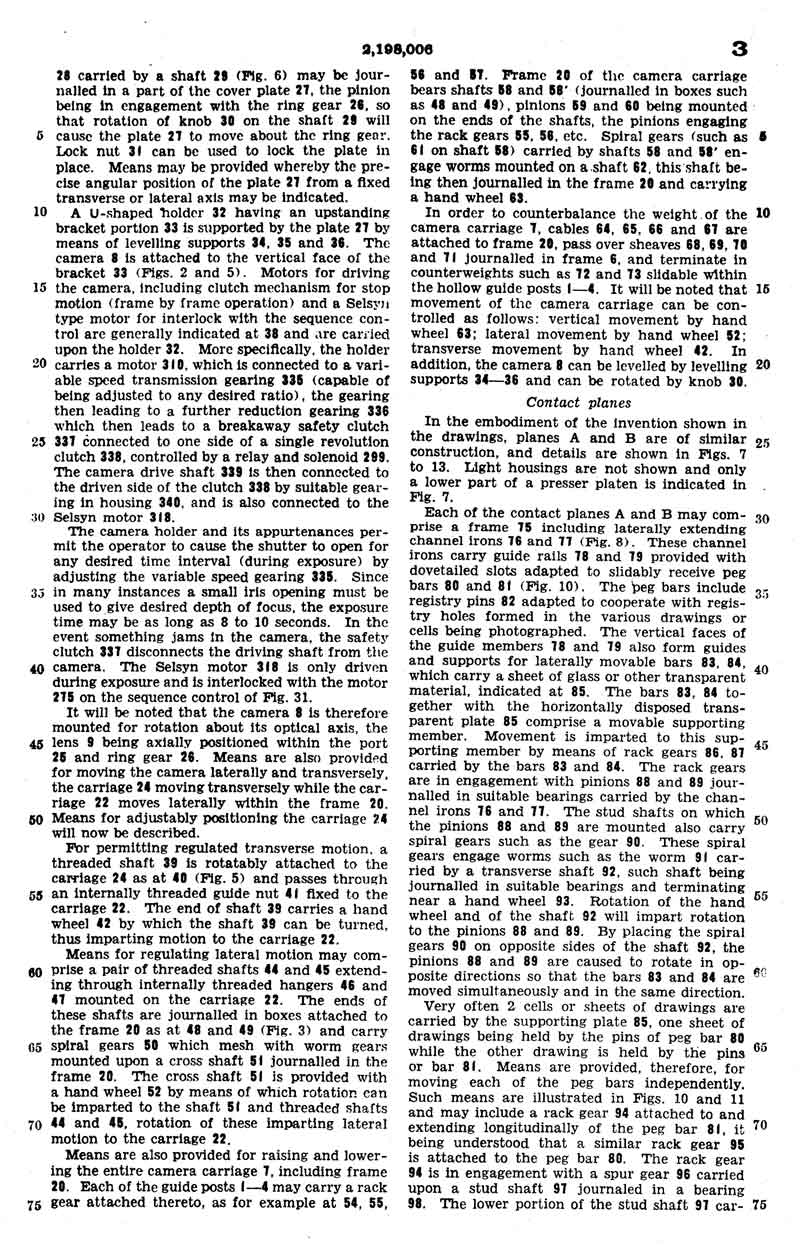
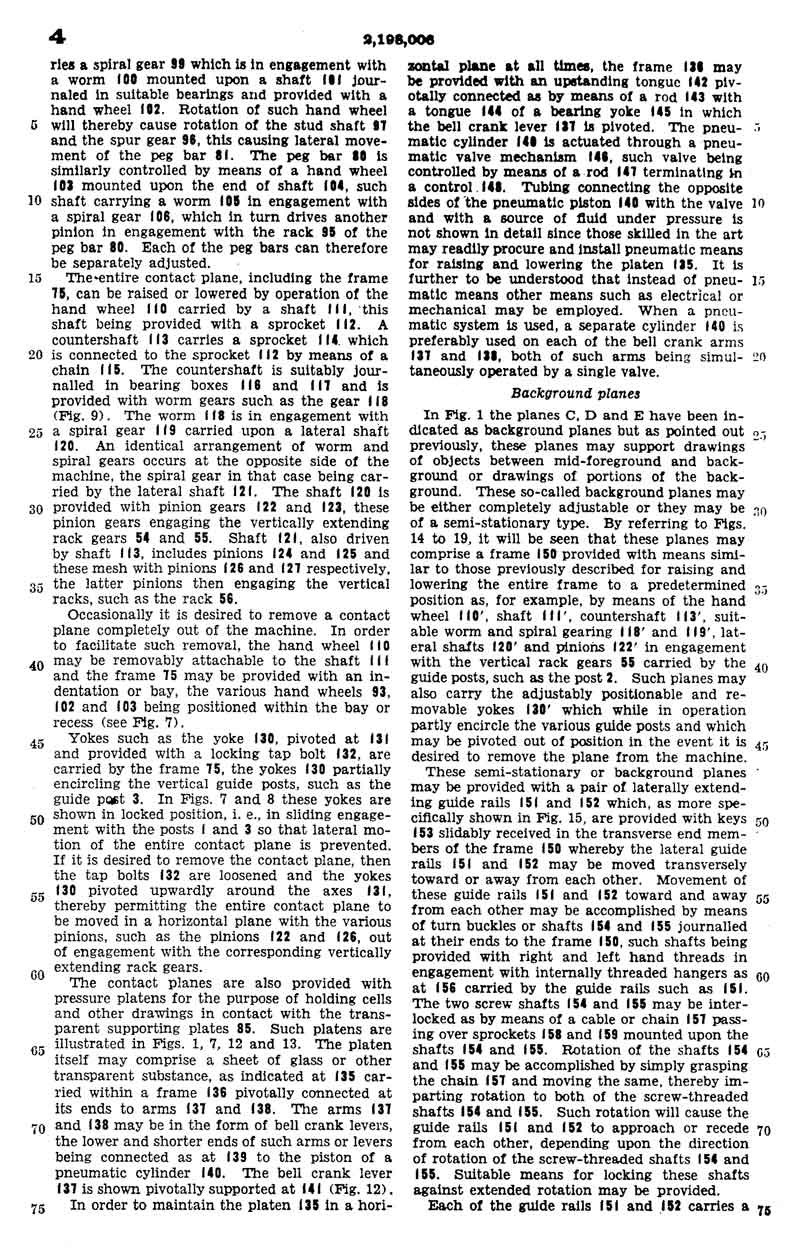
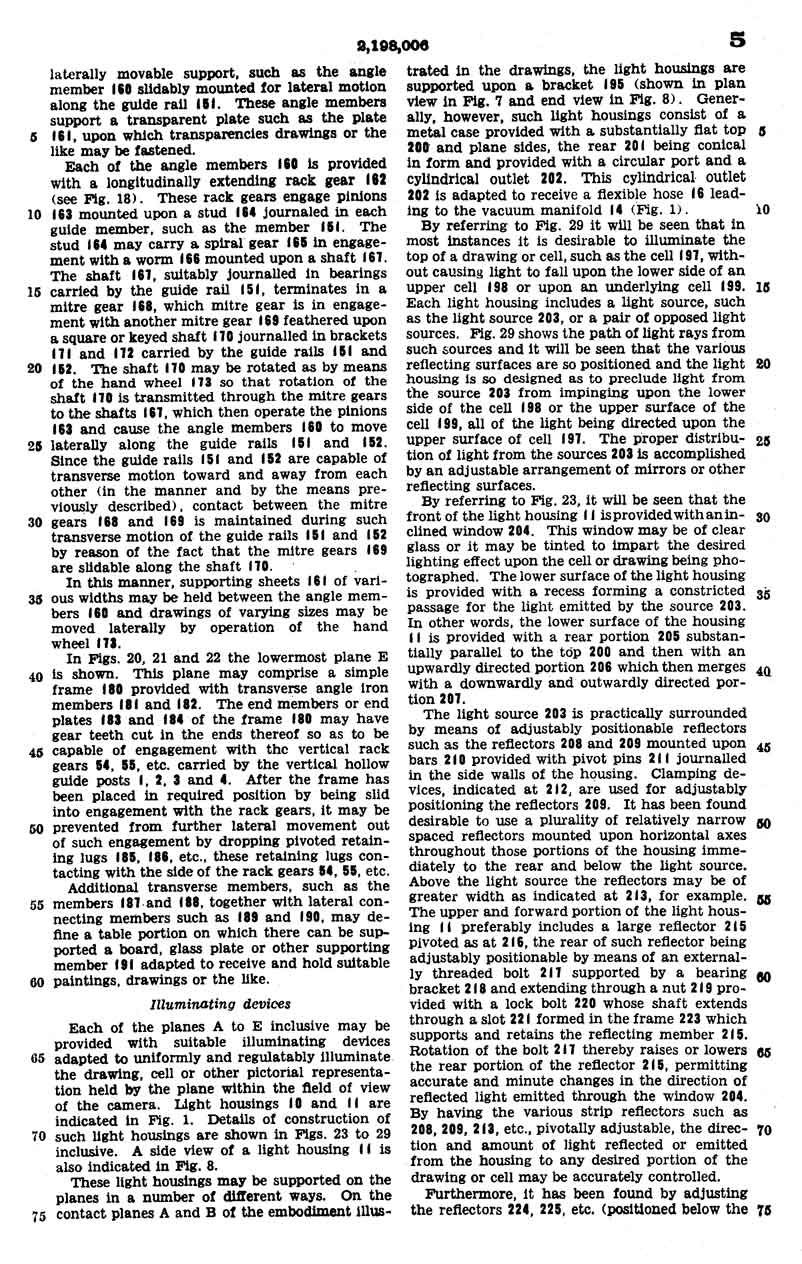
In the first sheet we see the apparatus surrounded by the air vents. The columns 3 & 4 (and a similar set behind them) that support the camera and levels A to E are hollow and have the weights of the camera level can slide up and down inside them. Levels A and B are animation levels, C and D underlays and E holds the background.
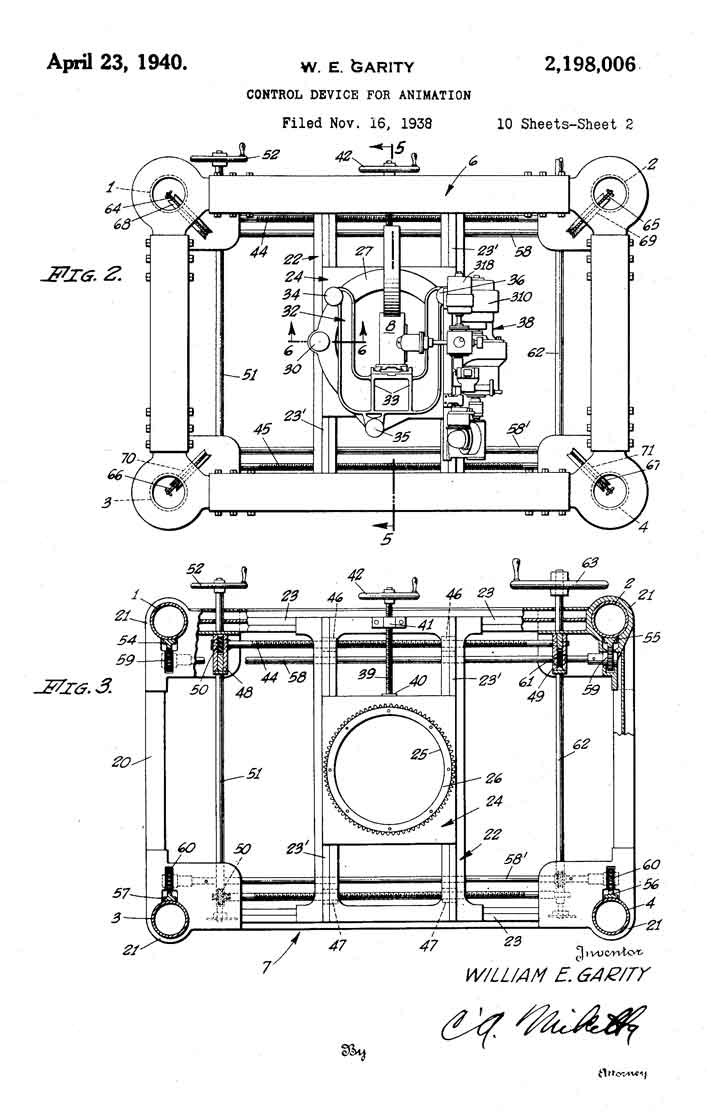
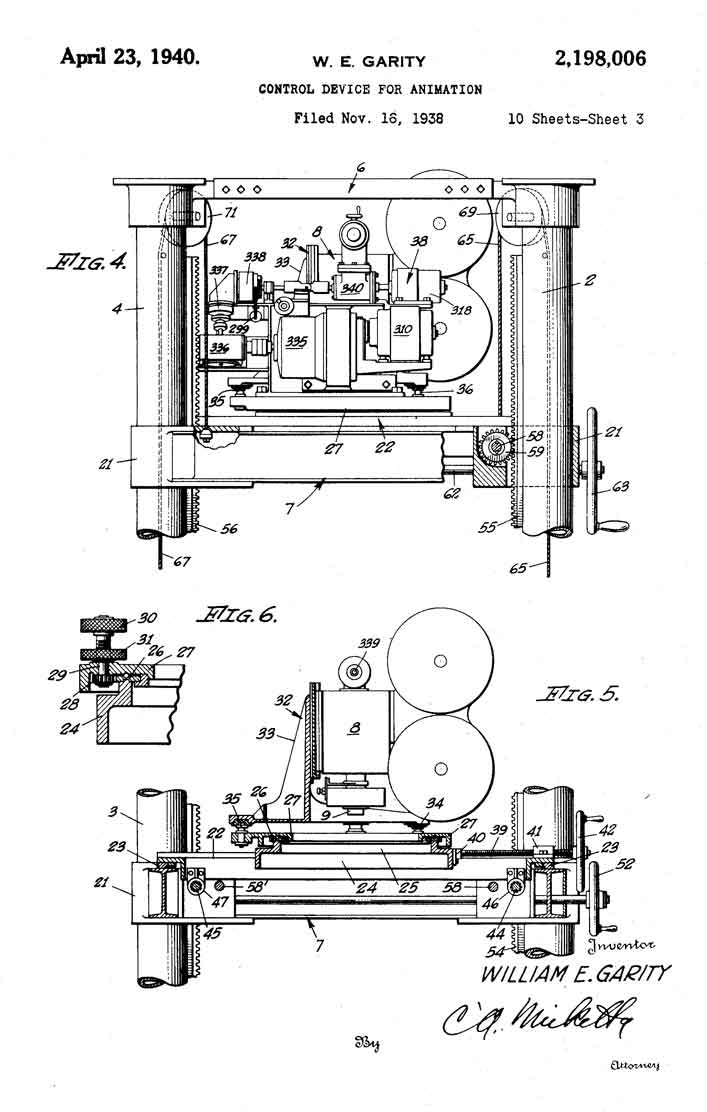
Sheet 2 shows the top frame and the camera level, sans camera. The top drawing shows both - we see the frame, and within it the camera level with the holder for the camera, while the bottom drawing has this removed. When we compare with yesterday's photos (bottom right), we see that the drawing explains "the old rig." In sheet 3 we see the top and camera level from the side, with the camera in place.

Sheet 4 shows the animation level, and the placement of the lamp housing that goes with it. Sheet 5 shows the system of the platen (the glass that presses the cels down) and the peg bars.

Sheet 6: the overlay/underlay level where the glass plate can travel East-West. Sheet 7 the background level.

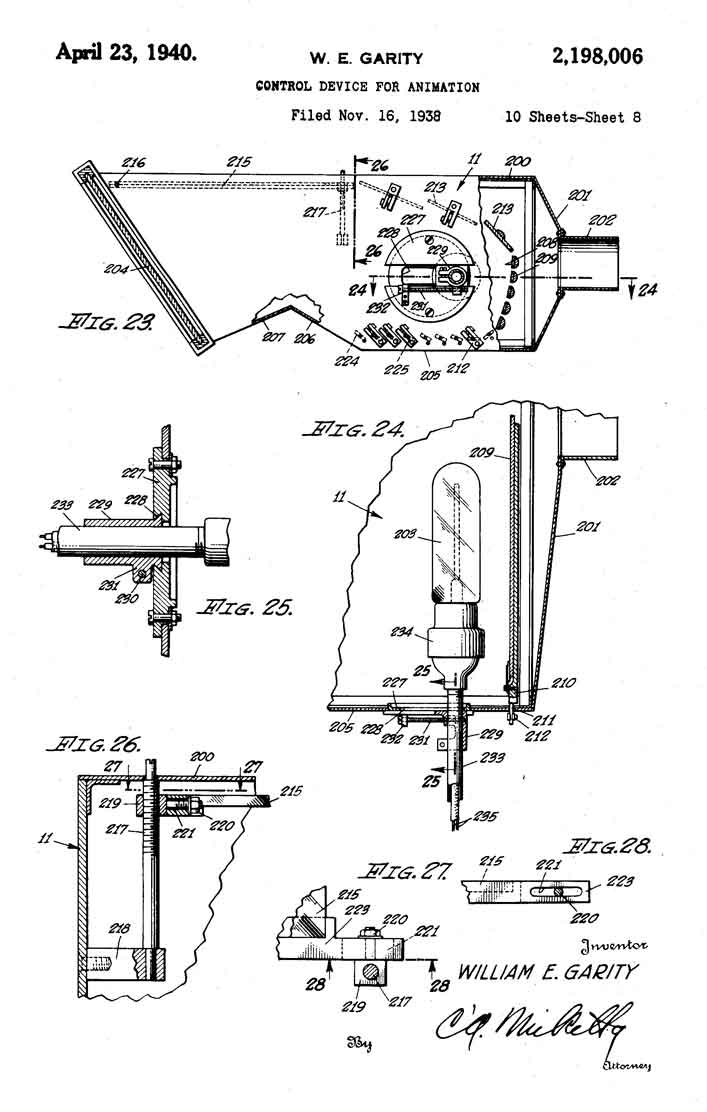
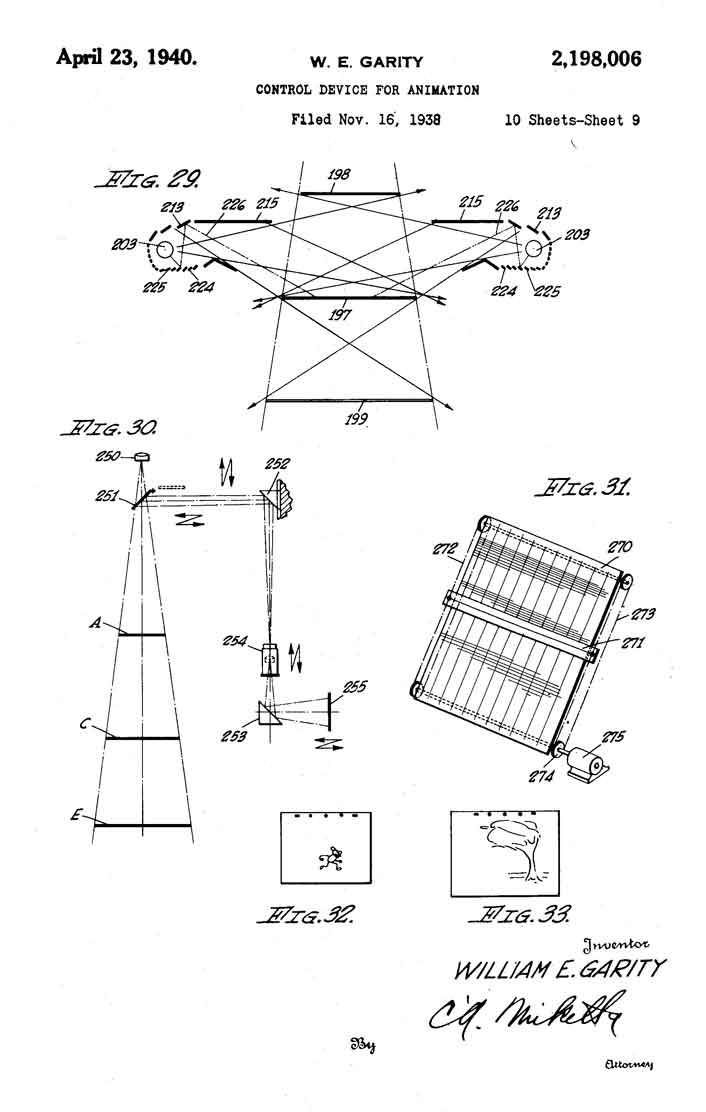
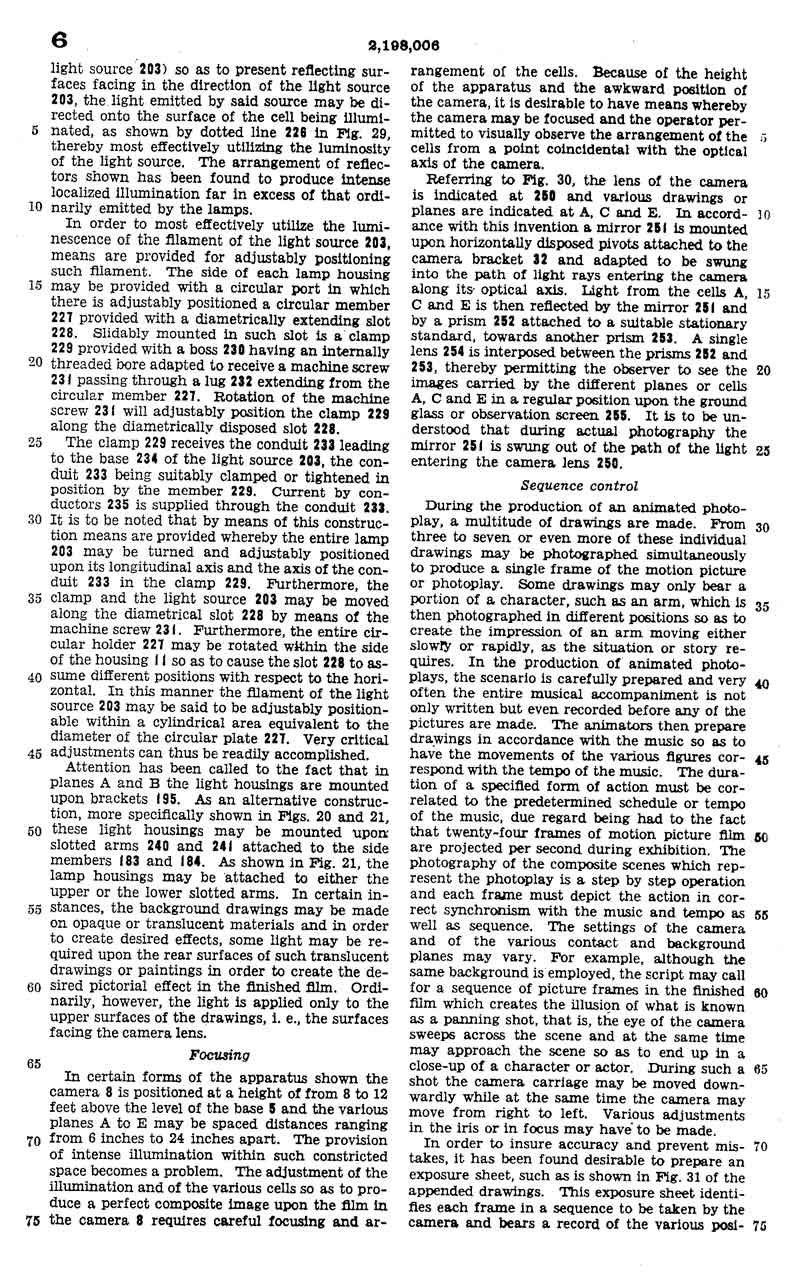
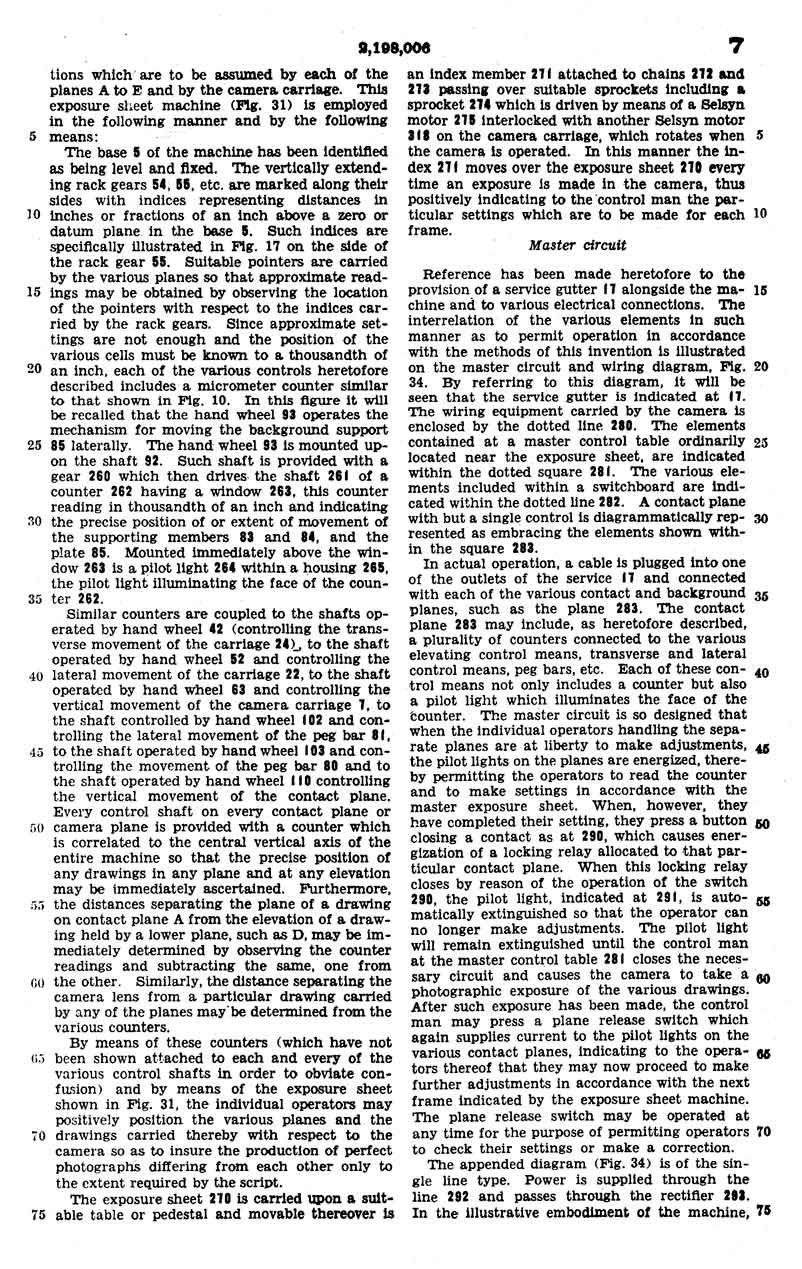
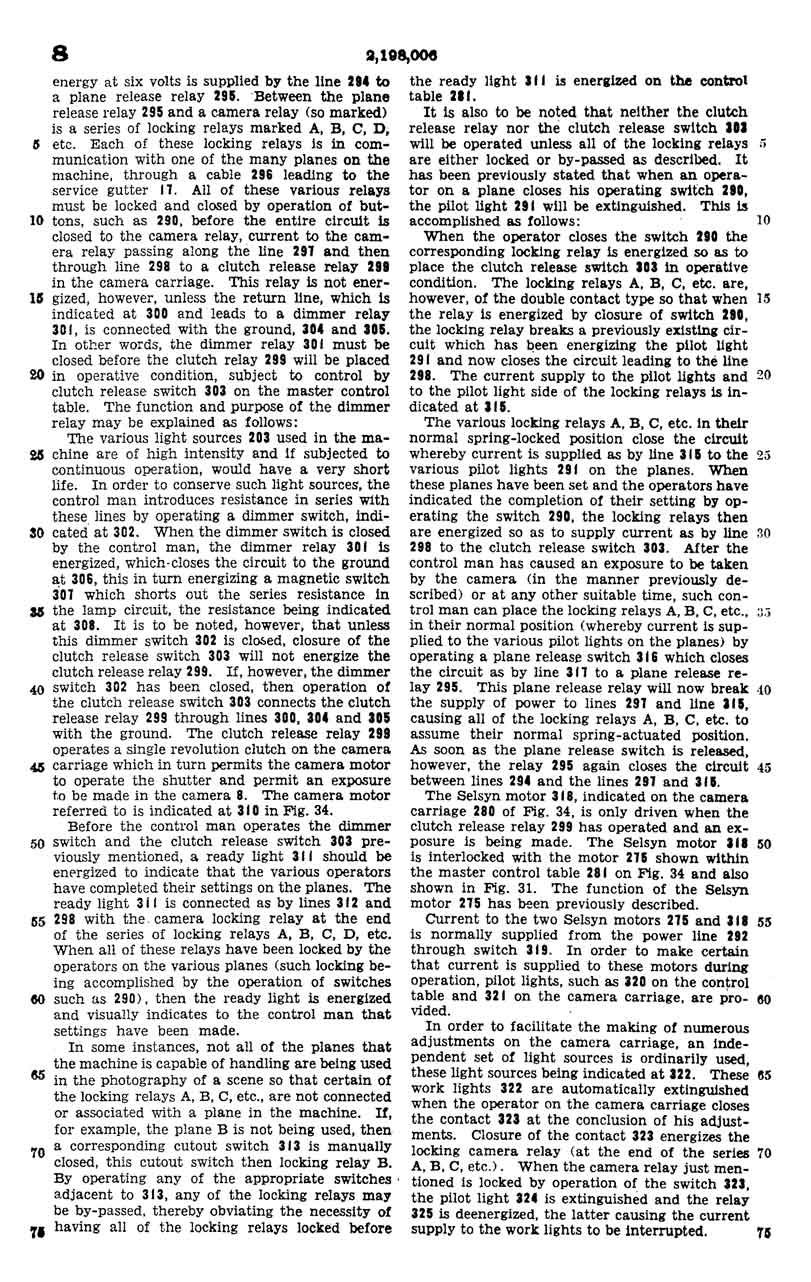
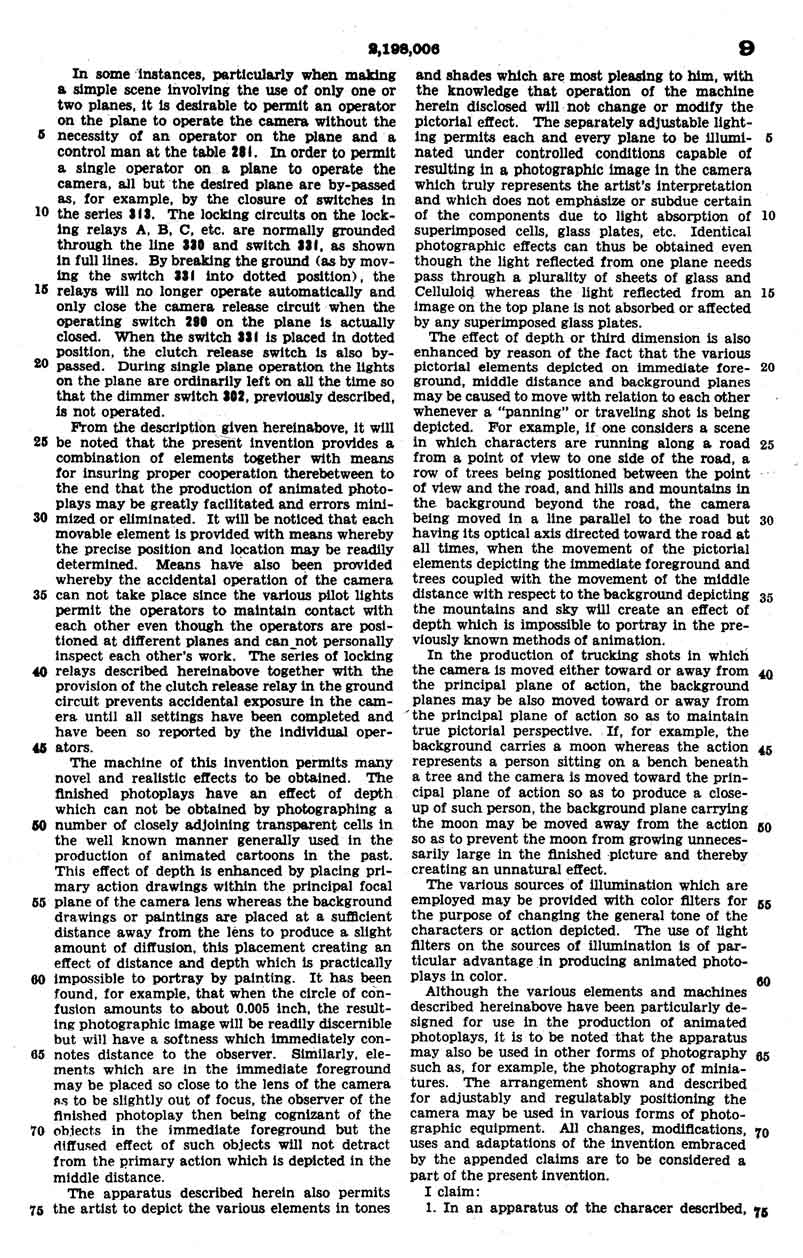
Sheet 8 explains the light holder, while sheet 9 shows the actual path of the light as reflected by the small adjustable strips of mirror around the lamps. We also see the viewfinder and the motorized exposuresheet holder, that moves to the next frame when the exposure button is pressed. Finally we see an example of a Disney 5 Field sheet of paper or cel next to a "new" 6.5 Field piece of artwork. The last change is itself hardly earth shattering - just make it larger. To see the conversion to ACME Field sizes, see my converter ==>

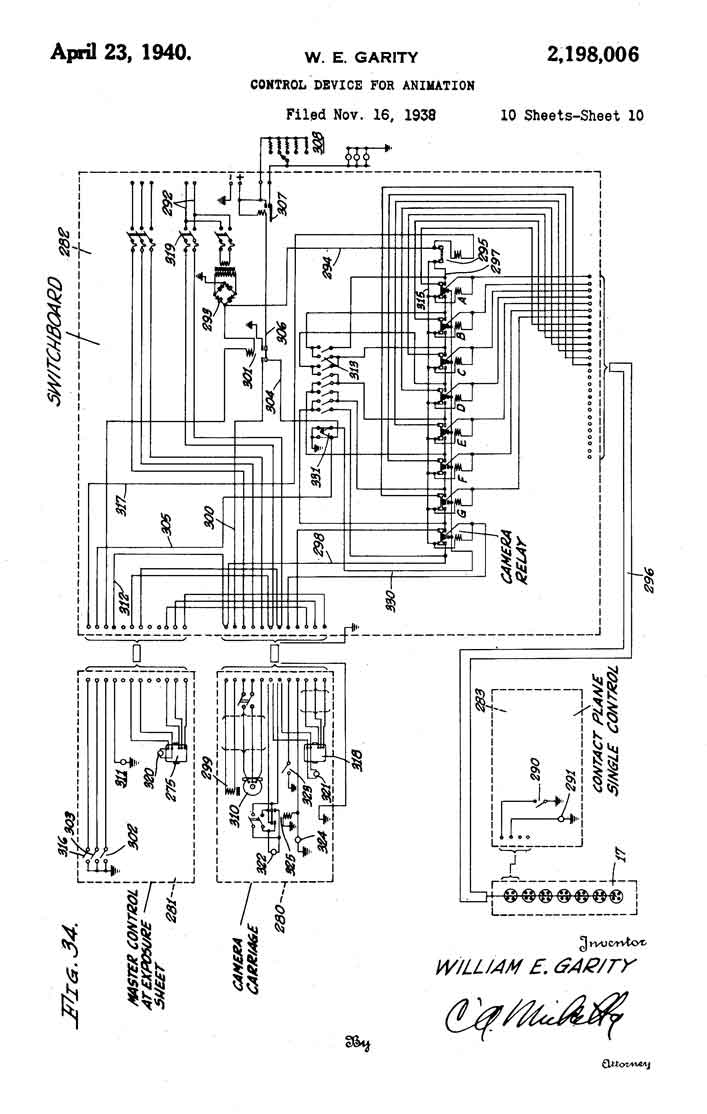
The final sheet shows the schematic for the electrical system, from the switchboard to the camera carriage and the exposure sheet indicator. Remember that all other things were all controlled by hand! No step motors to control pegbars or levels heights!

12345
678910

The written description goes in-depth with all the details in the well-known dry and pretty boring way. Still, you'll have to read it...
1112131415
1617181920
212223
Isn't this fun? You can build your own!

Labels: , ,