Please note: if an earlier link doesn't work, it may have changed following an update! Check the Category Labels in the side-bar on the right! There you can find animator drafts for sixteen complete Disney features and eighty-six shorts,
as well as Action Analysis Classes and many other vintage animation documents!

Sunday, May 31, 2026

Beatronome update! Now on the web!

My Beatronome is now available as a simple web page here!
This works on any device with a newish browser, including Windows, Macs, and even iPhones! You can now also download a sound file (WAV on Windows, AIFF on Mac) of the beats! Give it a try!

Note that the preset beats are pretty much the same as the click track machine at the Disney studio on Hyperion Ave. You can write in your own beat and also add 1/8th fractions (half sprocketholes).

Also, here is a timecode calculator. Add or subtract frames and/or timecode, and between framerates. Let me know what you think!

This last reminds me of the film "Anna & Bella." When we started production, my old mentor Børge Ring wanted to make the film in 24 fps, but got the money people at the Ministery of Culture convinced it would be in 25 fps. That meant that, instead of 7 minutes 30 seconds, we could make it 7 minutes 48 seconds and 18 frames.
We chuckled about that... (though the budget was ridiculously low).


I know, I know - it's far between my posts. I haven't forgotten, though, and I keep thinking what next to show. I haven't the same scanning possibility as I had before, which is a large part of my not posting more...

By the way, I have noticed someone is mirroring my blog without permission. This page, afilmla.blogspot.com, is the real one...

Labels:

Friday, March 06, 2009

Beatronome Update

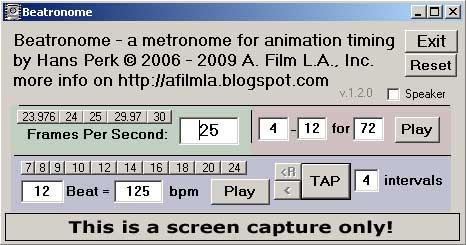
When I made my little Beatronome, a beat-metronome--to tap or play beats as used in animation--for the PC, I used a method to beep the PC speaker, which seems to disagree with certain computers. That is why I have added the possibility to have the program generate regular computer sounds through the sound card. To do this, one has to (re)install the program using the executable in this 1.8 MB ZIP file. PC ONLY!
Right-click and choose "Save As..." etc.

Beatronome Screen Capture

The Beatronome is free of charge, adware free and virus-checked.
I hope more people will try using it, and through that get a better understanding of timing for animated pictures. What I REALLY hope is that users will post their findings when they check the timing of films - and maybe find something curious...

Labels:

Tuesday, February 17, 2009

Congrats, Børge!

Today marks the 88th birthday of Børge Ring, whom I am proud to call my mentor. He lives in a rural part of Holland, but though he feels slowed down by age, his mind is as sharp as always. He sent me following as follow-up on my mentioning of Steamboat Willie's timing:

      « As Hans justly states: A tempo of 2-16 aka 4-8 is the simplest and most manageable of tempos.
David Hand timed his Disney shorts by metronome and beat. He gave this advice: "If you make changes in your timing - making an action slower or faster - never add or subtract anything less than a whole beat. That way you stay within the pattern and you do not bring the musician into weird difficulties."

      Dave was not intimately conversant with music techniques and his musician Bert Lewis gave him this rule of thumb; "Write your timing in bars of 4 beats. Always put strong accents on 1 or on 3 in the bar. Then you will never get me into trouble."
I contended that a musical accent can have much more sock when placed on 2 or 4 in the bar - as often used in jazz. Dave answered that "You can do anything as long as it makes sense musically."

      During the making of the short ON ICE Goofy exchanges whacks with an obstinate fish. Walt Disney suggested to director Sharpsteen that Ben give the sound effects the rhythmic pattern of (what he called) a "Dixieland Ending" [the old "Shave and a Haircut, Two Bits"]:
Dab dabbedy dab dab uhm dab dab.
1 2 3 4 1 2 3
      The result on the finished film is amusing to listen to. Sharpsteen seems to have sweated and the piece of sound film must have contained a great number of splices, old and new. »

Børge mentions Dave Hand telling to never add or delete less than a whole beat, which means a measure can have e.g. one or three beats, even though it originally has two beats (if it's a 2-12 as in the example from The Pointer that I show here). This always posed an interesting challenge to the musician...

Labels: , , , ,

Saturday, September 06, 2008

Musical Beats Revisited  ...Now hear it from an old master...

         Much of animation is simply a matter of doing a job as it should be done. Maybe a scene is no more than a funny walk or a brief dance step. An animator's responsibility is to interpret a track, picking it apart mentally and then making his animation interpret each innuendo, each nuance with drawings that hopefully add life to a scene—even beyond the scope of the soundtrack.
         An important part of a track is musical. The music beat is vital to the artist. On an animator's work sheet, usually referred to as an Exposure Sheet, music beats are indicated in actual film frames. An eight (8) beat would be eight frames of film; a twelve (12) beat, twelve frames of film. It is natural to assume that an artist's plan would be to carefully accent each musical beat, however, astute animators avoid anything so mundane.
         A musical beat is a marvelous thing. An animator can split it in the middle, avoid it completely, or even divide it into three or four parts as a musical composer often does. A musical beat is the skeleton on which an animator builds the muscle of his action. He can plan an accent to happen before, behind or right on a beat, according to how he desires to psyche his audience.

         Art Babbitt, the suave and talented savant of Animation's Golden Years, has a tantalizing way of reaching an accent a twelfth of a second late. It reminds one of a magician catching a coin or a playing card in midair at the very instant you are sure he will not get it. It is maddening, but it is good entertainment.
         An experienced animator has many strings on his bow. Milt Kahl, recently retired Zeus among animators, picks up a beat with the adeptness of Sherlock Holmes pinpointing an important clue in a murder plot. To Frank Thomas, an artist with unusual musical skills, the reading of a beat came naturally and tastefully. He accomplished it with the sang froid of a fastidious gourmet putting just the proper touch of Escoffier sauce to a serving of chilled oysters. Every beat has its special character—its special importance.
         Freddy Moore had a slam-bang manner of animating rough-shod through one beat, then picking up the next beat with the caution one might use in picking up a live rattlesnake. Norm Ferguson, master of all of the elements of animation, could carry three characters through a syncopated sound track and put the right emphasis on each beat so neatly that no one could ever quite tell how it happened. His exposure sheets were more complicated than the musical score for Beethoven's 9th Symphony.
         Bill Tytla was a glittering star among animators, a modern Pieter Brueghel working with living pawns, a wild cossack riding a loco horse over the steppes of the Ukraine. He was a wizard at searching out beats—a fantastic planner and plotter. Sometimes a beat is hidden away in a pile of trashy sound effects, but it is still worth searching for. Bill always found and used a hidden beat. It added a touch of Tabasco to his animation.
         Too often a novice hopes to accent a beat with exaggerated mouth action. Mouths can be funny, but they do little to help an accent—even with funny dialogue. A body accent, a dramatic posture, is The Thing—always. An animator may have a track that is only dialogue or recorded sound. Lacking a musical beat with which to work, he must choose from the track accents on which he can structure his animation.

--Thus wrote master animator Grim Natwick, of Betty Boop and Snow White fame, on January 6th, 1978, in an article or chapter called "Reading Sound." It is not known to me what he wrote this for, but I find it very interesting and in line with my previous postings on beats and barsheets. If you have not yet read these, I invite you to do so, as "animation to a musical beat" has been undervalued for much to long, especially among CG artists who wrongly consider any technique applied to hand-drawn animation to be too old-fashioned or just inapplicable to the CG medium. In the past century, many wonderful artists have pioneered the medium of entertainment through animation, and it would be a crying shame not to at least take notice of their advancements!

Labels: , ,

Wednesday, May 07, 2008

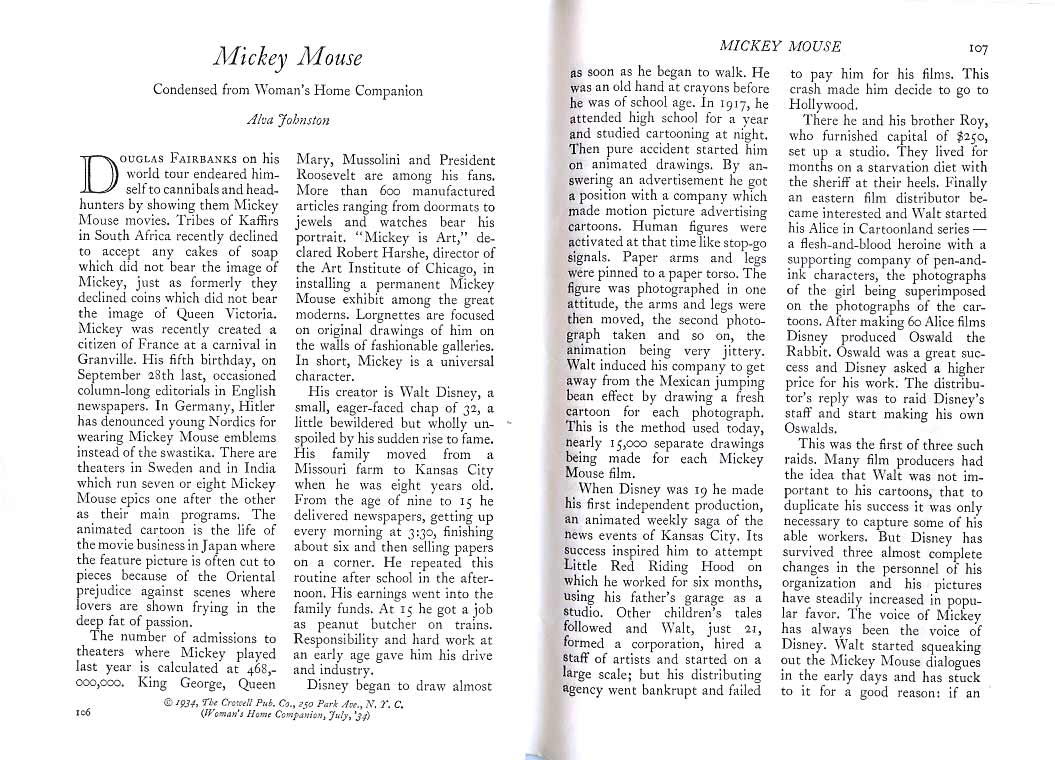
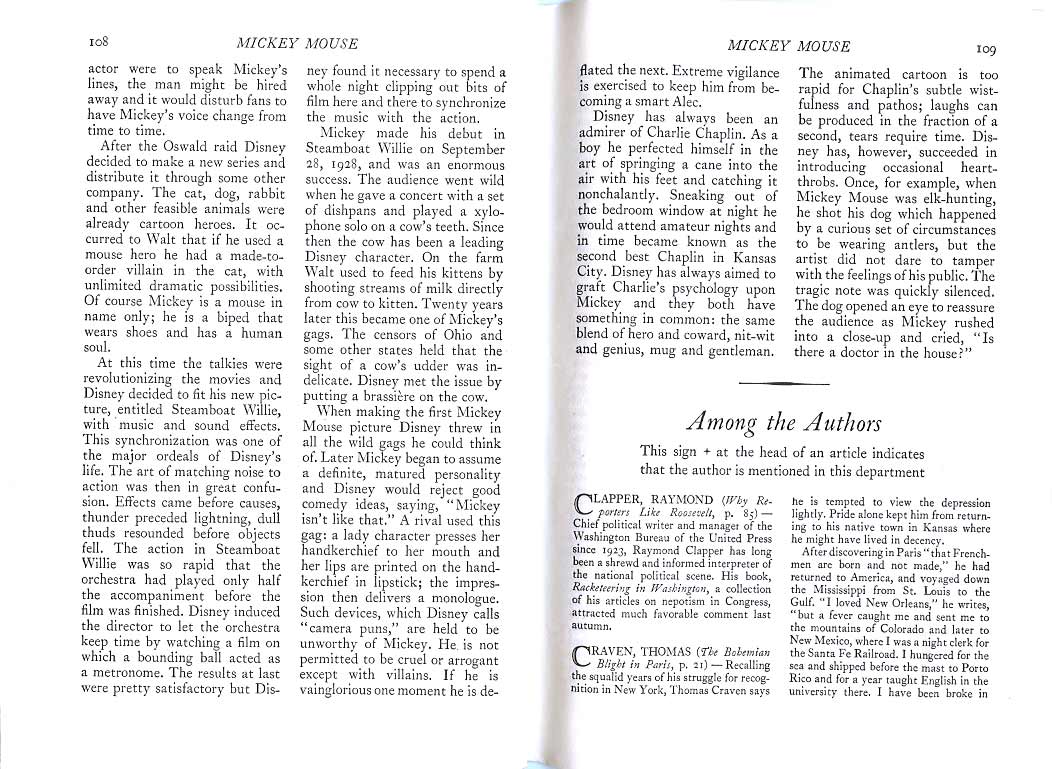
More on Synchronizing Mickey

In this Readers Digest (August 1934) version of an article from the July 1934 Woman's Home Companion, we find on page 108 a simple description of the bouncing ball system to record Steamboat Willie...
12
We also find mention of "the three raids on Disney's staff."
Now - the first was Mintz' Oswald take-over in early 1928, and the second was Pat Powers' Iwerks/Stalling maneuver in January 1930.
But what was the third that this article refers to?

Labels: , ,

Saturday, December 09, 2006

Beatronome Update

Here is a little update to my metronome program (see below). What's new: I added a row of buttons with the standard beats as described by Albert Hay Malotte in his lecture notes. (Again in .zip format) PC ONLY!

[Added: It updates the program found here and the manual is here.]

Labels: , , ,

Friday, December 01, 2006

Users Manual for Bar Sheet DIY

First - DIY is Do It Yourself - this for those who aren't used to coloquializms. The excercize is really relatively simple. Before we begin, I suggest that it may be good to re-read Albert Hay Malotte's lecture notes at this point. It also may make more sense to hardened readers of this blog than it did on May 25th when I posted it.

Ok, here we go. On your favorite DVD player in view and earshot from your PC (with should have a working, non-muted PC speaker, I haste to add again), insert the short film you'd like to analyze. This can be a Disney short, but really most of the films of the 30s and 40s seem to have been timed to a beat throughout - Looney Tunes, Harman-Ising etc.

To get the feel of things, start like this: When the film plays, use my Beatronome program to tap out the beats of the music of a certain sequence. You should tap the number of times indicated in the little box right of the tap button, plus one. The beat will then show up below the button. You'll find it will normally be 'whole' beats: 7, 8, 9, 10, 12, 14, 16, 18, 20, 24. Tap several times to give you an average, and type the closest whole beat in the metronome bit. This may be more accurate in the long run than just transferring the tapped beat to the metronome. Rewind the sequence on the DVD, and press Play on the metronome when you hear the rhythm. Write down which tempo this sequence was in.

It gets more tricky when there are bits without music, of course. As you see in Mickey's Elephant, the music often just continues. Try to let the metronome run - and see if the action hits the beats. See if you can spot where the tempo changes, and continue doing this over again for the next part of the film. In the end you have a listing of which sequences are in which beat (I for one would like to see this!) If you are really persistent, you can now count how many beats there are in each tempo, and you can write this out on a simple bar sheet as the one I supplied yesterday. Now - what are you waiting for?

Oh - 'why would we even try', you may ask. Well, through this excercize, you can reveal the sense of stucture and backbone that were underlying the films of the time. And as such, learn more about what made these films great entertainment. So much has been published about the drawings, but this beat thing, this is all about direction. As Norm Ferguson said: 'timing is the essence of the thing'. It need not be a forgotten art anymore...

(Note for MAC users: you CAN use an ordinary metronome, most certainly. To convert between frames per beat and beats per minute, you can use the converter here on the right, if your math fails you.)

Labels: ,

Thursday, November 30, 2006

The Bar Sheet DIY...

Not long ago, I wrote somewhere in a bar sheet posting that it might be fun to recreate bar sheets from shorts from the 30s, as a classroom activity. Well, to begin with, you will need a pencil and paper with bars written on them - find inspiration from the previously posted examples. "Here is one I prepared earlier" in PDF format. Finally you will need a metronome. And for that, I wrote a little program I unimaginatively called Beatronome, which you can download here. It is packaged inside a zip archive.
If you are an animation director, animator, or animation researcher, and you use a PC, you might like to have a look at it, as well...

It is really simple, uses the PC speaker, and should work under Windows XP SP2. (No, not on a MAC...) You can convert beats, play them, tap beats and play those. Now, you only have to be able to count. If it doesn't work, or protests by telling you that the run-time is missing etc., you can download a full distribution package here. Sorry, PC ONLY!

I look forward to hearing your findings!

Labels: , ,