Please note: if an earlier link doesn't work, it may have changed following an update! Check the Category Labels in the side-bar on the right! There you can find animator drafts for sixteen complete Disney features and eighty-six shorts,
as well as Action Analysis Classes and many other vintage animation documents!
Wednesday, December 23, 2009
Friday, December 18, 2009
My View...
![]() |
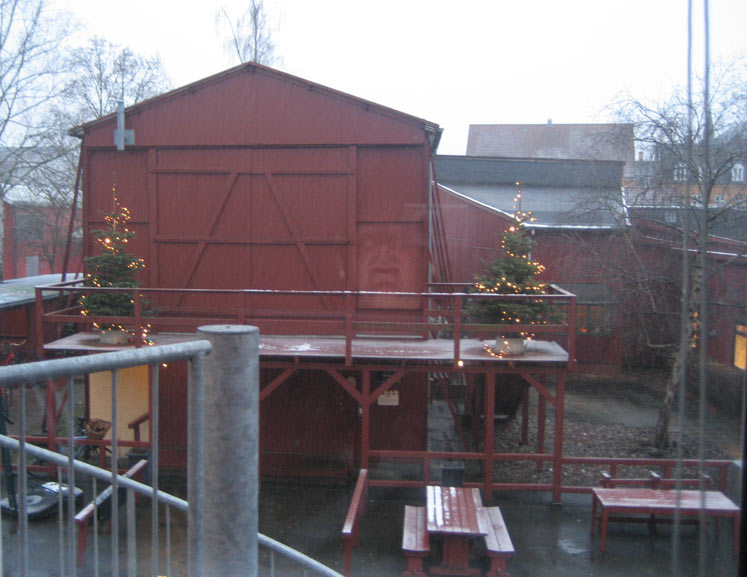
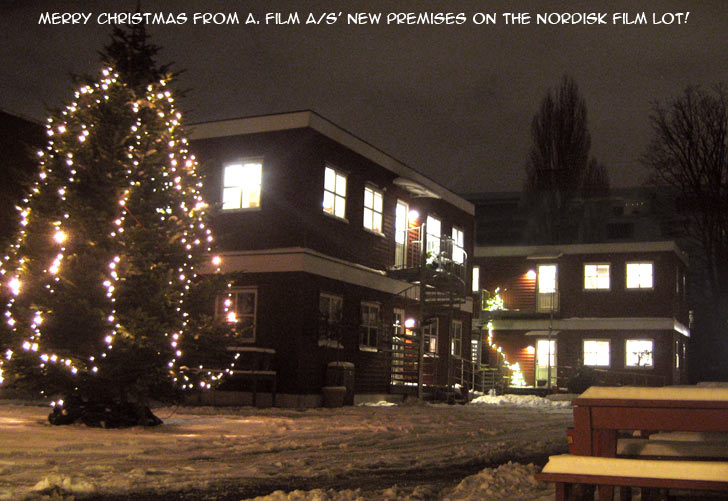
So what is it we see here? We see two of the oldest film stages in the world. On the left "Stage 2," built in 1909 and in use since 1910, and still usable as stage, with glass walls and roof. The inside is currently used as exhibition space of a few of Nordisk Film's most notable productions, with props and costumes. In the 50's and 60's it was used as the costume warehouse.
On the right we see another wooden structure. Now, keep in mind that founder Ole Olsen already shot his own films from January 1906, bought part of the area in the summer and was shooting at this location from September that year (though Nordisk film officially counts its starting date as November 6th 1906). But until 1908 all shoots were in the open air, even indoor locations, which means you often can see the walls blowing in the wind in those early films! Therefor they built "Stage 1," Nordisk Film's first stage built in 1907 and in use since 1908! The glass walls and roof were later replaced with wood when it became feasible to use artificial lighting. Stage 1 is currently called "Kinografen," and is used as the studio cinema.
In a corner in the back of Stage 1 is Valdemar Psilander's dressing room, with its original implements and many pictures of this famous actor of the silent screen, who, before he passed away of heart failure in 1917 was Nordisk Film's biggest star, together with Asta Nielsen who later became Germany's darling before WWII. Psilander was widely known over the entire world, though not everywhere under his own name. In Russia they called him Mr. Garrison, which they did not convey to the Danes, which resulted in confusion when a letter arrived at the studio inviting Mr. Garrison to a tour of Russia. They had no idea who this Garrison was, and Psilander did not get to go...
Of the other three original stages of the mid 1910's (3, 4 and 5), only Stage 4 is left. This was the dance stage at this year's Christmas party! The smaller Stage 3 was replaced by a much larger stage of the same name/number in the early 70's (our Christmas party's dining room and the stage of most of Nordisk Film's indoor shoots and TV shows of the last 40 years), while Stage 5 bit the dust only a few years ago when a new multistory Media building, which also includes the executive offices, was erected.
The face in the window reflected in the light of a Cintiq is mine...
For the curious, our move is nearly finished and we are already enjoying the Nordisk Film commissary food immensely! If you are disappointed because I am not posting Disney history, don't worry, I will return to that in a bit. For the moment, though, I am intrigued by the history of the new location of my own studio - please indulge me!
Tuesday, December 01, 2009
Moved (largely)
Today, we moved most of the studio to two buildings in the very heart of the Nordisk Film studio lot: my Danish Desk looks out over "Stage 2," built in 1910 as Nordisk's second stage (funny how that works) which is also one of the oldest still exsisting stages in the world. I was close to writing Sound Stage, but of course there was no sound film recording of note back then (though it seems to have started in Berlin in 1896). Still, this reminds me of the following:
When it comes to sound film, Nordisk was an early player. After the founder Ole Olsen's death, Nordisk Film's new owner Carl Bauder had procured the patent of the Danish inventors Poulsen and Petersen for a sound-on-film method and proceded to produce the film Eskimo in 1930 in four versions: a silent, a Norwegian, a German and a French version. Thus, the first true Danish "Tale- og Tonefilm" (Talk- and Soundfilm) was Præsten i Vejlby (The Priest of Vejlby) released May 1931, followed later that year by Hotel Paradis, and in 1932 by Kirke og Orgel (Church and Organ). These three films were based on heavy Danish literature, with a script by theater-writer Fleming Lynge (pronounced "lúh-nguh"). Actually, eight days before that last film, Nordisk released a light comedy called Skal Vi Vædde en Million? (Shall we bet a million?), also with a script by Lynge, who lived from 1896 to 1970 and basically wrote all of Nordisk Film's scripts during the 30's and early 40's, and still wrote for Nordisk up through the 50's.
I especially note Fleming Lynge, as I have started a little collection of films written by him. Why?, you may ask. Well - some twelve years ago, an antiquarian bookseller around the corner and four doors down from my apartment closed its doors, and in the one-day blow-out sale, everything had to go - and did, except that I noticed among the empty shelves a whole little bookcase with strange, uneven magazines and bound books - or so I thought. It turned out to be the remainder of Fleming Lynge's private collection of his own scripts, some with his own hand-written notes, and even a theater script all in his hand-writing. About seventy scripts, including seven film scripts done for Nordisk Film, the earliest being Skal Vi Vædde en Million? and Kirke og Orgel. Now - I did not know a lot about them -
I just carried them home for less than a dollar a piece!
I enjoyed reading the scripts - Lynge has a personal and free-floating writing style and he writes much like people talk, more so than how they write, which is a boon for a screen writer. Interesting also that, in the musicals, he writes dialog and then just notes "they sing a song," and it was thus up to the songwriters, which most often included noted composer Kai Normann Andersen [but also Svend Gyldmark, known domestically for a song called "Hi for You and Hi for Me" which was later bought by Disney for the original Mickey Mouse Club,] to write something that fit the spot in the script.
As to the success of the early films, Fleming Lynge himself wrote about this in the book 50 År i Dansk Film (50 years in Danish Film) published for Nordisk Film's 50th anniversary. He noted the first film (Præsten i Vejlby) was an experiment and made very cheaply, and was quite a success. The second film was more expensive to make (not only because Bauder doubled Lynge wages after the first film!), which was the reason they decided to produce comedies - lots of comedies, starting with "Shall we Bet a Million," and giving many of the luminaries of the Danish stage a chance to shine!
It is an intriguing thought that our studio now is situated in the very heart of the company that produced those monumental (for Denmark) films back then...
Mosedalvej directly translates to "SwampValleyRoad" but don't go looking for a swamp. Driving around, you don't notice where Copenhagen ends and Valby begins; Valby is just a part of Greater Copenhagen. [It WAS a swamp back in 1906 when founder Ole Olsen bought part of the current area...]
When it comes to sound film, Nordisk was an early player. After the founder Ole Olsen's death, Nordisk Film's new owner Carl Bauder had procured the patent of the Danish inventors Poulsen and Petersen for a sound-on-film method and proceded to produce the film Eskimo in 1930 in four versions: a silent, a Norwegian, a German and a French version. Thus, the first true Danish "Tale- og Tonefilm" (Talk- and Soundfilm) was Præsten i Vejlby (The Priest of Vejlby) released May 1931, followed later that year by Hotel Paradis, and in 1932 by Kirke og Orgel (Church and Organ). These three films were based on heavy Danish literature, with a script by theater-writer Fleming Lynge (pronounced "lúh-nguh"). Actually, eight days before that last film, Nordisk released a light comedy called Skal Vi Vædde en Million? (Shall we bet a million?), also with a script by Lynge, who lived from 1896 to 1970 and basically wrote all of Nordisk Film's scripts during the 30's and early 40's, and still wrote for Nordisk up through the 50's.
I especially note Fleming Lynge, as I have started a little collection of films written by him. Why?, you may ask. Well - some twelve years ago, an antiquarian bookseller around the corner and four doors down from my apartment closed its doors, and in the one-day blow-out sale, everything had to go - and did, except that I noticed among the empty shelves a whole little bookcase with strange, uneven magazines and bound books - or so I thought. It turned out to be the remainder of Fleming Lynge's private collection of his own scripts, some with his own hand-written notes, and even a theater script all in his hand-writing. About seventy scripts, including seven film scripts done for Nordisk Film, the earliest being Skal Vi Vædde en Million? and Kirke og Orgel. Now - I did not know a lot about them -
I just carried them home for less than a dollar a piece!
I enjoyed reading the scripts - Lynge has a personal and free-floating writing style and he writes much like people talk, more so than how they write, which is a boon for a screen writer. Interesting also that, in the musicals, he writes dialog and then just notes "they sing a song," and it was thus up to the songwriters, which most often included noted composer Kai Normann Andersen [but also Svend Gyldmark, known domestically for a song called "Hi for You and Hi for Me" which was later bought by Disney for the original Mickey Mouse Club,] to write something that fit the spot in the script.
As to the success of the early films, Fleming Lynge himself wrote about this in the book 50 År i Dansk Film (50 years in Danish Film) published for Nordisk Film's 50th anniversary. He noted the first film (Præsten i Vejlby) was an experiment and made very cheaply, and was quite a success. The second film was more expensive to make (not only because Bauder doubled Lynge wages after the first film!), which was the reason they decided to produce comedies - lots of comedies, starting with "Shall we Bet a Million," and giving many of the luminaries of the Danish stage a chance to shine!
It is an intriguing thought that our studio now is situated in the very heart of the company that produced those monumental (for Denmark) films back then...
Mosedalvej directly translates to "SwampValleyRoad" but don't go looking for a swamp. Driving around, you don't notice where Copenhagen ends and Valby begins; Valby is just a part of Greater Copenhagen. [It WAS a swamp back in 1906 when founder Ole Olsen bought part of the current area...]
Wednesday, November 25, 2009
Moving Day...
The studio is moving! In an effort to consolidate functions, A. Film will have this new address from next week:
A. Film A/S
Mosedalvej 14
2500 Valby
Denmark
[We are still in Copenhagen, but in a part that has its own name...]
Some of you may recognize the address: for a hundred years it has been the address of the Film Studio Nordisk Film. Arguably the oldest constantly-producing film studio in the world, Nordisk Film was started November 6th, 1906. Yes, Pathé is ten years older, but it has not had the same continuity...
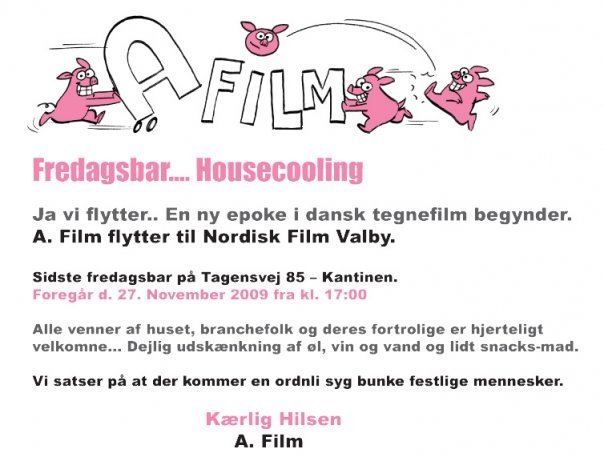
This Friday afternoon, after the main move, we will have a "House Cooling Party" in our old address on Tagensvej, for which this invite was made (in Danish!):
By the way, we keep our telephone numbers!
Our scanners have already moved, so that settled it - no new posts until sometime next week!
A. Film A/S
Mosedalvej 14
2500 Valby
Denmark
[We are still in Copenhagen, but in a part that has its own name...]
Some of you may recognize the address: for a hundred years it has been the address of the Film Studio Nordisk Film. Arguably the oldest constantly-producing film studio in the world, Nordisk Film was started November 6th, 1906. Yes, Pathé is ten years older, but it has not had the same continuity...
This Friday afternoon, after the main move, we will have a "House Cooling Party" in our old address on Tagensvej, for which this invite was made (in Danish!):
![]() |
Our scanners have already moved, so that settled it - no new posts until sometime next week!
Sunday, November 22, 2009
In the works since 1986
![]() |
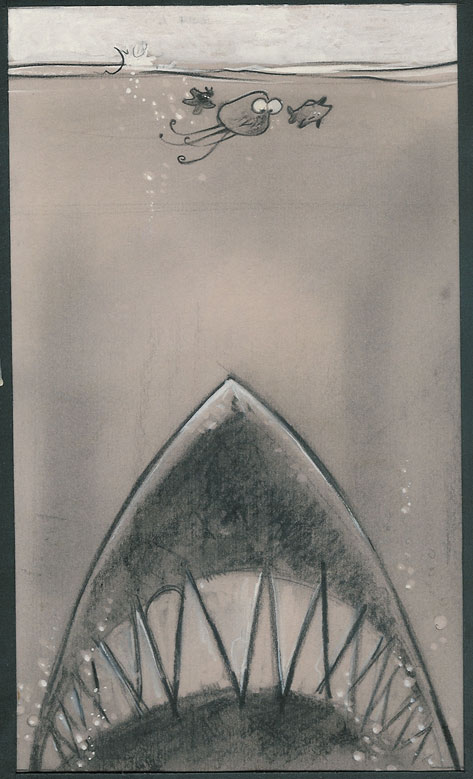
It started as an animation test for our assistants during our time at Swan Film in Copenhagen in 1986, two years before we founded A. Film. The test was "draw poses with different personalities for a fish, a starfish and a jellyfish." That was all. One of the first ideas we had for a feature film - see my previous post - was a film with these three characters basically commenting on the state of pollution under the sea. A few years later we cooked up the bit about three kids meeting a professor and being inadvertently changed into fish, and in 1996 we produced a two-minute pilot with symphonic score that financially sealed the deal. Terry Jones voiced the professor, Alan Rickman a megalomaniac pilot fish, the bad guy.
Because of the scope of the film, it eventually was a European co-production between our studio A. Film, German Münich Animation and TerraGlyph in Ireland, where Münich did much of the cleanups and coloring and TerraGlyph did some layout and the sound. We kept control, direction and much of the animation and styling were done in-house. We also had a few other studios help us with animation, including our own A. Film Estonia.
For this production I devised a system where Amiga Take-2 line tests, sent to us from all over the world in emails, were automatically unpacked and converted to OMF files for import in an AVID system. For nearly two years, the converting computer, a little IBM Aptiva that the finance department did not want to use because it was too small and too old, converted the thousands of scenes in different versions perfectly, and two weeks after the last scene was processed it died, in a little white cloud of burned-up electronics.
Above drawing is again one I picked up in our storage, a more unusual view (click on it and see WHY!) I suspect it is a gag drawing, though I do not know who drew it (yet).
Labels: A.Film
Saturday, November 21, 2009
Our First Feature(s)
![]() |
At the time, I had myself rented out to work on a project called "The History of Our Wonderful World" which I co-directed with Anders Sørensen - more about this later. I got to edit the animatic of "Jungle Jack" and animate only two scenes, as well as program the production software at night while working on the World History in the daytime. In the mean time, the studio animated on several other relatively well-known features, and a slew of commercials.
Since the first film turned out to be a success, at least locally, we began working on a sequel, "Jungledyret Hugo: den Store Filmstjerne" ("Jungle Jack the Movie Star"), with storyboard by Anders Sørensen and myself with Dan Harder and Stefan Fjeldmark who had directed the first film and would direct the second, again together with Flemming, the author. I also edited this film, and figured out how to work seamlessly with studios around the world who helped us animate it, including our own daughter company A. Film Estonia, and this resulted in my working full-time with computers.
In 2004 I happened to find a DVD called "Hugo the Movie Star" while browsing at Amoeba in Hollywood, and found that BOTH films were on it, with the first film, now called "Go Hugo Go," as a special feature to support the second one. More worryingly, I found that the soundtrack, originally produced professionally in 5.1, had been replaced by a rather awful and completely new stereo track, with actors "so good you can hear they are real actors" and music that made it sound like a cheap tv series. Then I found that, since Miramax had bought it before the Disney take-over, it had ended in the Disney library, and in a catalog for the Disney Movie Club it was on a page with "Classics" with Pocahontas and Mulan! My jaw dropped when I saw that! NONE of these things we had heard anything about before I happened upon them: when the distribution rights are sold to be able to produce the film, it is out of our hands completely.
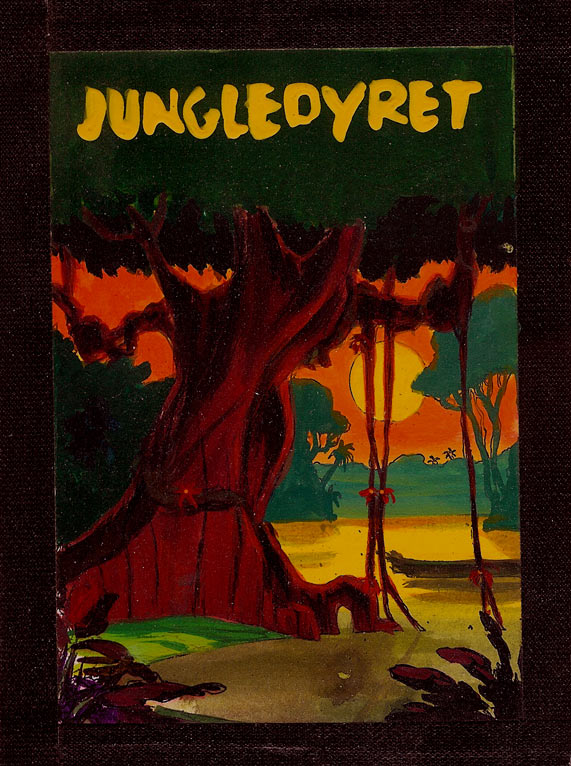
Above sketch is a very small color painting that fell out of a box in our storage when I recently rummaged through it. I have no idea who painted it, or with which exact purpose...
Labels: A.Film
Friday, November 20, 2009
The Fairytaler...
![]() |
In the year 2005, which was the 200th anniversary of his birth, my studio A. Film produced a series of television programs called Hans Christian Andersen: The Fairy Tales. Actually, the original name of the series is "The Fairytaler," which admittedly is rather constructed. We received the Hans Christian Andersen Award 2005 for this series, for “re-interpretation of H.C. Andersen's stories for children through animation”, awarded by the H.C. Andersen Committee from Andersen's home town of Odense.
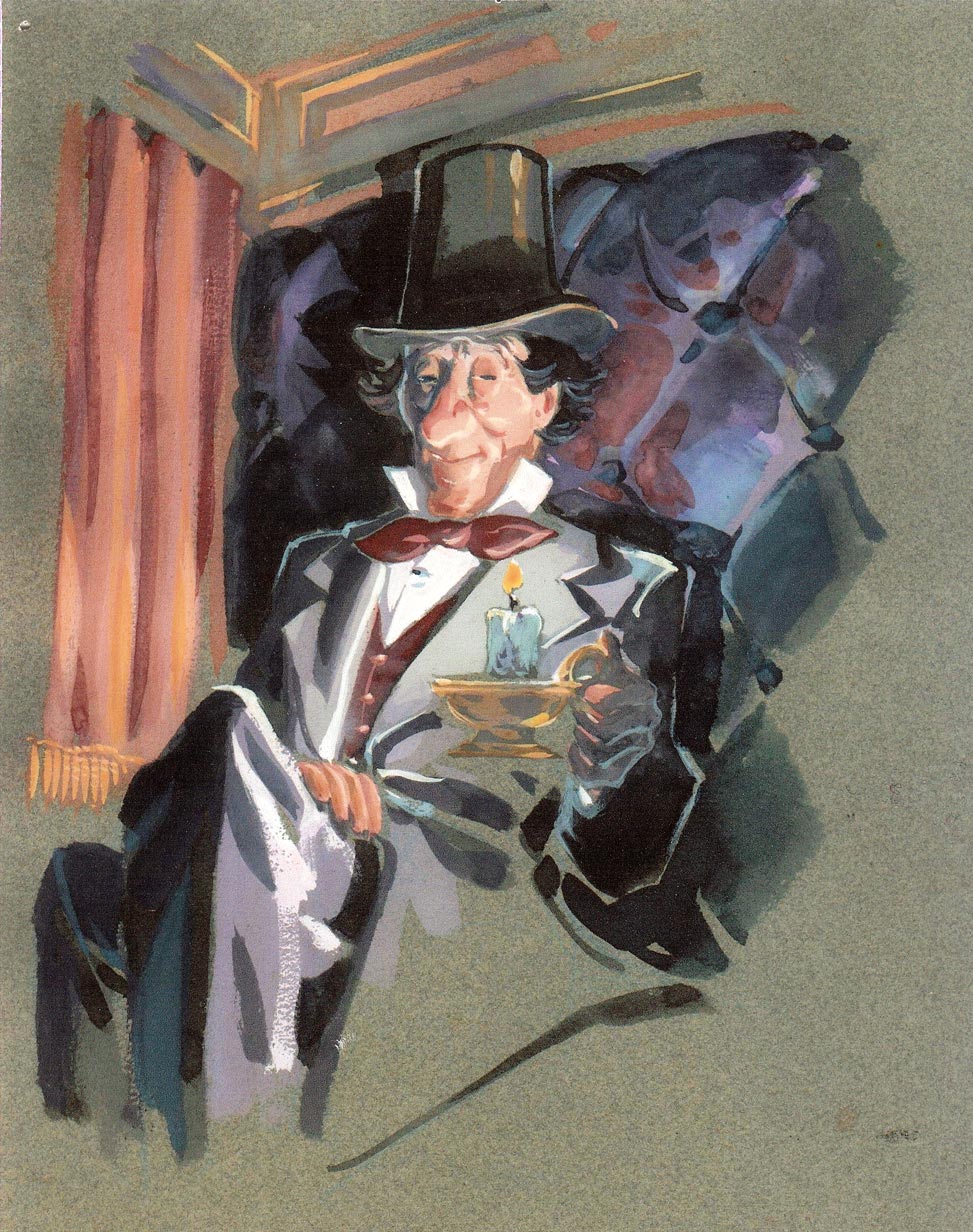
In our storage, I recently dug up a copy of above inspirational illustration which was painted by Serbian comic book author Rajko Milošević-Gera (or Guera) who is credited as storyboard artist; the series art director was Malene Laugesen with whom we have worked since the mid-80s. I like this painting, and hope you do, too...
Labels: A.Film
Wednesday, November 18, 2009
Happy Birthday, Mickey!
Mr. Mouse is 81 today!
Let's see if I can find something worth posting today...
...erh - maybe you like this one?
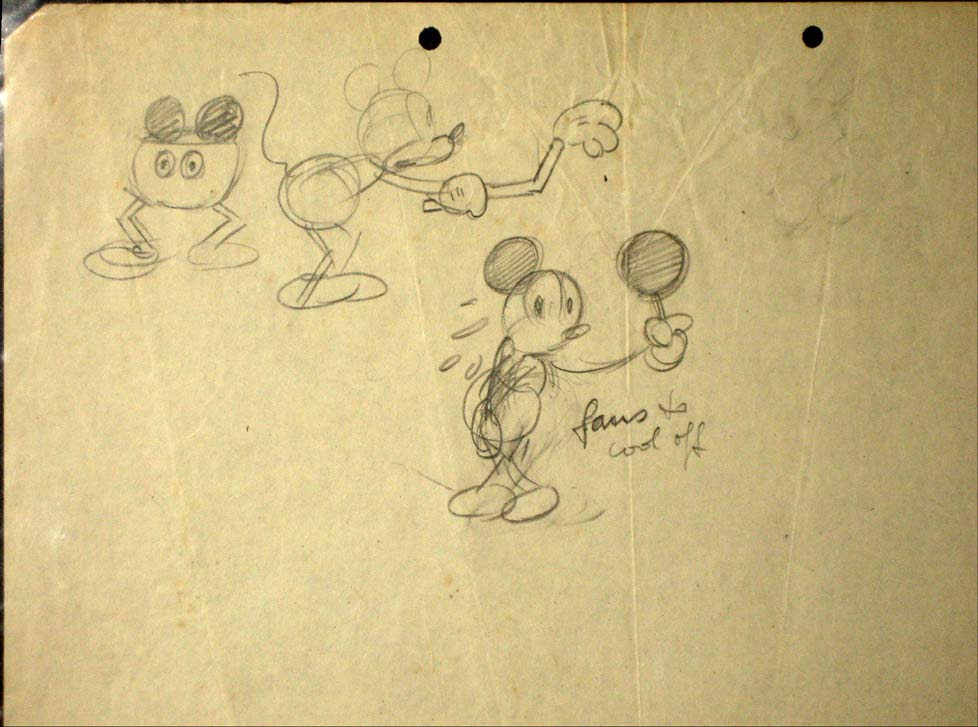
It was originally also part of the "Kentucky Stash," the box of papers that Burt Gillett gave to the daughter of a family he befriended after being hired by Van Beuren in New York in 1934. It seems to have been made as a gag drawing, to show a few things that you were not expected to do with Mr. Mouse.
Let's see if I can find something worth posting today...
...erh - maybe you like this one?
![]() |
Labels: Other Disney
Tuesday, November 17, 2009
Why different? Who cares, just buy one!
![]() | ![]() |
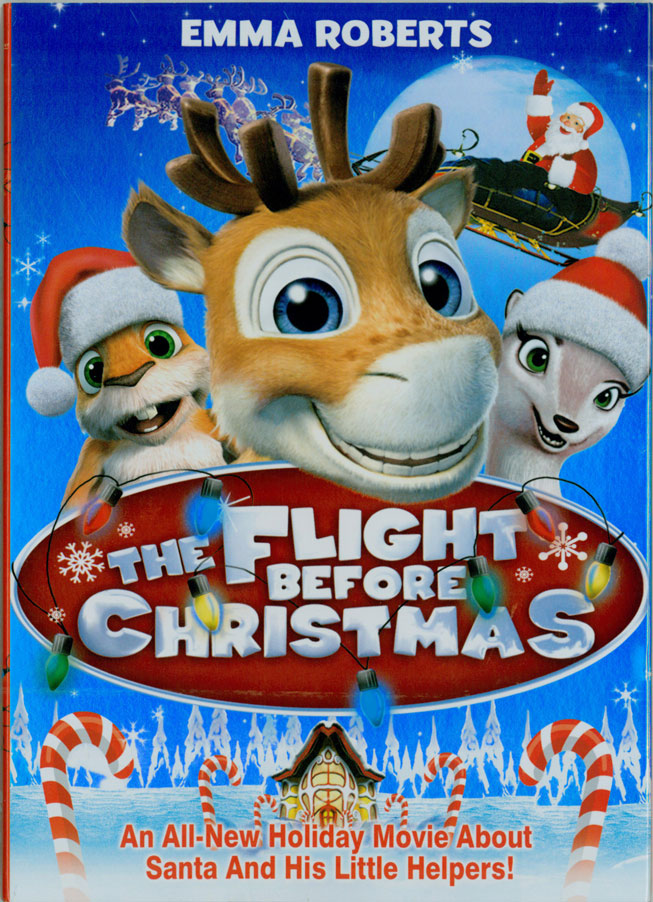
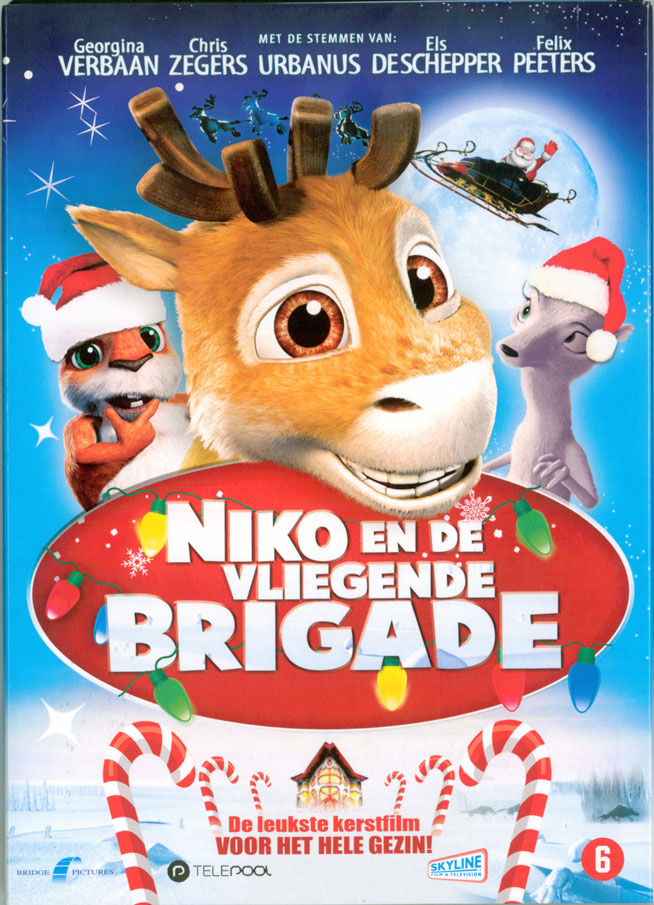
Last year, we co-produced with Anima Vitae, Cinemaker and Magma Films an originally Finnish project "Niko - Lentäjän poika," internationally released as "Niko and the Way to the Stars," in the US as "Flight Before Christmas." We did most all of the animation and a whole lot more, and are pretty pleased with the film. It was seen by 9.35 million viewers when it aired last December on CBS and CW domestically, and is currently in release in theaters in Germany as "Niko - Ein Rentier hebt ab" where it runs in nearly 400 cinemas and has been seen by over 200,000 in the past two weeks, which is a lot!
Here are the US and Dutch covers! Have a look up close - they are actually similar yet completely different! I wonder why this is - I guess it is a rights issue between the distributors.
I can only hope that everyone buys the film, if only to see what they missed by the cutting of 27 minutes for the US airing!
Monday, November 16, 2009
Upside-down Cake...
The last one of this type for now, it is a short one - not for a short cake but shortning for an upside-down cake.
Also from the Babbitt/Hubley reel, this is so controlled, it MUST be Art Babbitt's animation! I wish someone would make a DVD with all these wonderful commercials!
Labels: Video
Sunday, November 15, 2009
Faygo Black Cherry
Just a little thing from the Babbitt/Hubley reel that I have had lying around a loooong time...
Labels: Video
Friday, November 13, 2009
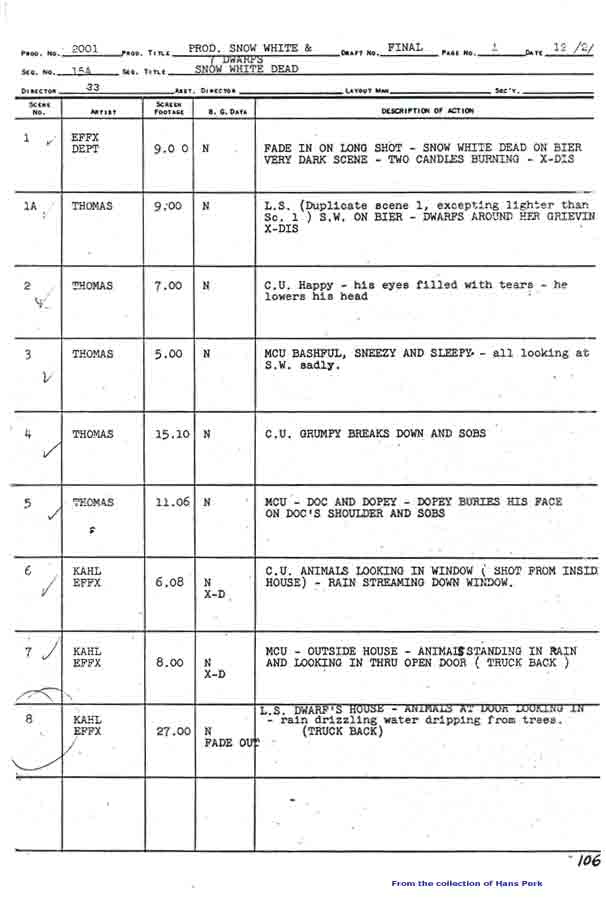
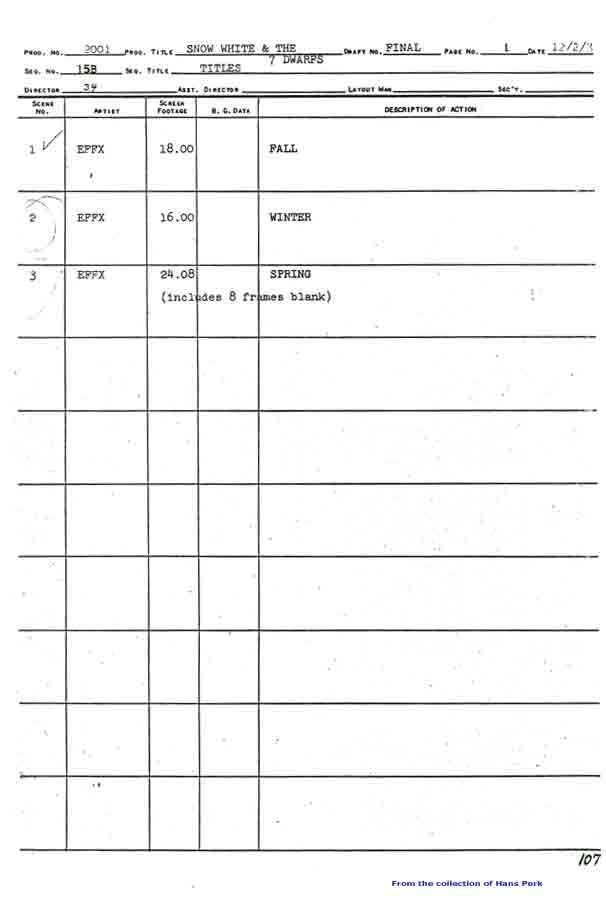
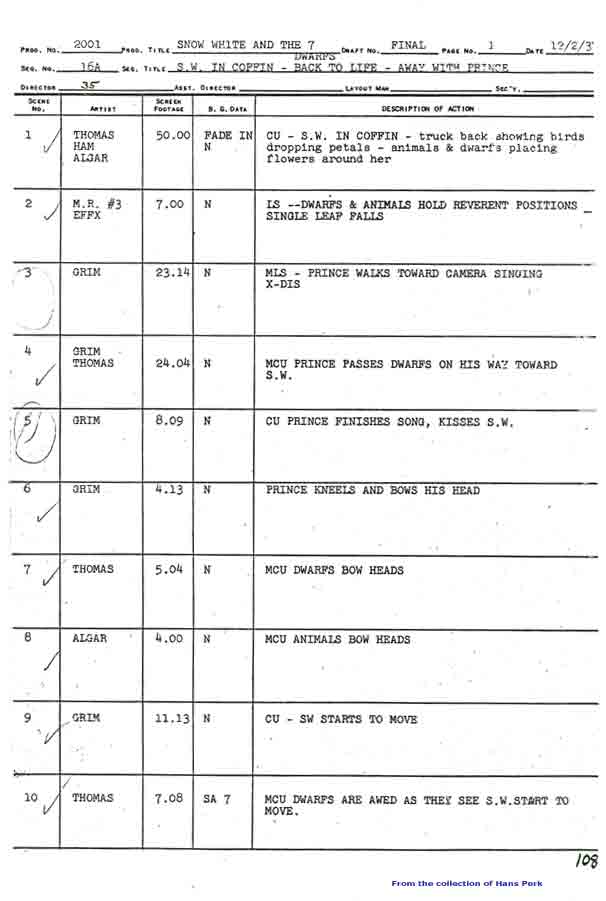
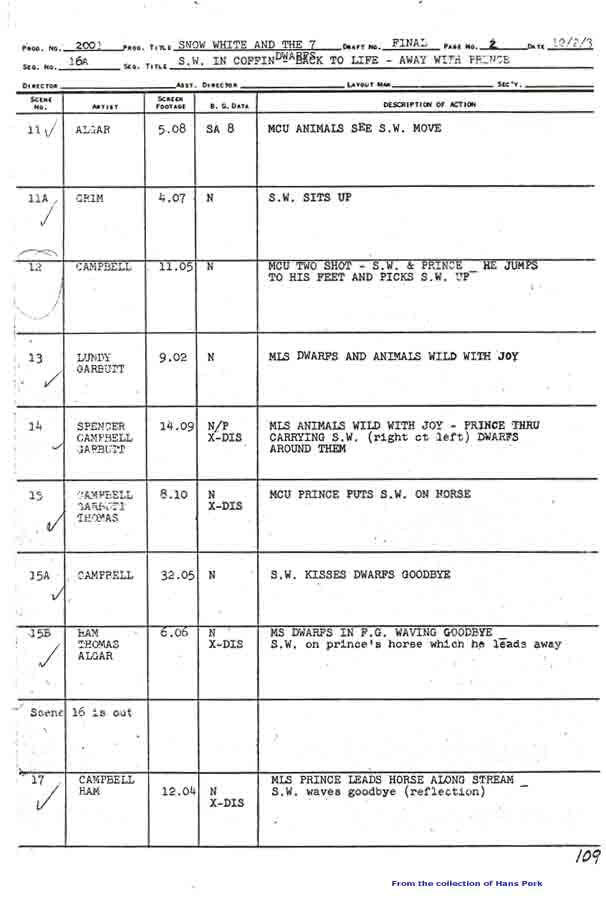
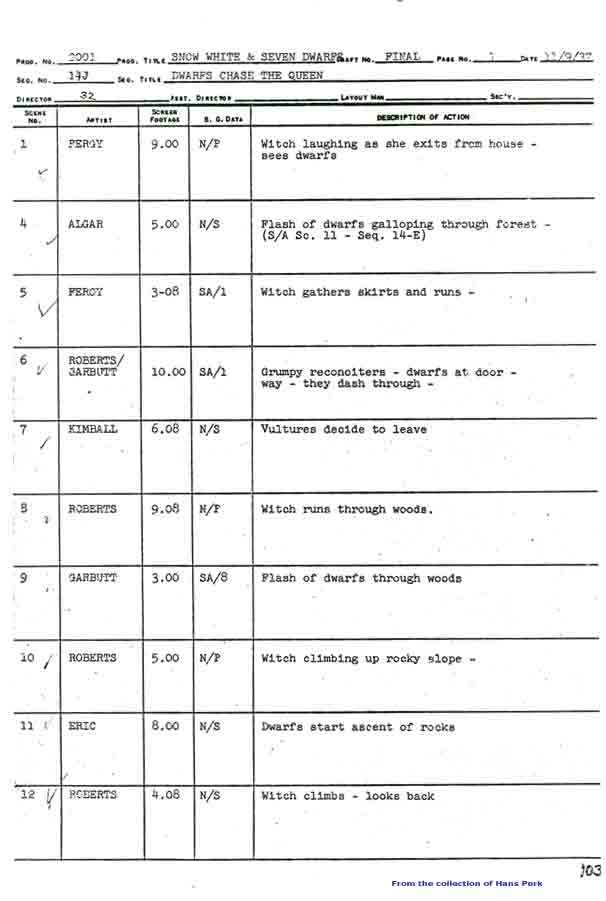
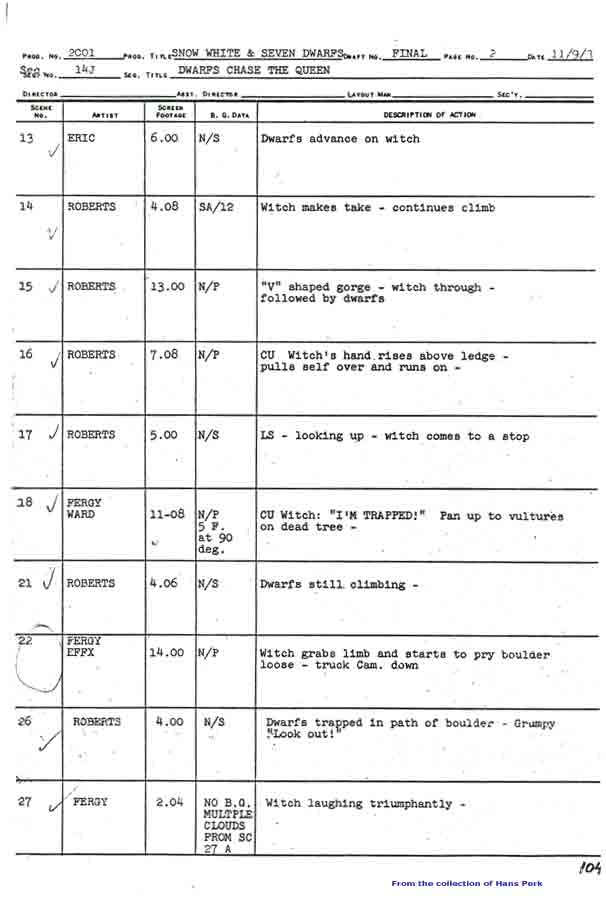
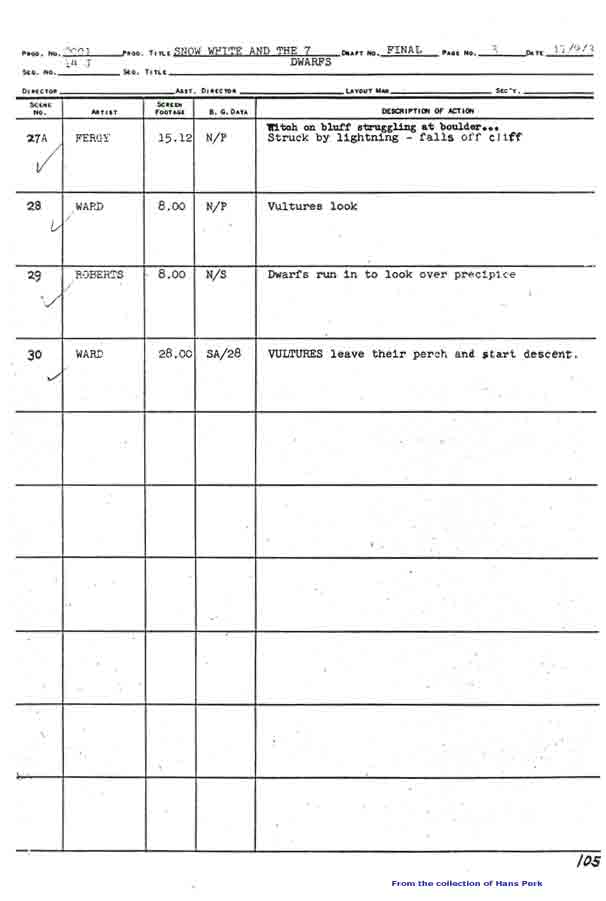
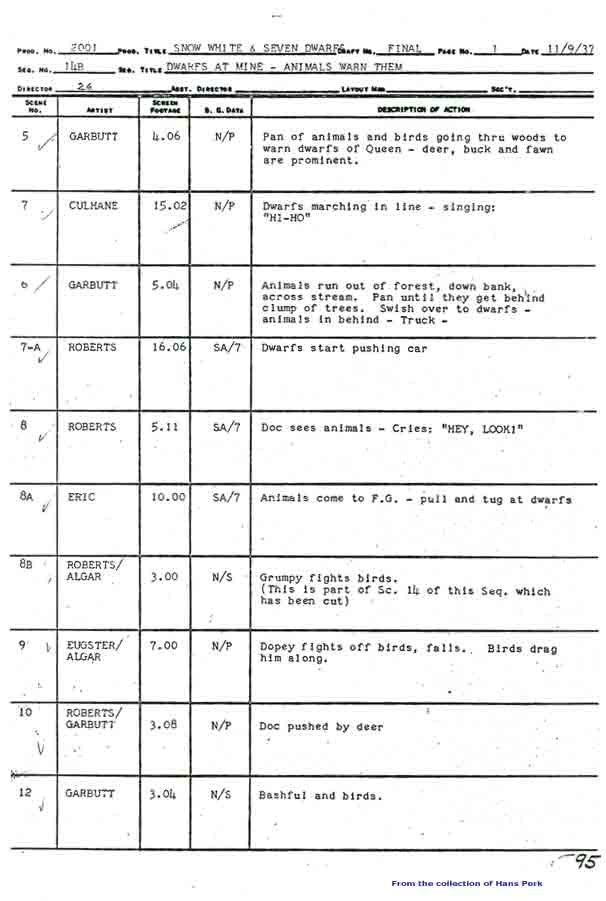
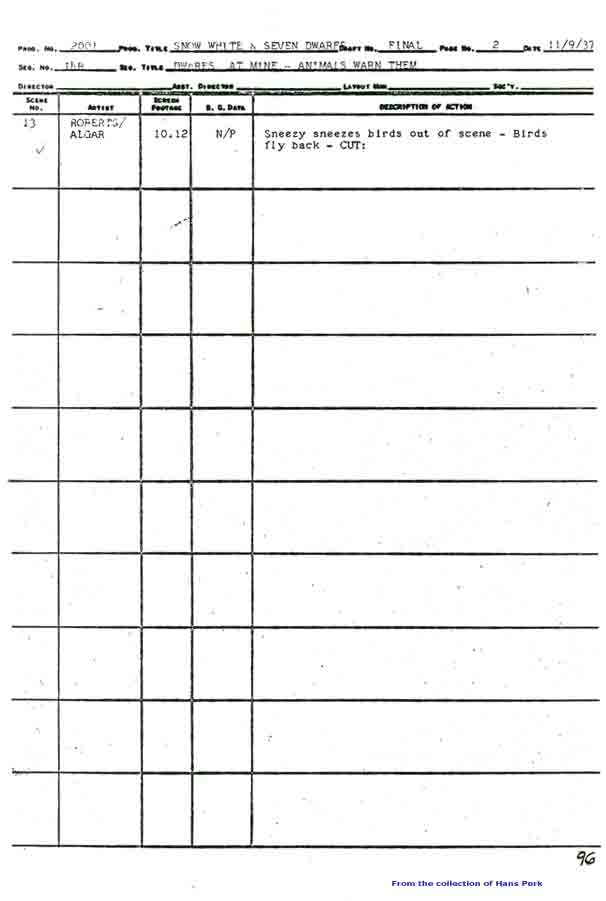
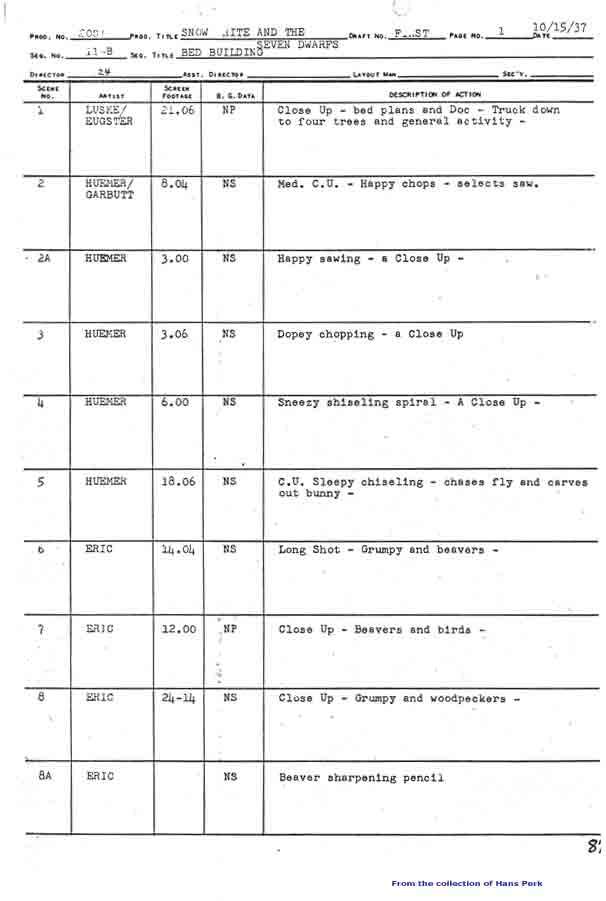
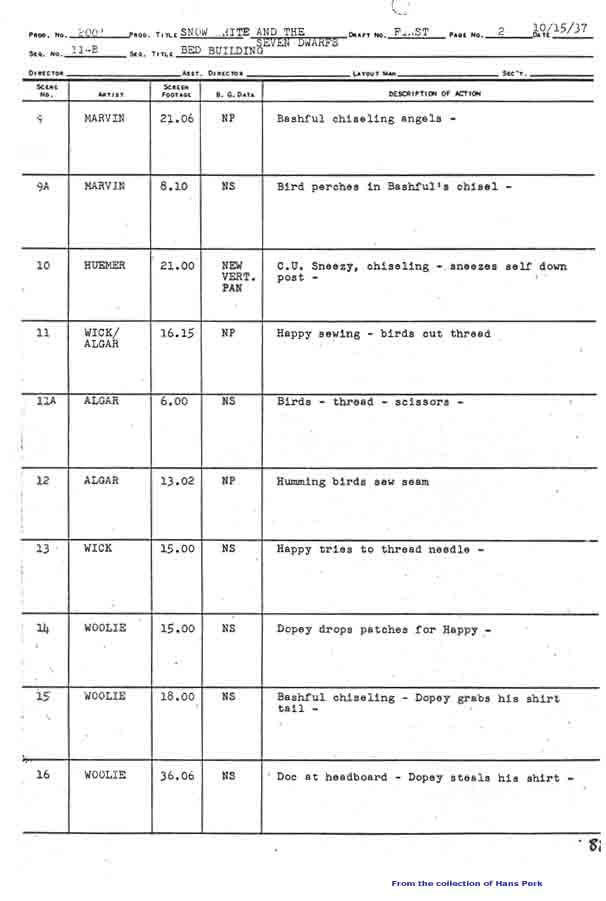
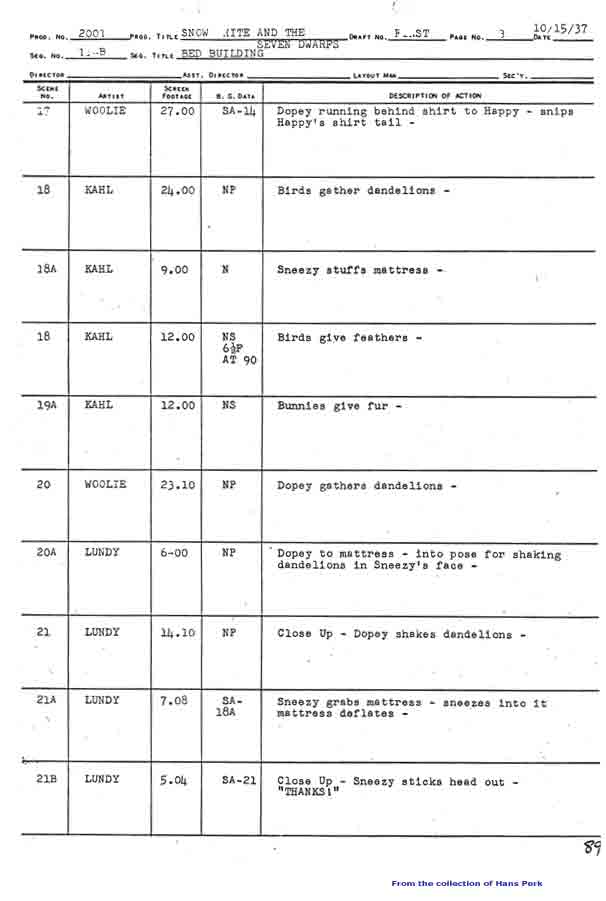
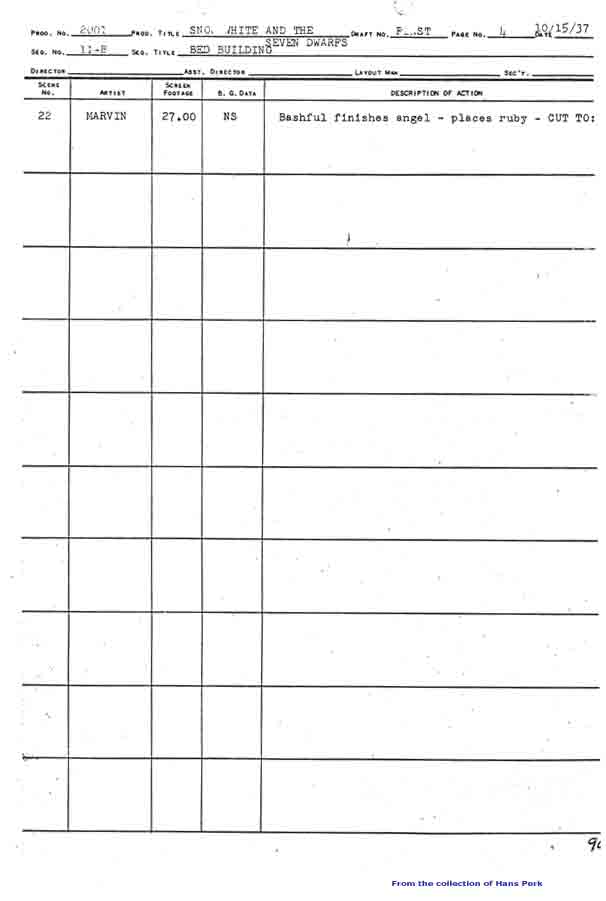
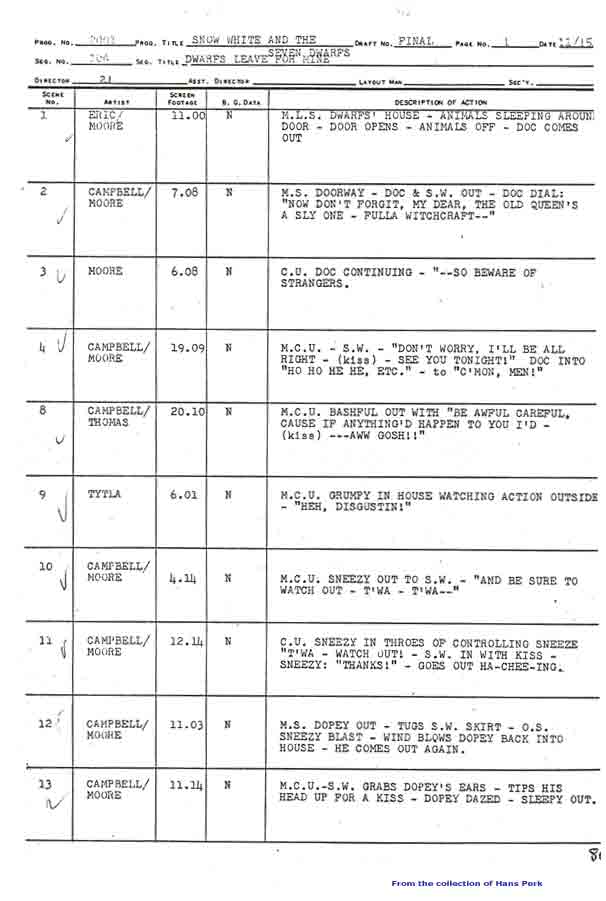
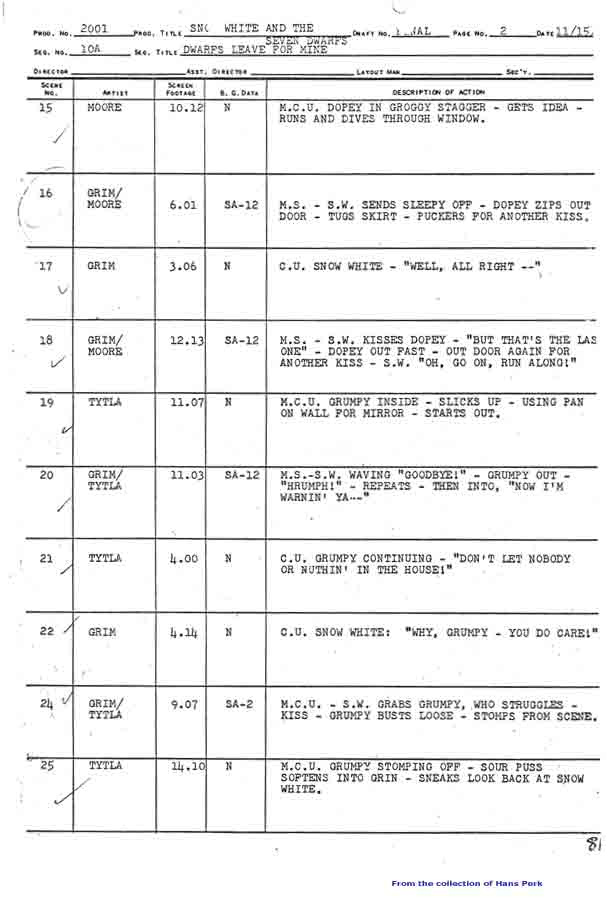
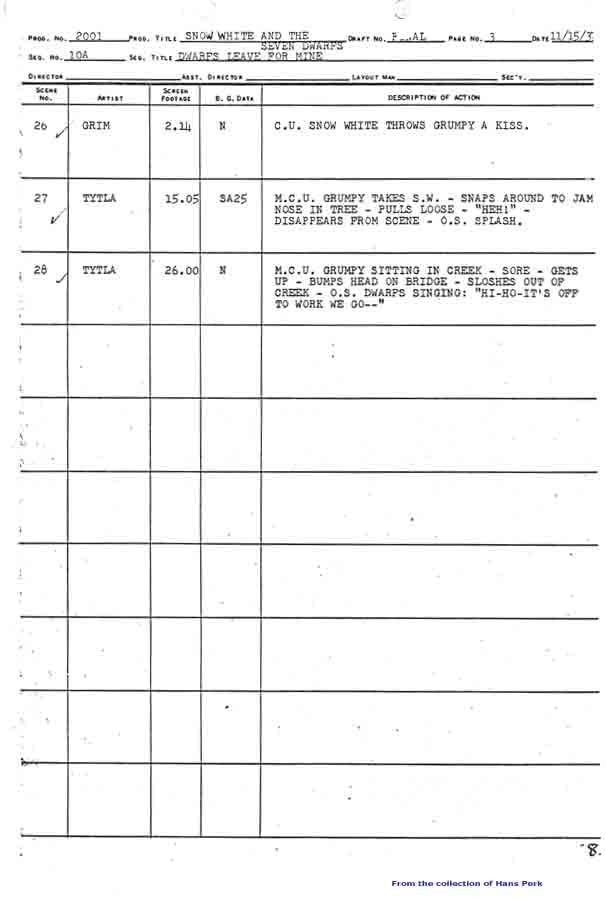
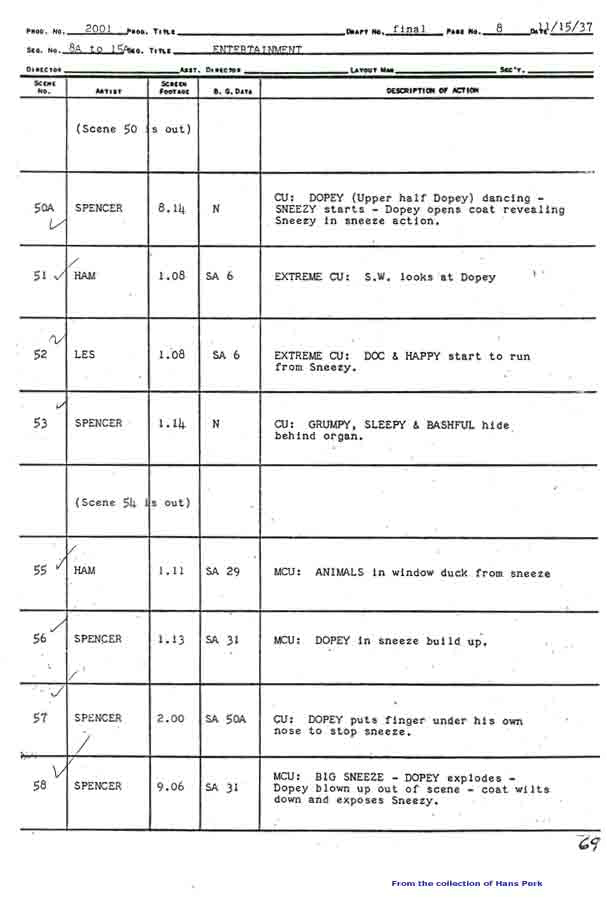
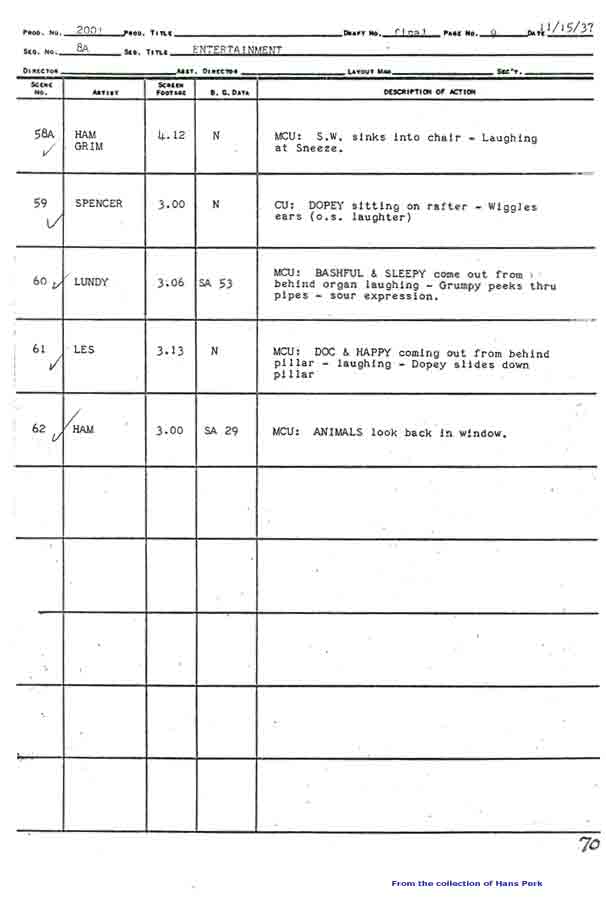
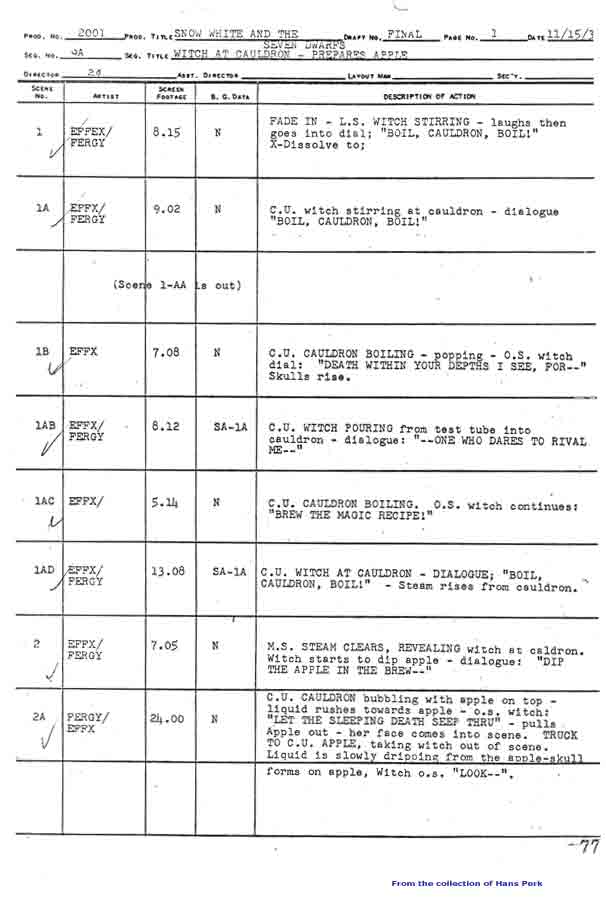
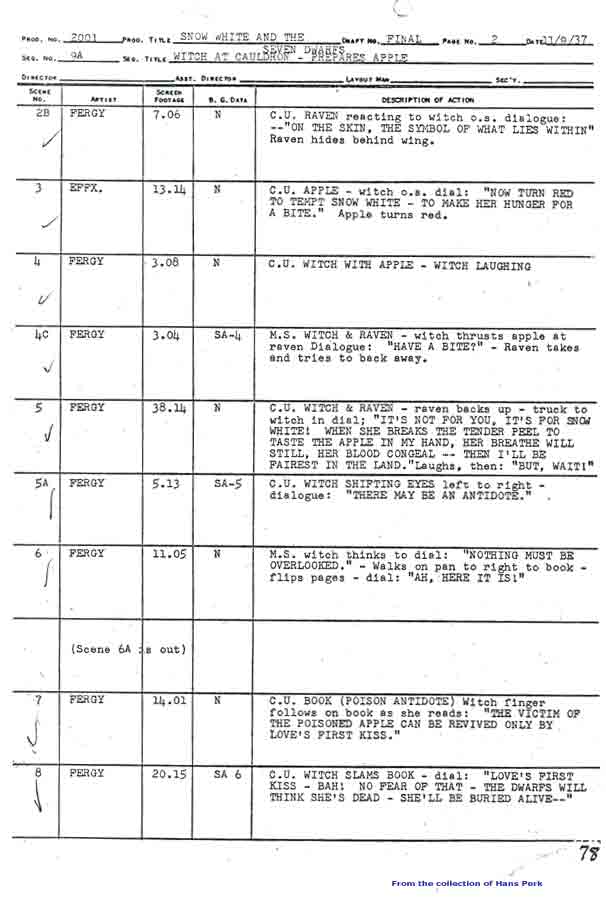
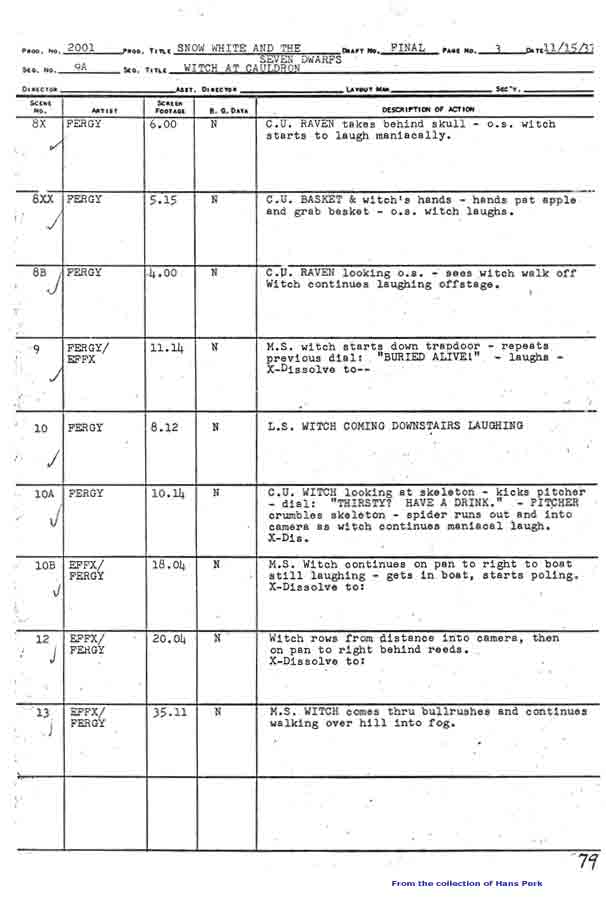
Prod.2001-Snow White&the Seven Dwarfs(XXIII)
![]() | ![]() | ![]() | ![]() | ![]() |
- Dwarfs by Frank Thomas, animals by Milt Kahl
Seq. 15-B "Titles"
- Three titles by the effects dept.
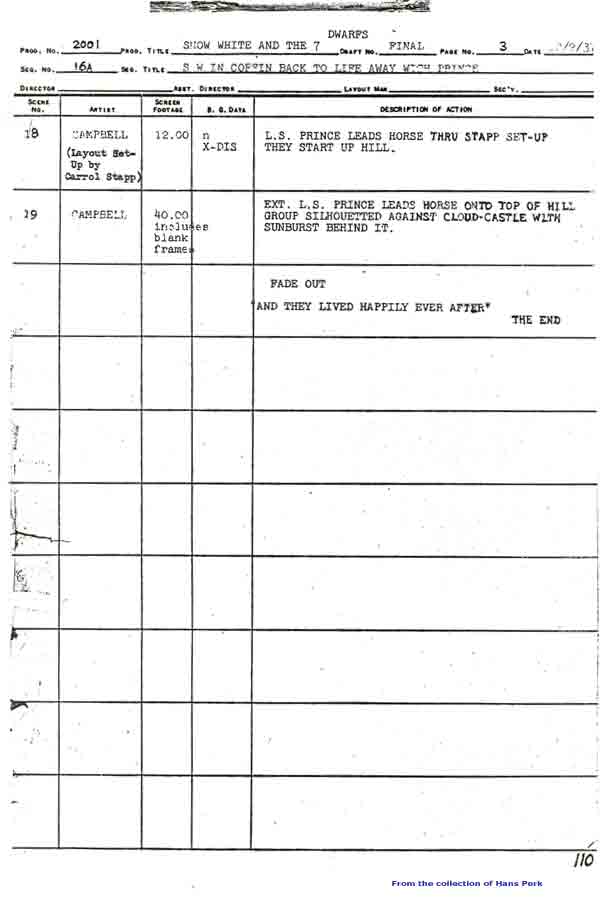
Seq. 16-A "S.W. in Coffin - Back to Life - Away with Prince"
- Snow White by Ham Luske, Grim Natwick and Jack Campbell, dwarfs by Frank Thomas, Dick Lundy and Fred Spencer, animals by Jim Algar and Bernard Garbutt.
Frank Thomas' famous sequence of crying dwarfs - the sequence that had hardened moguls crying at the premiere - is so well described in The Illusion of Life that I will suffice to refer to that most important of all books on animation. If you do not have it, GET IT! It is still in print! Then look it up on pages 173ff. and 475ff...
This concludes the draft for Snow White: it is no secret that they lived happily ever after...
Snow White and the Seven Dwarfs was Walt Disney's BIG gamble, which grew bigger as it went along. At first it was thought that it would cost about the same as ten short films, since its length would be similar. But then costs ballooned, and it ended around a million and a half dollars. When the L.A. liaison of Bank of America, Joe Rosenberg said to Walt "That thing is going to make a hatful of money," he wasn't kidding! (By the way, I saw a documentary recently that spoke of "the evil banker." If Rosenberg, under orders from A.P. Giannini, really was an evil banker, there would NOT have been a Snow White!) Currently, IMDb has its Domestic gross as $184,925,485. Adjusted for inflation it ranks as the number two film after Gone With The Wind with $2.36 billion!!!
The eight million the film made in its initial release was quickly plowed back into the studio, with new films (Pinocchio, Fantasia) lined up and a whole new studio to be built. Eventually this led to a darker period, as well, as the money got spent so quickly that the bonuses that were promised during the production of Snow White were left unpaid. This became one of the breeding grounds of the unrest that fostered the 1941 strike. But let's not get too much into that - let us instead return to the tranquil beauty of the first successful Technicolor animated feature film Snow White. It was Walt's first, the film that took up all his attention. It will stand forever as a touchstone for all further success and advances in the field of animation!
Here is a line of trivia that I swiped from IMDb: "Publicity material relates that production employed 32 animators, 102 assistant, 167 "in-betweeners", 20 layout artists, 25 artists doing water color backgrounds, 65 effects animators, and 158 female inkers and painters. 2,000,000 illustrations were made using 1500 shades of paint."
For those of you who followed the last 23 postings and would like to be able to browse the Snow White draft more freely, you can find all 110 pages that are available on this blog in this handy 3.42MB .zip file! Just please remember where you saw it first! Note that if you haven't read the postings from the start, you are not invited to download the .zip file yet, go back and read them all first!
By the way, I am on a small trip, back some time next week! Please do not let that keep you from commenting on my Snow White postings, and remember to look at John V.'s blog for more of his thoughts on character casting etc.
Remember to check out the archives (see labels in the right column!), where you can find eighty (80) short film drafts, six other complete features and parts of others, as well as some twenty Action Analysis Classes, twelve patent descriptions and a lot of other documents, clippings and videos, and most importantly, information about my own studio, A. Film!
Happy Friday the 13th!
Thursday, November 12, 2009
Prod.2001-Snow White &the Seven Dwarfs(XXII)
![]() | ![]() | ![]() | ![]() | ![]() | ![]() |
- Snow White by Bob Stokes, Witch by Norm Ferguson
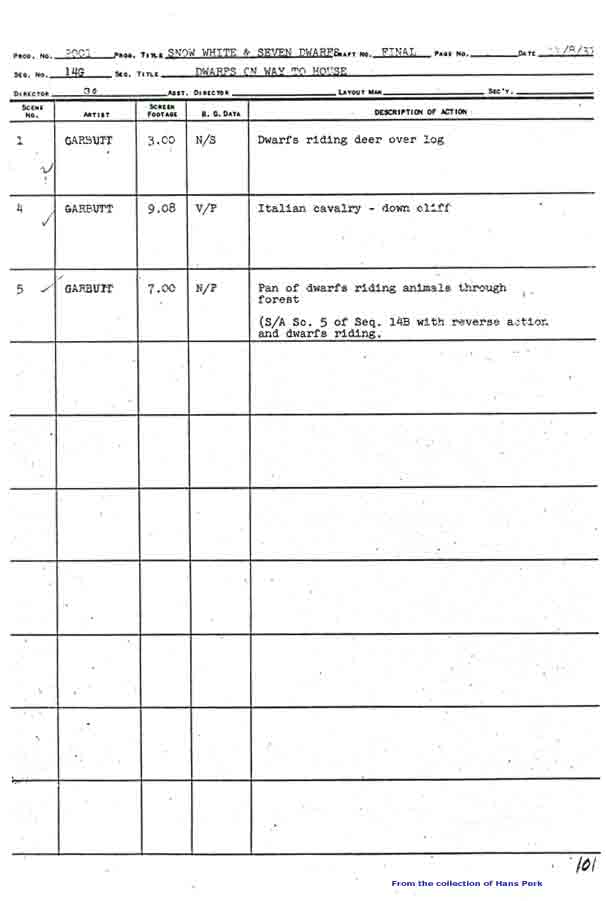
Seq. 14-G "Dwarfs on Way to House"
- Animals and dwarfs by Bernard Garbutt
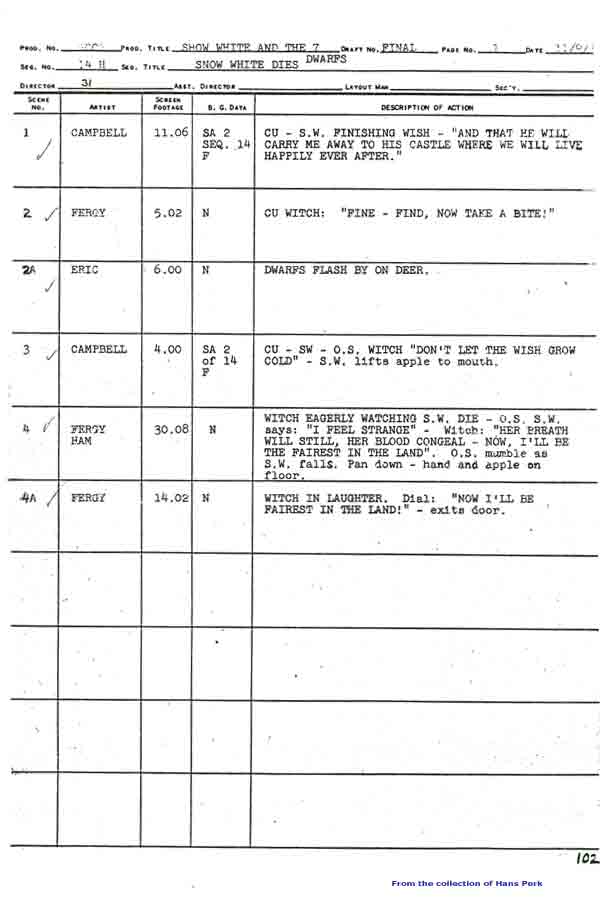
Seq. 14-H "Snow White Dies"
- Snow White by Jack Campbell and Ham Luske, Witch by Norm Ferguson, Dwarfs on deer by Eric Larson.
Seq. 14-J "Dwarfs Chase the Queen"
- Witch by Norm Ferguson, Dwarfs by Bill Roberts, with fast action scenes by Jim Algar, Bernard Garbutt and Eric Larson, vultures by Ward Kimball.
Fast cutting, lots of excitement!
Not a lot of surprises on the draft...
Wednesday, November 11, 2009
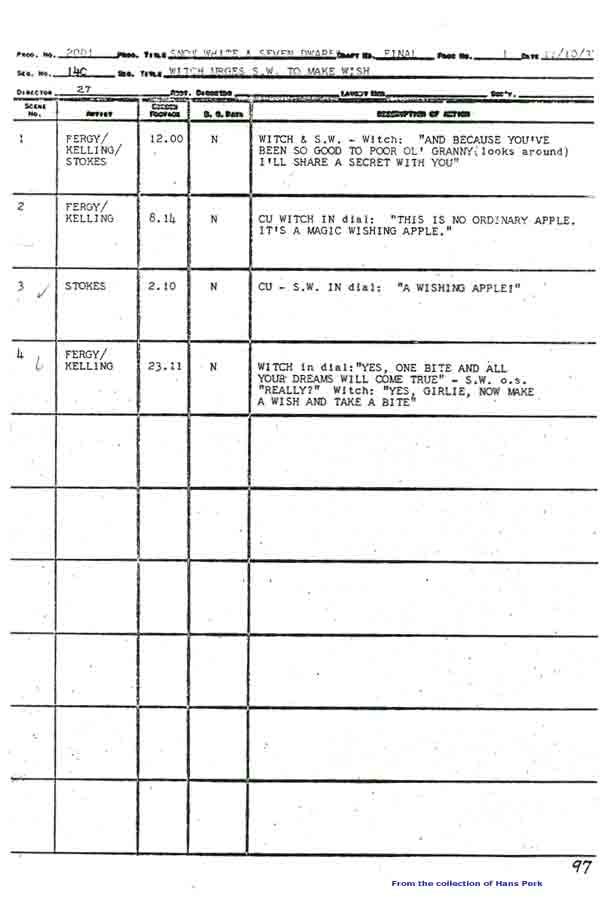
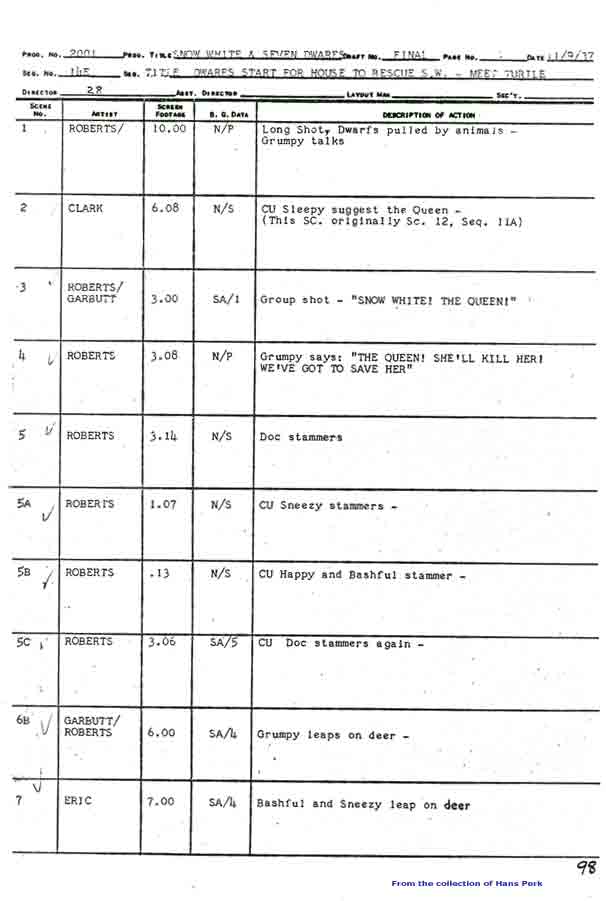
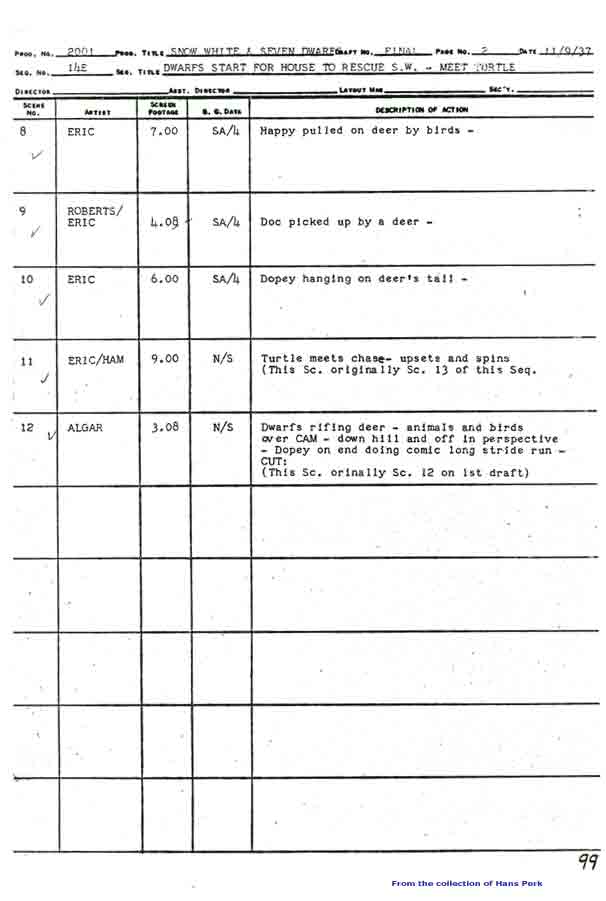
Prod.2001-Snow White & the Seven Dwarfs(XXI)
![]() | ![]() | ![]() | ![]() | ![]() |
- Dwarfs by Shamus Culhane, Bill Roberts, Al Eugster, animals by Eric Larson, Jim Algar and Bernard Garbutt (incl. incidental dwarfs).
Culhane will always be connected with Heigh-Ho! Also it is interesting to see the "animal expert" Garbutt be entrusted to "put dwarfs on his deer," as if they are just part of the animals' overlapping action.
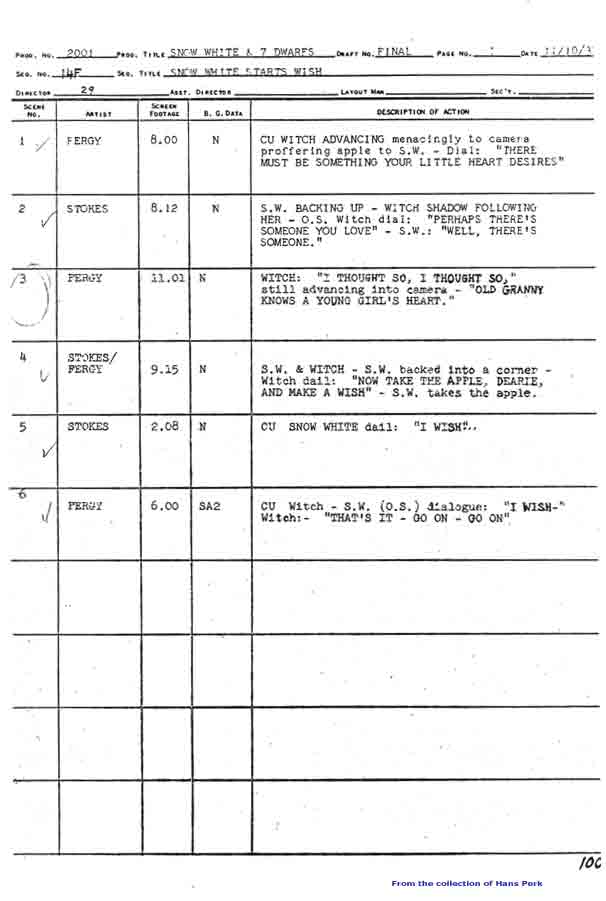
Seq. 14-C "Witch Urges Snow White to Make Wish"
- Witch by Norm Ferguson and Frank Kelling, Snow White by Bob Stokes.
Frank Kelling, another of the animators that found their way onto Gulliver's travels, like Shamus Culhane, Grim Natwick, Al Eugster and Stan Quackenbush, not to mention Joe D'Igalo, Tom Palmer, Bob Leffingwell or even Thurston Harper and Ben Clopton (who worked on Disney's Alice series), may here have been animating assistant for Norm Ferguson. We know that Kelling was animating for Disney already in 1931. He worked on Oswald for Lantz as seen in the group photo in this recent posting by Mike Sporn.
Seq. 14-E "Dwarfs Start for House to rescue S.W. - Meet Turtle"
- Dwarfs by Bill Roberts, Les Clark, animals by Bernard Garbutt, Eric Larson and Jim Algar. Whether Ham Luske animated the turtle or the passing crowd of dwarfs is not clear. His experience from "The Tortoise and the Hare" may be a clue.
Les Clark's scene FEELS like it is taken out of context, and lo - it is, originally from the lodge meeting, where Sleepy suggests building a bed! Does this mean that that sequence was animated in its entirety?
Tuesday, November 10, 2009
Prod.2001-Snow White & the Seven Dwarfs(XX)
![]() | ![]() | ![]() | ![]() |
- Snow White by Bob Stokes, Witch by Norm Ferguson, animals by Eric Larson, Milt Kahl, Ward Kimball (vultures) and Bernard Garbutt.
This very scary sequence has some very interesting cuts: having the vultures land while the Witch says "Just wait till you taste one!" is a strong statement of imminent death. The birds attacking the Witch again is very symbolic - nature tries to help poor innocent Snow White. Bob Stokes' animation is, of course, based on photostats, but he manages to make it look natural and not just boring tracings, while Fergy's witch is deliciously over the top.
Monday, November 09, 2009
Prod.2001-Snow White & the Seven Dwarfs(XIX)
![]() | ![]() | ![]() | ![]() |
- Dwarfs by Ham Luske, Al Eugster, Dick Huemer, Marvin Woodward, Bob Wickersham, Woolie Reitherman and Dick Lundy, animals by Eric Larson, Jim Algar and Milt Kahl (incl. one dwarf scene).
How much of this sequence was actually animated, I do not know. Again, the missing check marks on this Morgue draft tell me that there are no animation folders extant. This sequence was all storyboarded, though, and at the very nice exhibit a year or two ago in DCA (south of Disneyland), quite a few of the story drawings were on display.
Al Eugster complained that all his animation was cut out of the film. We will see later that this was not altogether true, but at least here went one scene. We haven't anything by Dick Huemer either! But what I find most interesting to see is the (quite logical) casting of Woolie Reitherman on action scenes with the dwarfs...
[Quick note, nothing to do with Snow White: publication date of Colin White's book on Kay Nielsen now shows as February 2010!]
Sunday, November 08, 2009
Prod.2001-Snow White&the Seven Dwarfs(XVIII)
![]() | ![]() | ![]() | ![]() |
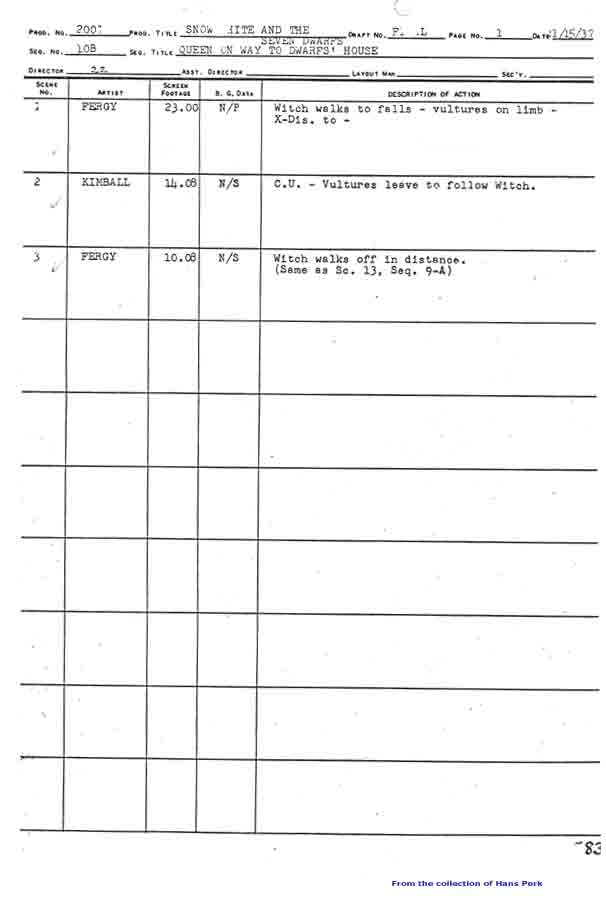
- Witch by Norm Ferguson, Vultures by Ward Kimball.
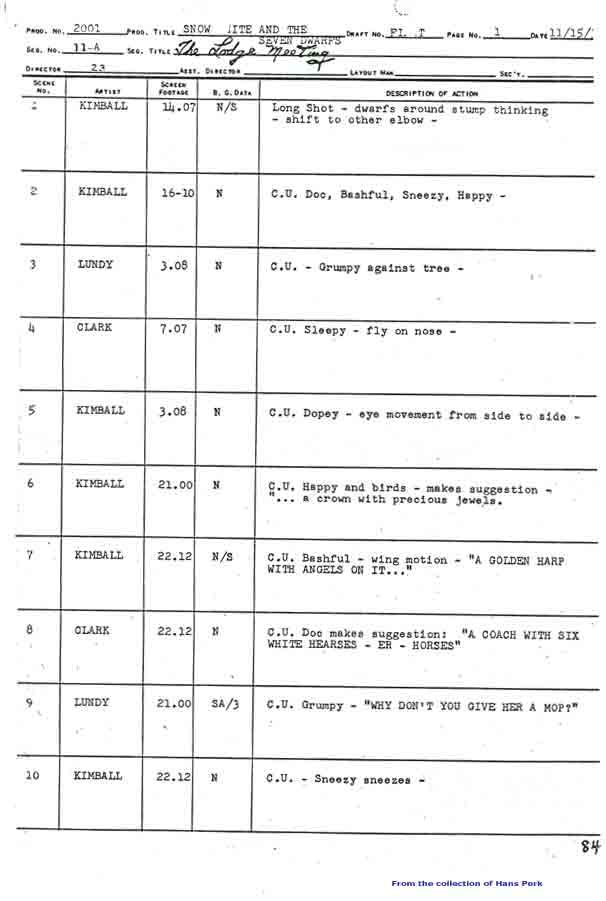
Seq. 11-A "The Lodge Meeting"
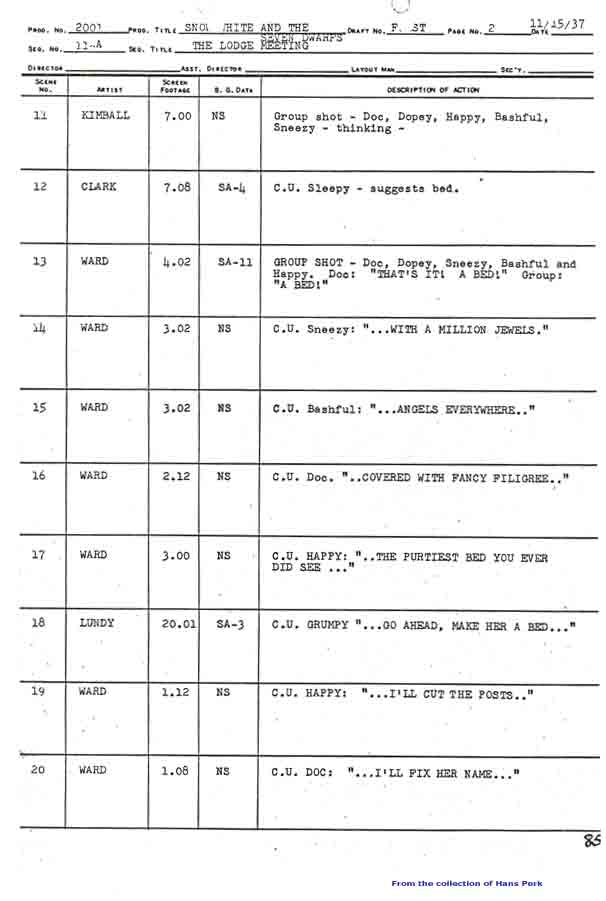
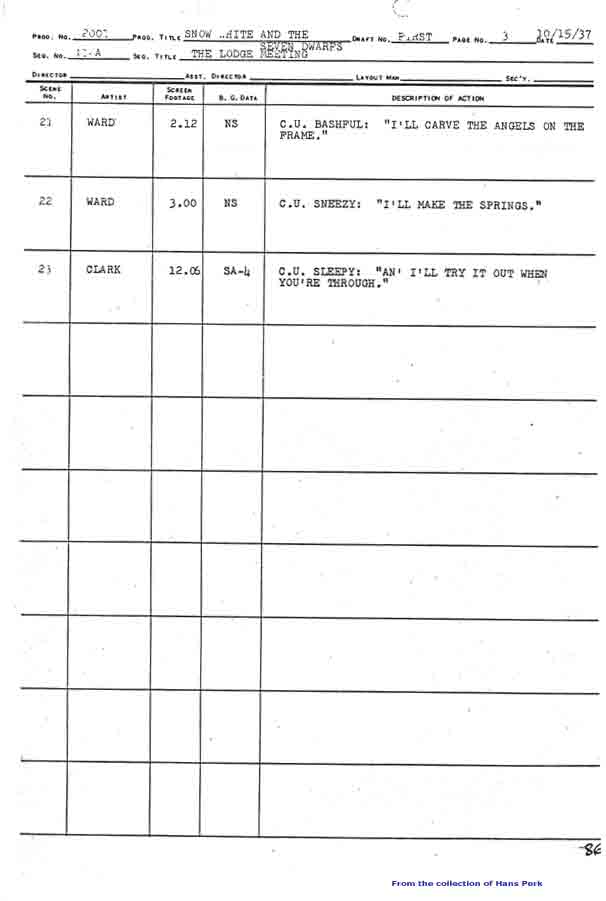
- Dwarfs by Ward Kimball, Les Clark and Dick Lundy.
The Lodge Meeting is the second of the three sequences cut from the film, where the information is still found in the draft, and the second cut sequence with animation by Ward Kimball, in this case nearly a minute and a half (133-03 ft or 1min:28sec:19fr), basically only leaving him the vultures that follow the witch. It would be interesting to know just how far the animation had been finished when the sequence was cut. Since there are no check marks in this, the Morgue's, draft, I am tempted to deduce that there are no animation folders in existence...
(But wait and see Seq. 14-E Sc. 12!)
Saturday, November 07, 2009
Prod.2001-Snow White &the Seven Dwarfs(XVII)
![]() | ![]() | ![]() |
- Snow White by Jack Campbell and Grim Natwick, Dwarfs by Fred Moore, Frank Thomas and Bill Tytla, animals by Eric Larson.
In the first part of this sequence, Jack Campbell shares the screen with Fred Moore, with a Bashful scene by Frank Thomas and a Grumpy scene by Bill Tytla. Then Grim Natwick takes over on Snow White, and the final Grumpy character scenes are all Bill Tytla. Somehow all this sounds logical - only the scene by Frank Thomas is a bit of a surprise.
My old mentor Børge Ring commented to me, based on the sequence where Snow White tells the dwarfs to go wash, that during a lunch in Amsterdam in 1984--when I got Frank and Ollie to lecture in Holland--he (Børge) told Frank "You were the first to reduce squash and stretch to its present day proportions." Frank laughed and said "Yes, and the others warned me "You'll get killed for this!""
An addition to previous postings: Tony Rivera, who seems to have been an animating assistant in the Snow White unit, had quite a career afterwards. A few days ago, I happened to see his name on "A is for Atom" (with animation by another ex-Disney artist, Emery Hawkins), then looked him up on IMDb, and found layout credits on Magoo's Christmas Carol, The Man from Button Willow, Chuck Jones' The Phantom Tollbooth, and even The Nine Lives of Fritz the Cat!
Friday, November 06, 2009
Thursday, November 05, 2009
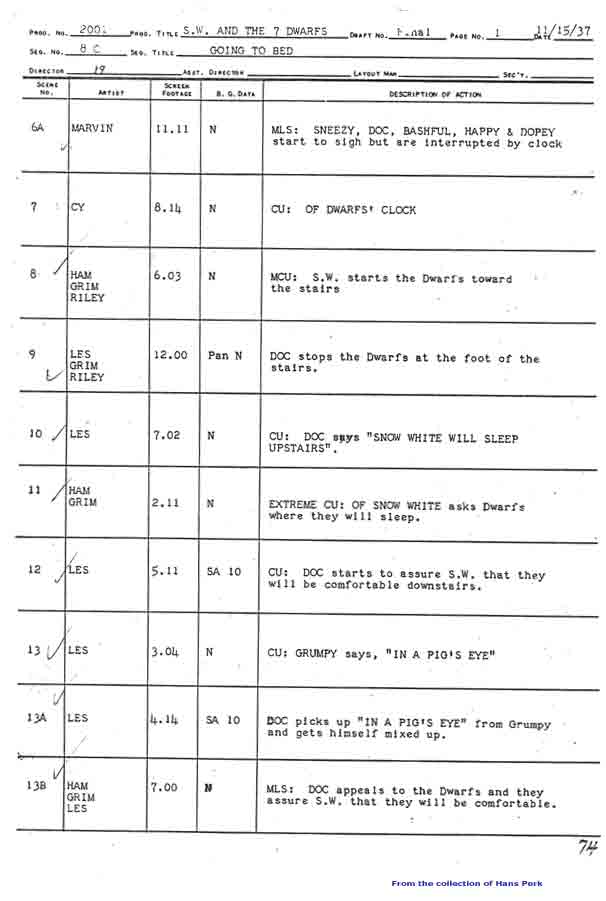
Prod.2001-Snow White & the Seven Dwarfs (XV)
![]() | ![]() | ![]() |
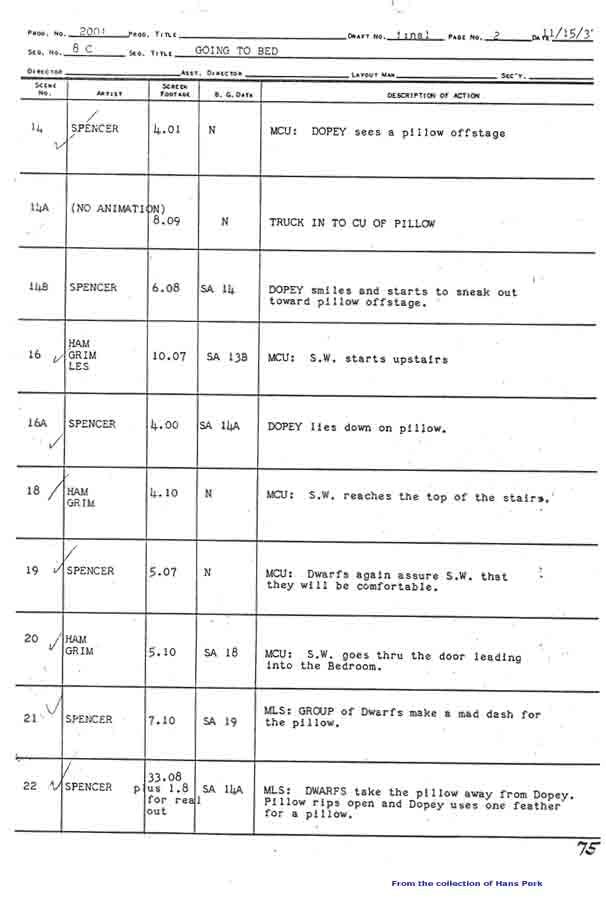
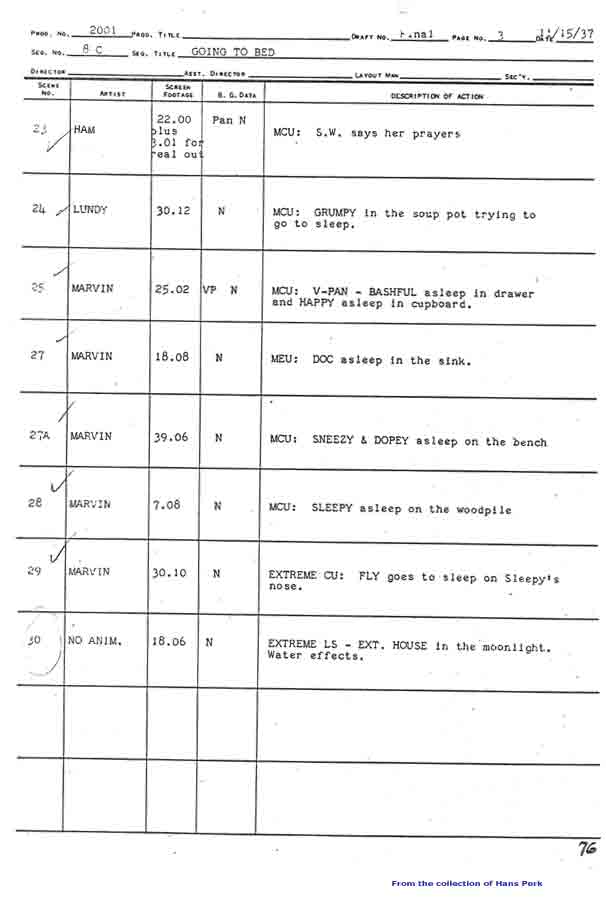
- Snow White by Ham Luske and Grim Natwick, dwarfs by Marvin Woodward, Riley [Thomson], Les Clark, Fred Spencer and Dick Lundy, effects (clock) by Cy Young.
Basically we have character dwarfs by Les Clark, slapstick dwarfs by Fred Spencer and sleeping dwarfs by Marv Woodward...
Note that we start with scene 6A, and there are, again, many inserted numbers, where a situation is divided into several scenes. This seems most often to entail cutting to a close up and back, which could have been instrumental in heightening our nearness--and thus our interest--in the characters.
I cannot come up with an explanation as to why scenes 22 and 23 have extra footage (1-08 and 3-01 respectively) added "for real out." What would that mean? Should it be "reel" and not "real"? Why the odd length? I mean, 1-08 is one second, that's a good length in any circumstance, but 3-01? Any takers?
Wednesday, November 04, 2009
Prod.2001-Snow White & the Seven Dwarfs(XIV)
![]() | ![]() | ![]() |
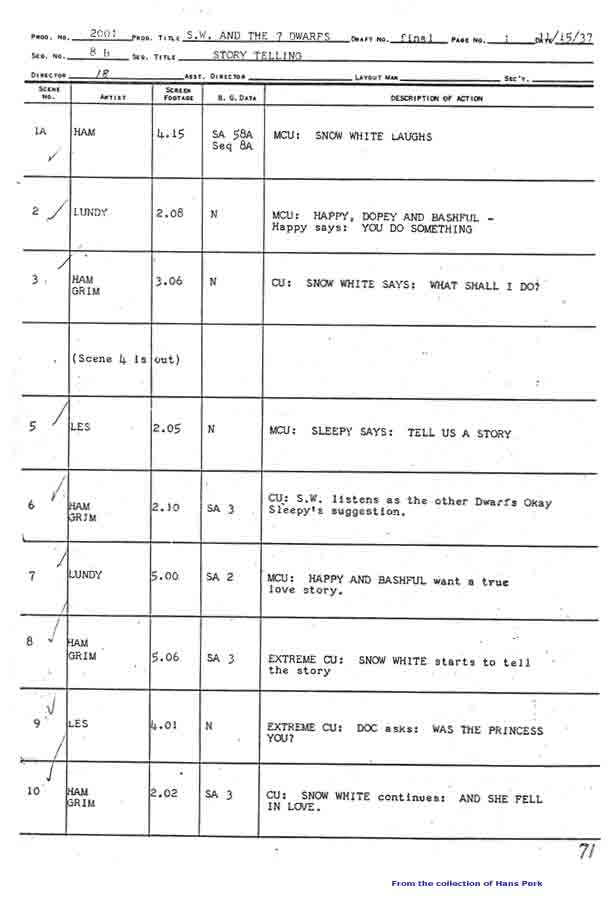
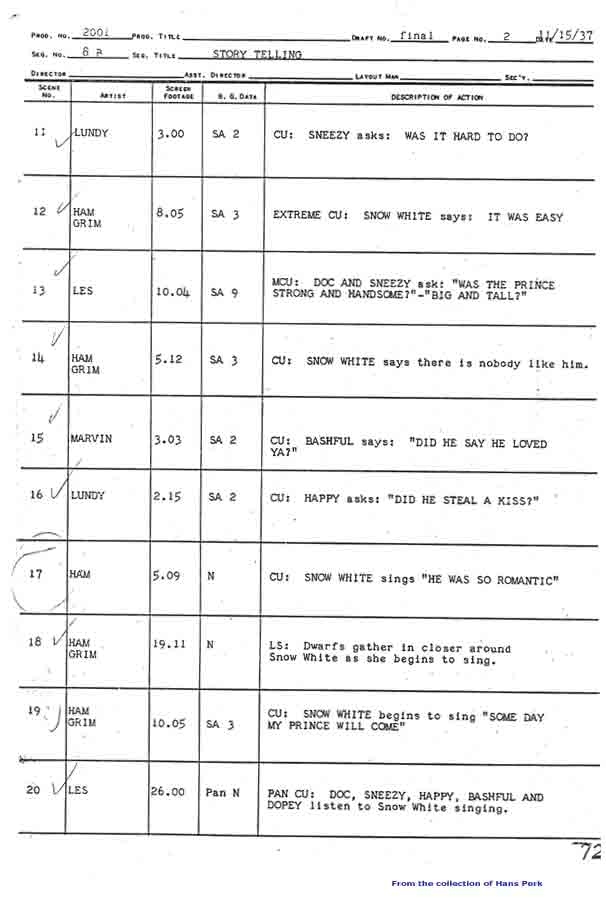
- Snow White by Ham Luske and Grim Natwick. Dwarfs by Dick Lundy, Les Clark and Marvin Woodward. Animals by Jim Algar.
In a way, this is the extension of "I'm Wishing," a reprise of the
"I want" song, but here it is a whole new song, and a very memorable one, to boot. Several scenes are credited to both Ham and Grim, but in a way I am most surprised by scene 18, a long shot of the dwarfs gathering around Snow White, that has no "dwarf animator" credits.
It is interesting to see the Christie's auction in London on the 24th of this month, as it does not only have the "Future Fantasias" book that I referred to in an earlier posting, but it also has a sketch of Sleepy in scene 25 in the sequence described above.
By the way, I bet the Alice shot list originally came from the same box of Burt Gillett documents that I talked about earlier!
Tuesday, November 03, 2009
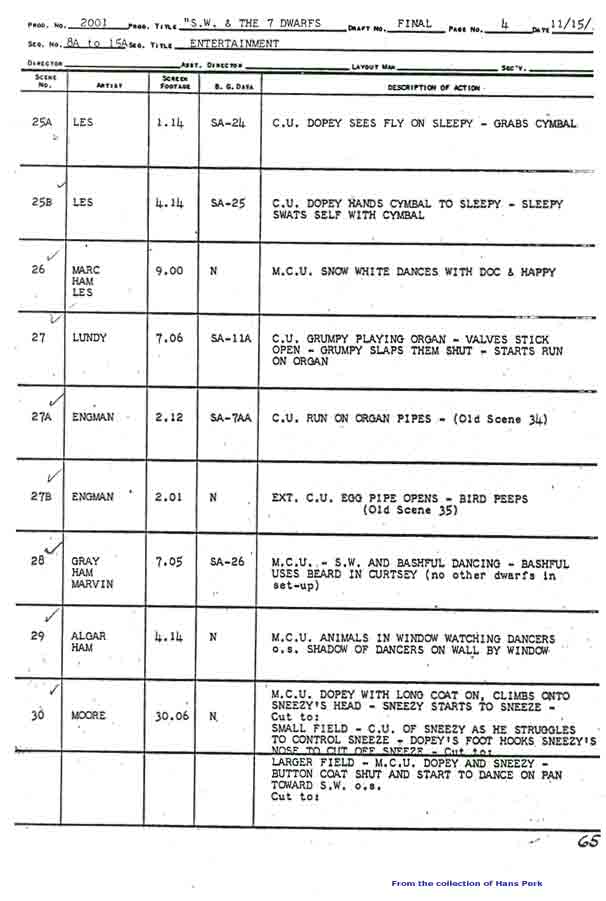
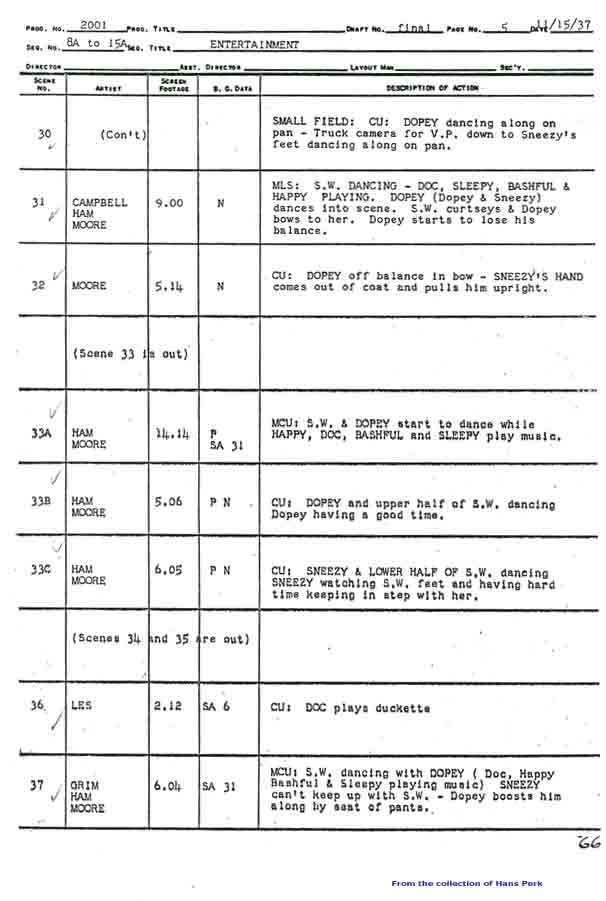
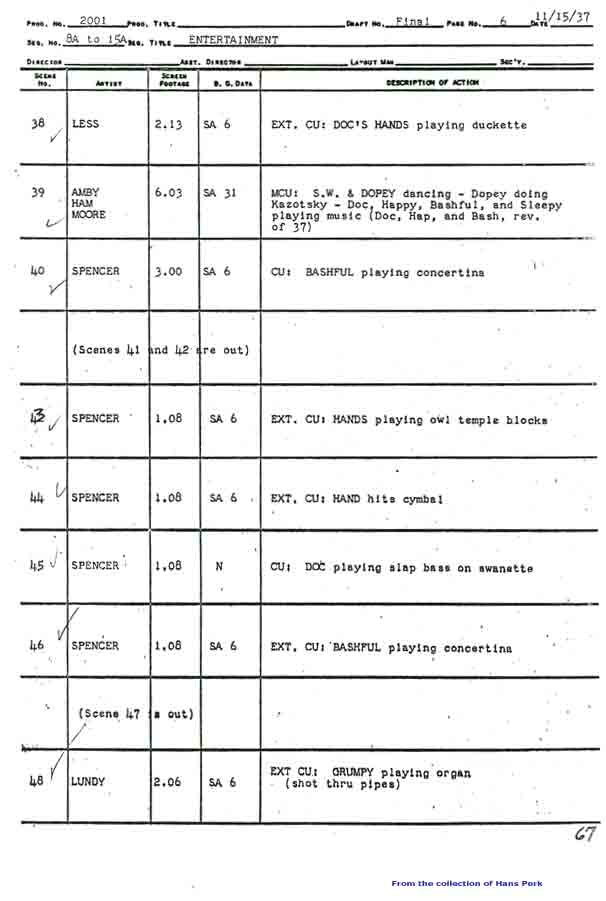
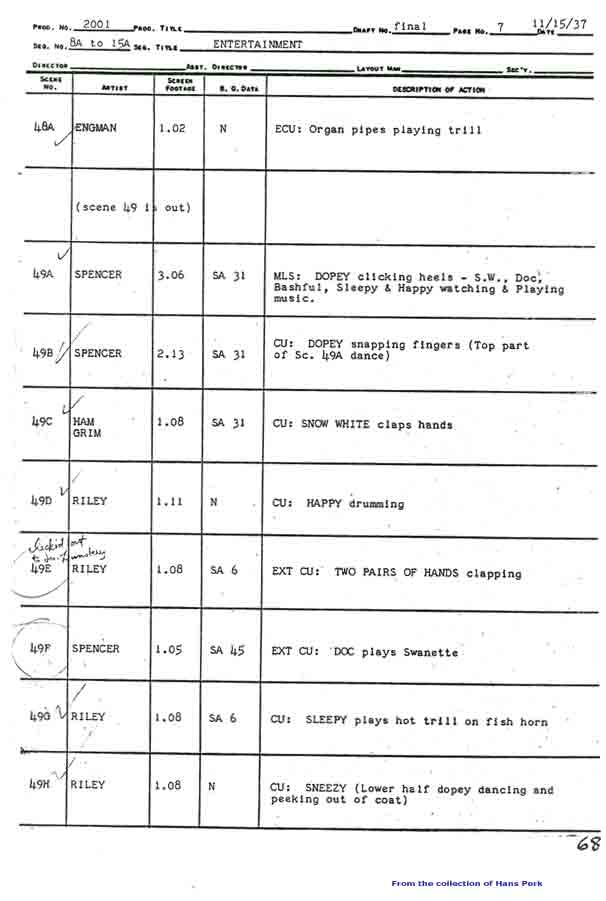
Prod.2001-Snow White & the Seven Dwarfs (XIII)
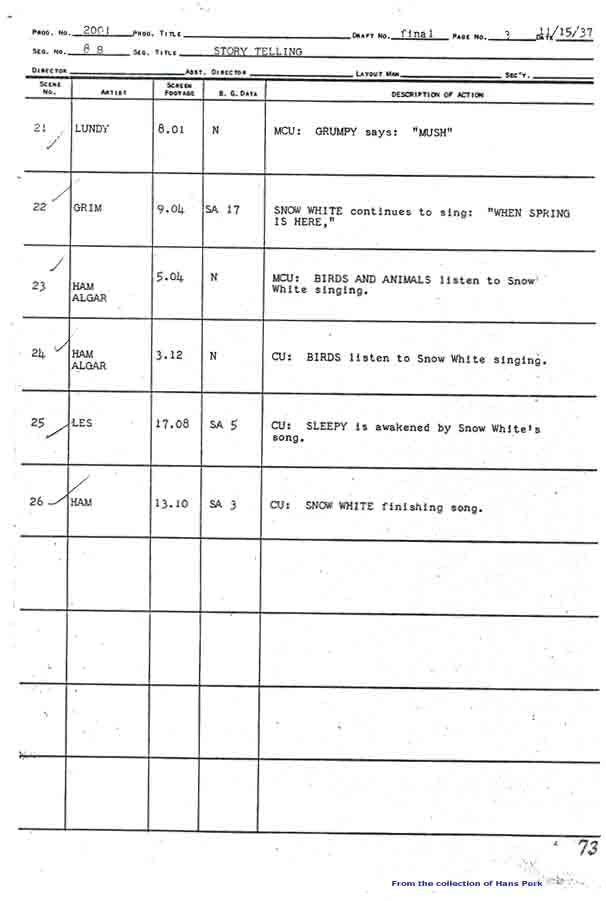
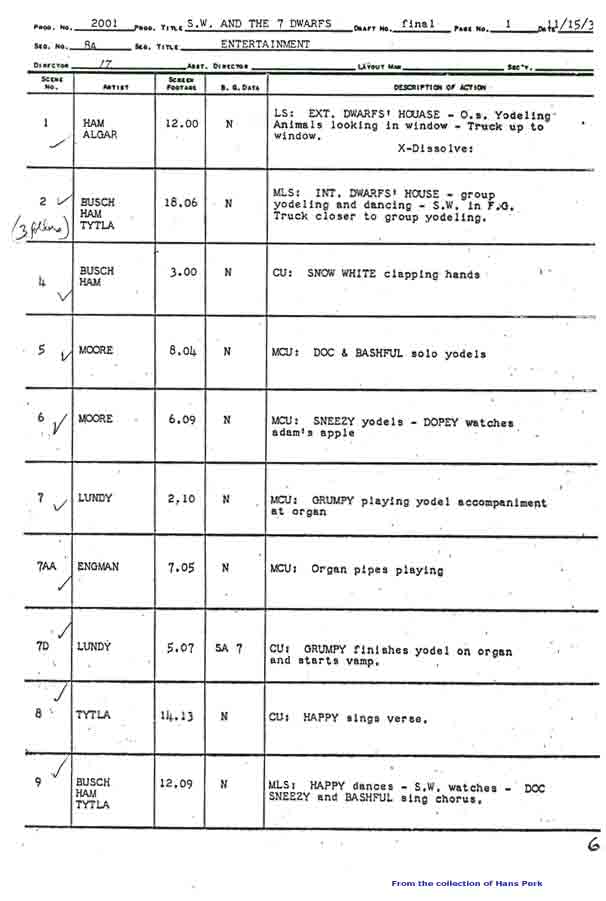
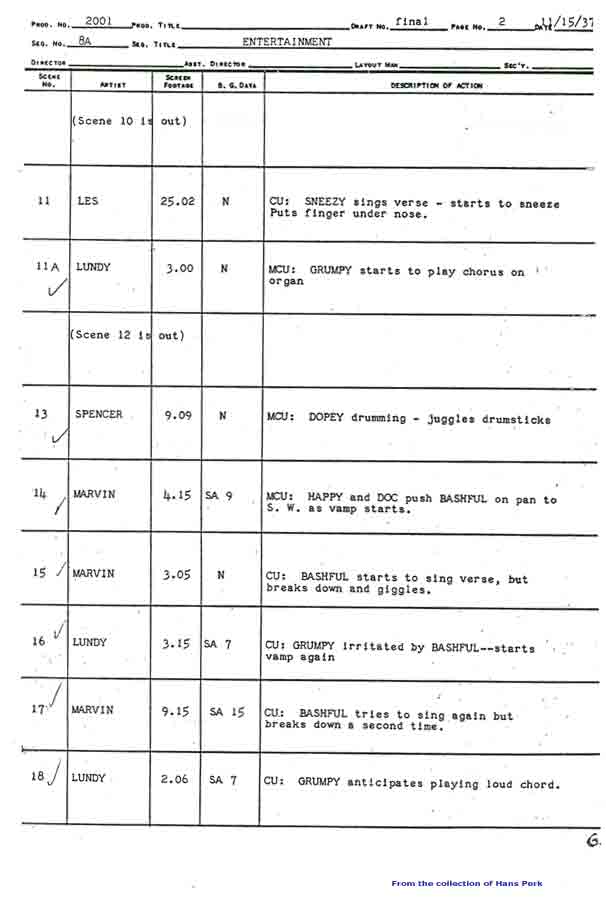
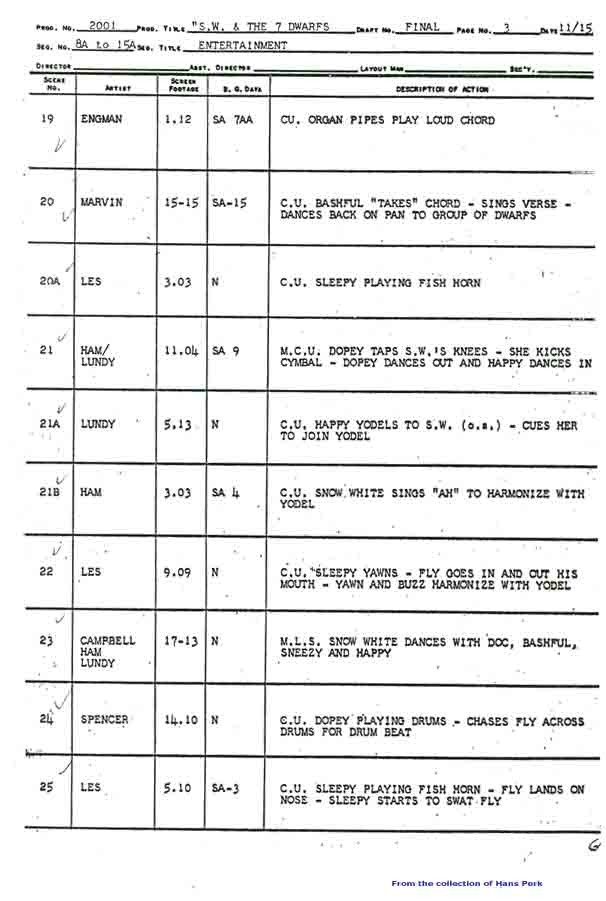
![]() | ![]() | ![]() | ![]() | ![]() |
![]() | ![]() | ![]() | ![]() |
- Snow White by Ham Luske, Grim Natwick, Jack Campbell and Paul Busch. Dwarfs by Bill Tytla, Fred Moore, Dick Lundy, Les Clark, Fred Spencer, Marvin Woodward and Riley [Thomson]. Animals by Jim Algar and effects by Andy Engman. Marc Davis, Max Grey and Amby Paliwoda animated either Snow White or dwarfs.
I suggest that "Riley" is Riley Thomson, on Snow White the assistant to Dick Huemer according to Alberto Becattini. Now - there was also a Larry Riley somewhere who started at Fleisher ca. 1938, and who knows, maybe he was an assistant at Disney in 37? Things like that were seen before - Izzy Ellis is not a known Disney entity, and yet his name is all over a lot of 1937 Action Analysis Classes I have. [See the comments where it is pointed out that this could not be Larry Riley!]
I will have to leave further analysis to my trusted commenters, as
I really do not have a lot of time to wallow in this material today!