Please note: if an earlier link doesn't work, it may have changed following an update! Check the Category Labels in the side-bar on the right! There you can find animator drafts for sixteen complete Disney features and eighty-six shorts,
as well as Action Analysis Classes and many other vintage animation documents!

Saturday, August 25, 2018

Les Demoiselles de Rochefort (1967)

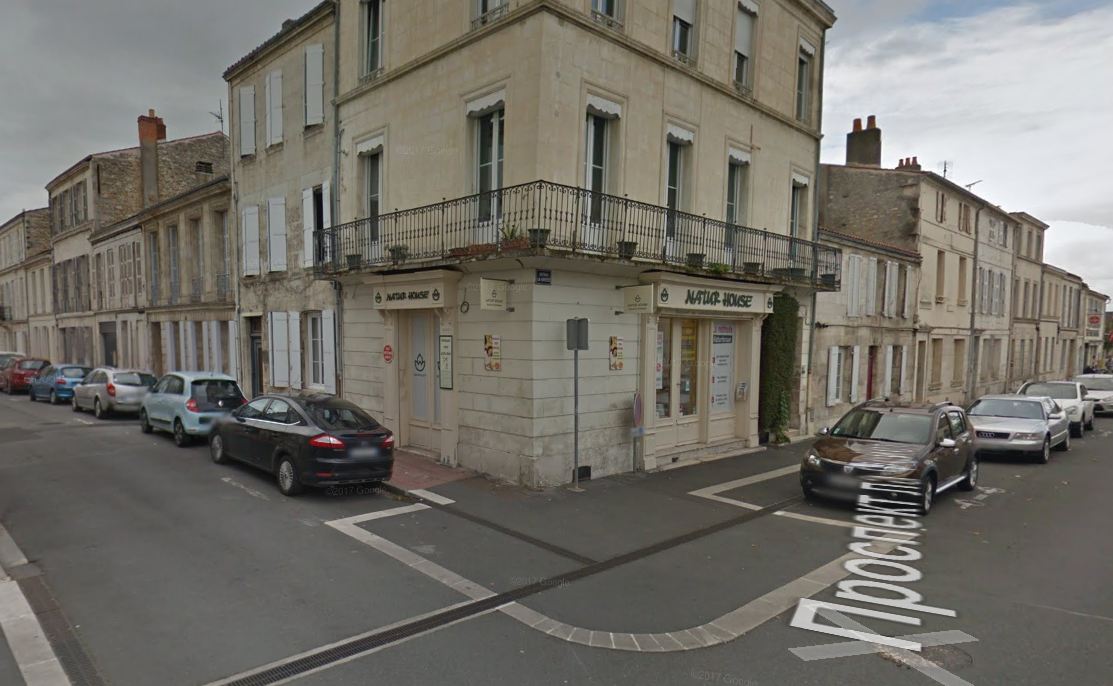
As a departure from my usual Disney-related posts, here is a bit about my "guilty pleasure," the French musical film by director Jacques Demy, "Les Demoiselles de Rochefort," in English "The Young Girls of Rochefort," released March 8, 1967. The first DVD I ever bought in the late 90s, in Annecy, France, was just this film. Recently I also got the Blu-Ray, and now having just received the 5-CD box set with Michel Legrands great music that came out last year, I revisited the movie and had a look at, where in Rochefort the film was shot.

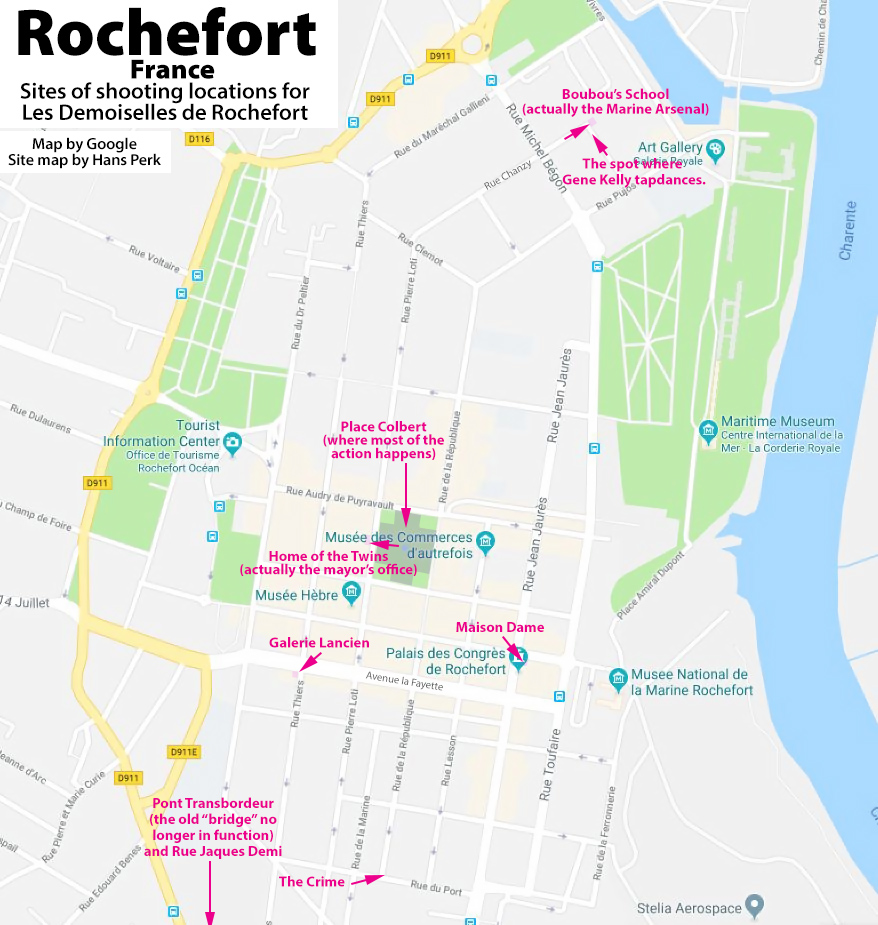
With the help of Google Maps, here is an overview of the locations:
1

The film begins and ends around the strange (and defunct since 1967!) bridge Le Pont Transbordeur, south of the city, but most of the action happens around Place Colbert, the center of the old town, with the office of the town's mayor used as the home of the twins, played by the Dorléac sisters, Françoise and Catherine, the latter using as stage name her mother's maiden name of Deneuve. In the town square we find the coffee shop of Yvonne Garnier (Dannielle Darrieux), with server Josette (Geneviève Thénier), frequented by Maxence (Jacques Perrin) and carnies Etienne (George Chakiris) and Bill (Grover Dale), who visit the town to sell boats and motor bikes. The dancing troupe (from England, many seen in Summer Holiday and Half a Sixpence, and choreographed by Norman Maen) is basically everywhere, and when we are in the square - they are there, as well. But not everything happens in the town square.
[Le Pont Transbordeur, built between 1898 and 1900, has been restored and in use since Spring 2020, but only as a curiosity!]

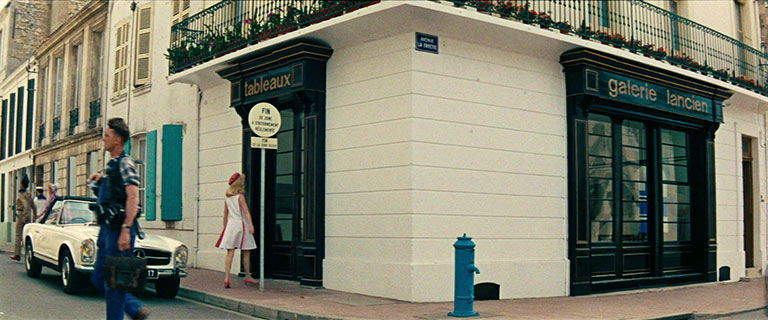
Delphine Garnier, the dancing twin, sporting a large blonde wig (played by Catherine Deneuve - the twin, not the wig) visits her "friend," gallery owner Guillaume Lancien (Jacques Riberolles).
1 1
S-W corner of Avenue la Fayette and Rue Thiers.

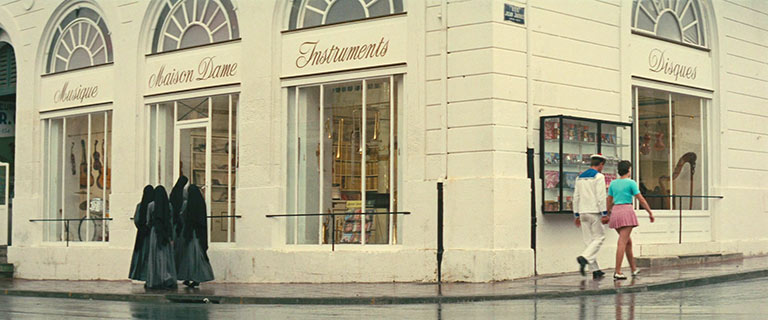
Solange Garnier, the musician (Françoise Dorléac wearing the red wig) visits monsieur Simon Dame (played by Michel Piccoli) who is the owner of a store with musical instruments.
1 1
S-E corner of Rue Jean Jaurès and Avenue Charles de Gaulle.

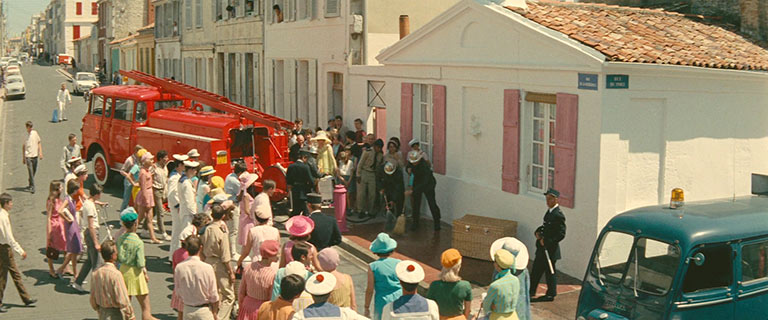
Spoiler alert: Subtil Dutrouz (played by venerable actor Henri Crémieux) turns out to be the one who is the "ignoble sadist" who has cut the old lady into 15 pieces and put her in a basket. We see nothing of this except a crowd around the basket.
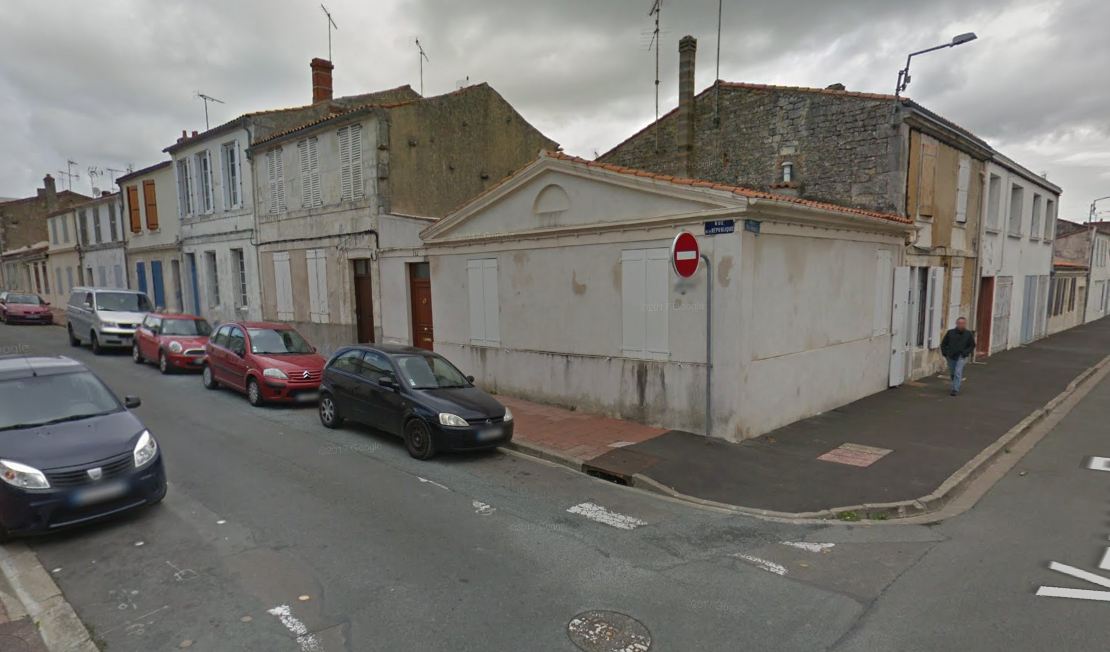
Maxence meets Solange here, but he only likes blondes.
1 1
1 1
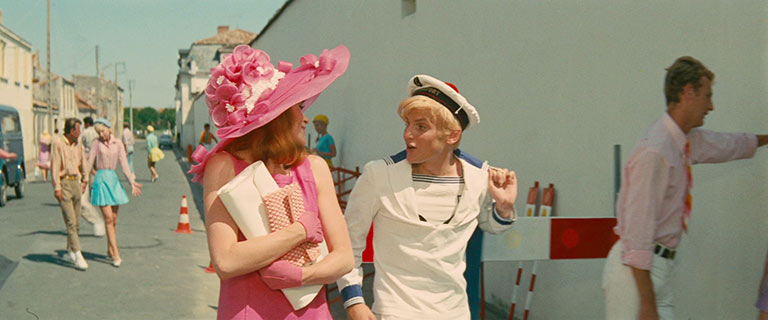
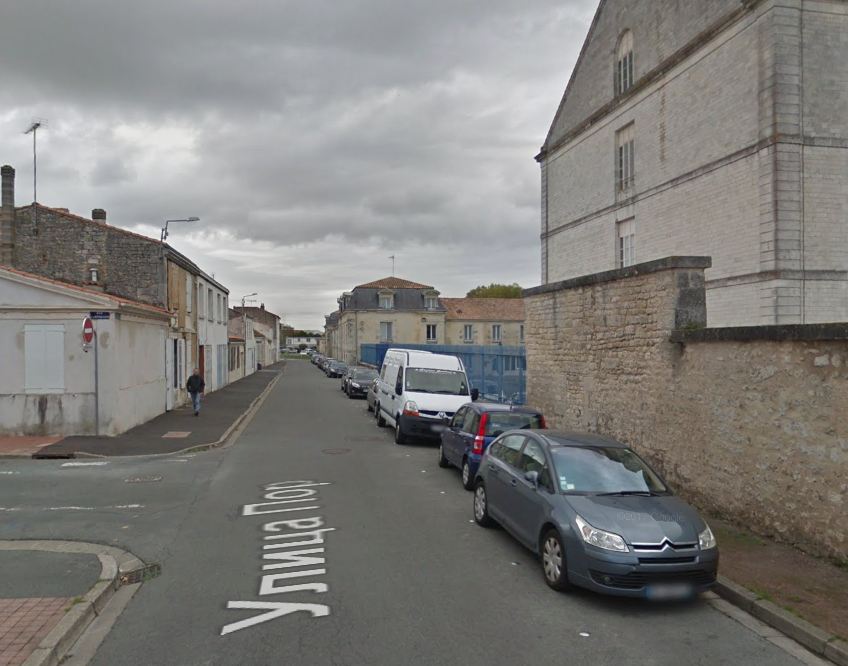
N-E corner of Rue du Port and Rue de la République (which had a different name in the 60s, it seems). Maxence and Solange afterwards walk along Rue du Port with the dancing troupe behind them as if it's the most natural thing in the world.

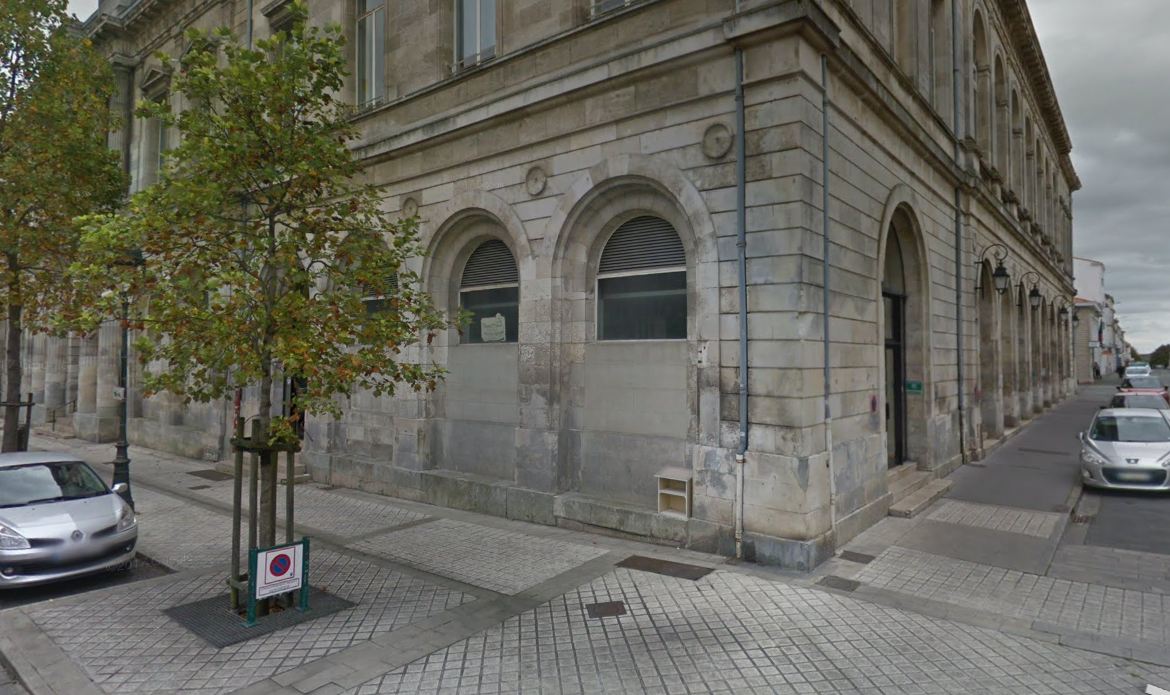
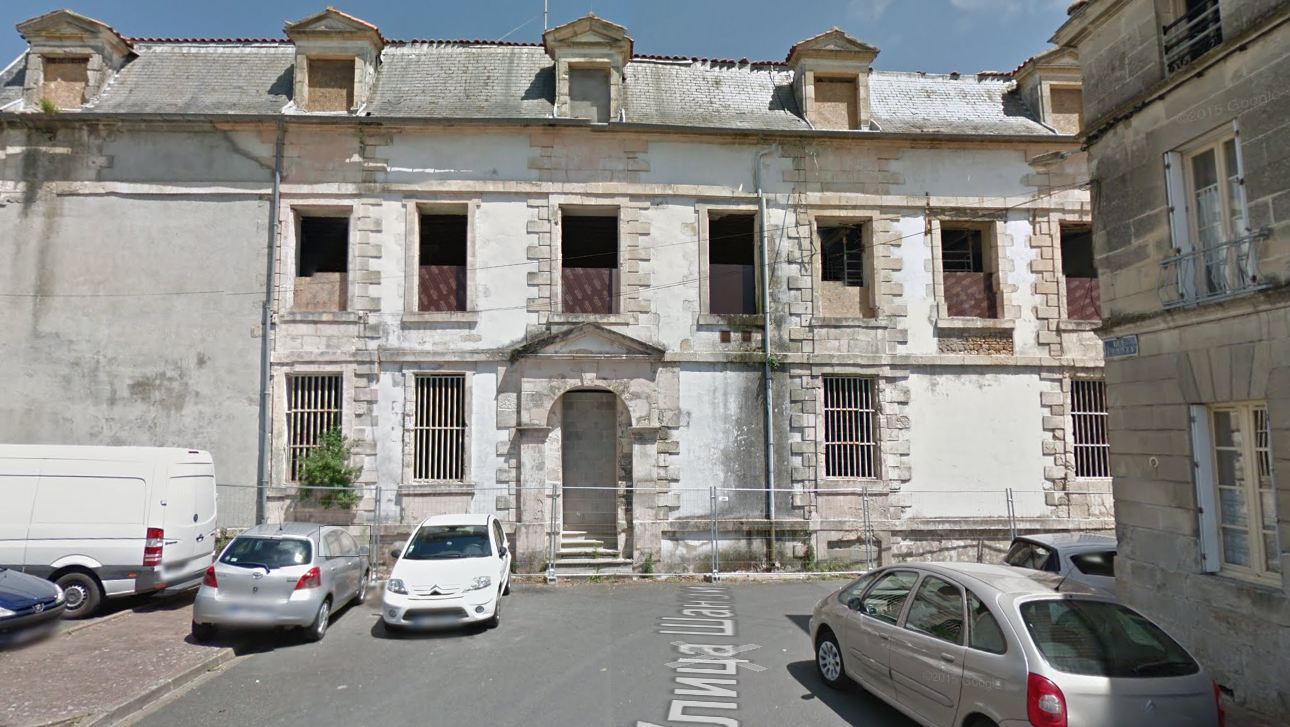
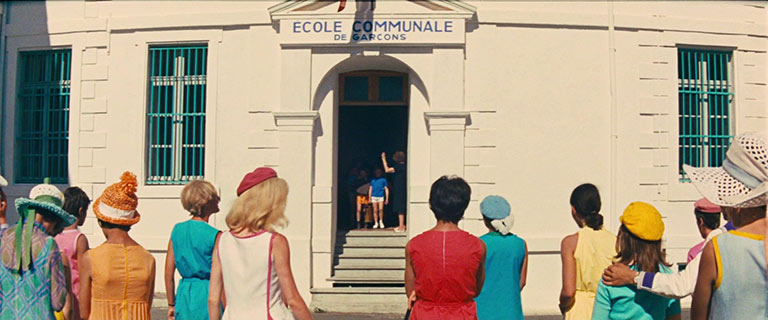
Yvonne Garnier's son Boubou (Patrick Jeantet) has to be fetched from school several times in the film. Yvonne tells Etienne and Bill it is "not two steps behind the square" but it's still a 9 minute walk.
Boubou is quite naughty. No wonder there are bars in the windows!
1 1
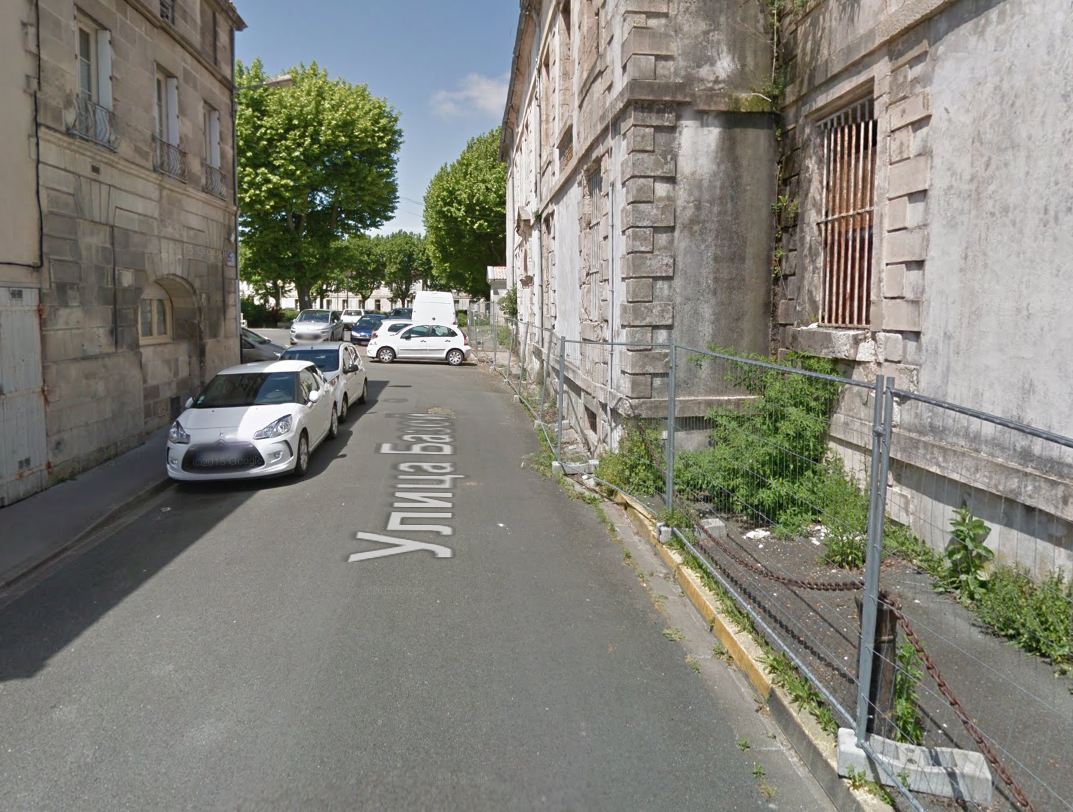
The N-E end of Rue Chanzy. This was the Maritime Arsenal (hence the bars in front of the windows), and it seems it is being restored. However, the building on the left of the doorway the kids come out of was completely removed, which is clearly visible in the next images! [2019: It was quite beautifully restored, and the windows have changed! See Google Maps.]

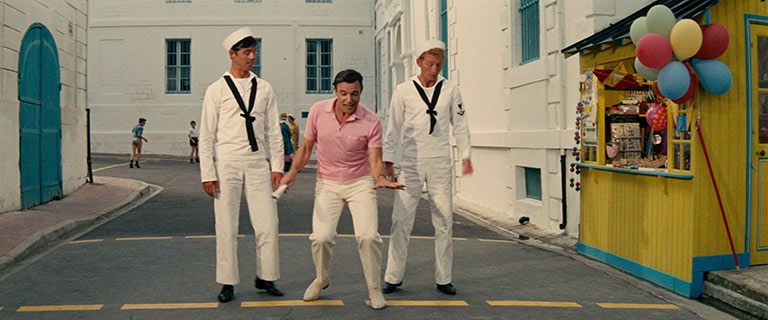
Finally, just around the corner from the school, piano virtuoso Andy Miller (Gene Kelly) meets Solange, and afterwards does a little tap dance (with two of the English dancers dressed as sailors). Strangely, his taps were dubbed by some drummer who seems to not have been very interested in hitting the action on the screen. If you want to hear the live sound, however, six seconds (which is most of it) are in the trailer for the film! Also, the English version of the song (mostly sung by Gene!) on the CD set has all the taps, but these do not correctly follow the music if you that sync that to the picture! Sigh...
1 12019
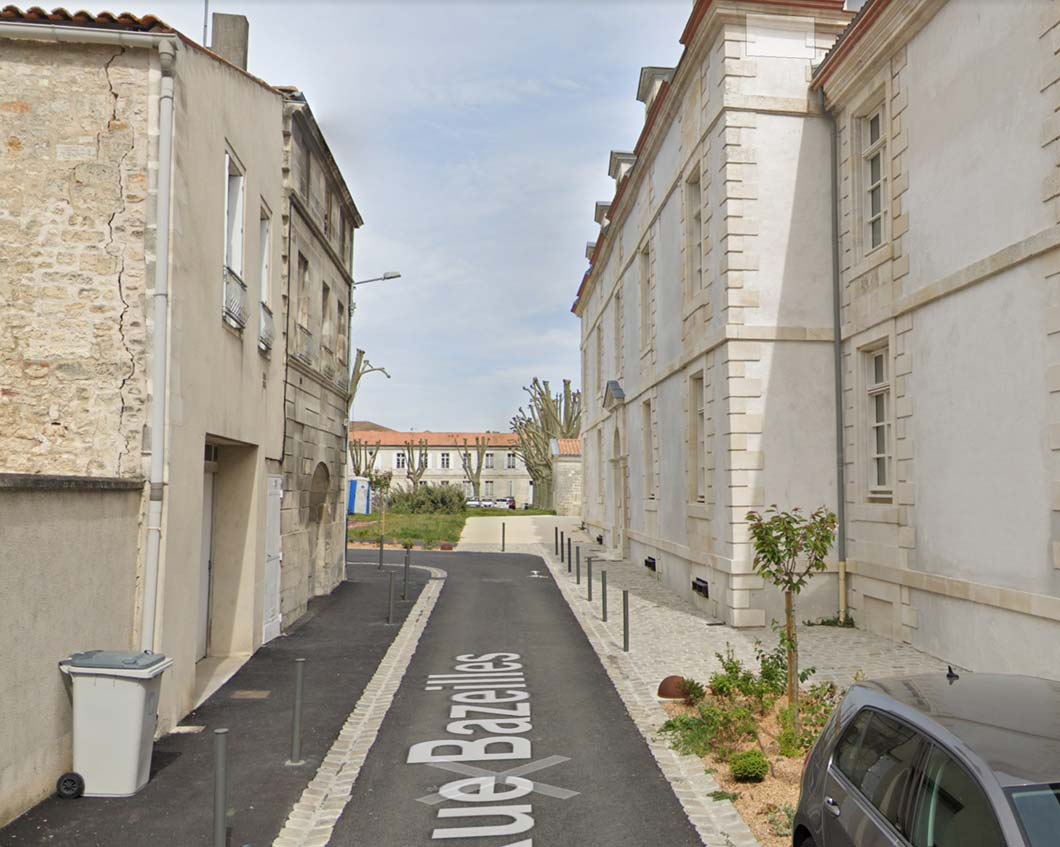
We are in Rue Bazeilles looking towards Rue Chanzy.
[2019: They shined up the buildings and took out the original sidewalks...]

It seems the last 50 years have not been too kind to these areas in this interesting city. The film itself is such a curious, colorful fun piece of fluff. It has Gene Kelly! George Chakiris! If you don't know it, and your French is pretty good, have a look at it some day!

The Criterion Blu-Ray does have English subtitles, but only on the feature film. Sadly, the 25-year old documentary by (Jacques Demy's wife and filmmaker) Agnes Varda is not subtitled. However, the film was originally shot in two versions! Yes, EVERY shot of song or dialog was shot in French and English! The English version songs fill the whole CD number 3 in the box set! (Amazon US: here!) But when Warner was to release the English version they deemed it too "European" and shelved it! Only few scenes are known, some in the documentary and these on YouTube.
So - do you know anyone good at diving into film vaults?

(By the way, don't ask me why my Google Maps shows streetnames in Cyrillic letters, I do not know!)

Labels:

Sunday, May 02, 2010

Our Latest: "Aura: Song for Sophie"

Let's not forget that I made this blog primarily to showcase (albeit unofficially) my studio, A. Film, and its subsidiary, A. Film L.A., Inc. Here is the latest music video we produced at break-neck speed a month ago. It features the Danish singer Aura Dione singing "Song for Sophie " (for the Music for Dreams/Universal Music label).
Shot against green, this video combines the digital live action plates shot on stage 4 at Nordisk Film with CG (Maya), composited with eyon Digital Fusion and After Effects at our studio in Copenhagen, actually just a 20 second walk from stage 4. Directed by long-time
A. Film'er Stefan Fjeldmark, produced by our Sarah Brandt Talreja, sets/props by Sten Mesterton, lighting by Niels Grønlykke, head of animation and compositing Karsten Friis Nielsen. I helped on keying and compositing, as well as on the final output at crunch time...

Labels: , ,

Wednesday, January 06, 2010

Party in the Forest - by Ring & Rønde 1950

The last two days were all about A/S Nordisk Tegnefilm, mainly because their old premises are just outside my window. I also spoke of Ring & Rønde studios, which were situated first in Arne Rønde's apartment on Vesterbrogade 63 (where we also had our studio just before we started A. Film in 1988, it being the apartment of my business partner Karsten Kiilerich who's father-in-law was Arne Rønde), then finally at Fredensvej 3 in Vedbæk.

I thought it would be nice to see an example of Ring & Rønde's production, so here is the 1950 commercial "Fest i Skoven" (Party in the Forest). Animation by my old mentor Børge Ring, Bjørn Frank Jensen and "grand old man of Danish animation" (sadly more old than grand) Jørgen Myller, who was asked to design the characters, set the colors and paint the backgrounds. Ring and Jensen later went to Toonder in Holland, remember? Here is the film, which I blatantly ripped from a 2007 Danish DVD that everyone should own anyway (though I do not right now recall its title), and color-corrected quite a bit - the original was badly interlaced, so my excuses for the quality.


The rhyme tells of a party in the forest that Mr. Eagle throws to please his children. Carpenter Mr. Woodpecker has to build a house. The original song has a fox and a starling as priest and parish clerk, and it ends with a drunk Mrs. Owl complaining that her days are numbered, but though we see her getting tipsy, we instead focus on Miss Field Mouse (who is not in the original song) who has to do - the dishes. "But who would complain if they could use Imi?" she says.

You will notice several things: first, the quality of animation, timing and general entertainment is much more advanced that done for Allan Johnsen's 1946 film Fyrtøjet (The Magic Tinderbox). Clearly the stork-cook was animated by Ring. The characters around the table were animated quite stiffly by Myller.

[Børge Ring adds: "I animated from the beginning of the film with the eagle at his dressing table until the sequence with the woodpecker building the house, which was animated by Bjørn. Then I drew the stork, the horn orchestra and the dansing couples except a scene with two yellow chickens, which was Per Lygum's debut in Vedbæk.
I also animated the Miss Field Mouse.

Jørgen Myller was irritated that the camera was so close to the mouse when she sang. "The scene with the big rat" he called it.
I learned my lesson on that one.
Jørgen drew all layouts and chose the colors, but he also animated the soap bubbles on the packshot using a template with circular holes in many sizes; he also animated the water circles around a pole of the landing.

I had at first animated the dance sequence as a jazzy jitterbug thing like The Cotton Club in Harlem NYC, where young dancers swing the girls around in the air above them. I liked it, but Persil got afraid when they saw the line test."]

Furthermore, it only becomes apparent that this is a commercial for the Persil detergent product imi "Foaming with Energy!" in the end of the film. This is how things used to be, folks. The beautiful Philips films that George Pal made in Holland in the late 1930s are in my opinion the best examples of this. The reason was, as explained to me, that advertising budgets for films were higher, since there were no TV ads to be produced. When TV came, the budgets were basically cut in two, and everyone suffered.

Labels: ,

Monday, November 16, 2009

Upside-down Cake...


The last one of this type for now, it is a short one - not for a short cake but shortning for an upside-down cake.
Also from the Babbitt/Hubley reel, this is so controlled, it MUST be Art Babbitt's animation! I wish someone would make a DVD with all these wonderful commercials!

Labels:

Sunday, November 15, 2009

Faygo Black Cherry


Just a little thing from the Babbitt/Hubley reel that I have had lying around a loooong time...

Labels:

Wednesday, December 19, 2007

Premiering on Friday...

Our latest feature film, Jungo Goes Bananas (I did not name it!) has its Danish premiere on Friday, exactly 70 years after Snow White.

Of course there is no comparison, especially as our film was produced for Denmark, a country with 5 million inhabitants, about the same as the San Fernando Valley, and though I do not remember the exact amount, the budget was probably around a third of a Disney Direct-to-DVD.1 Our latest effort was made in CG since the financiers did not want to invest in a hand-drawn film, the first two Jungo films (and the TV series) being hand drawn. But I must say - the film is actually fun. Especially the scientist's song in the end as he is cracking up - cracked me up! Just imagine what we can do with a REAL budget!

Here is the trailer, in Danish...

In Danish, the title is Jungledyret Hugo: Fræk, Flabet og Fri - which means Hugo the Jungle Animal: Impudent, - well, another kind of impudent - and Free. Really, it sounds better in Danish.
I hope this film gets a better treatment than the horribly Miramaxed versions of our previous films, available in the US as Go Hugo Go, with completely new soundtracks etc. The original films can be seen on YouTube, I just noticed...

(1 Danish newspapers have generally given the film a thumbs-up (Politiken, Berlingske, EkstraBladet) and quote the cost as 25 mln Danish Kroner, which is 4.8 mln US$ - less than a quarter of a Disney Direct-to-DVD, which tend to be around 20 mln US$!)

Labels: , ,

Saturday, October 13, 2007

Børge on Babbitt

This in from my old mentor Børge Ring:
When the production of theatrical cartoons dried up during the late 1950es a lot of Disney-trained animators moved over to the studios that made limited animation for TV series.
One who did not was Arthur Babbitt...no Flintstones for him. He opted for animating commercials because they had budgets that allowed for full animation. For some years he was heading a department for commercials at Hanna-Barbera winning 80 Awards for them.

"How big was the department, Art?"
"You mean the staff and the whole staff?"
"Yes."
He got up from his chair and into a soldier's pose, arms stretched down the sides and said: "You are looking at it right now."
Sitting down again he recounted: "I had everything made in free lance, even camera. My favourite animator was Irving Spence and I let all commercials be done in full animation regardless of the design style."

After some years he moved to London to the studio of Richard Williams to train Dick's young staff all the while animating on Williams's feature about "The Cobbler and the Thief" and incidentally directing a few commercials.
One day I asked Richard Williams what Bill Hanna and Joe Barbera were doing about their commercials with Art Babbitt over here in London. "Oh" said Dick, "They are so big they don't even know they have a department for commercials."


Here, at the 2007 Disney Legends, 10/10/2007, is Roy Disney introducing Art's bubbly widow, and her acceptance speech.

Labels: , , ,

Friday, October 12, 2007

A Very Good Choice...

Dave R. Smith, Disney Archivist Emeritus, has been the hub of interest for many Disney enthusiasts, myself included. I met him for the first time 8/14/1978, when he personally showed me the collections' highlights and the basement of the ROD building, then the seat of the Archives. He is seen here receiving the Legends award, 10/10/2007. Congratulations, Dave! It is well deserved!

Labels: , ,

Thursday, October 11, 2007

Congrats, Mr. Fun!

Just came back from the Disney Legends awards 2007. One of the recipients is writer and animator Floyd Norman, a.k.a. Mr. Fun.
Here is Roy Disney presenting the award.

And here is the recipient. Congratulations!

Labels: , ,

Sunday, May 27, 2007

A Stan Freberg Classic...

...and another gem from the 50's Babbitt/Hubley reel.
Simple and elegant....and funny!

[And no longer available, due to Philip Morris USA, Inc...]

By the way, after 10 years, I stopped smoking March 31st, 1995, and I advice anyone who smokes, to stop as well, as it WILL kill you!
After trying to stop several times, I decided in the START of March that I would stop midnight next month. I kept smoking a package a day the next three and a half weeks, and when the time came, my mind had already been conditioned to stop. I gave away my remaining cigarettes and I have never felt like smoking again.
Someone (was it Norm Ferguson?) said "Drawing is primarily a matter of the mind," well, so is quitting smoking...

Labels:

Tuesday, January 30, 2007

Cars...

Another little pearl from the Babbitt/Hubley reel...
Gives a whole new meaning to lip-synch!
I really love this one! It is so simple yet excruciatingly precise!


For those of you who want to know my position on Neil Gablers book on Walt (I know this really is an after-the-fact note): I actually LIKE a book that is a summing up of notecards that describe the history - "summing it up so I don't have to...". Being stuck in Europe, I have not enjoyed the same access to the archives, acknowledging the great people who populate it (I have visited twice, in 1978 - thank you, Dave Smith and Ron Miller! - and 2005 - thank you, Becky Cline!). I just would like any book to not have errors, and as such,
I think it is good to have an ajoining list of these. Only a pity that the book seems to be less than inspired by interest in the animation medium, ultimately my "in" into the material. In the end, hopefully, our opinion is based on a cross-section of all the available data...

Labels:

Sunday, January 21, 2007

Legend Imagineer Don Edgren Dies

It took nearly a month for the media to notice that Disney Legend Don Edgren, who was principle engineer on staff at WED/Imagineering, and who engineered such feats as the Matterhorn in Disneyland, had died, Dec. 28th, 2006, age 83.
Read more in the L.A. Times.

Here is a short clip, the end of his Disney Legends acceptance speech, which I recorded October 9th, 2006 at 4:21 pm:

Labels: ,

Sunday, December 31, 2006

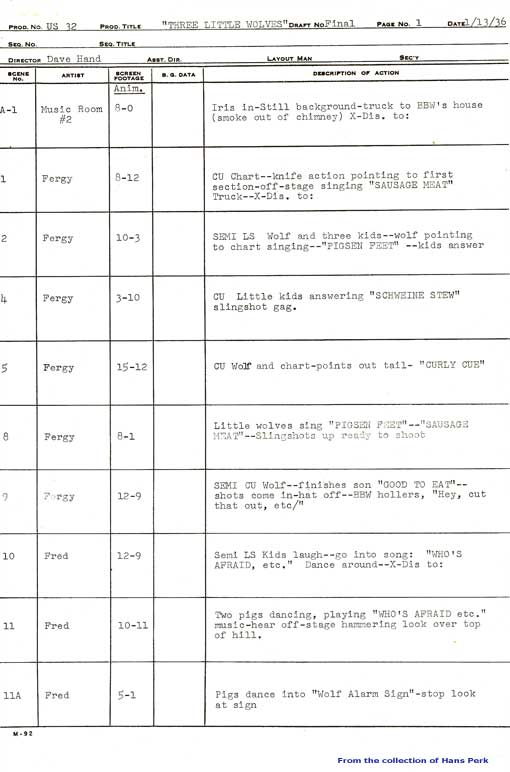
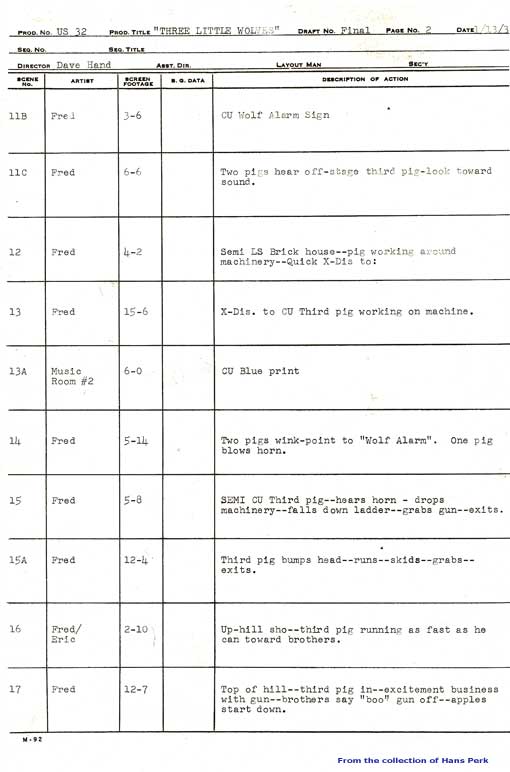
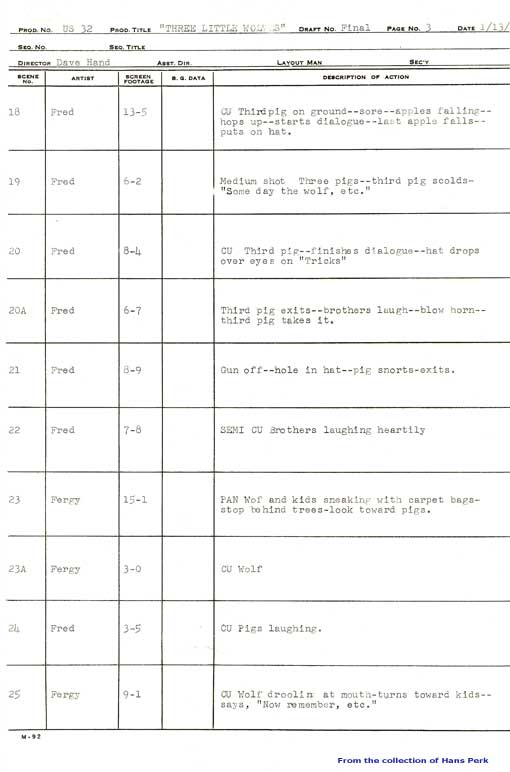
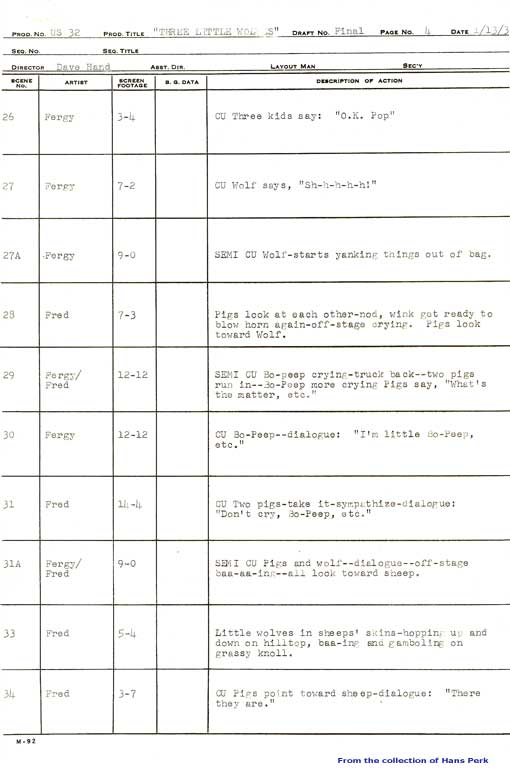
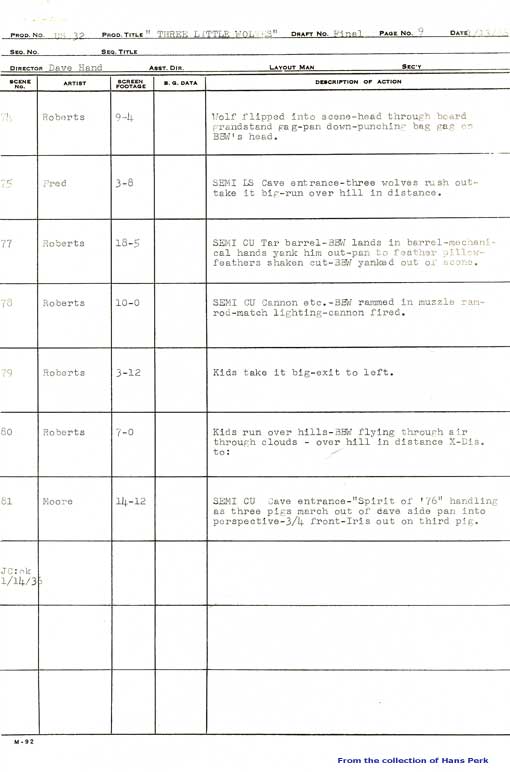
Prod. US34 - Three Little Wolves

I thought it nice to end the year with a bang, albeit a little one. Originally prod. S32, the number of Three Little Wolves was changed to US34 to let Broken Toys have a Christmas release. If you find S32 here, it was what was on the bar sheet and the draft.

Directed by Dave Hand, assistant director Jack Cutting, story by Bill Cottrell, Joe Grant and Bob Kuwahara (Feb. 1934-May 1935 - Outline 4/10/1934). Music by Frank Churchill. Layout by Ferdinand Huszti Horvath, backgrounds by Mique Nelson and animation by Norm Ferguson, Fred Moore, Eric Larson and Bill Roberts.
It premiered in front of Chaplin's Modern Times at the Dallas Majestic, 4/18/1936, and can now be found on Disney Treasures: Silly Symphonies (2001). It was the first Disney picture held over for a second program at Radio City Music Hall. (Thank you, Russell Merrit and J B Kaufman!)

Three Little Wolves is timed in a classical "start slow, speed up, fast climax, slower ending" pacing, as you can see by this timeline:

I really hope this stuff is studied, as I feel it is just as important to know how this works now, as it was when the films were made...

Check the timing on this annotated film:


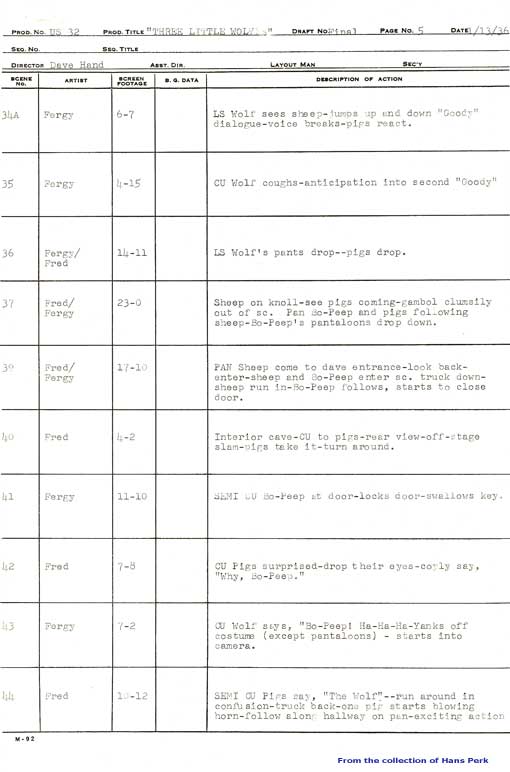
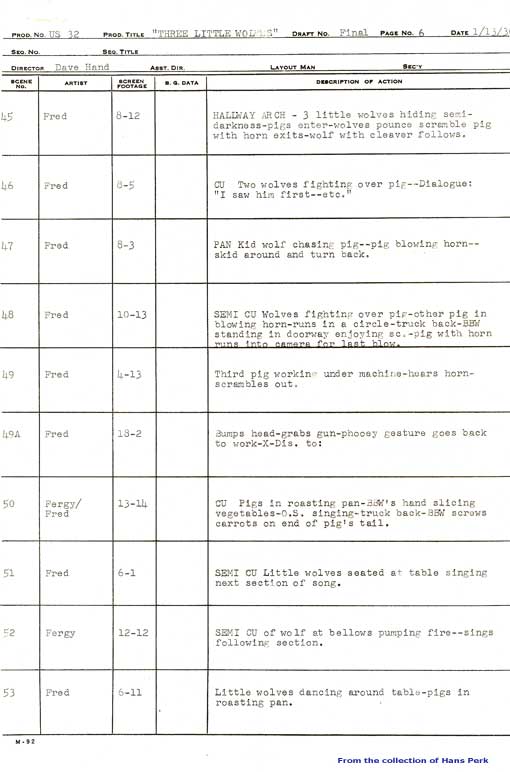
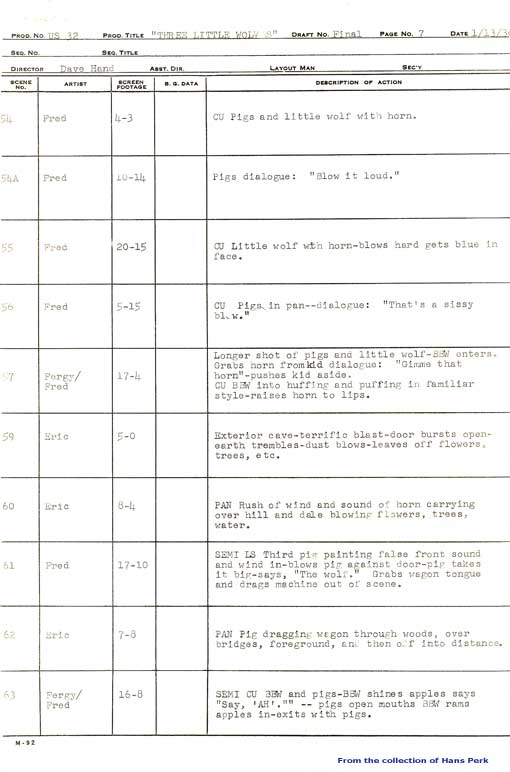
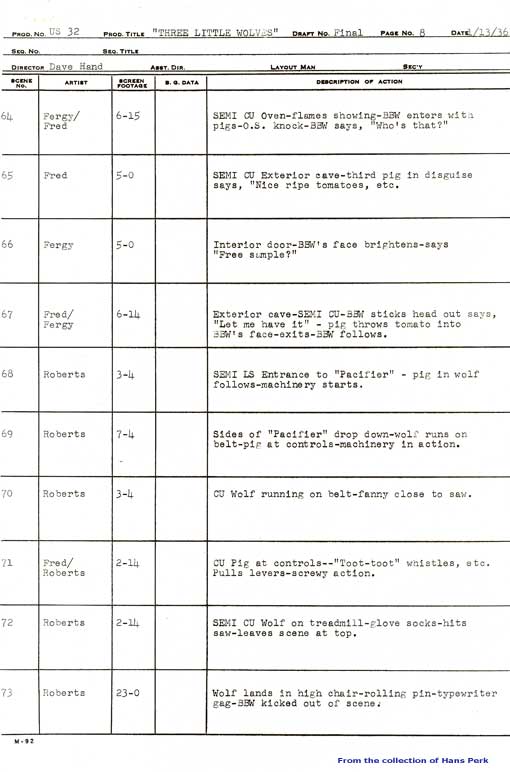
Again, for good measure, the draft, from 1/13/1936.
12345
6789
Well, I'm 45 today. To everyone a Happy New Year, from myself, and from everyone at A. Film in Denmark, Estonia, Latvia and Germany!

[Addition 03/31/2015: I removed it from YouTube because they find it infringes the song "R3tric-Black Is Night", sound recording administered by: Believe Music. Go figure. YouTube should fix their automatic recognizer instead of threatening strikes.]

Labels: , , , , ,

Tuesday, November 28, 2006

M46 with Click Track

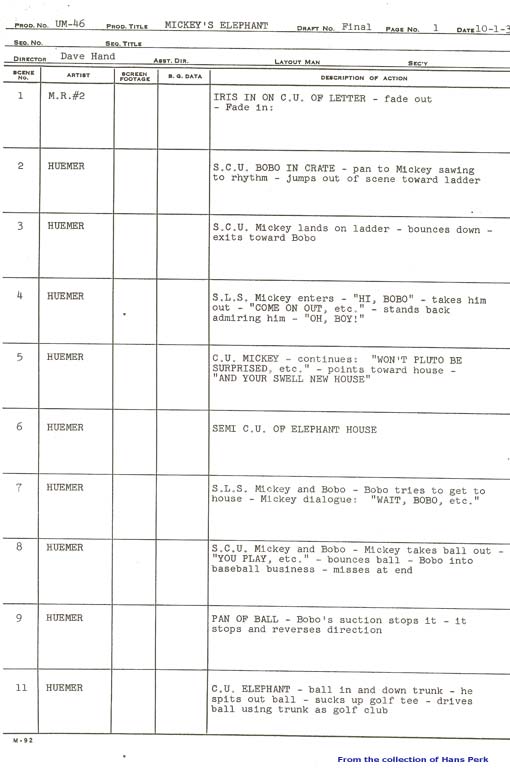
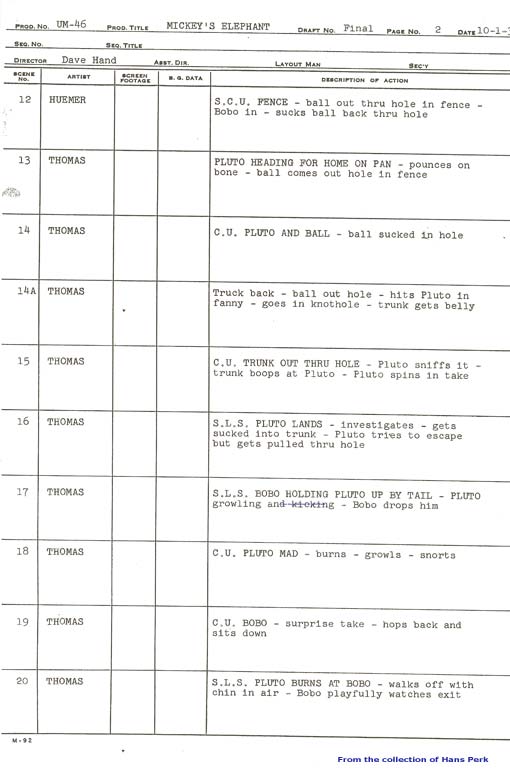
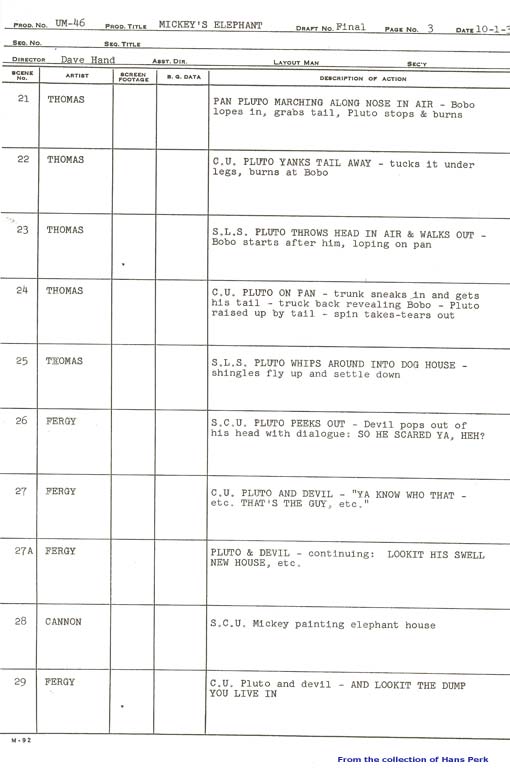
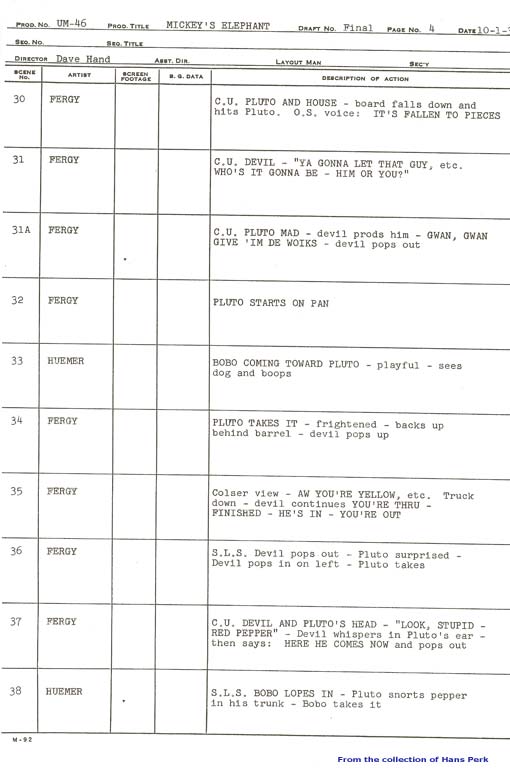
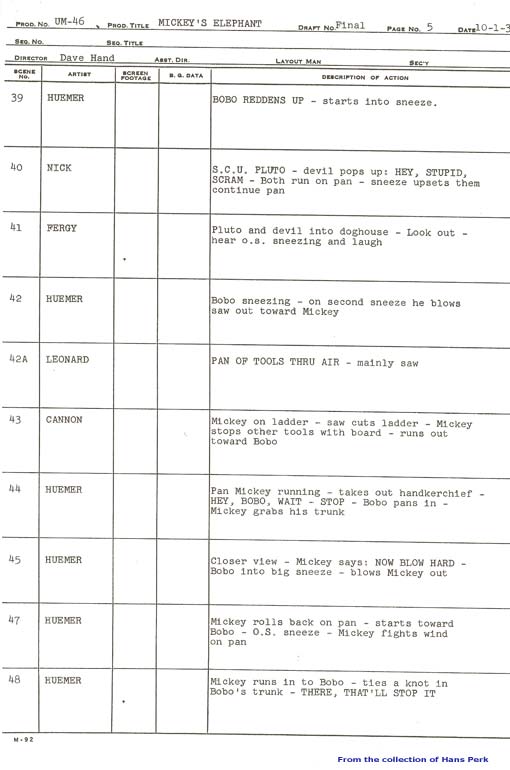
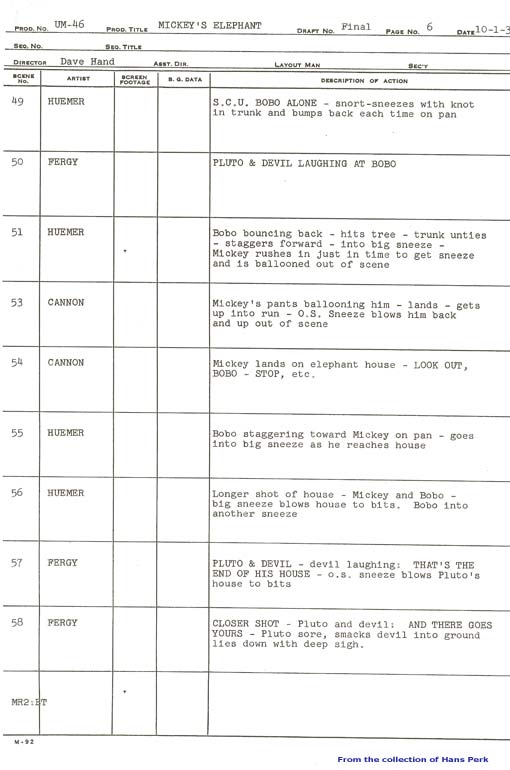
Here is another short with click track based on a bar sheet I have. Prod. UM46 is known as Mickey's Elephant. Released Oct. 10th, 1936, it was directed by Dave Hand, with Jack Cutting keeping the bar sheets as assistant director.
Animation mainly by Dick Huemer (Bobo and Mickey), Frank Thomas (Pluto) and Norm Ferguson (Pluto and Devil), with Johnny Cannon (Mickey), and single scenes by Leonard [Sebring] and Nick - either Charles Nichols or Nick George (anyone?).

Very interesting is the way the beat changes as the animators do. One can put a lot of effort in explaining that, but it is probably just because they were basically different sequences, and as such just cast to different animators. Click this:


The film opens on a 12 beat (2-12), then, as Bobo the elephant is playing, it is 8 beat (3-8, waltz tempo). Pluto arrives jauntily:
12 beat (2-12). Then, the bit with pluto and the devil: a slower, more thoughtful 14 beat (2-14), and here the music isn't onmi-present as in the beginning. Then 10 beat (2-10) and we end in chaos on an
8 beat (2-8). There is one place where a measure was shortened to four frames by cutting a foot in the 2-10's bit.

Obviously, the director (Hand), helped by the musician (Malotte) decided the tempo with a metronome, to be most fitting to the action and mood on screen. A beat was chosen that could be sustained for a good number of bars, but, as we also saw on The Pointer, in the end it is possible to cut a few frames out if needed, as long as the musician can incorporate that decision - or there is no music. It seems that a 12 beat was generally chosen as a 'generic' not-too-fast, not-too-slow beat. An 8 beat is readily used as a waltz-type faux-24 beat, a subdivided slower 16 beat, or a quick 2-8's as chaos unfolds.

Have a look:


Here is the draft, for good measure (pun intended):
123456

It would be interesting to hear from other directors who tried this method of timing - and to hear from musicians what they think about it. I remember the musicians I worked with - they at first thought it strange, but they quickly embraced the way of working as very natural... By all means feel free to comment!

Labels: , , , , ,

Monday, November 13, 2006

M27 (2227) with Click Track

The Pointer is not a film that you'd think would be timed to a beat throughout - but it is! It seems that most--if not all--Disney shorts were timed like this, and not only those dependent on music.
To my mind, it adds a sense of continuity, of perfection even.

Pre-planning a film with the timing to a musical beat makes it easier to "put music to it", and we hear the musical queues fit the music - and sometimes be on the off-beat. There was a close working relation between the director and the musician, but in a case like this, with several spots of dialogue, the beats seem to be chosen by the director from a generic story-telling point of view.

The timing of this film is incredibly logical: it speeds up slowly, from starting on 2-14's to Mickey whistling on 2-12's, then the bear bit on 2-10's, running away on 2-8's and ending quietly in the dark on 2-12's. In many cases a beat was added, changing e.g. 2-12's into 3-12's, but keeping the rhythm. This is only "sinned against" in a single spot:
16 frames (one foot) is added during Pluto's quail ordeal.
This timeline shows that most of the film is 12 beat:


When doing this, I notice that the bar sheet is kept so meticulously that it fits directly to the frame with the final film. Only my own counting mistake made me have to use more than the few minutes it takes to count the bars and write them into the little text file that is the input to my program...

Note: I put the beats spot on. It would sound more "with" the music if I had moved them 2 frames back (as one would do generally with dialogue), but for "scientific precision", I chose not to.
[UPDATE: I did move it ONE frame! Also, it's clearer now!]

For those of you who intend to learn from this, get yourselves a metronome, preferably one you can tap the beats on (like my old BOSS Dr. Beat DB-66 that I used on Quark), and figure out the timing structure of films that we do not have bar sheets of (you can use the Beat to/from Metronome converter on the right). This may be a fun assignment in schools, too! And then, time your own film!

Again, though this is for educational purposes, one never knows how long this lasts on YouTube, so see it while you can. [After the fact I wonder why I didn't name this posting "Point and Click!"][No longer using YouTube for this clip!]


And remember to have a look at the intro to our showreel, if you haven't already!

Labels: ,

Thursday, November 09, 2006

UM41 Revisited - Now With Nasty Clicks...

Last night and tonight I had some fun programming a click track .WAV and .AVI program, which uses a simple text file as input. I put the beat info of UM41 Mirrorland in it, and below is the result, put together in Premiere with a rip from the DVD (excuse my interlace). It fits like a glove... Check it out before it is removed by people who cannot see the educational value in it!

Since it can be hard to follow the film with the bar-sheets in hand, I found this more immediate and obvious. It is interesting to hear (and 'see') how the music was written - the 'vamps' that cover the transitions to other beats. And also I note that the music once in a while 'lags behind' in fast passages, only to recover when the conductor regains control. I never understood that strangly out-of-place queue before the Neptune bit. And the end might just as well have played as 2-16s instead of 2-8s. It seems pretty hecktic...
The conductor would not hear all these clicks, though - probably only every second or even fourth click - one per measure.

If the timing to a beat was a 'lost art', I hope that these posts help change that. It is an integral part of the entertainment of the 'Golden Age of Cartoons', and deserves recognition as a tool that can improve the value of the project at hand. There are many ways of dealing with this. Loosely, sequence for sequence (as we did on Anna & Bella) or throughout, like here. It's a matter of taste.


[A note on the symbols: a circle is a beat. If it has a cross through it, it is the first beat in a measure and the note is a bit higher. If the cross is red, and the note is even higher, then it is the first beat of a new tempo (though note that a change from a 2-12 to a 3-12 and back also generates red crosses and higher notes).]

Labels: ,

Tuesday, November 07, 2006

Timing and Music... again...

Because we can't get enough of it... Here is a sin of my youth, the beginning of a short we made here in Denmark for TV on basically a shoe-string budget, way back in 1986-87.

In my attic, in September 2003, I found a tape with linetests and click track of this film, Quark and the Highway Robber, as I was doing research for a 13 minute making-of that I did for the DVD re-issue of the Danish 1986 feature which was the reason I moved from Holland to Denmark, Valhalla, in which Quark is a prominent character. I co-directed this episode of the Quark series, and timed it on a bar-sheet. It starts as a 12 beat, then shifts to a 10 beat.

The animation isn't great, at times even awful, but I though it may show that timing to a beat "isn't just an outdated way of organizing time by giving it structure, but it gives the scenes a backbone, and thus an attitude." (Loosely translated from something Børge Ring told me as reaction to my last posting on timing).

Having been misled by our management back in 1987, we, the directing animators at the studio, resigned, to work with Frank and Ollie on the Troll Story project. Though I had a LOT of constructive discussions with the musicians, Øyvind Ougaard and Michael Friis, the linetest shows the state of the film as I left the studio. The final color and sound is from disc 2 of the Valhalla Special Edition DVD, that was issued in 6,000 copies in Denmark...

Yes, the voice is John Cleese. I showed him the film on our Steenbeck cutting table. Management didn't think we lowly directors should be at the dialog recording in London. They sent one of the Executives. And I then had to find ways around this guy's errors, which was another interesting learning experience.

Labels: , ,

Friday, November 03, 2006

Well, don't you?

A little pearl from the Babbitt/Hubley reel...

Labels:

Saturday, October 28, 2006

Your Mother Won't Know You!

Here is another commercial from the 50's Babbitt/Hubley reel...
And then there is always this reel to look at....

Labels:

Friday, October 20, 2006

John, Marsha and Snowdrift...

Another gem from the Babbitt/Hubley reel...

Labels: