Please note: if an earlier link doesn't work, it may have changed following an update! Check the Category Labels in the side-bar on the right! There you can find animator drafts for sixteen complete Disney features and eighty-six shorts,
as well as Action Analysis Classes and many other vintage animation documents!

Monday, June 02, 2008

Feature Production Numbers

For reference, here is a little list of some of the Disney production numbers for features and a few featurettes and specials:

2001 Snow White and the Seven Dwarfs
2002 Bambi
2003 Pinocchio
2004 Fantasia
2005 The Reluctant Dragon
2006 Dumbo
2007 Victory Through Air Power
2015 Saludos Amigos
- 2712 Lake Titicaca
- 2714 Pedro
- 2711 El Gaucho Goofy
- 2717 Aquarela Do Brasil
2016 The Three Caballeros
- 2713 The Flying Gauchito
- 2718 The Cold Blooded Penguin
- 2721 Bahia
- 2725 Solamente una Vez, Pinata, Las Posadas
2025 Make Mine Music
- 2024 Peter and the Wolf
- 2026 Two Silhouettes
- 2027 The Martins and the Coys
- 2028 All the Cats Join In
- 2030 After You've Gone
- 2041 Casey at the Bat
- 2045 Whale at the Met
- 2046 Johnny Fedora & Alice Blue Bonnet
- 2047 Without You
- 2050 Blue Bayou
2029 Song of the South
2057 Fun and Fancy Free
- 2043 Mickey & the Beanstalk
- 2048 Bongo
2061 Melody Time
- 2052 Little Toot
- 2054 Melody Time (Trees)
- 2055 Once Upon a Wintertime
- 2056 Pecos Bill
- 2058 Johnny Appleseed
- 2059 Bumble Boogie
- 2060 Blame it on the Samba
2051 So Dear to My Heart
2067 The Adventures of Ichabod and Mr. Toad
- 2011 Fabulous Mr. Toad
- 2062 Ichabod Crane
2063 Cinderella
2069 Alice in Wonderland
2074 Peter Pan
2079 Lady and the Tramp - Standard Academy
2084 Lady and the Tramp - CinemaScope

2082 Sleeping Beauty
2097 The Truth about Mother Goose
2110 One Hundred and One Dalmatians
2138 Sword in the Stone
2162 Mary Poppins
- 2165 Jolly Holiday
2504 Winnie the Pooh and the Honey Tree
2179 Jungle Book
0101 The Aristocats
2515 Winnie the Pooh and the Blustery Day
2518 Winnie the Pooh and Tigger Too
0112 Robin Hood
2519 The Rescuers
2521 The Small One
0136 The Fox and the Hound

Note that the live-action features are interspersed in this list,
e.g. 2068 is Treasure Island etc. Also, the parts of the compilation features like Make Mine Music each have a separate number, as well.
[Note: I added these - 7/27/08]

(I'm back in Denmark, folks!)

Labels:

Tuesday, June 15, 2010

Time for Melodies...

01

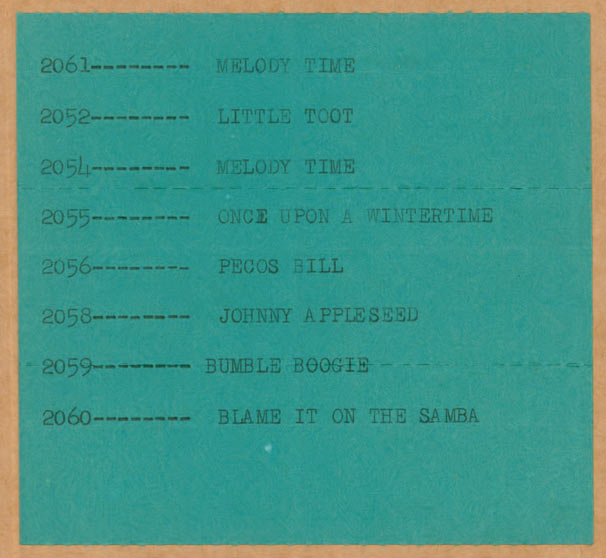
After Thad Komorowski's posting of the "Blame it on the Samba" sequence of Melody Time, it seems fitting to show the complete draft of this film, Prod. 2061. Though I have scanned it, I still have to do some work on the images, but I can promise it will appear here soon!

Above image is the label with the contents that is stuck on the inside of the folder. This one also originated in the BG Morgue.

If you wonder where Prod. 2057 went, then have a look at my list of Feature Production Numbers and you find it is Fun and Fancy Free!

[For those of you who do not have the film handy, this is the order of the sequences in the final film (after the opening credits, of course):
- Once Upon a Wintertime
- Bumble Boogie
- The Legend of Johnny Appleseed
- Little Toot
- Trees
- Blame it on the Samba
- Pecos Bill
In the draft, the segments have obviously been ordered by production number, not by the order of appearance in the film.]

Labels: ,

Friday, May 10, 2013

In 'Scope (2084) and Regular (2079)...

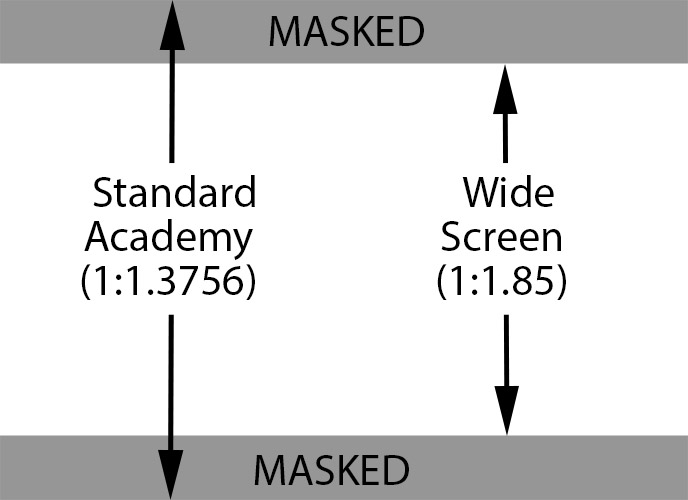
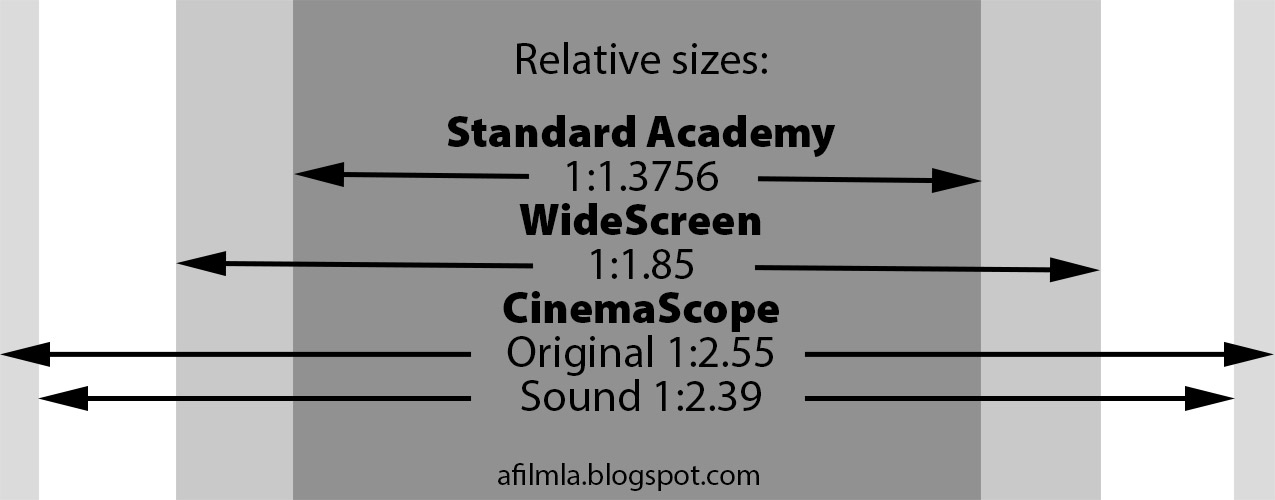
The masking of the Standard Academy (with its aspect ratio of 1:1.3756) image, as used since the silent days, to a wide screen image of 1:1.85 was introduced in May 1953, while Fox introduced CinemaScope with its 1:2.55 image ratio that very same year as its answer to the problem to waning cinema audiences due to the boom that happened in television around 1950.

Below I have indicated the differences in picture size:
- first the difference between Standard Academy and WideScreen, where WideScreen just masks off part of the image in the projector;
- then the differences in perceived size between Standard Academy, WideScreen and two flavors of CinemaScope: the 1:2.55 ratio was used with separate magnetic sound until 1955, when optical sound was added that cut off part of the frame, reducing the image to an aspect ratio to 1:2.39.

CinemaScope is an anamorphic system: the image on the 35mm film is stretched to two times its size but only in its horizontal direction. This system was actually invented in the early 1930s by Henri Crétien and bought by Fox.
WS   CS

Prod. 2079 - Lady and the Tramp - was planned for a 1955 release, which meant that much of the final stage of production was during the upheaval of wide-screen cinema. It was originally perceived as a Standard Academy feature as all the films before it, but it was decided to produce a CinemaScope version, which meant wider cels and backgrounds, and the need to recompose some artwork for the much wider format. The "new" production was numbered 2084.
In the draft that is to follow over the next period, we will see the differences between the regular and the CinemaScope versions noted in the scenes where this was an issue.

00a00b00c00d
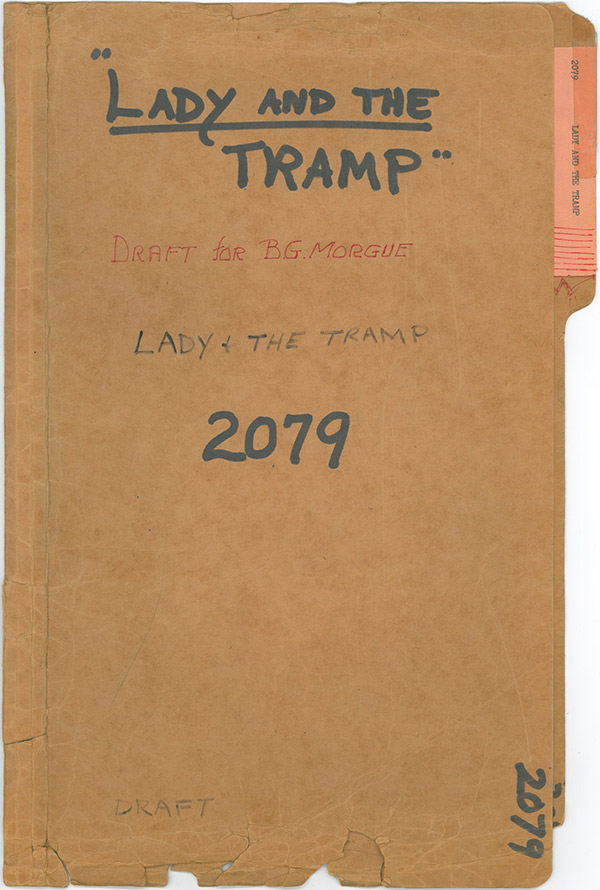
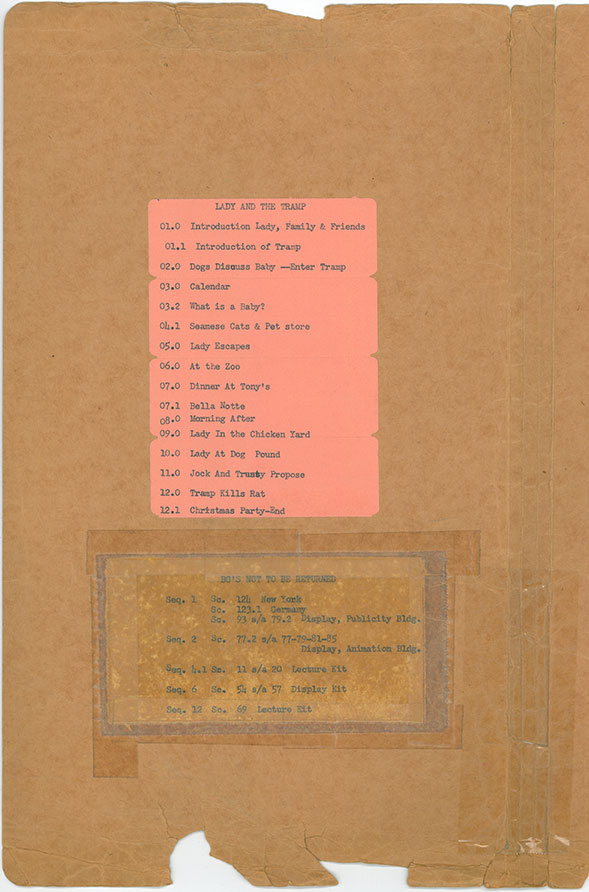
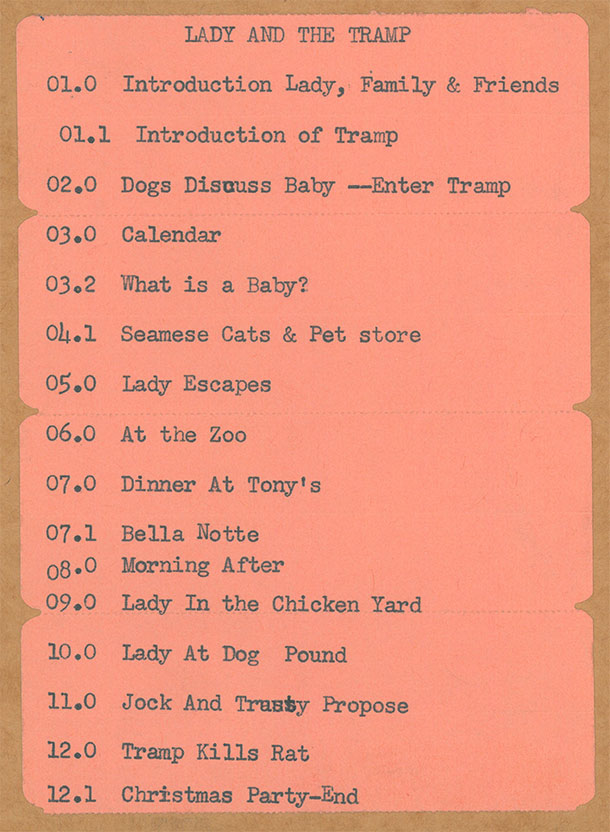
First the outside cover of the draft which notes that this draft was used in the Background Morgue, originally situated in the basement under the Ink & Paint building on the Burbank lot.
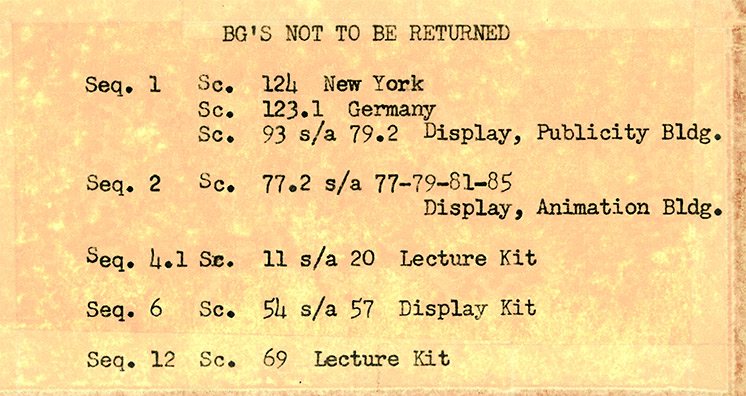
The inside (with two enlargements) shows the sequence numbers, and a list of backgrounds which were used for promotional or other purposes, and not expected to be returned.
The draft itself shows handwritten notes by the staff of the Background Morgue about backgrounds checked out at different dates, though mainly (with red crosses) whether the backgrounds were present during a major check-up in March 1966.

Lady and the Tramp, directed by Peter Pan stalwarts Gerry Geronimi, Wilfred Jaxon and Ham Luske, is a happy mix of Joe Grant's story about Lady, and Ward Greene's book "Happy Dan the Whistling Dog." In The Reluctant Dragon of 1941 one can see models of Lady and the Siamese cats, while the very interesting 1944 book "Surprise Package" has the story of Lady, together with a load of other stories for films that would eventually be released a lot later.

As always, I invoke my "standard disclaimer:"
"Animation drafts were never meant to be historical documents. They were meant as go-to documents, showing the responsible artist for a certain scene, who might be able to help in case there would be any need for this further on in the production line. Therefore we often see e.g. that animators who left have been replaced by others, often their assistants, in later versions of a draft. Also for this reason it is most often the actual animator, not the supervising animator, who is mentioned. The drafts may also be directly inaccurate - showing early assignments where the animator actually changed when the scene was finally handed out. Keeping all this in mind, though, the drafts can give us some sort of hands-on insight into the inner workings of the production of some of the most "magical" (yes, an over-used word) motion pictures of all time.".

By the way, talking about aspect ratios in relation to Lady and the Tramp, it is worth noting that the film was issued on VHS in a Pan and Scan version from the Scope print in the 80s, because no-one seems to have known that there was a perfectly good and original "regular" version. Then, when it came out on DVD they were not aware that the original was shot 1:2.55 for the 4 separate magnetic tracks, so it was shown in Scope 1:2.39. Only for the 2010 Blu-Ray and DVD was the film restored to its proper width. [Addition: of course the optical track cut off only one part of the screen, so twice what you see on my graphic, but only on the left side. It was this "new" area that was added by the latest Blu-Ray transfer.]
That goes to show that a little research can go a long way, right?

I note that this will be my 14th feature draft, if I counted correctly - see the column on the right for links to the others! >>>


On a personal note, I am very busy editing A. Film's next CG feature film after having been happily seeing my "baby," Miffy the Movie open in cinemas around the world. Really, 167,000 tickets sold in Holland alone is pretty darn good for a film for 2-to-5 year olds! But it does mean that I may not be able to post the above draft on an extremely regular basis. I will try, though! In the mean time a shout out to a lot of people I wish I could have been with tomorrow!

Labels: ,

Sunday, July 27, 2008

The How To of Seeing Double

When television was acknowledged as a threat to the cinema, all producers were looking for gimmicks to attract audiences, and one of the ways they lured them into the dark was through 3-D movies, which had their heydays in 1953. "A Lion in your Lap" ...or was it a girl? Anyway, 3-D movies were subsequently blown out of the water by the very wide screen 2-D CinemaScope, that was easier to project and didn't need glasses to view—but not before some very interesting experiments had taken place.

Disney produced An Adventure in Music: Melody with Professor Owl, Ernie Birdbrain, Penelope Pinfeather and the Canary Sisters, a bird and a cricket and a willow tree, and later Working for Peanuts with Donald Duck, Chip'n'Dale and Dolores the elephant...
Melody was released 05/28/53, Working for Peanuts 11/11/53.
Both were shown in Disneyland from 06/16/56 within the recently restored live-action Mouseketeer vehicle 3-D Jamboree.

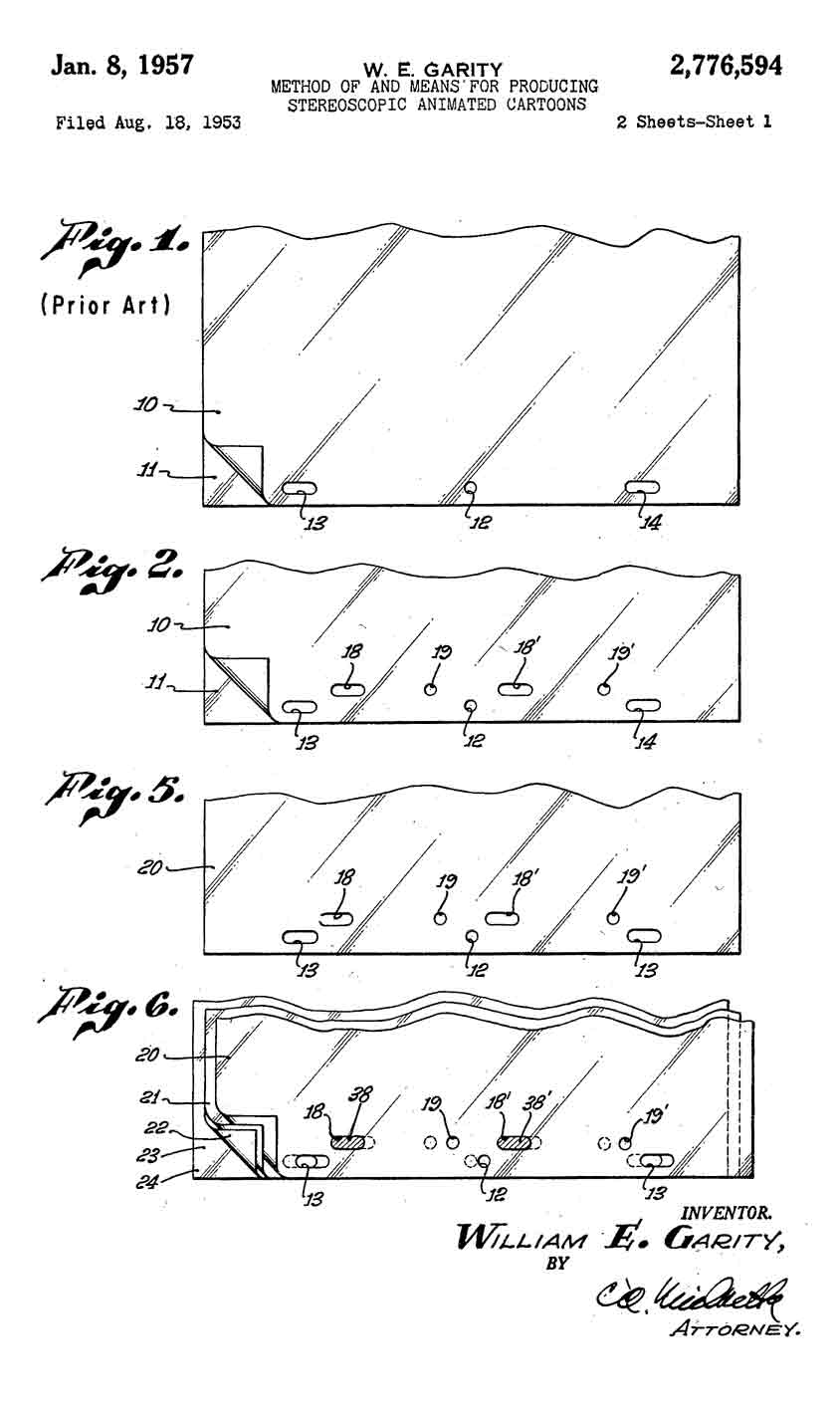
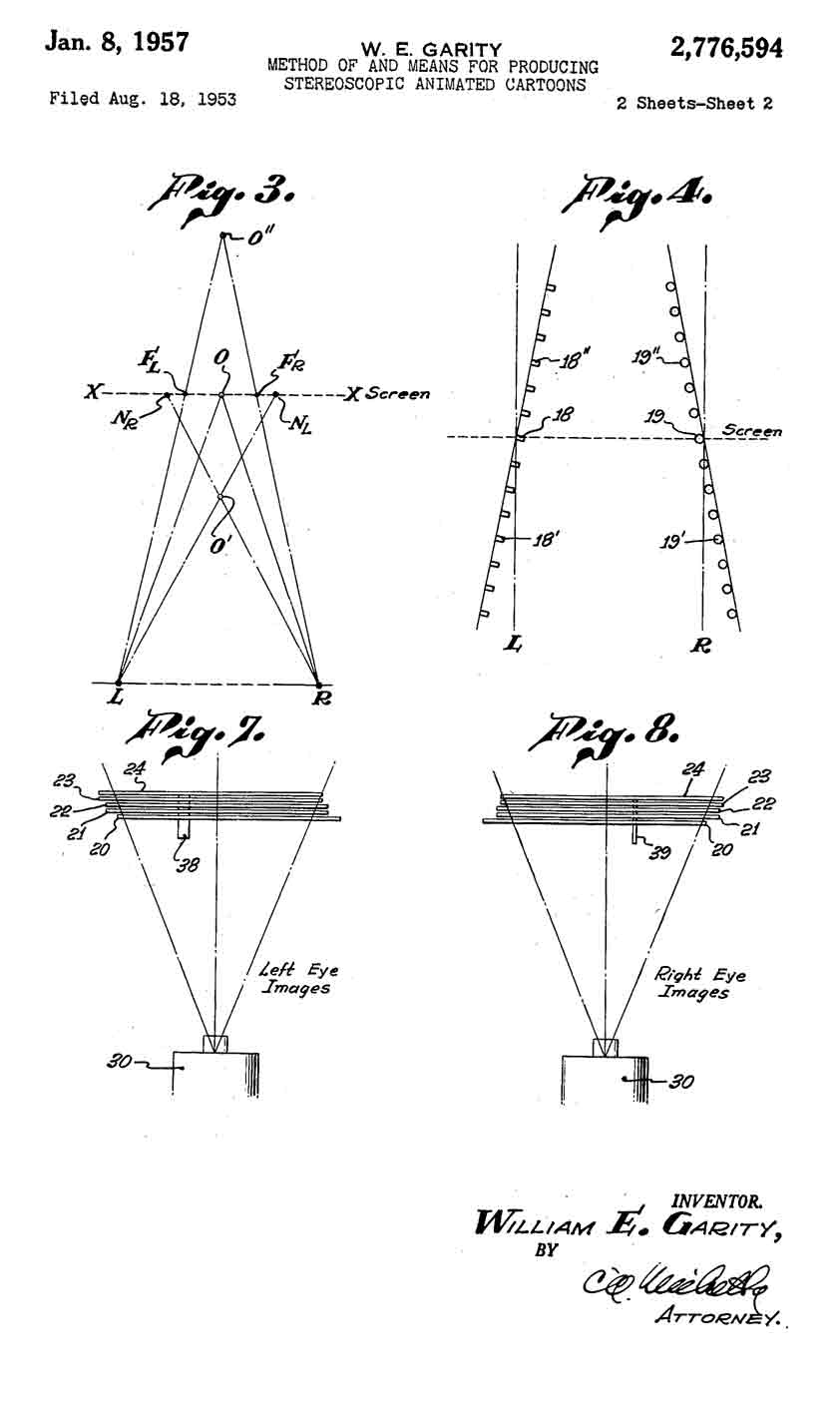
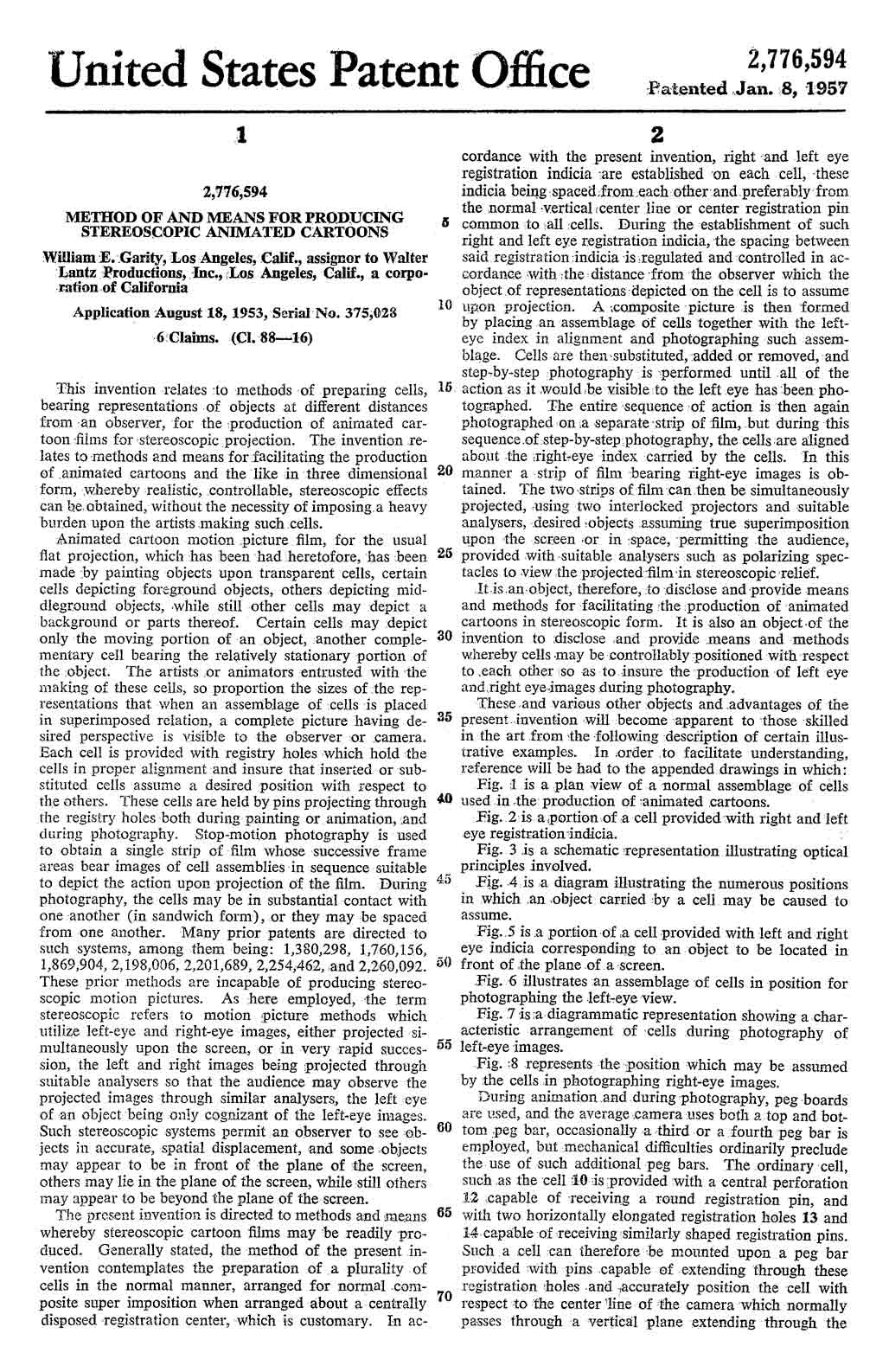
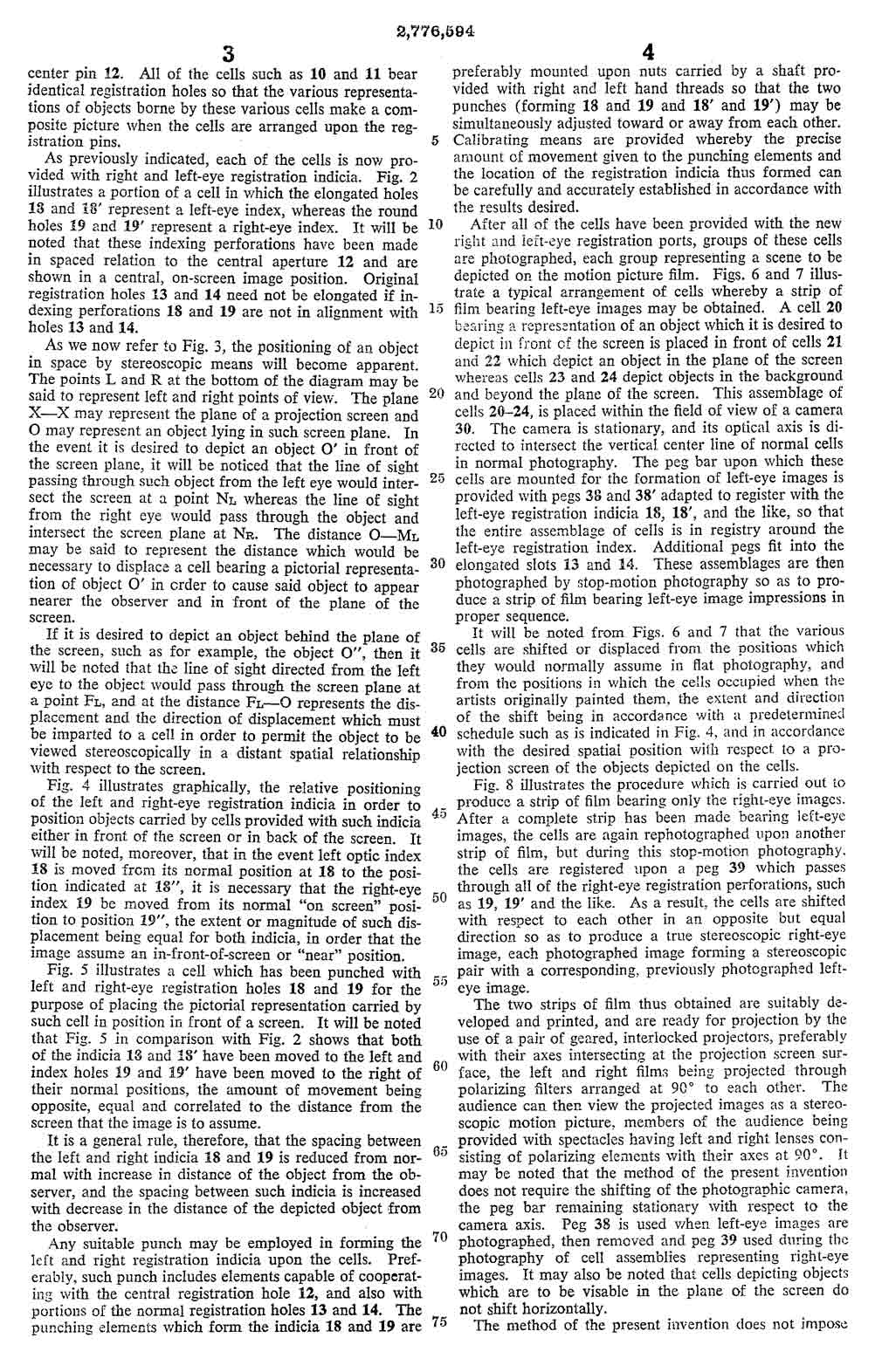
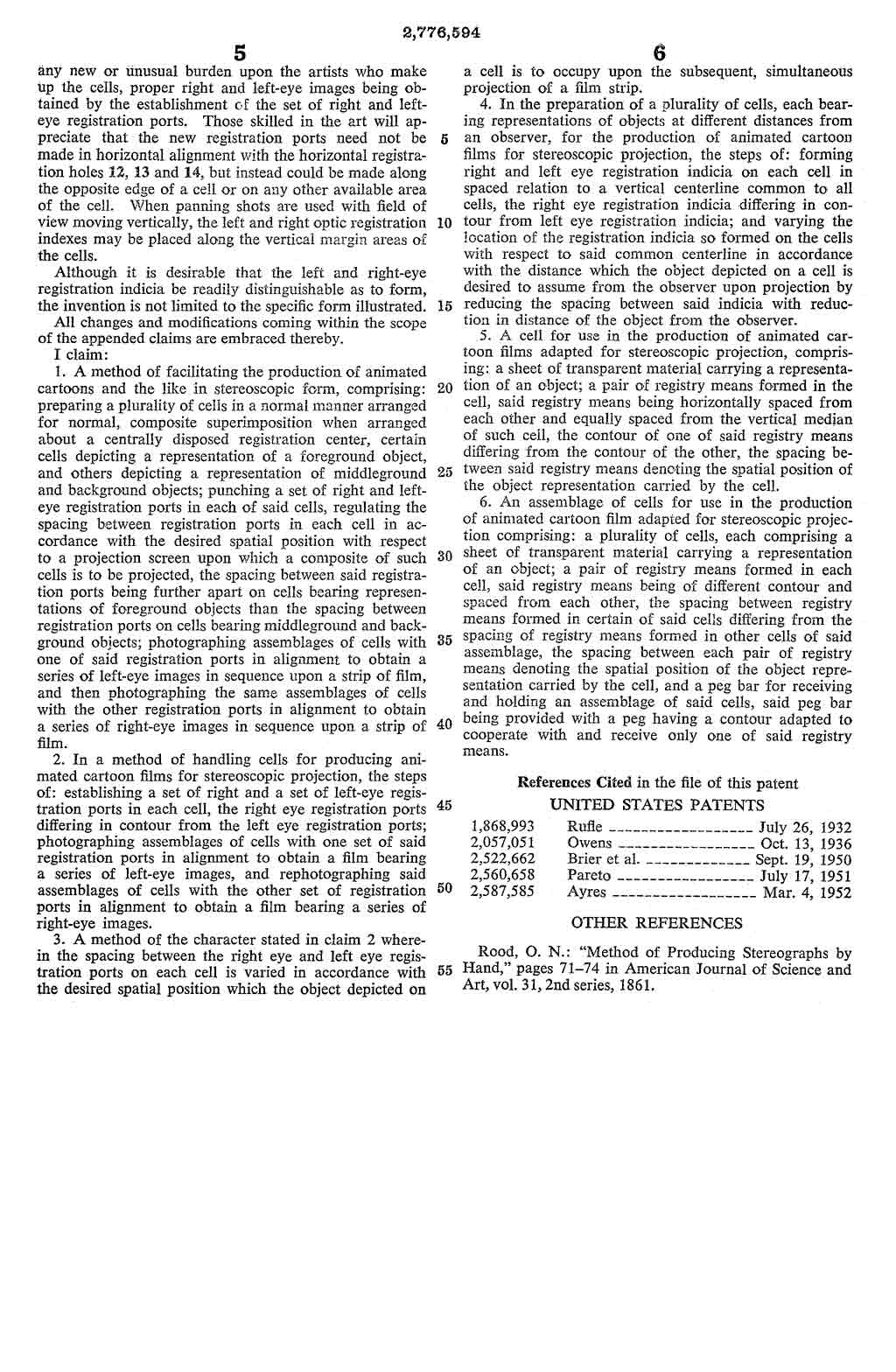
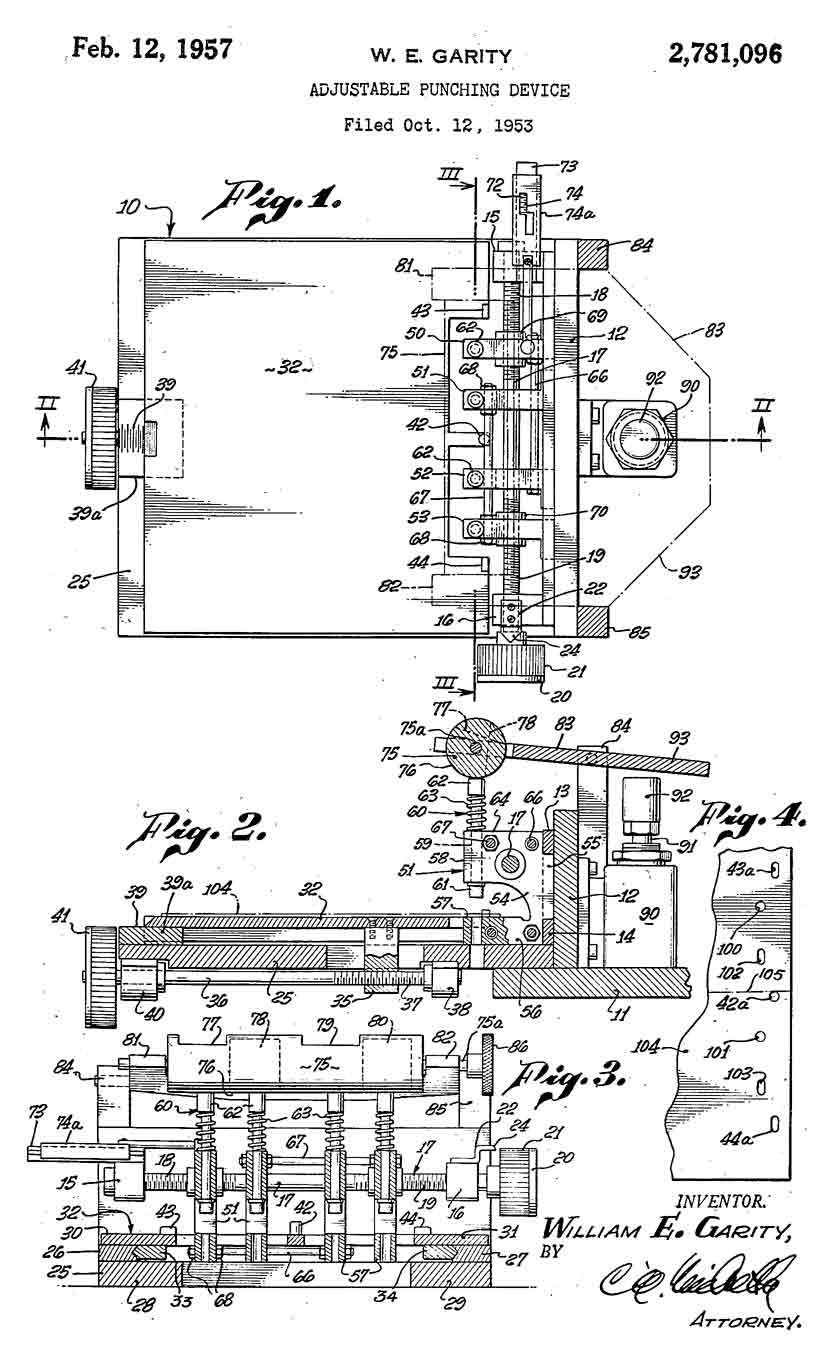
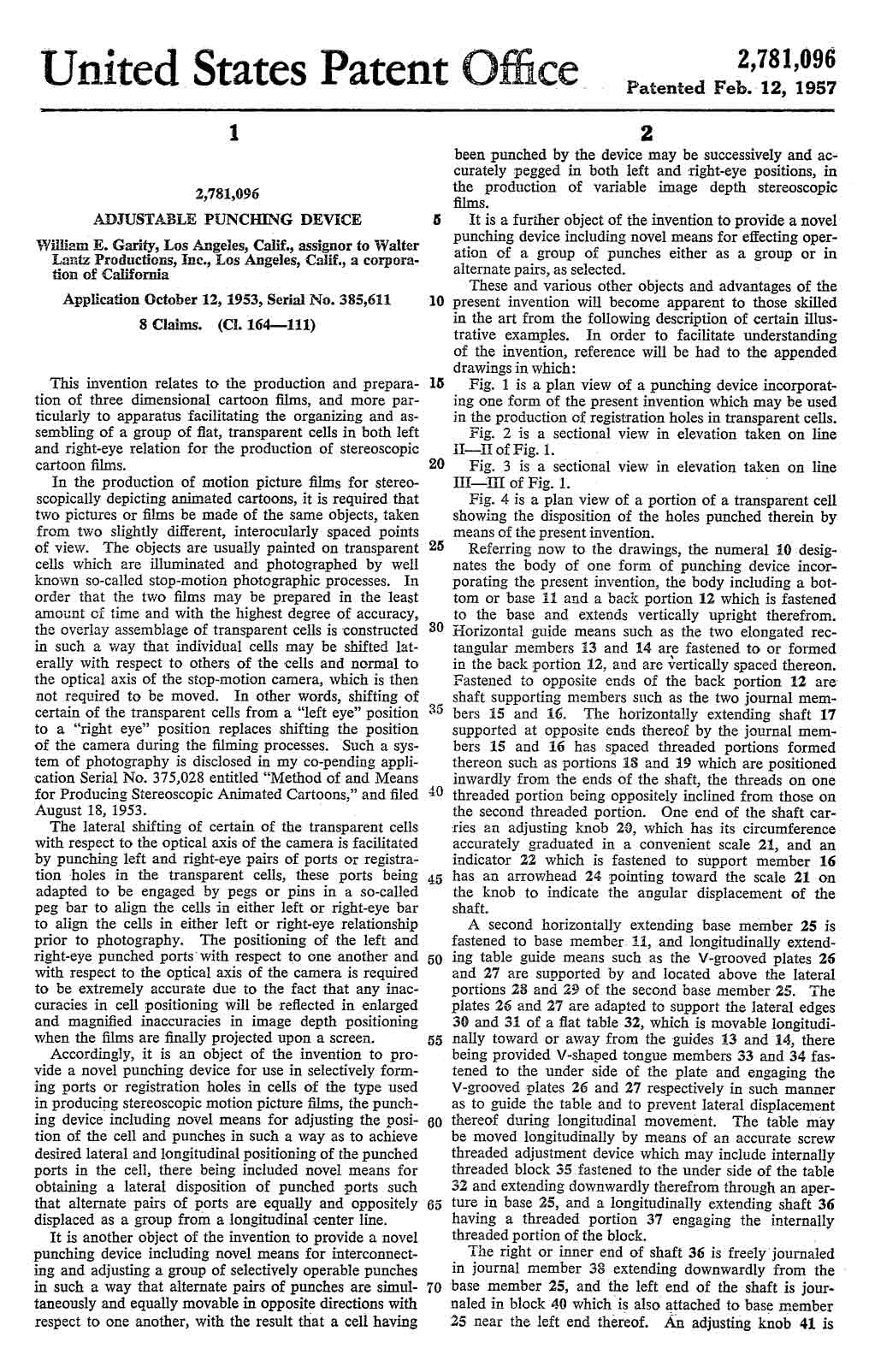
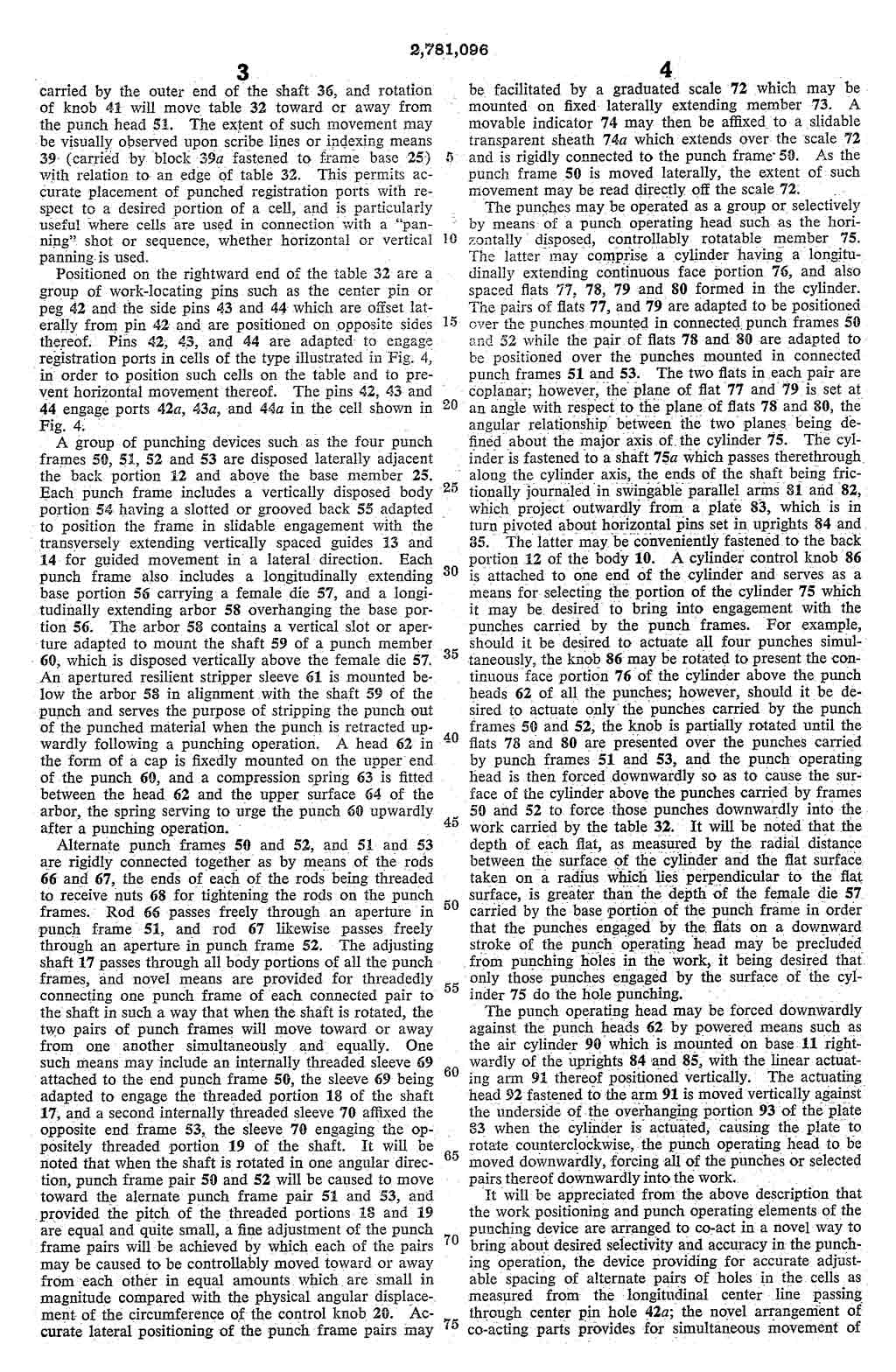
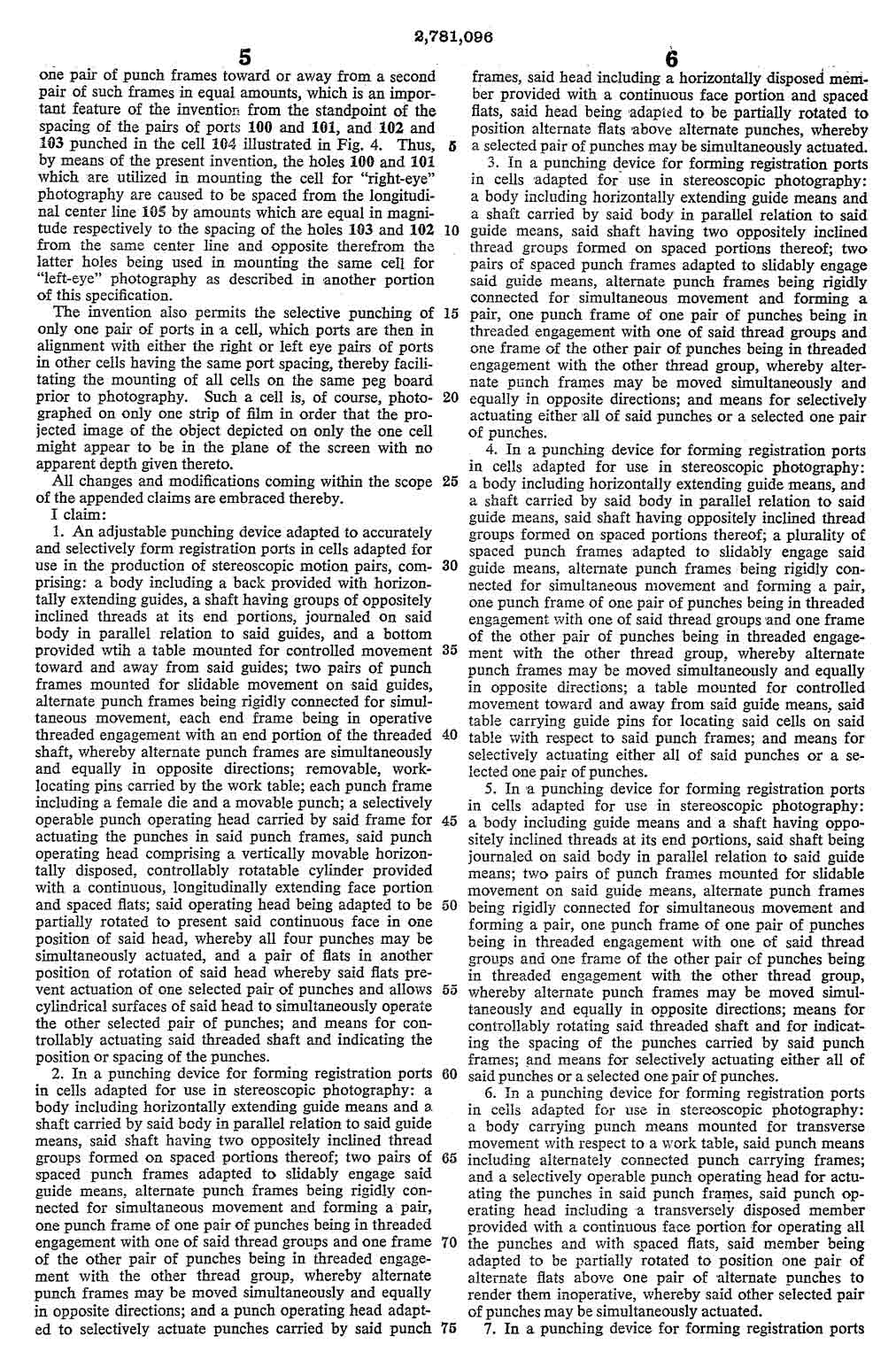
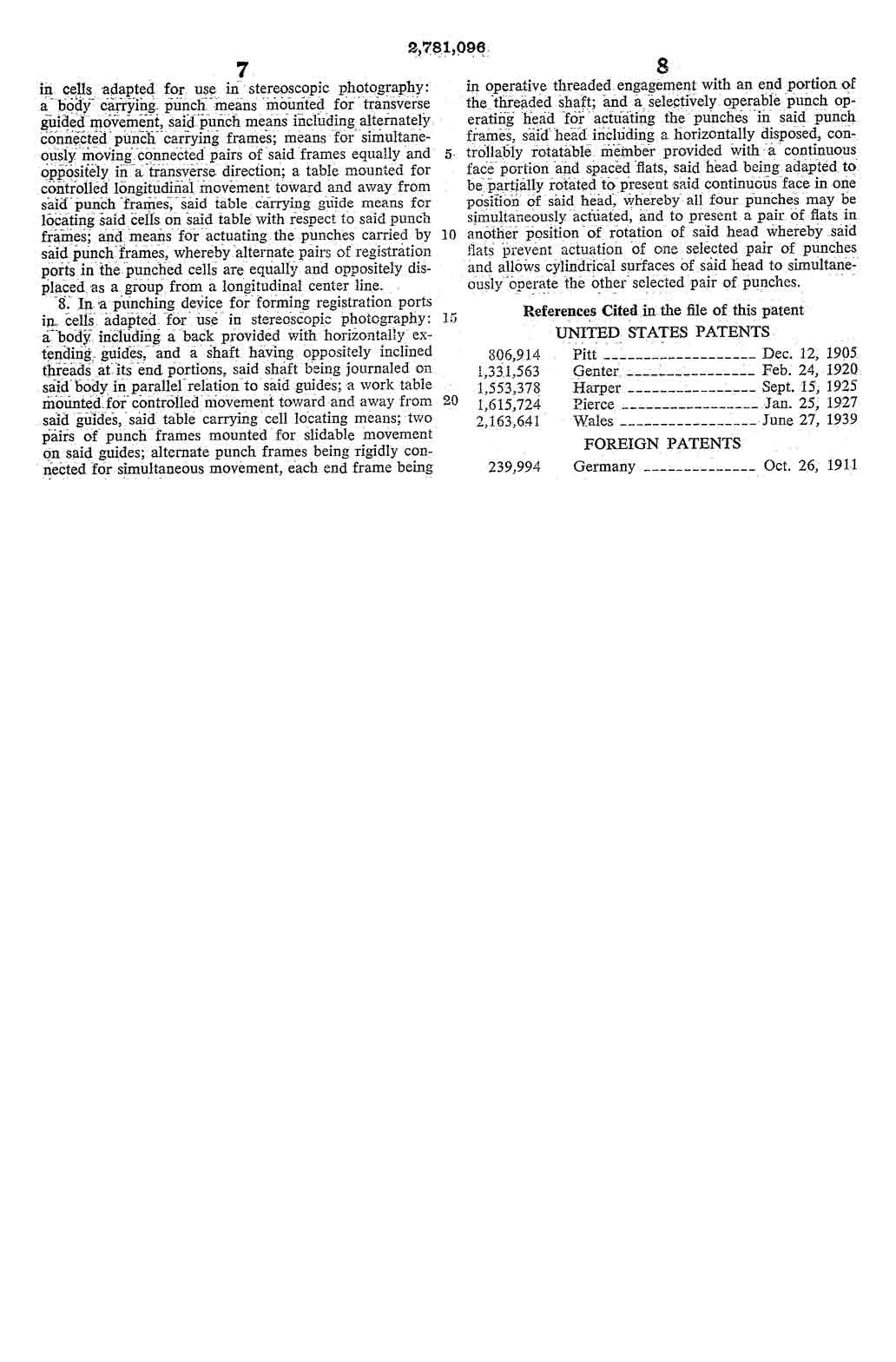
The system to actually make these films is described in Disney's engineer Bill Garity's patents, the first describing the Methods and Means for producing the films. It is a really simple system, based on punching the artwork differently for each eye...
12345
[Note: Garity made these for Walter Lantz' studio. It would not surprise me if the Disney system was somewhat similar, but I have not seen any evidence of this, or to the contrary.]

...and the second a more specific description of the paper and cell punching device used. The animation is produced in the usual way, and the cells are inked and painted. Then, using this special punch which registers to the original three holes, four new separate holes are punched. Two holes are used to register the cells for the left eye and two for the right. The distance between these holes can be varied between cel levels, which results in different apparent distance from the screen when projected using 3-D projection systems. When the holes are centered, the drawing is in center, and the image is in the screen plane. Turning the knob moves the two sets simultaneously, but in opposite directions. Move the two sets closer together, the image seems to be behind the screen; when moved apart the image appears to be in front of the screen.
12345

A little calculating based on the drawings of the punch: we know the standard "old" Disney pegs to be 3.75" apart. [Though, of course, these were Lantz pegs, probably 4" apart.] The "new" 3-D peg sets, two pegs for each eye, were this same distance apart, and the sets are spaced 1.5" from each other in neutral position. It seems they could move about 1.4" further apart and 0.7" closer together. This seems logical, as the displacement for the area in front of the screen needs to be larger than that for images appearing behind the screen. The center lines for the new pegs were obviously parallel to the original pegs, but half an inch further away from the edge of the cel.

The two patents were filed in 1953. When they finally were granted in 1957, 3-D was a thing of the distant past, and would stay that way for another 50 years.

We have previously seen other Garity patents for Disney, including the ubiquitous click track. He also held the patent for Walt's Multiplane camera, which I intend to come back to later.

During the last 3-D Expo at the Egyptian in Hollywood, during the "specials" screening, not only was 3D Jamboree screened to many wet eyes (Annette in 3-D!), but a film strip was shown for the first time that to me was one of the most exciting experiments of the time:

Though normally the 3-D screenings used two regular film strips and polarized lenses and glasses, this was a SINGLE strip IB Technicolor film with one eye printed POLARIZED on one side of the film, the other eye on the other side. It was generally considered impossible to print the thin polarized lines on film, but here it was! This was a test strip from the Land corporation, and it used Disney's Melody as its subject. And it worked! It proved that a single-strip polarized synchronous 3-D film was possible!But it was too late: when they made this test, Fox had already introduced CinemaScope.
The test was shelved, and not seen until 2006...

Note: I updated the List of Feature Production Numbers!

Labels: , ,

Saturday, June 28, 2008

Prod. 2082 - Sleeping Beauty Draft

Time for a new feature film. Since Sleeping Beauty is up for the big beautiful BluRay experience - with music that will sound like originally recorded in Germany (I can hardly wait!) - it is the obvious choice. Therefor, throughout the next couple of weeks I will bring you the draft of Prod. 2082 - Sleeping Beauty.

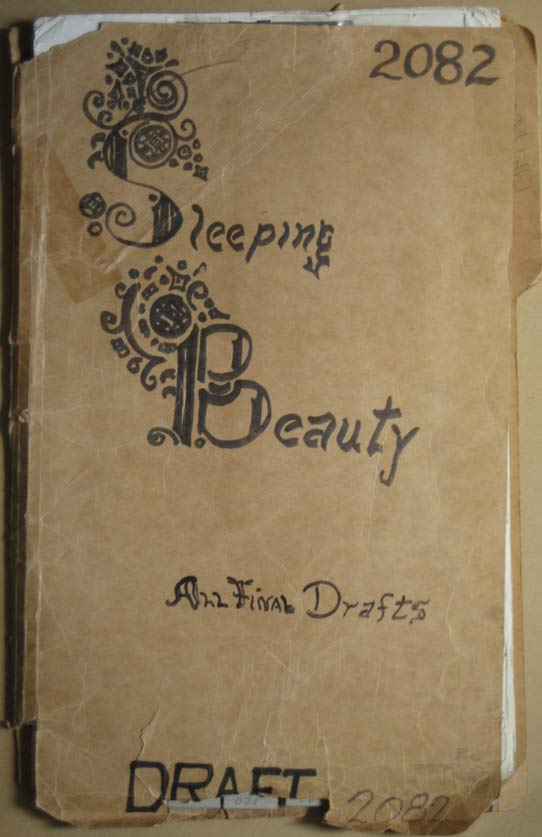
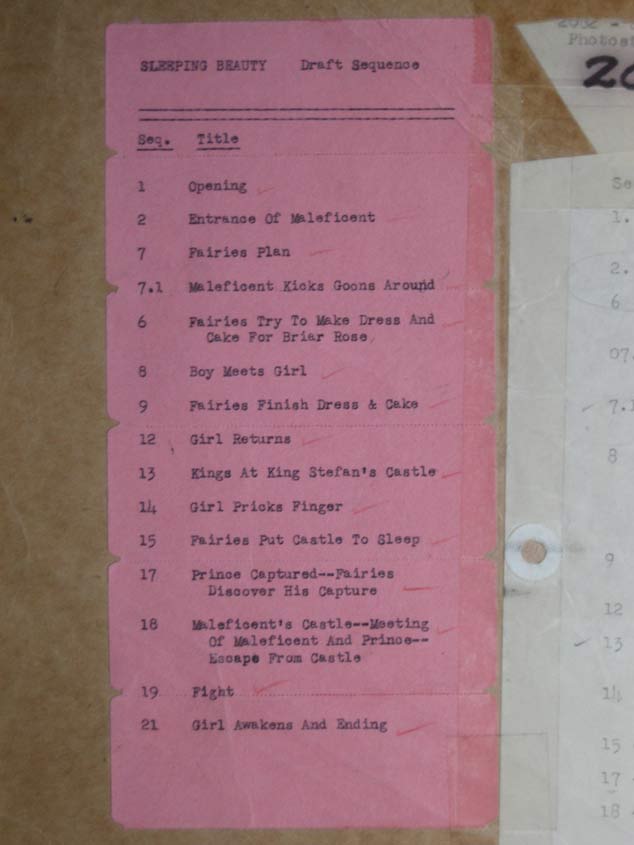
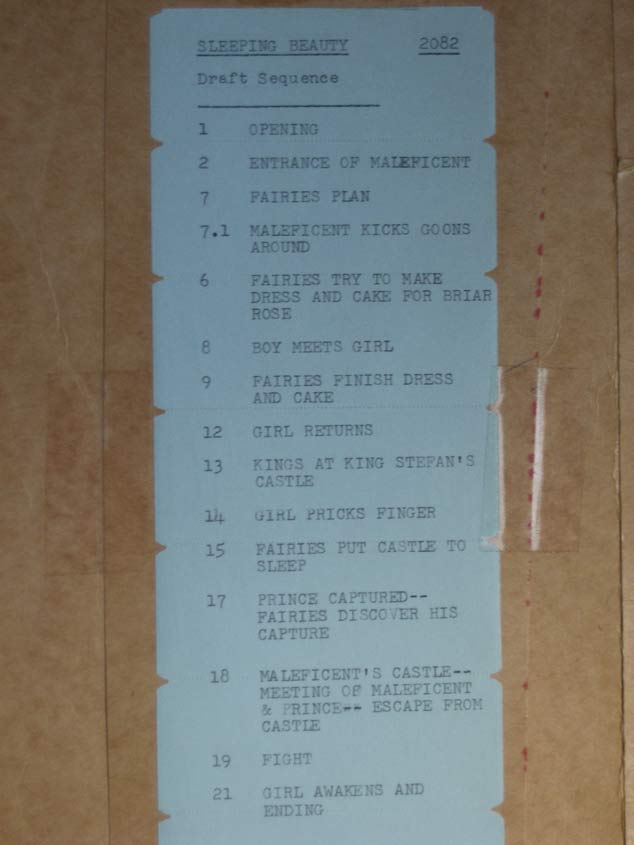
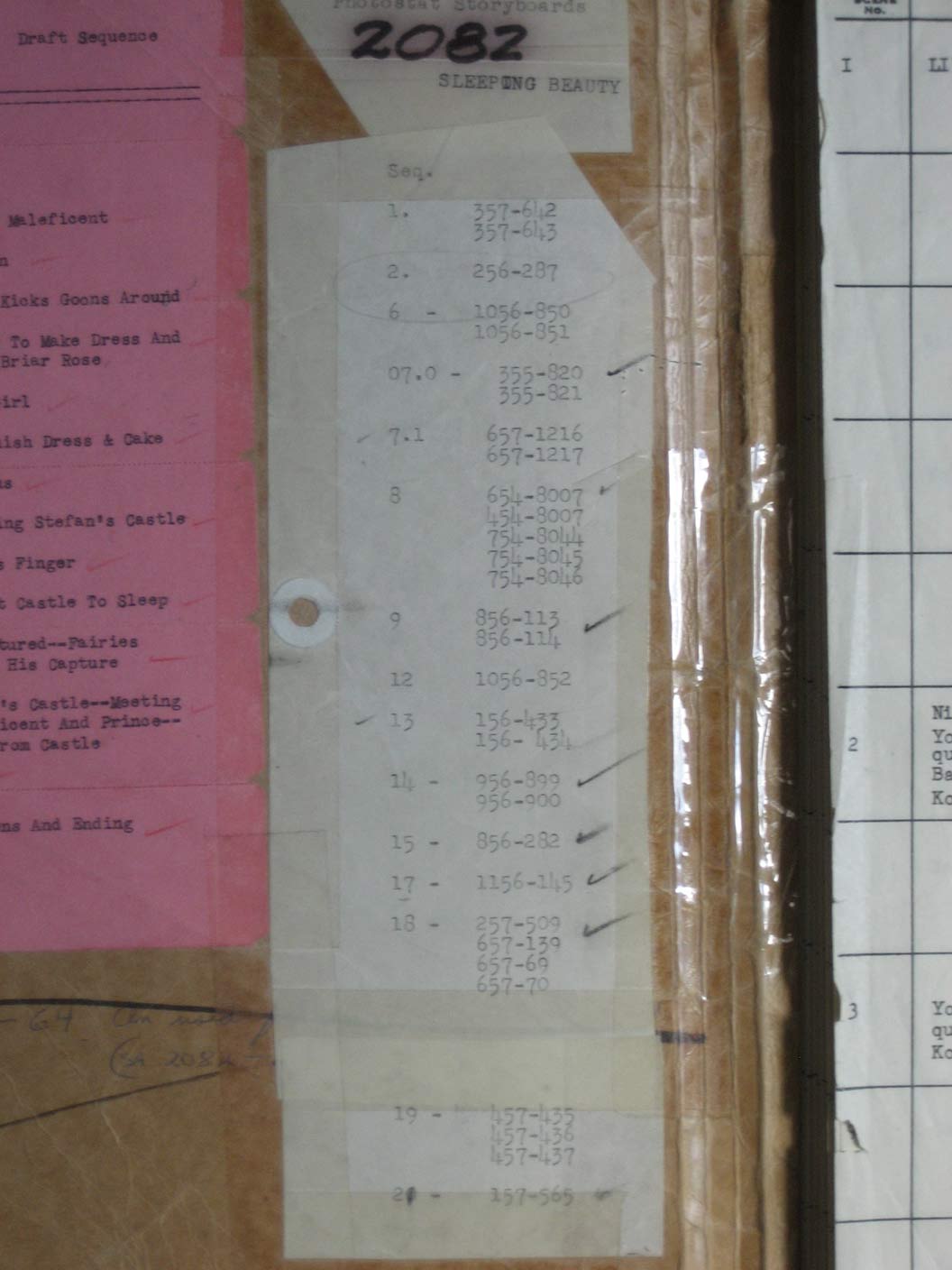
Here are the cover and notes in the inside of my copy. It was originally kept in the Background Morgue - the storage of old BGs that was located in the basement of the Ink & Paint building on the Burbank lot. This has, of course, been transferred to the ARL, the Animation Research Library. For internal use, these drafts are said to have been digitalized, and the old ones discarded. Like this one...

Very interesting to me is the list of photostat numbers for the storyboards. When the board was OK'ed, it was photographed. From the negative numbers we can make some conclusions as to when the sequences were ready for full production. The first number are month and year of the negative. As we have learned from Frank and Ollie's Illusion of Life, the first sequence in animation was Boy Meets Girl, Seq. 8 - and lo, it has the earliest neg. numbers: April to July 1954. Followed by Seq. 07.0 - Fairies Plan, March 1955. The rest is from 1956 except Seq. 1 - Opening, Seq. 7.1 maleficent Kicks Goons Around and the last Seq. 21, Girl Awakens and Ending, all from 1957...
A01A02A03A04
Disclaimer: As always, drafts were not meant as historical documents, they were made during production to be able to trace the person responsible for the actual drawings in case there was anything that needed to be cleared up. They were also used for footage counts, to establish credits, and to see if there were any "slackers." In many cases, a Supervising Animator would pose out a whole sequence, but only animate a few scenes, if any at all. Therefor, the draft MAY not always give a clear view of who was the main responsible person. But it is right now all we have...

Labels: ,

Tuesday, November 14, 2006

Another form of Bar Sheet

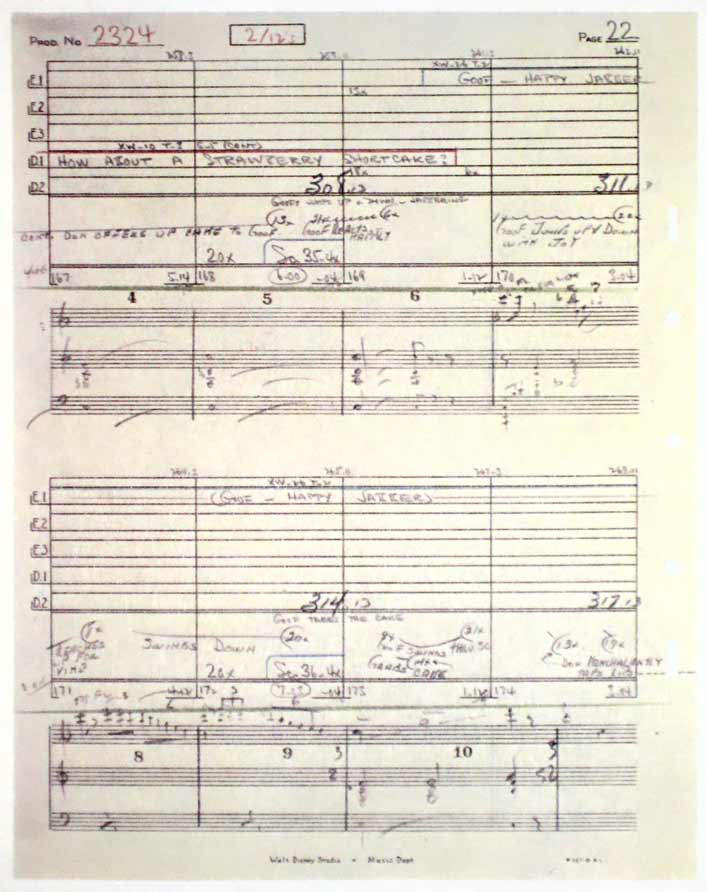
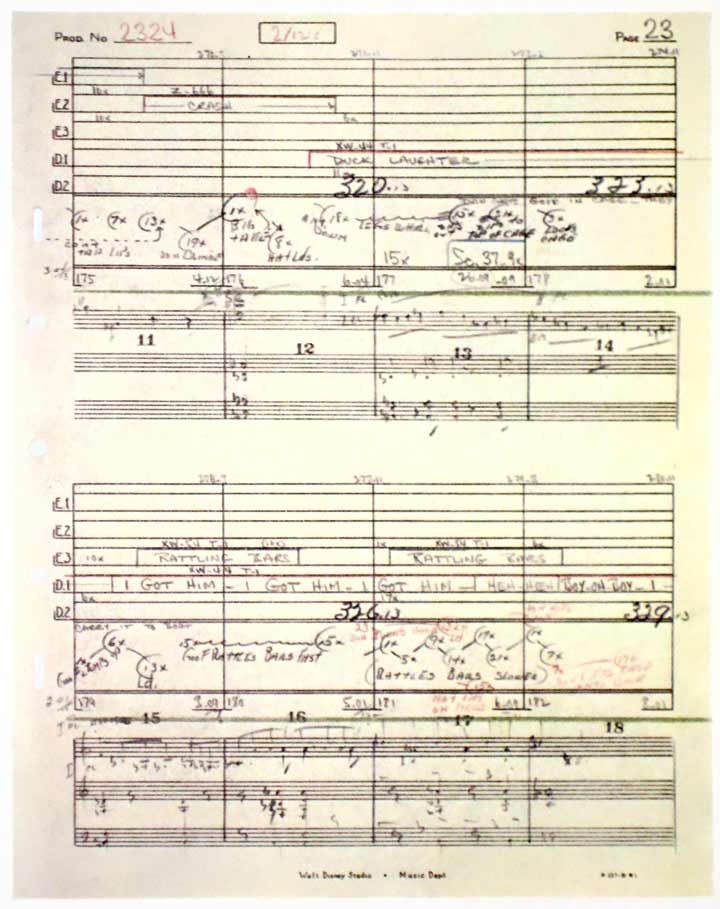
Just to be as complete as I can be here, I include these example bar sheets that I mentioned earlier, probably the most well known, and the first ones I got familiar with, as they are found in Christopher Finch's The Art of Walt Disney (Abrams, 1973), my first book on Disney (a present from my parents), the one that "pushed me over the edge". The sheets are from Prod. 2324, Frank Duck Brings 'em Back Alive, directed by Jack Hannah, released 11/1/1946.

Finch notes that the top lines are for indicating the different tracks of sound: Effects and Dialogue. (We saw those on the The Pointer sheets, as well). Then action, measure numbers and footage, and finally the music staves. In the box at the top we read the tempo, a 2-12's beat, making each measure a second of screen time.

Bar sheets were used in different forms in different phases of the production. The very first ones to be used would be the ones the director uses to time out the film, as the one I showed made by Dave Hand for Trader Mickey. As I noted before, we can see Hand holding this kind of sheets in the promotional film that the studio made for the RKO people at the end of the Snow White production in 1937 (on the Treasures DVD: Behind the Scenes at the Walt Disney Studio).

Then, the "main" bar sheet would be made and kept by the assistant director, as the one Jack Cutting prepared for The Pointer. I suspect that these were then copied onto sheets like the ones in this post, for the musician to write his score [Note that this sheet is marked at the bottom: Music Dept.], and to keep track of all sound channels, which could also be used by the sound editor. On the other hand, at the time of The Pointer, the sound editor's job was not so much juggling channels, so the musician may have instead received sheets like the sheets I showed for Mirrorland (Thru the Mirror), which were especially made to indicate special sound effects, or the ones found at ASIFA-Hollywood's excellent Animation Archive blog. Of course, as always, the bigger and more 'set' a studio/factory gets, the more complicated are the forms that represent the structure of its work - thus, much of this is conjecture based on the artifacts.

The important thing to remember is, that none of these bar sheets have dimensions that are frame-related. You cannot put an exposure sheet up to them and copy the information. Now, that IS a practical feature, but for anyone to be able to time to a beat on those (newer) sheets like the ones we used on Anna & Bella, functionally similar to the ones Michael Sporn showed recently here, one would need to mark off the beats, basically by counting frames, a VERY stultifying line of work, one that you would not want to have to repeat for too long. How well I remember doing that. The Disney bar sheets, however, are devoid of that. They are first and foremost related to music and rhythm. Only after all the timing is done are they copied to exposure sheets, which is where the counting has to be done. But by that time, the film's timing has been perfected, and the desired result (as to the timing) is more or less guaranteed...
12(Thank you for these, Christopher Finch)
Thank you, Mark and Michael for linking to this stuff, and the films in my previous posts - I am so happy there is an interest in it, as I have been preaching the basis of this into the wind for so many years!

[Added later: I found in copies of hand-written notes by Frank Thomas to Ollie Johnston in preparation of their bible "The Illusion of Life," a note regarding above barsheet, mentioning that it was prepared for a re-recording session, and thus an "after-the-fact" document and not the very first original sheet, like my example from The Pointer.]

Labels: