Please note: if an earlier link doesn't work, it may have changed following an update! Check the Category Labels in the side-bar on the right! There you can find animator drafts for sixteen complete Disney features and eighty-six shorts,
as well as Action Analysis Classes and many other vintage animation documents!

Friday, December 08, 2006

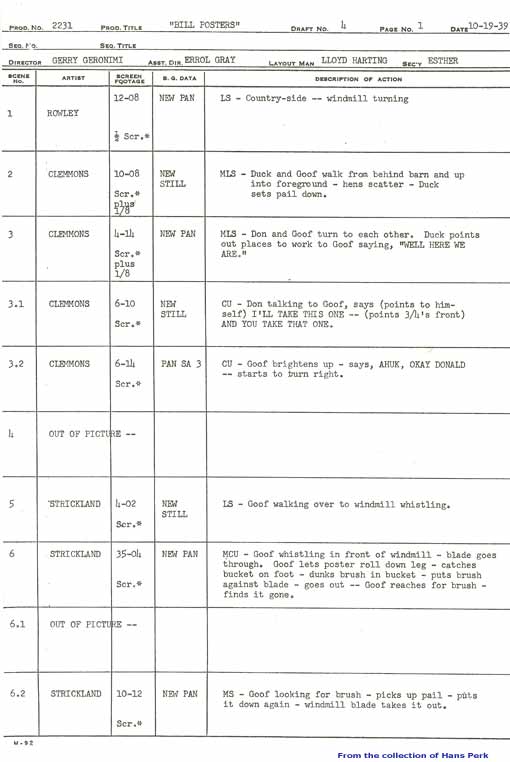
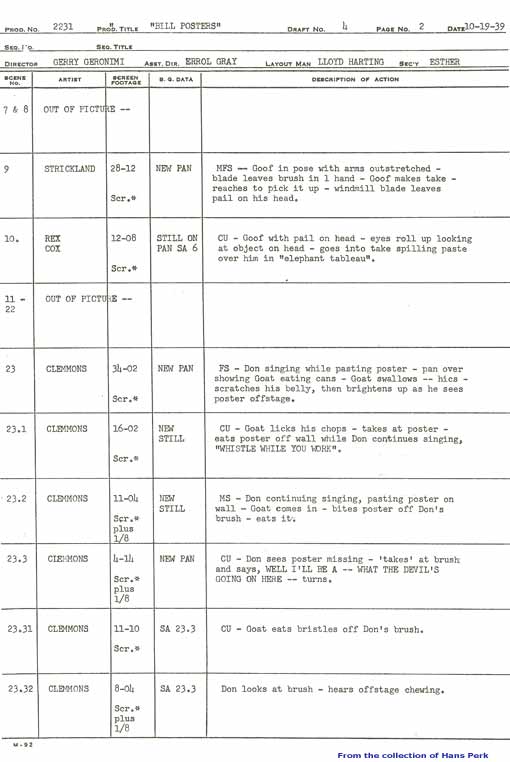
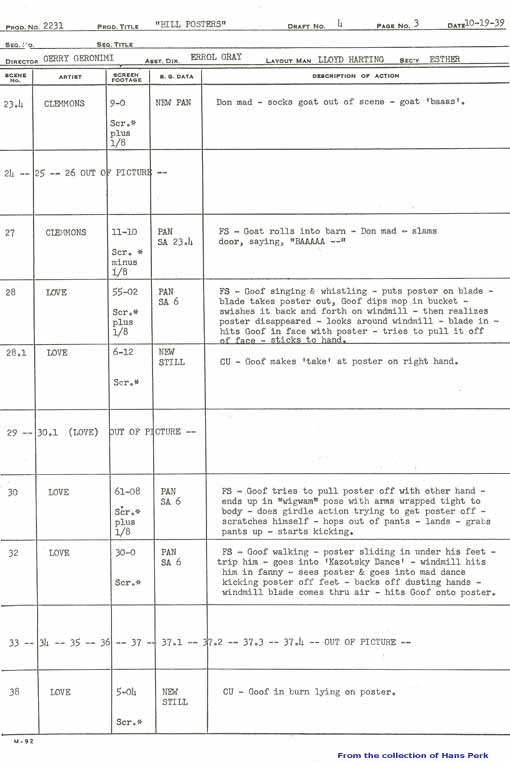
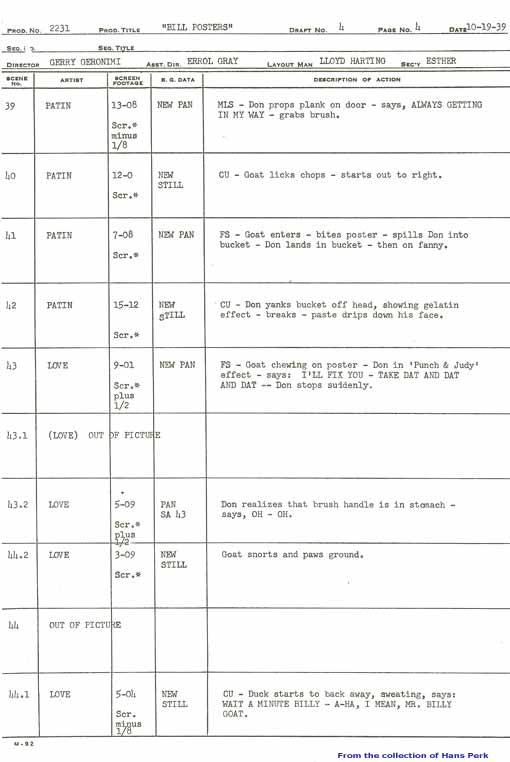
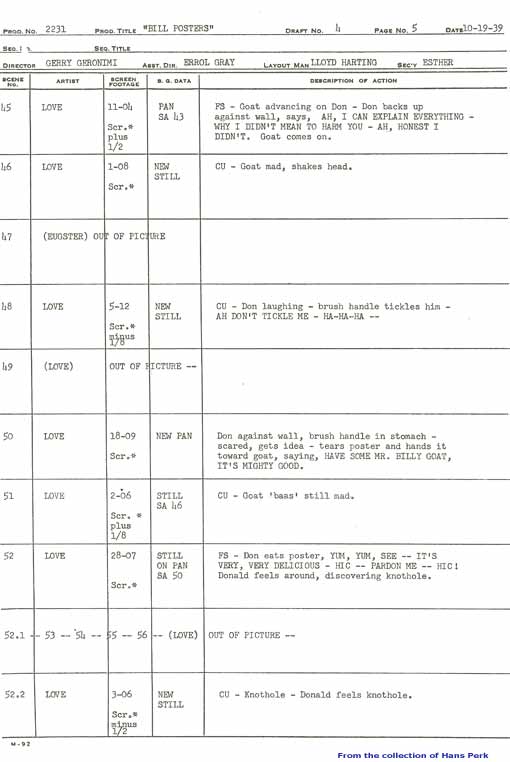
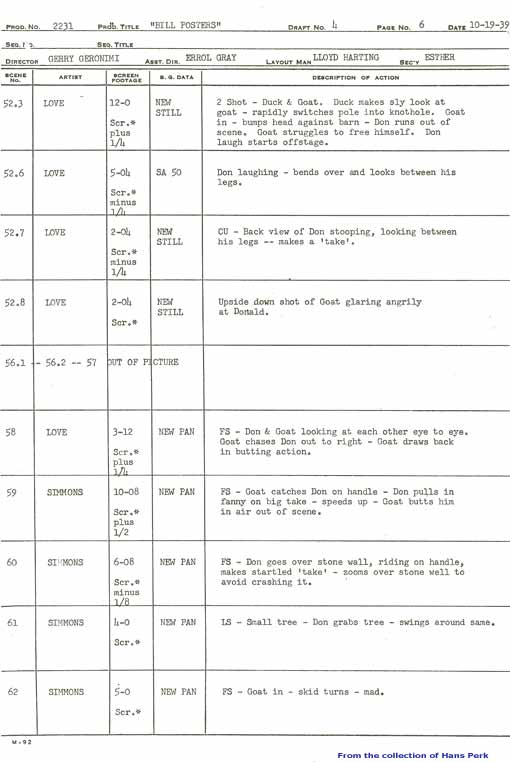
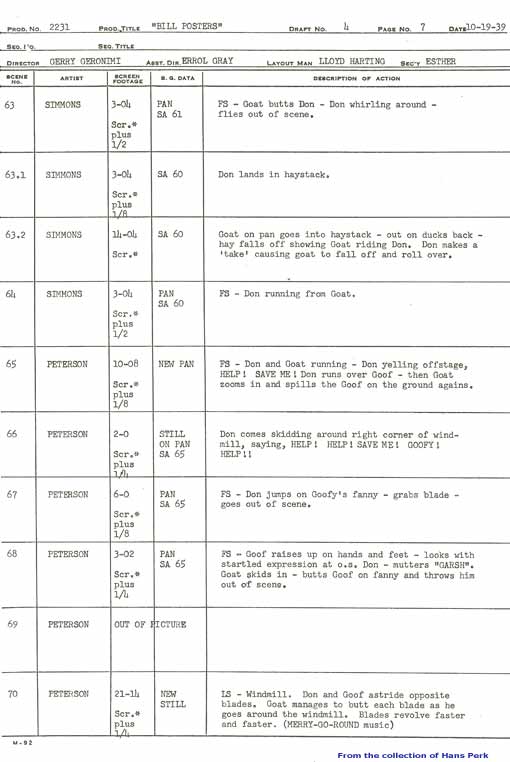
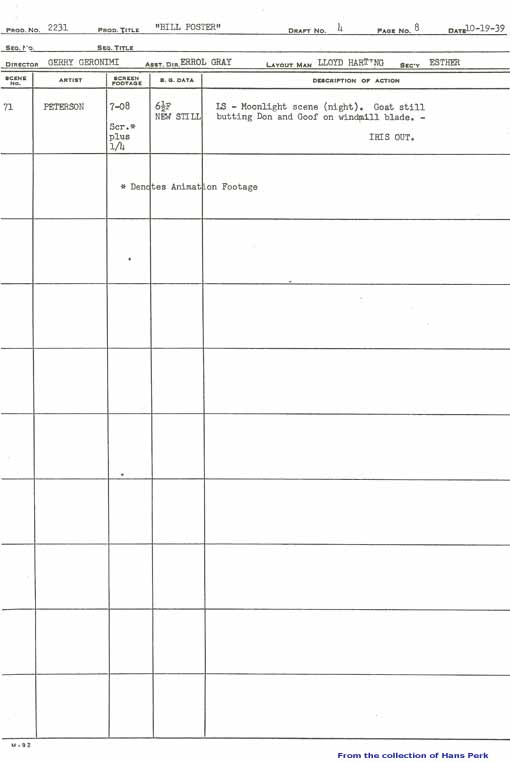
Prod. 2231 - Bill Posters

A quick posting on this day of the TAG Christmas Party.
Directed by Gerry Geronimy, released 5/17/1940.
This draft nr. 4 is from 10/19/1939...
1234
5678

Labels: , , ,

Thursday, December 07, 2006

Prod. UM28 - Two Gun Mickey

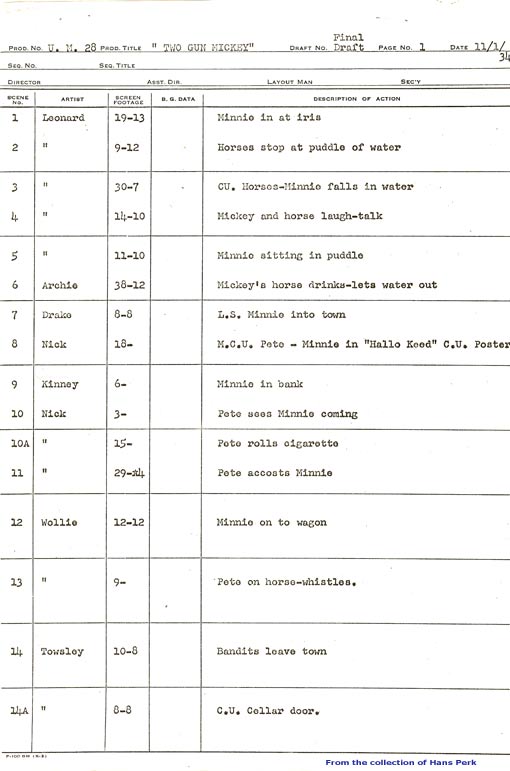
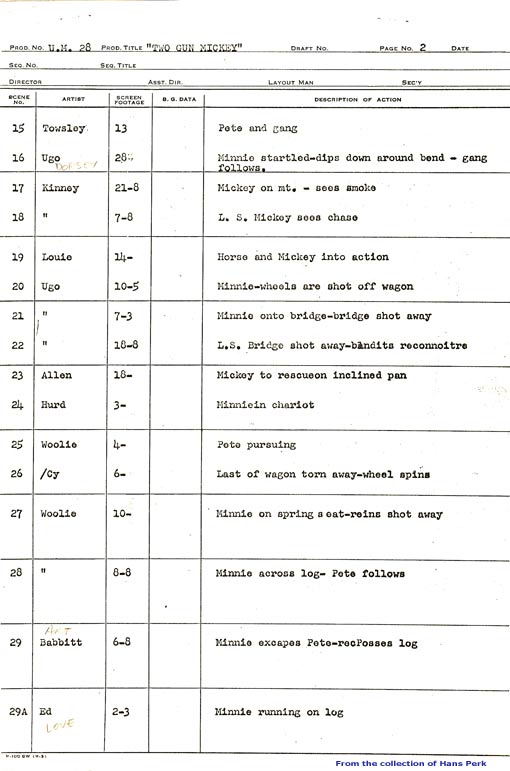
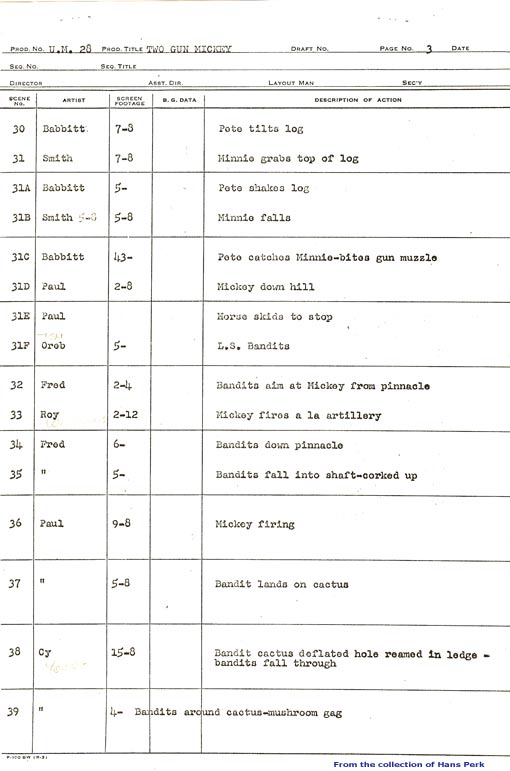
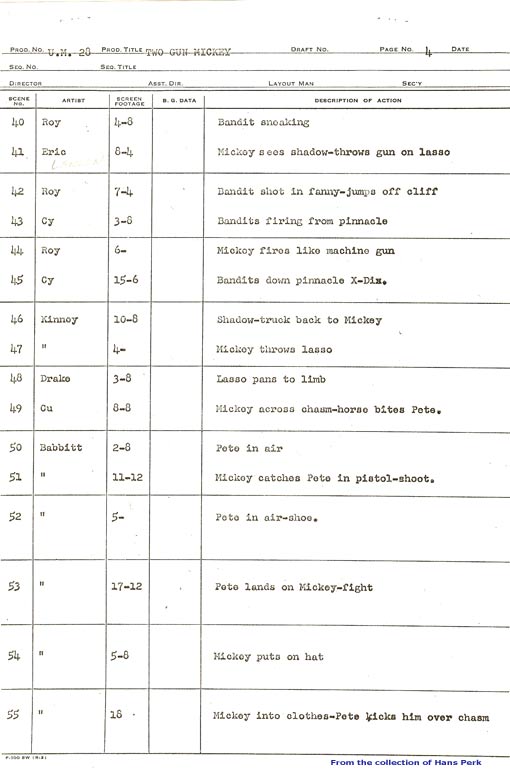
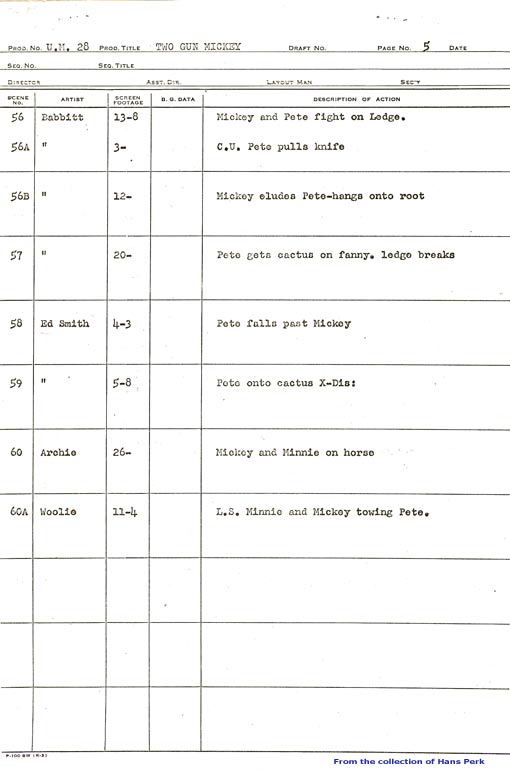
Another request: Ben Sharpsteen's first directorial credit is for the film called Two-Gun Mickey, released 12/15/1934. This draft, this blog's number 30 short film draft, is from 11/1/1934, and has no dash in the title. The film is a lively picture with a true hero.

Nineteen animators are credited: Leonard Sebring, Archie Robin, George "Ol' Flop-Ears" Drake, Nick [George], Jack Kinney, Woolie Reitherman, Don Towsley, Ugo D'Orsy, Louie Schmidt, Paul Allen, pioneer Earl Hurd, Cy Young, Art Babbitt, Ed Love, Ed Smith, Frank Oreb, Fred Moore, Roy Williams and Eric Larson. On IMDb we can read that Ollie Johnston assisted on this. Les Clark is there also credited for animation, but he sure ain't on the draft!

It is available on Disney Treasures DVD "Mickey Mouse in B&W."
12345
Say, has anyone tried out the Beatronome yet?

Labels: , , ,

Friday, December 01, 2006

Users Manual for Bar Sheet DIY

First - DIY is Do It Yourself - this for those who aren't used to coloquializms. The excercize is really relatively simple. Before we begin, I suggest that it may be good to re-read Albert Hay Malotte's lecture notes at this point. It also may make more sense to hardened readers of this blog than it did on May 25th when I posted it.

Ok, here we go. On your favorite DVD player in view and earshot from your PC (with should have a working, non-muted PC speaker, I haste to add again), insert the short film you'd like to analyze. This can be a Disney short, but really most of the films of the 30s and 40s seem to have been timed to a beat throughout - Looney Tunes, Harman-Ising etc.

To get the feel of things, start like this: When the film plays, use my Beatronome program to tap out the beats of the music of a certain sequence. You should tap the number of times indicated in the little box right of the tap button, plus one. The beat will then show up below the button. You'll find it will normally be 'whole' beats: 7, 8, 9, 10, 12, 14, 16, 18, 20, 24. Tap several times to give you an average, and type the closest whole beat in the metronome bit. This may be more accurate in the long run than just transferring the tapped beat to the metronome. Rewind the sequence on the DVD, and press Play on the metronome when you hear the rhythm. Write down which tempo this sequence was in.

It gets more tricky when there are bits without music, of course. As you see in Mickey's Elephant, the music often just continues. Try to let the metronome run - and see if the action hits the beats. See if you can spot where the tempo changes, and continue doing this over again for the next part of the film. In the end you have a listing of which sequences are in which beat (I for one would like to see this!) If you are really persistent, you can now count how many beats there are in each tempo, and you can write this out on a simple bar sheet as the one I supplied yesterday. Now - what are you waiting for?

Oh - 'why would we even try', you may ask. Well, through this excercize, you can reveal the sense of stucture and backbone that were underlying the films of the time. And as such, learn more about what made these films great entertainment. So much has been published about the drawings, but this beat thing, this is all about direction. As Norm Ferguson said: 'timing is the essence of the thing'. It need not be a forgotten art anymore...

(Note for MAC users: you CAN use an ordinary metronome, most certainly. To convert between frames per beat and beats per minute, you can use the converter here on the right, if your math fails you.)

Labels: ,

Thursday, November 30, 2006

The Bar Sheet DIY...

Not long ago, I wrote somewhere in a bar sheet posting that it might be fun to recreate bar sheets from shorts from the 30s, as a classroom activity. Well, to begin with, you will need a pencil and paper with bars written on them - find inspiration from the previously posted examples. "Here is one I prepared earlier" in PDF format. Finally you will need a metronome. And for that, I wrote a little program I unimaginatively called Beatronome, which you can download here. It is packaged inside a zip archive.
If you are an animation director, animator, or animation researcher, and you use a PC, you might like to have a look at it, as well...

It is really simple, uses the PC speaker, and should work under Windows XP SP2. (No, not on a MAC...) You can convert beats, play them, tap beats and play those. Now, you only have to be able to count. If it doesn't work, or protests by telling you that the run-time is missing etc., you can download a full distribution package here. Sorry, PC ONLY!

I look forward to hearing your findings!

Labels: , ,

Tuesday, November 28, 2006

M46 with Click Track

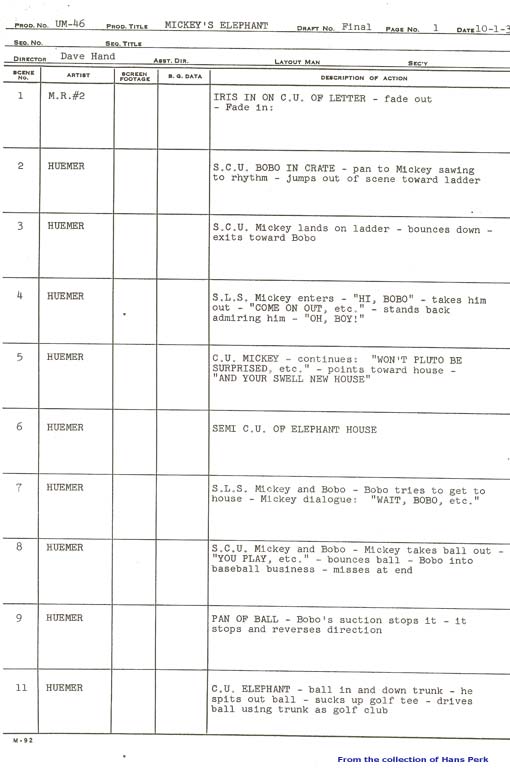
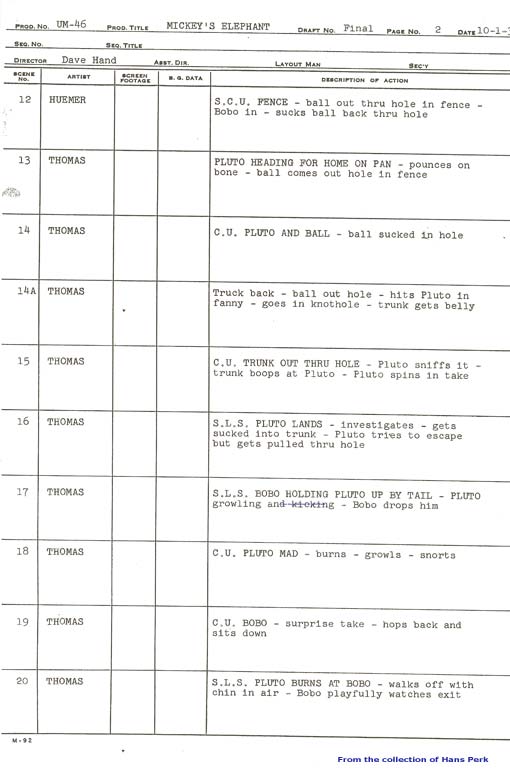
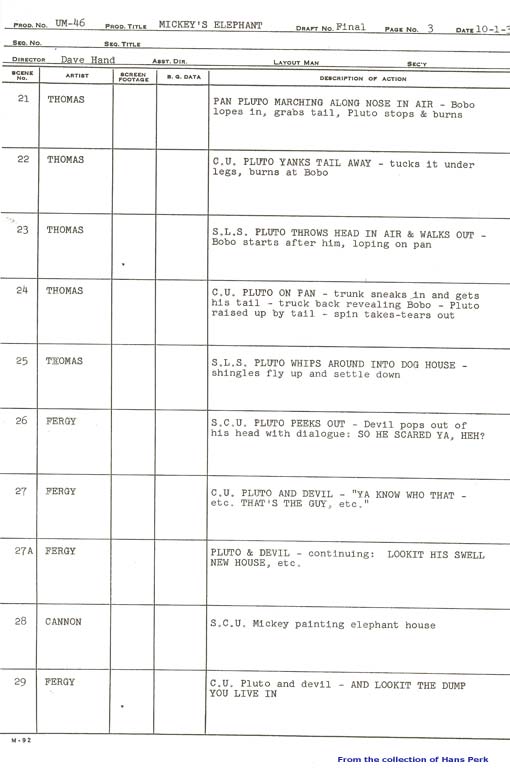
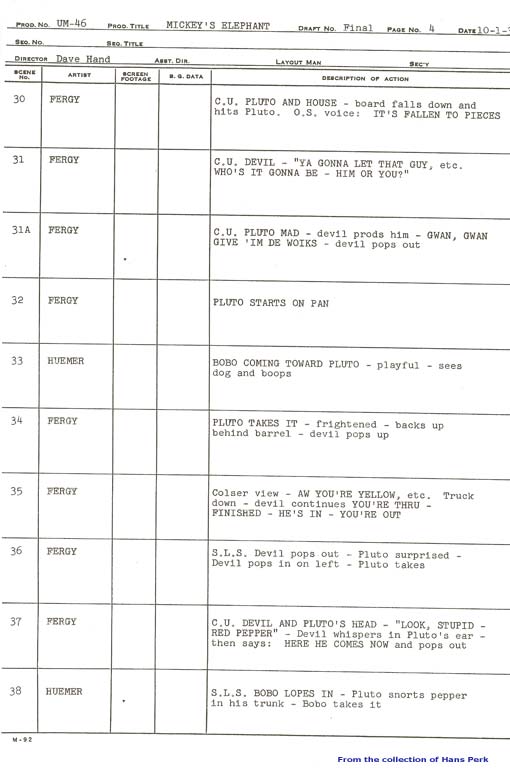
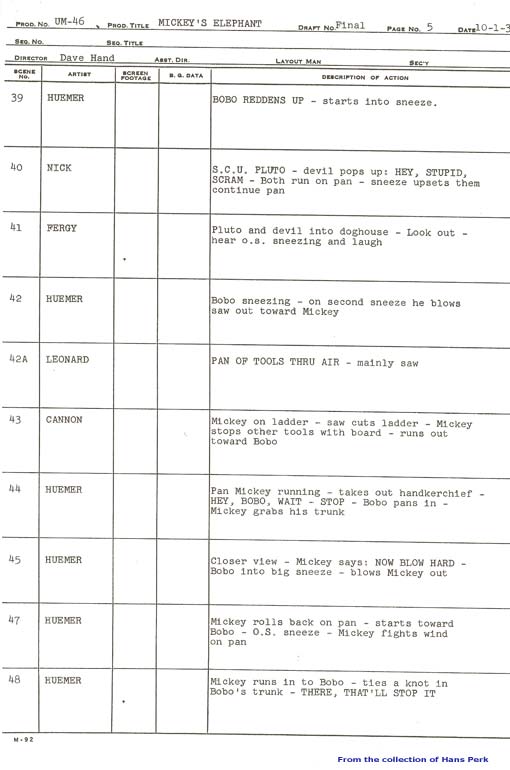
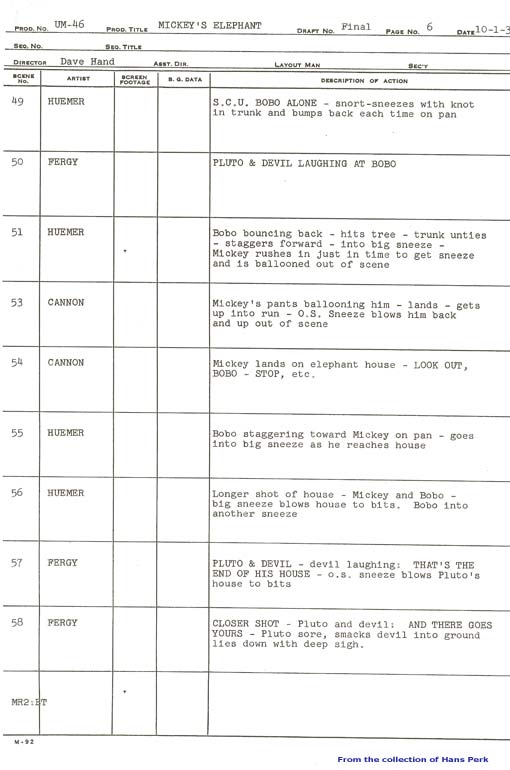
Here is another short with click track based on a bar sheet I have. Prod. UM46 is known as Mickey's Elephant. Released Oct. 10th, 1936, it was directed by Dave Hand, with Jack Cutting keeping the bar sheets as assistant director.
Animation mainly by Dick Huemer (Bobo and Mickey), Frank Thomas (Pluto) and Norm Ferguson (Pluto and Devil), with Johnny Cannon (Mickey), and single scenes by Leonard [Sebring] and Nick - either Charles Nichols or Nick George (anyone?).

Very interesting is the way the beat changes as the animators do. One can put a lot of effort in explaining that, but it is probably just because they were basically different sequences, and as such just cast to different animators. Click this:


The film opens on a 12 beat (2-12), then, as Bobo the elephant is playing, it is 8 beat (3-8, waltz tempo). Pluto arrives jauntily:
12 beat (2-12). Then, the bit with pluto and the devil: a slower, more thoughtful 14 beat (2-14), and here the music isn't onmi-present as in the beginning. Then 10 beat (2-10) and we end in chaos on an
8 beat (2-8). There is one place where a measure was shortened to four frames by cutting a foot in the 2-10's bit.

Obviously, the director (Hand), helped by the musician (Malotte) decided the tempo with a metronome, to be most fitting to the action and mood on screen. A beat was chosen that could be sustained for a good number of bars, but, as we also saw on The Pointer, in the end it is possible to cut a few frames out if needed, as long as the musician can incorporate that decision - or there is no music. It seems that a 12 beat was generally chosen as a 'generic' not-too-fast, not-too-slow beat. An 8 beat is readily used as a waltz-type faux-24 beat, a subdivided slower 16 beat, or a quick 2-8's as chaos unfolds.

Have a look:


Here is the draft, for good measure (pun intended):
123456

It would be interesting to hear from other directors who tried this method of timing - and to hear from musicians what they think about it. I remember the musicians I worked with - they at first thought it strange, but they quickly embraced the way of working as very natural... By all means feel free to comment!

Labels: , , , , ,

Monday, November 27, 2006

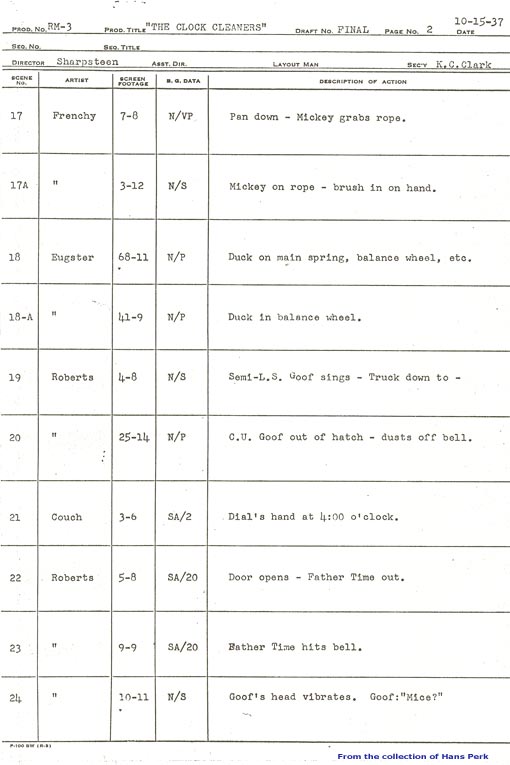
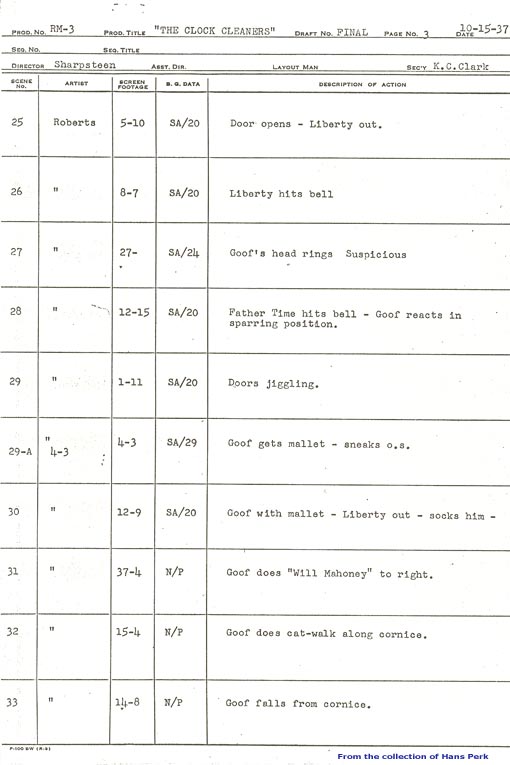
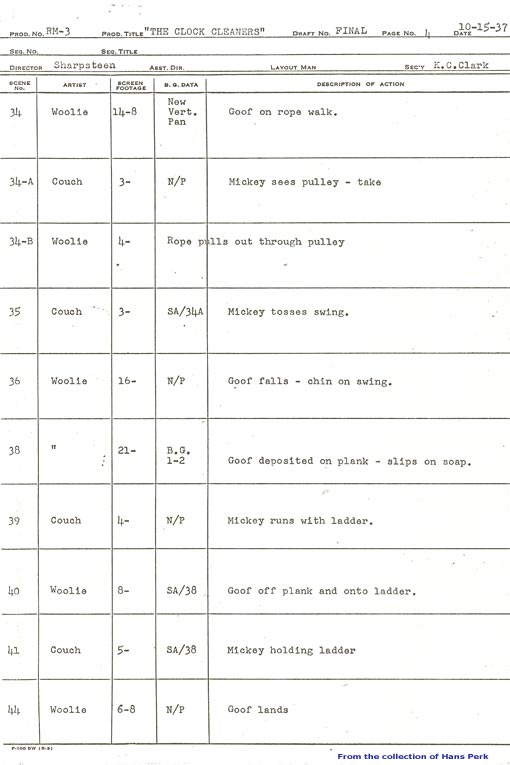
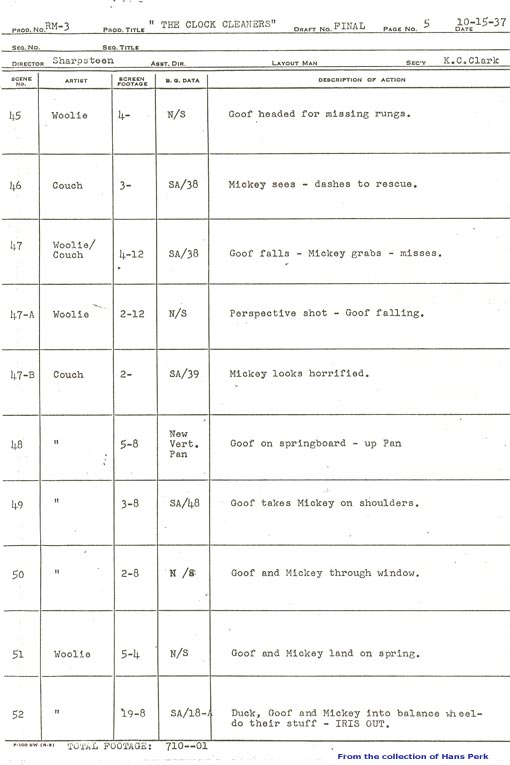
Prod. RM3 - The Clock Cleaners

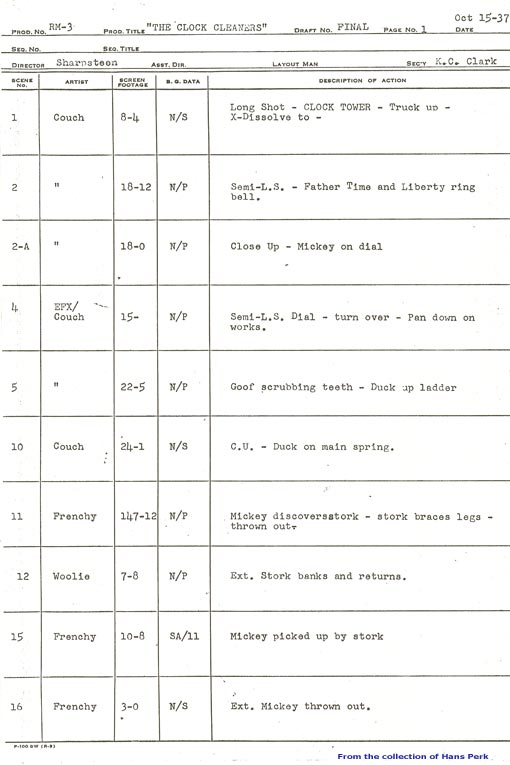
Another timeless classic, this one directed by Mr. Benjamin Luther Sharpsteen (11/04/1895-12/20/1980). The date on the draft is the release date, 10/15/1937.

The Mickey/Donald/Goofy films around this time (on this blog see RM1 Lonesome Ghosts and RM5 Hawaiian Holiday) were cast pretty much similarly, and had many of the same animators, including Woolie Reitherman, Frenchy de Trémaudan (with at last an acting scene! A BIG one!) and Al Eugster. This episode also features Chuck Couch and Bill Roberts.

The auction catalog of the Horvath estate in the 70s had an interesting letter by Ferdinand Horvath called 'Surprise in Gags' in which he talked about the gags of Goofy up on the ladder. He thought it more interesting to have Goofy step over the hole in the ladder to then fall through a rung that seemed good. Seeing that Goofy was not conscience, it might have been hard to pull off...
12345

Labels: , , ,

Sunday, November 26, 2006

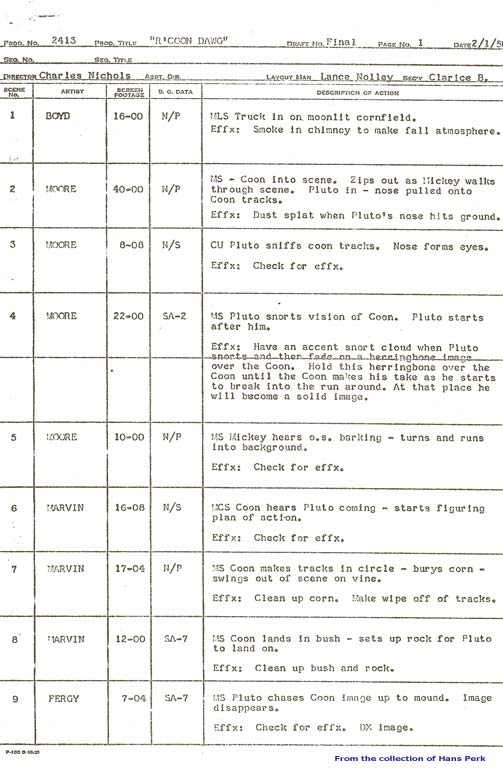
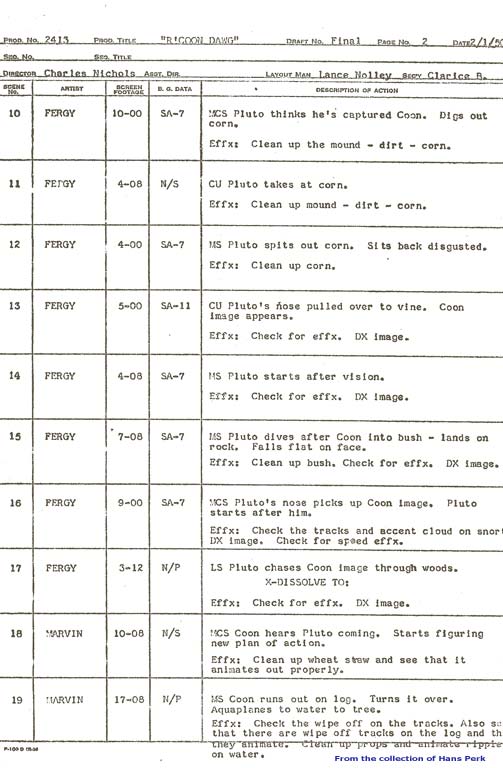
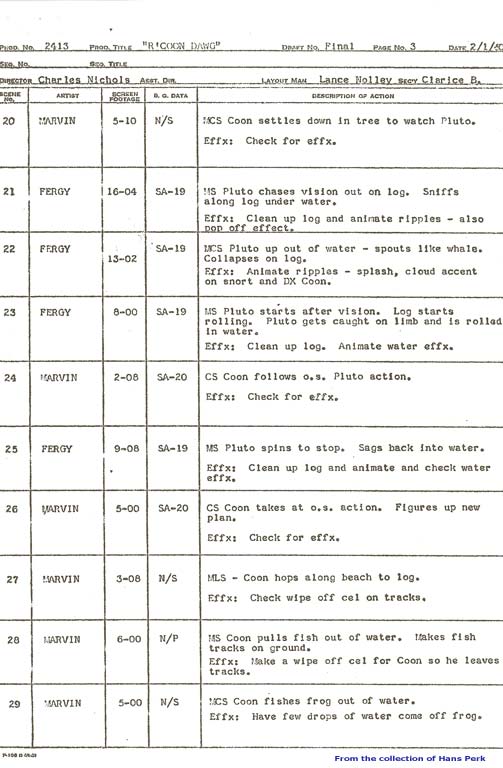
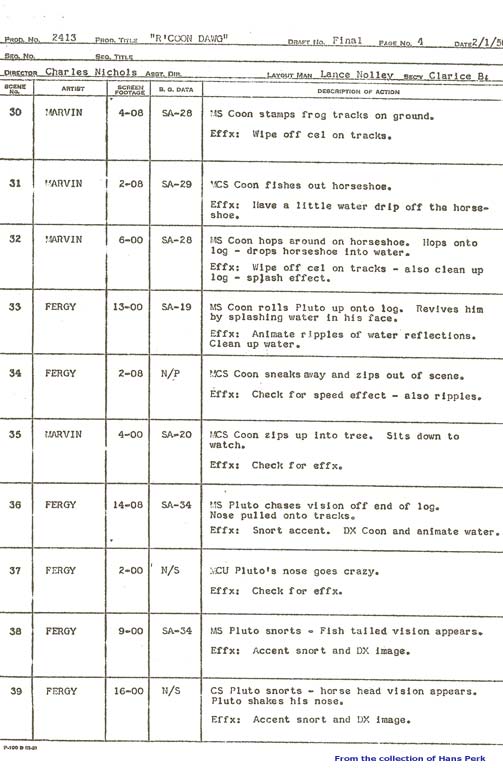
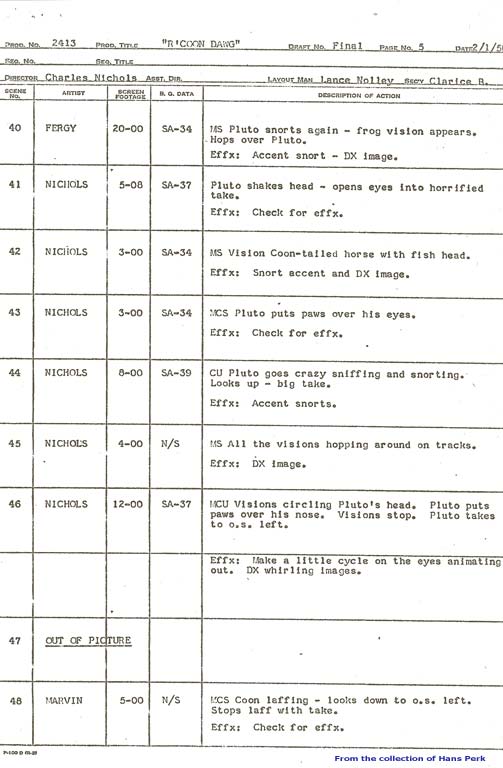
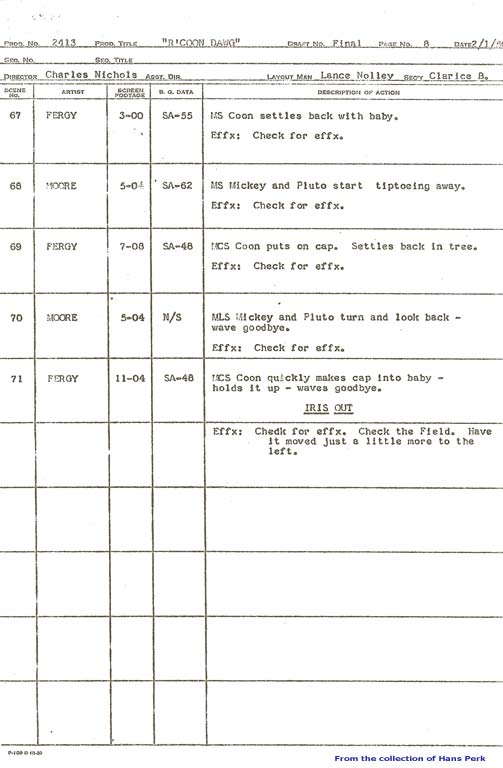
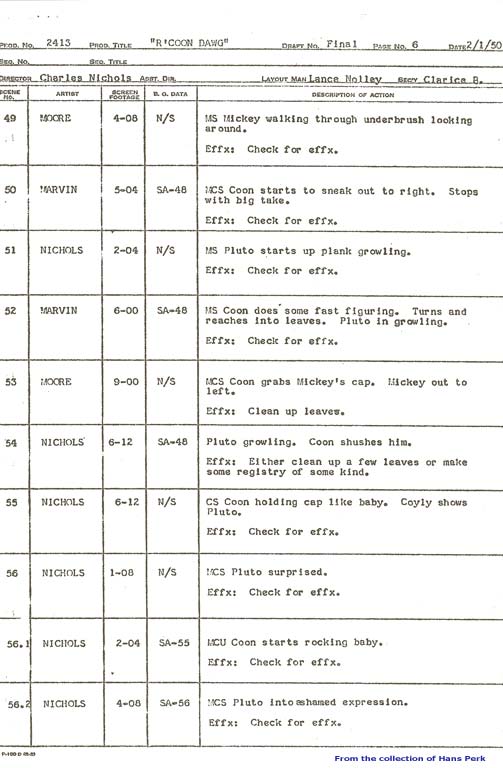
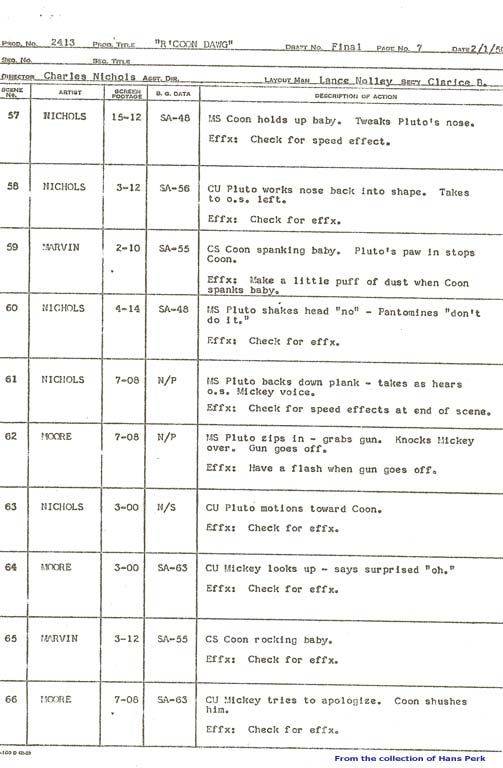
Prod. 2431 - R'Coon Dawg

By special request. Directed by Charles Nichols, layout by Lance Nolley, backgrounds Art Riley. Story by Ralph Wright (before or after Cookham and Dave Hand?) and Al Bertino. With animation by the director himself, and Norm Ferguson, Marvin Woodward and Fred Moore, with effects by Jack Boyd. Music by Paul Smith, whom we can hear a lot more from soon, when the True-Life Adventures DVD set is released, Dec. 5th.

This draft 2/1/1950, released 8/10/1951 (A year and a half later!!!) The copyright synopsis was written 7/18/1950, and the credit listing for same is of 9/20/1950. (And sporting a SCG 'bug' and a IATSE 'bug'. I am currently reading Tom Sito's very interesting 'Drawing the Line' on the animation unions, where these two unions are described. Obligatory reading!)
1234
5678

Labels: , , ,

Saturday, November 25, 2006

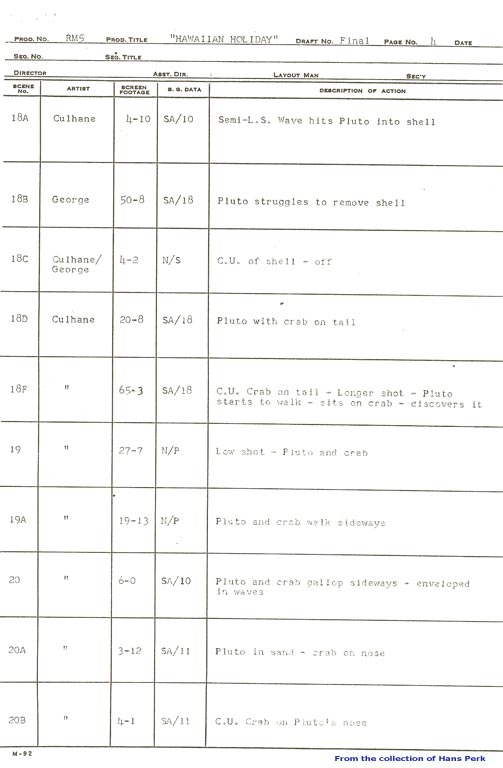
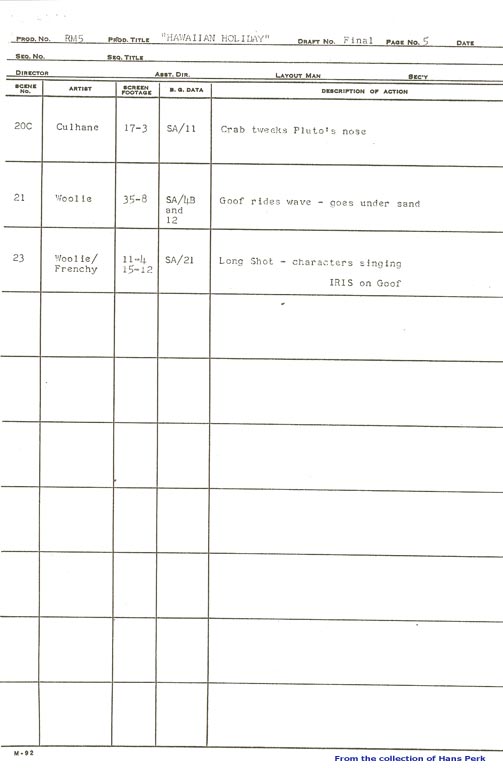
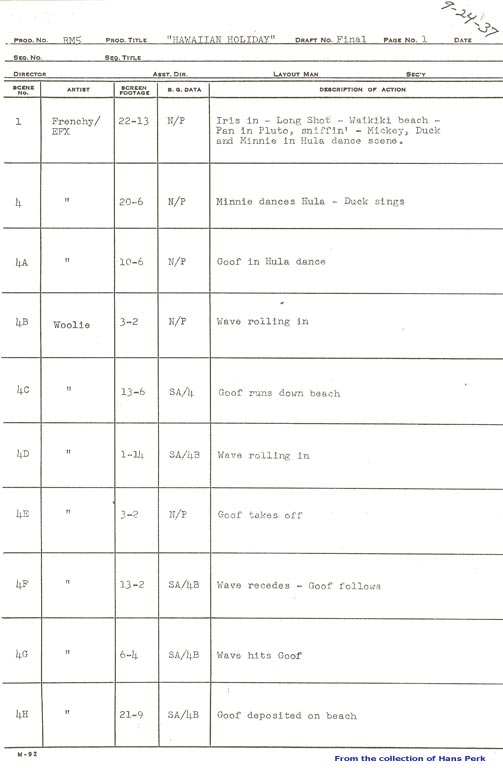
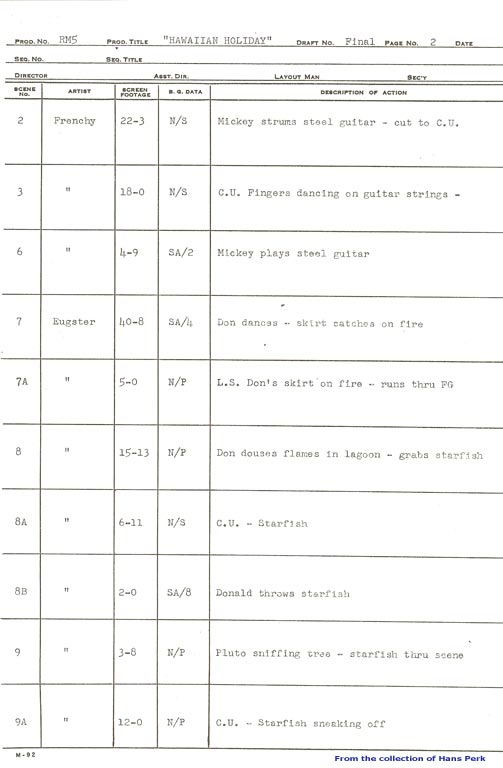
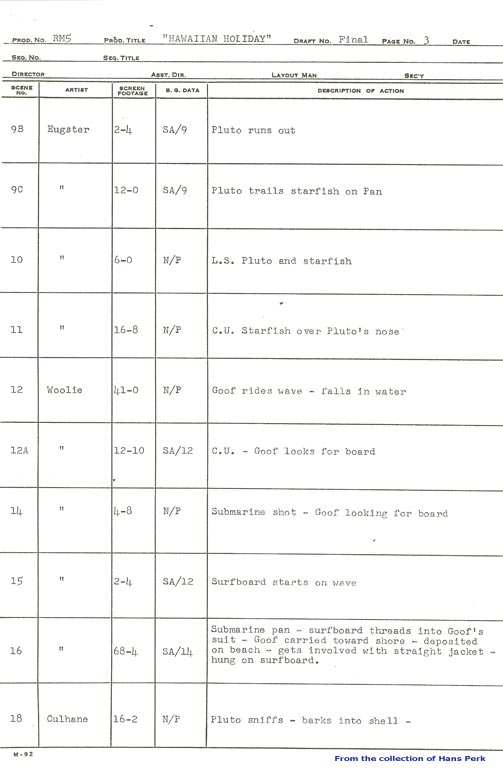
Prod. RM5 - Hawaiian Holiday

We have read a lot about certain scenes, now here is all of it.
Directed by Ben Sharpsteen. The header of the draft does not give other information: the date on the draft is the release date, 9/24/1937. Alberto shows that a Robert Dranko worked on layouts.

A classical bit of character casting to few animators. Woolie Reitherman animates Goofy, Al Eugster does the bit with Donald and Pluto and the starfish, and Shamus Culhane takes care of Pluto and the crab. 50 feet of Pluto by George - I suspect that is Nick George. Frenchy de Tremaudan is gratiously allowed a few long shots and two small intoductions. Small wonder he became a monk...
12345

Labels: , , ,

Monday, November 20, 2006

Missing Pages...

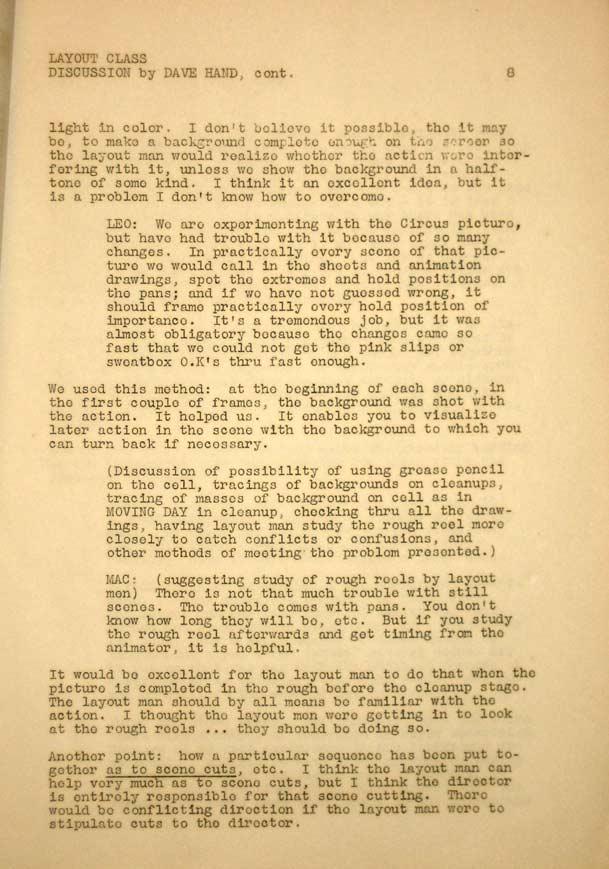
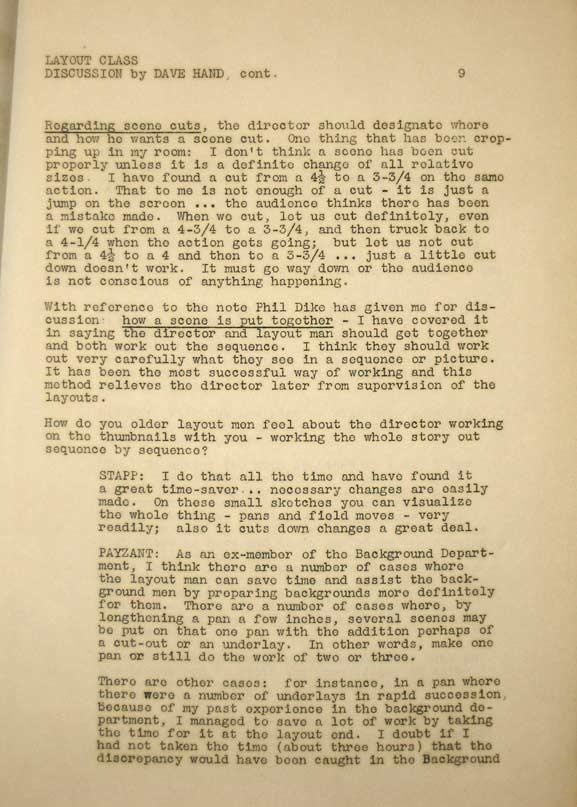
Michael Sporn posted a lecture by Phil Dike on October 20th, and two pages were distroyed by the xerox machine. Here are the two pages. Read or re-read the rest from his great site!
Dike Lecture page 8Dike Lecture page 8
I am currently in Orange County, CA, and I certainly prefer this weather over Denmark!

Labels:

Wednesday, November 15, 2006

One More Bar Sheet for the Road...

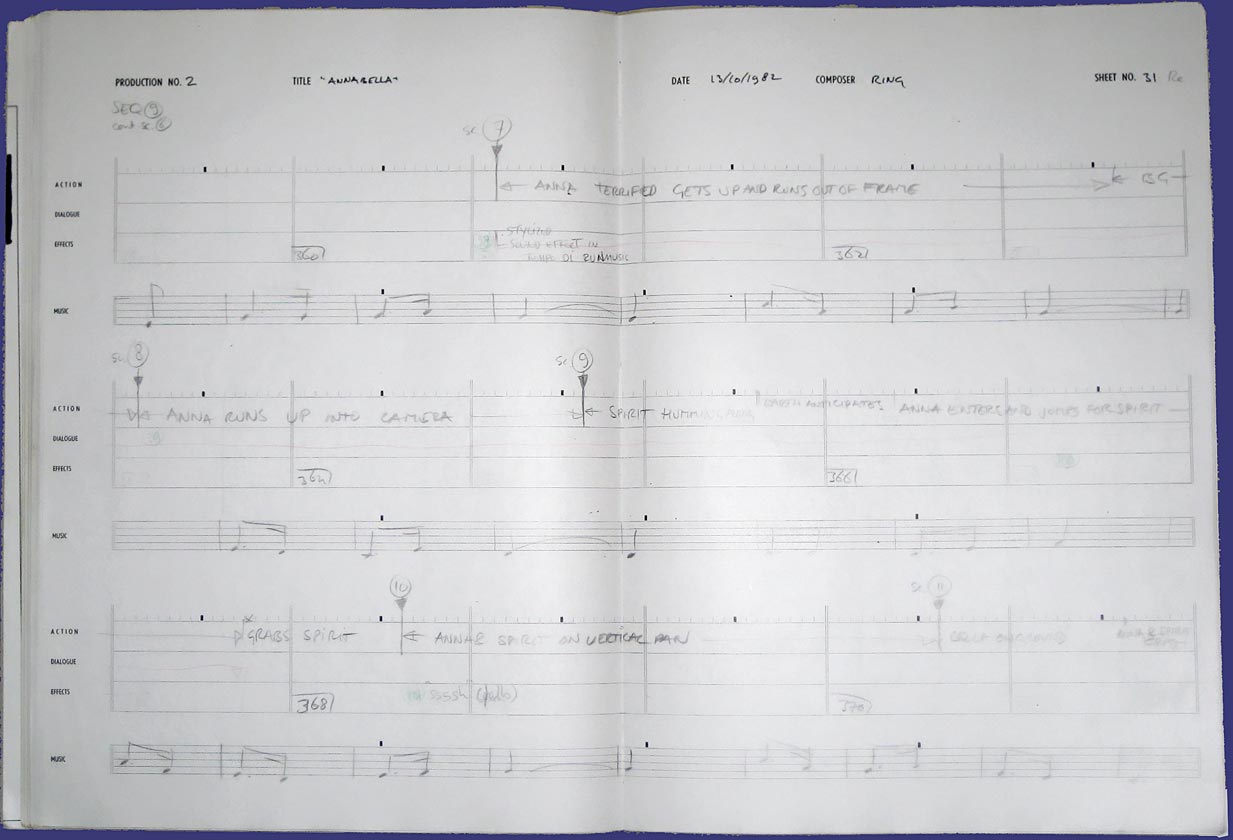
Since I mentioned Anna & Bella, the least I can do is show a sheet from the set of bar sheets I prepared in October 1982 for this our 1986 Academy Award winner. 'Our' in this case is the director Børge Ring and myself. I kept these sheets up to date and in the end I bound them into a neat, rather large book. Some of the notations in these sheets are by Børge, like the note "Stylized sound effect in Tempo Di RunMusic" - in this case the rest is mine, incl. the simple music notation. I had to count the frames for those 12 beats...
(You find shortcuts fast! Here: 2-8-2, 6-6, 2-8-2, 6-6 etc...)
Anna & Bella...< Click on it!
Note: I will be Stateside again from late the 18th, until the first week of January! In other words, I'll be closer to my shorts drafts.

Labels: ,

Tuesday, November 14, 2006

Another form of Bar Sheet

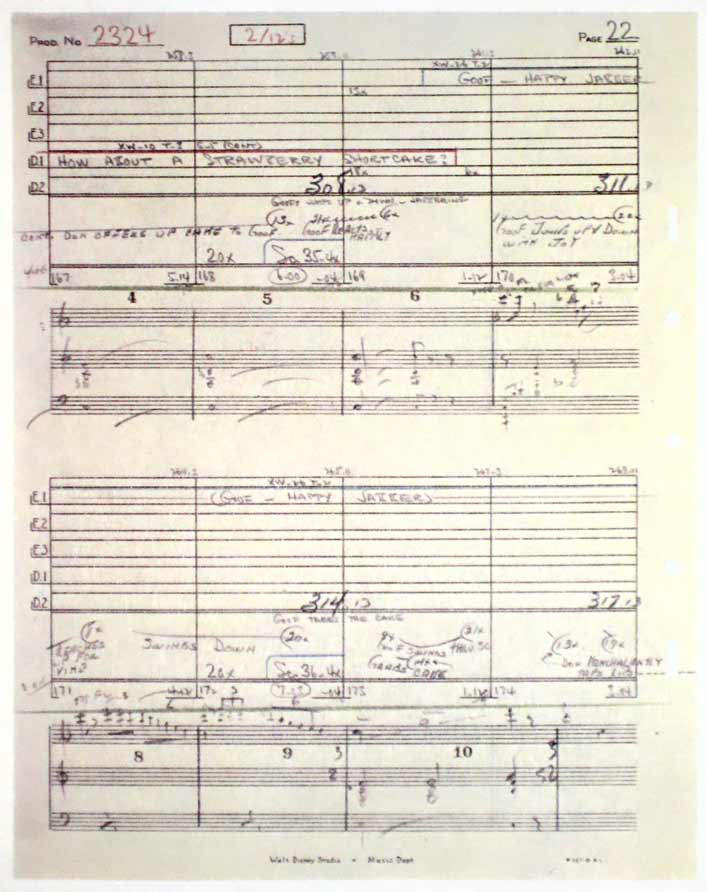
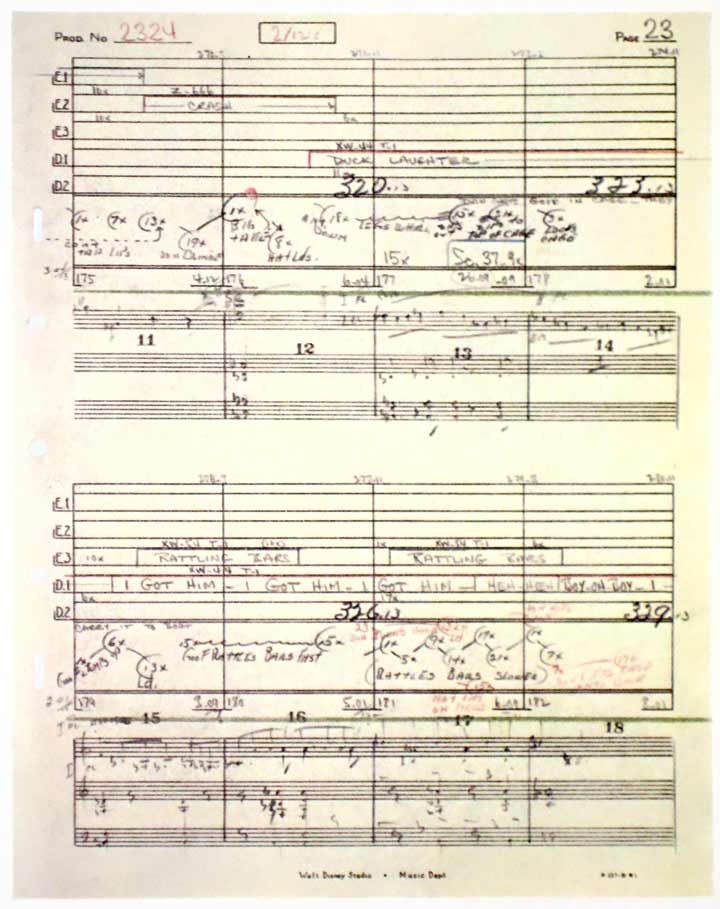
Just to be as complete as I can be here, I include these example bar sheets that I mentioned earlier, probably the most well known, and the first ones I got familiar with, as they are found in Christopher Finch's The Art of Walt Disney (Abrams, 1973), my first book on Disney (a present from my parents), the one that "pushed me over the edge". The sheets are from Prod. 2324, Frank Duck Brings 'em Back Alive, directed by Jack Hannah, released 11/1/1946.

Finch notes that the top lines are for indicating the different tracks of sound: Effects and Dialogue. (We saw those on the The Pointer sheets, as well). Then action, measure numbers and footage, and finally the music staves. In the box at the top we read the tempo, a 2-12's beat, making each measure a second of screen time.

Bar sheets were used in different forms in different phases of the production. The very first ones to be used would be the ones the director uses to time out the film, as the one I showed made by Dave Hand for Trader Mickey. As I noted before, we can see Hand holding this kind of sheets in the promotional film that the studio made for the RKO people at the end of the Snow White production in 1937 (on the Treasures DVD: Behind the Scenes at the Walt Disney Studio).

Then, the "main" bar sheet would be made and kept by the assistant director, as the one Jack Cutting prepared for The Pointer. I suspect that these were then copied onto sheets like the ones in this post, for the musician to write his score [Note that this sheet is marked at the bottom: Music Dept.], and to keep track of all sound channels, which could also be used by the sound editor. On the other hand, at the time of The Pointer, the sound editor's job was not so much juggling channels, so the musician may have instead received sheets like the sheets I showed for Mirrorland (Thru the Mirror), which were especially made to indicate special sound effects, or the ones found at ASIFA-Hollywood's excellent Animation Archive blog. Of course, as always, the bigger and more 'set' a studio/factory gets, the more complicated are the forms that represent the structure of its work - thus, much of this is conjecture based on the artifacts.

The important thing to remember is, that none of these bar sheets have dimensions that are frame-related. You cannot put an exposure sheet up to them and copy the information. Now, that IS a practical feature, but for anyone to be able to time to a beat on those (newer) sheets like the ones we used on Anna & Bella, functionally similar to the ones Michael Sporn showed recently here, one would need to mark off the beats, basically by counting frames, a VERY stultifying line of work, one that you would not want to have to repeat for too long. How well I remember doing that. The Disney bar sheets, however, are devoid of that. They are first and foremost related to music and rhythm. Only after all the timing is done are they copied to exposure sheets, which is where the counting has to be done. But by that time, the film's timing has been perfected, and the desired result (as to the timing) is more or less guaranteed...
12(Thank you for these, Christopher Finch)
Thank you, Mark and Michael for linking to this stuff, and the films in my previous posts - I am so happy there is an interest in it, as I have been preaching the basis of this into the wind for so many years!

[Added later: I found in copies of hand-written notes by Frank Thomas to Ollie Johnston in preparation of their bible "The Illusion of Life," a note regarding above barsheet, mentioning that it was prepared for a re-recording session, and thus an "after-the-fact" document and not the very first original sheet, like my example from The Pointer.]

Labels:

Monday, November 13, 2006

M27 (2227) with Click Track

The Pointer is not a film that you'd think would be timed to a beat throughout - but it is! It seems that most--if not all--Disney shorts were timed like this, and not only those dependent on music.
To my mind, it adds a sense of continuity, of perfection even.

Pre-planning a film with the timing to a musical beat makes it easier to "put music to it", and we hear the musical queues fit the music - and sometimes be on the off-beat. There was a close working relation between the director and the musician, but in a case like this, with several spots of dialogue, the beats seem to be chosen by the director from a generic story-telling point of view.

The timing of this film is incredibly logical: it speeds up slowly, from starting on 2-14's to Mickey whistling on 2-12's, then the bear bit on 2-10's, running away on 2-8's and ending quietly in the dark on 2-12's. In many cases a beat was added, changing e.g. 2-12's into 3-12's, but keeping the rhythm. This is only "sinned against" in a single spot:
16 frames (one foot) is added during Pluto's quail ordeal.
This timeline shows that most of the film is 12 beat:


When doing this, I notice that the bar sheet is kept so meticulously that it fits directly to the frame with the final film. Only my own counting mistake made me have to use more than the few minutes it takes to count the bars and write them into the little text file that is the input to my program...

Note: I put the beats spot on. It would sound more "with" the music if I had moved them 2 frames back (as one would do generally with dialogue), but for "scientific precision", I chose not to.
[UPDATE: I did move it ONE frame! Also, it's clearer now!]

For those of you who intend to learn from this, get yourselves a metronome, preferably one you can tap the beats on (like my old BOSS Dr. Beat DB-66 that I used on Quark), and figure out the timing structure of films that we do not have bar sheets of (you can use the Beat to/from Metronome converter on the right). This may be a fun assignment in schools, too! And then, time your own film!
Again, though this is for educational purposes, one never knows how long this lasts on YouTube, so see it while you can. [After the fact I wonder why I didn't name this posting "Point and Click!"][No longer using YouTube for this clip!]


And remember to have a look at the intro to our showreel, if you haven't already!

Labels: ,

Thursday, November 09, 2006

UM41 Revisited - Now With Nasty Clicks...

Last night and tonight I had some fun programming a click track .WAV and .AVI program, which uses a simple text file as input. I put the beat info of UM41 Mirrorland in it, and below is the result, put together in Premiere with a rip from the DVD (excuse my interlace). It fits like a glove... Check it out before it is removed by people who cannot see the educational value in it!

Since it can be hard to follow the film with the bar-sheets in hand, I found this more immediate and obvious. It is interesting to hear (and 'see') how the music was written - the 'vamps' that cover the transitions to other beats. And also I note that the music once in a while 'lags behind' in fast passages, only to recover when the conductor regains control. I never understood that strangly out-of-place queue before the Neptune bit. And the end might just as well have played as 2-16s instead of 2-8s. It seems pretty hecktic...
The conductor would not hear all these clicks, though - probably only every second or even fourth click - one per measure.

If the timing to a beat was a 'lost art', I hope that these posts help change that. It is an integral part of the entertainment of the 'Golden Age of Cartoons', and deserves recognition as a tool that can improve the value of the project at hand. There are many ways of dealing with this. Loosely, sequence for sequence (as we did on Anna & Bella) or throughout, like here. It's a matter of taste.


[A note on the symbols: a circle is a beat. If it has a cross through it, it is the first beat in a measure and the note is a bit higher. If the cross is red, and the note is even higher, then it is the first beat of a new tempo (though note that a change from a 2-12 to a 3-12 and back also generates red crosses and higher notes).]

Labels: ,

Silly Symphonies book!

My copy of Merritt/Kaufman's book Walt Disney's Silly Symphonies arrived today, and it is GREAT! One of the most well-researched books I have seen so far, including draft information crediting animators as available. It is a beautiful work that I thoroughly recommend! And this after a cursory glance...
I bought it through the Italian Internet Bookshop, see here!
[UPDATE: get it from Amazon here!]

Labels:

Tuesday, November 07, 2006

Timing and Music... again...

Because we can't get enough of it... Here is a sin of my youth, the beginning of a short we made here in Denmark for TV on basically a shoe-string budget, way back in 1986-87.

In my attic, in September 2003, I found a tape with linetests and click track of this film, Quark and the Highway Robber, as I was doing research for a 13 minute making-of that I did for the DVD re-issue of the Danish 1986 feature which was the reason I moved from Holland to Denmark, Valhalla, in which Quark is a prominent character. I co-directed this episode of the Quark series, and timed it on a bar-sheet. It starts as a 12 beat, then shifts to a 10 beat.

The animation isn't great, at times even awful, but I though it may show that timing to a beat "isn't just an outdated way of organizing time by giving it structure, but it gives the scenes a backbone, and thus an attitude." (Loosely translated from something Børge Ring told me as reaction to my last posting on timing).

Having been misled by our management back in 1987, we, the directing animators at the studio, resigned, to work with Frank and Ollie on the Troll Story project. Though I had a LOT of constructive discussions with the musicians, Øyvind Ougaard and Michael Friis, the linetest shows the state of the film as I left the studio. The final color and sound is from disc 2 of the Valhalla Special Edition DVD, that was issued in 6,000 copies in Denmark...

Yes, the voice is John Cleese. I showed him the film on our Steenbeck cutting table. Management didn't think we lowly directors should be at the dialog recording in London. They sent one of the Executives. And I then had to find ways around this guy's errors, which was another interesting learning experience.

Labels: , ,

Monday, November 06, 2006

Congratulations, Nordisk Film!

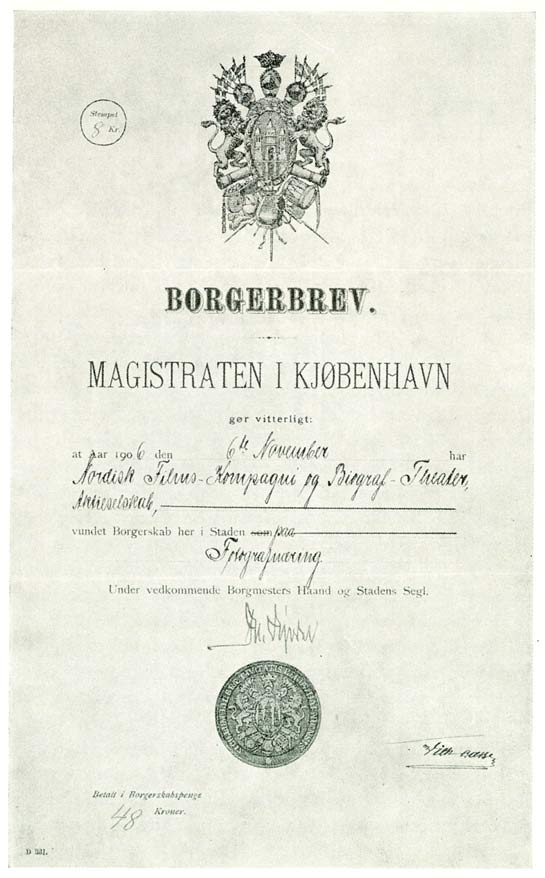
Today, Nordisk Film, the world's oldest functioning film studio, is 100 years old. A. Film A/S, the company that I established--with 4 other guys--in 1988, is half owned (since 1995) by the Danish publishing giant Egmont, which merged with Nordisk Film in 1991, which makes us part of this legendary Danish film studio. Nordisk Film's heyday was in the early 1910's, when they were among the world's largest film producers, with stars like Asta Nielsen and Valdemar Psilander. But they still produce films and distribute - and own a large part of the cinemas in Denmark.

It was Nordisk Film that in 1952 overtook Ring, Frank and Rønde studios, after having invested in them to make a feature directed by Dave Hand, and having aquired a 51% interest. They were not able to make a deal with Hand, so after a year they declared Ring, Frank and Rønde bancrupt, took over its assets and constructed Nordisk Tegnefilm A/S (Nordisk Animation Inc.) with Børge Ring and Bjørn Frank Jensen, but they soon decided to move to Holland to work for Toonder Studios. The story is actually much longer, and Nordisk Film really liked Ring, Frank and Rønde, but business was business even then...
Anyway, here is the official 'Borgerbrev' that gave Nordisk Films Kompagnie its civil right to establish itself in Copenhagen. The date of this document is considered Nordisk Film's official birthday...
Proof...< Click on it!

Labels: , ,

Sunday, November 05, 2006

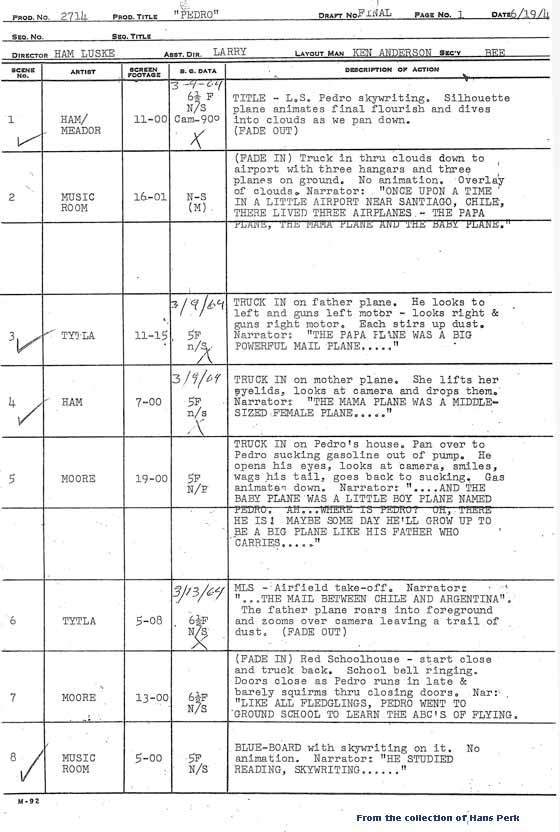
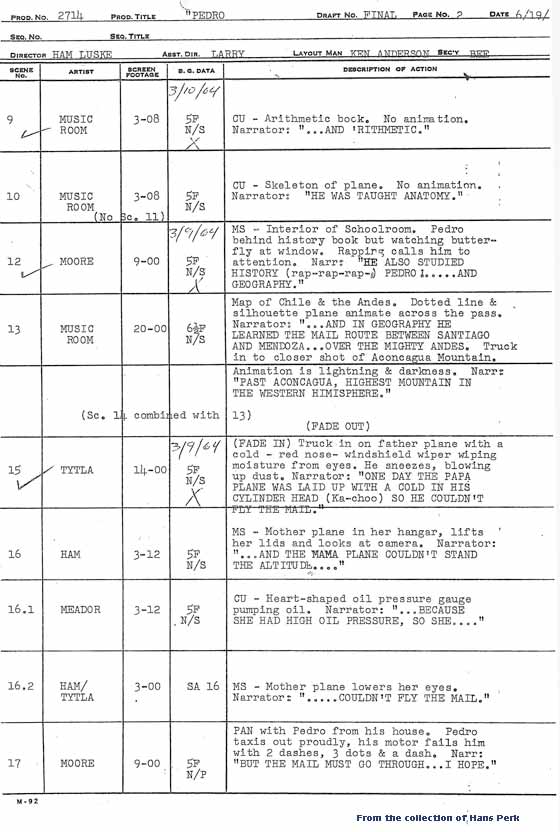
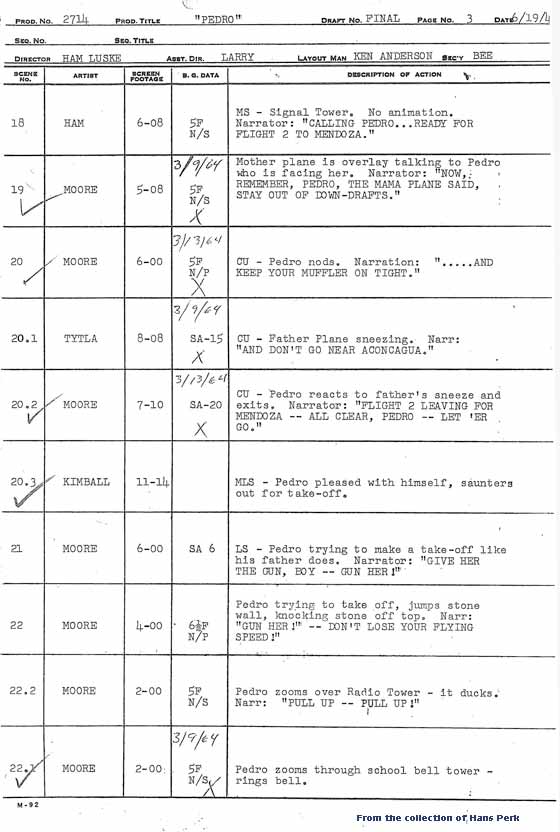
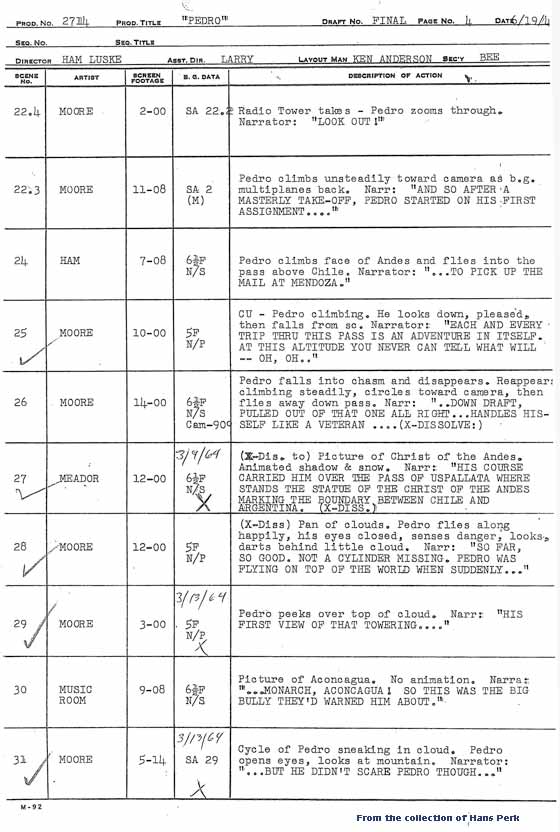
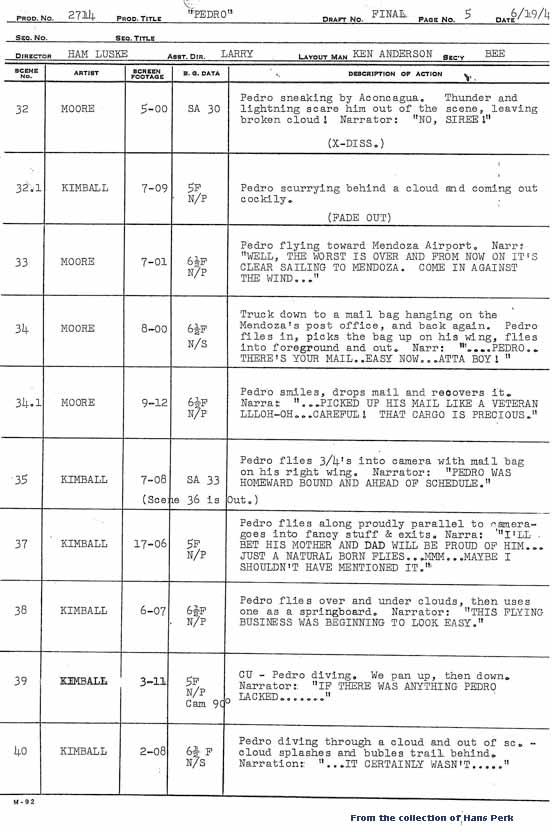
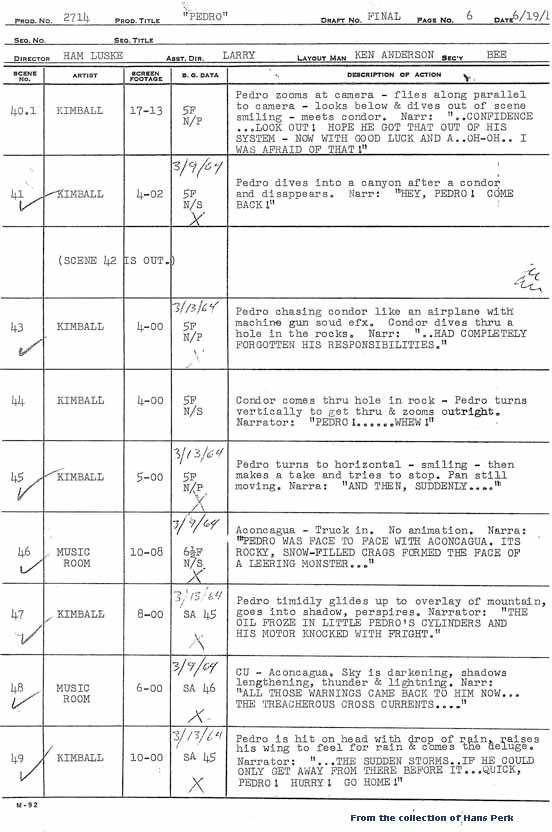
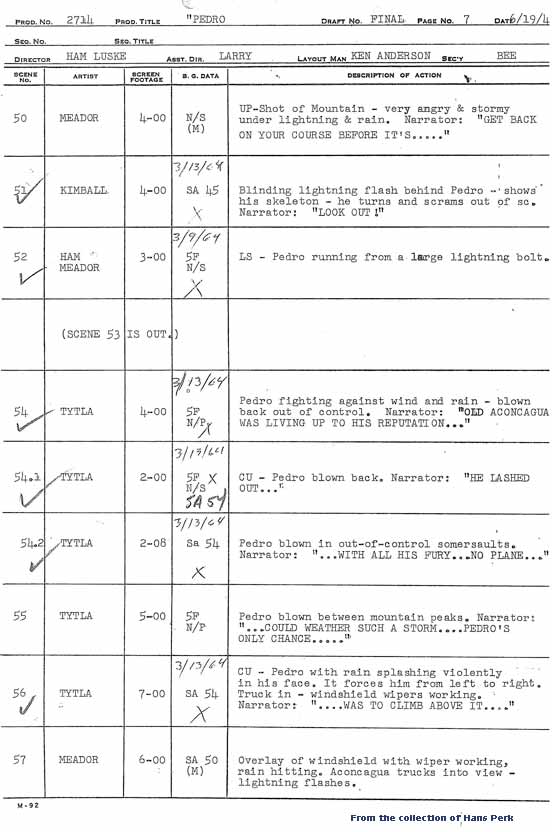
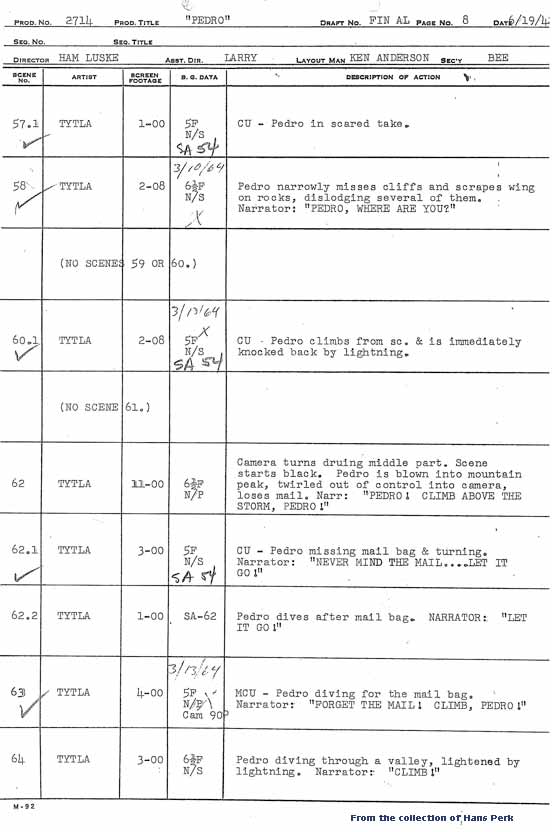
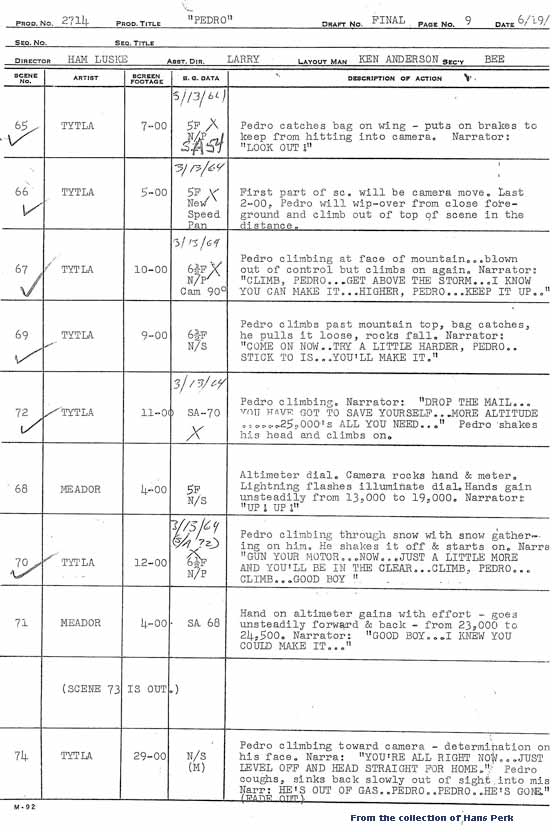
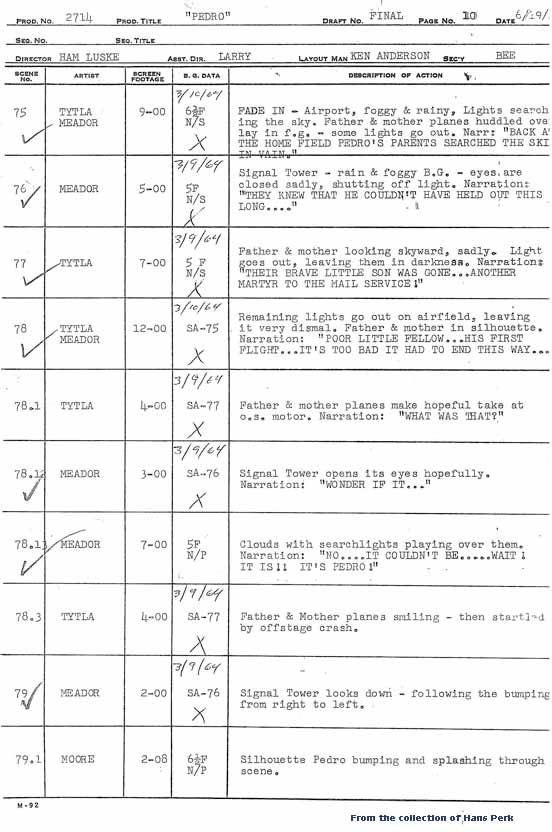
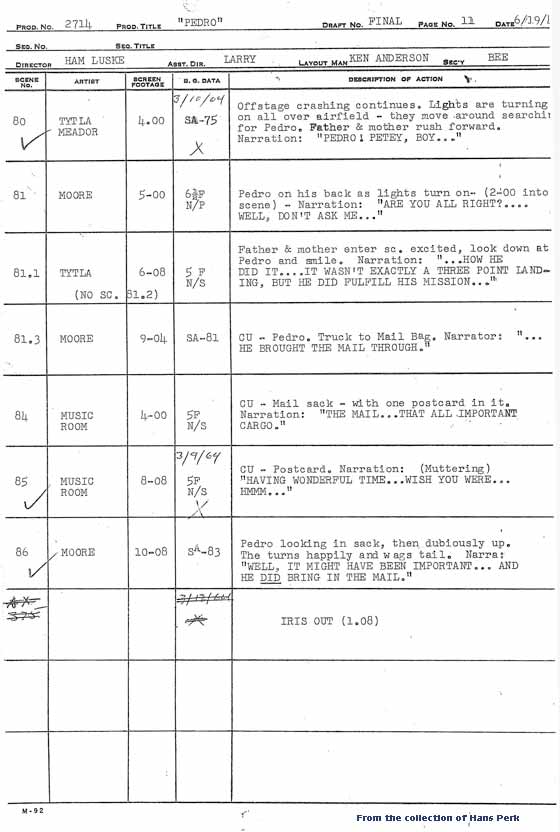
Prod. 2714 - Pedro

Released as a sequence in Saludos Amigos, the story of Pedro the mail plane is treated as a standalone short.
Directed by Ham Luske, this draft prepared 6/19/1942.
123456
7891011

Labels: